European patent office translation requirements are the language obligations that govern how applications are filed, prosecuted, and validated across the European Patent Convention’s member states. Get them right and your application moves efficiently toward grant. Get them wrong and the consequences range from missed deadlines that trigger deemed withdrawal to opposition proceedings that can invalidate a patent over a single mistranslated preposition.
This guide covers the full set of EPO translation rules: the official language framework under Article 14 EPC, the Rule 71(3) grant-stage requirements updated by the 2026 EPO Guidelines, the fee reduction structure introduced in 2024, the Unitary Patent transitional translation period, the London Agreement’s country-by-country breakdown, and the translation errors most likely to cause lasting damage to a patent portfolio. For IP attorneys managing European filings, this is the reference you need before commissioning any translation work.
The Three Official Languages of the EPO and What That Means for Filing
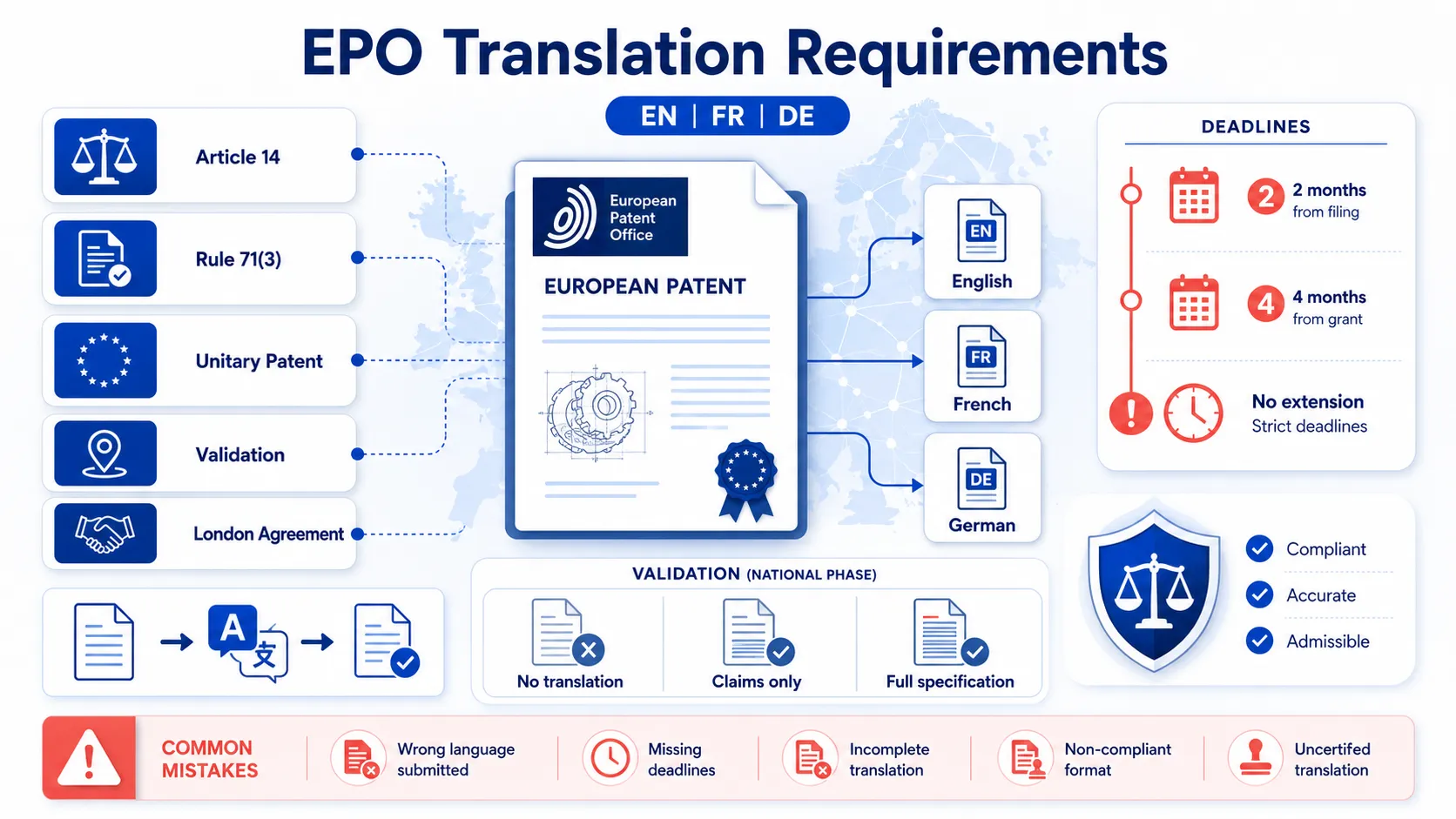
The EPO operates under three official languages under Article 14(1) EPC: English, French, and German. Every application must ultimately be in one of these languages, and the one chosen at filing becomes the language of proceedings for the entire examination lifecycle. This is not an administrative formality. It affects every communication, every amendment, every oral proceeding, and every translation obligation that follows for the life of the patent.
Filing in a Non-EPO Language: The Two-Month Translation Rule
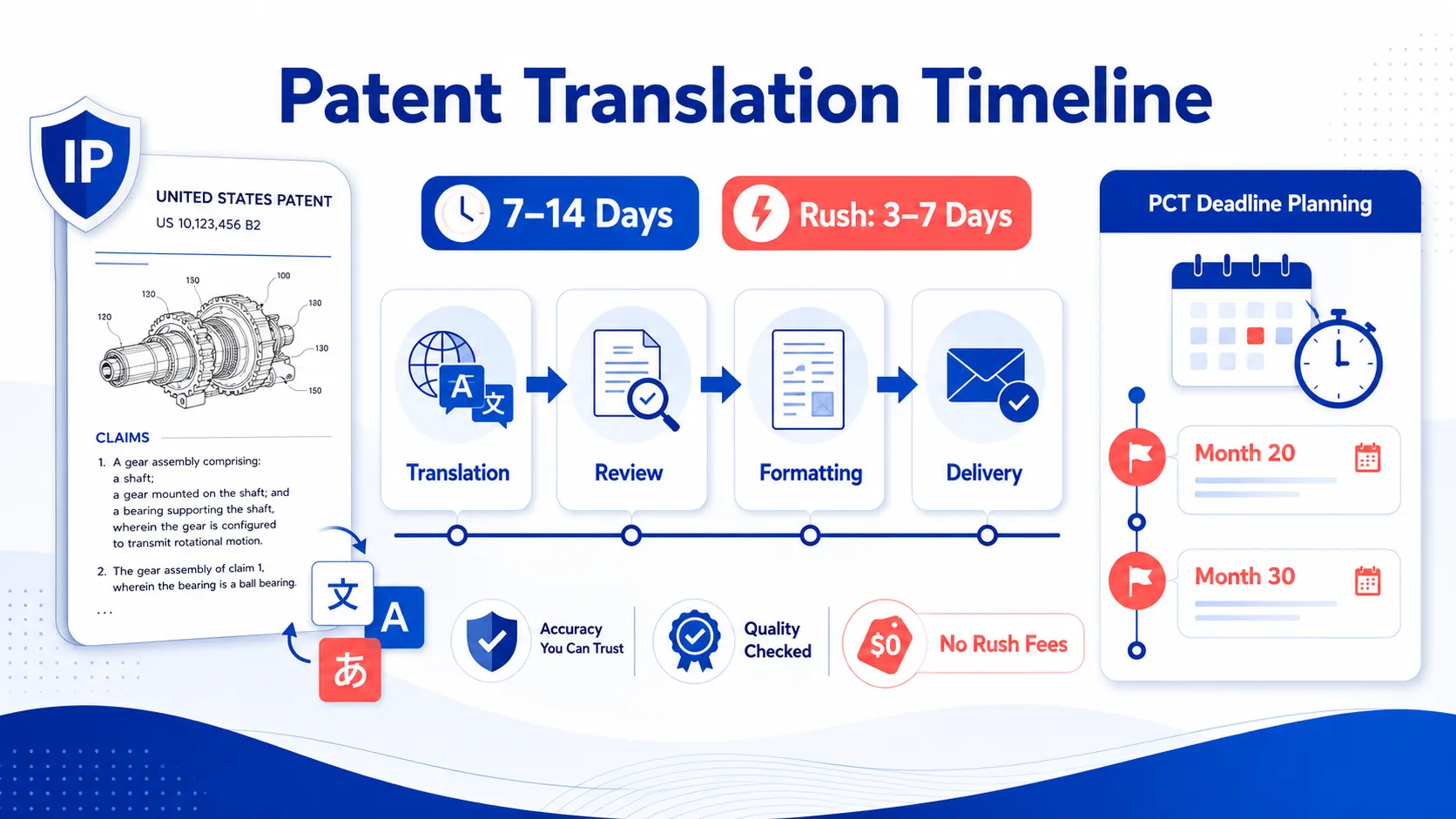
Filing in a language other than English, French, or German is permitted to establish a priority date, but the application must be translated into one of the three official languages within 2 months of the filing date. Failure to provide this translation within the 2-month window results in the application being deemed withdrawn. There is no grace period and no extension available. For applicants whose native language falls outside the three official languages, this means translation commissioning must happen simultaneously with the decision to file, not after the filing date has been secured.
Why the Language of Proceedings Cannot Be Changed
Once the language of proceedings is established, it is fixed for the life of the application and cannot be altered at any later stage. The Enlarged Board of Appeal confirmed this in G 4/08: EPO departments cannot use an official language other than the language of the proceedings for written communications, and applicants cannot change their language mid-prosecution regardless of preference or convenience. An international application published in French under the PCT cannot switch to English upon entry into the European regional phase. The French-language proceedings continue, all amendments must be filed in French, and all responses to communications must be in French throughout the examination.
Rule 71(3) EPC and the Grant Stage Translation Requirements
Rule 71(3) EPC is the communication issued by the Examining Division when it intends to grant a patent, and it triggers the final set of translation obligations before publication. This is the stage at which claim translations become mandatory across all three official EPO languages, regardless of which language was used for prosecution.
The Four-Month Non-Extendable Deadline for Claim Translations
When the EPO issues a Rule 71(3) communication, the applicant must pay the grant and publication fees and file translations of the claims into the other two official EPO languages within 4 months. This deadline cannot be extended under any circumstances. If prosecution was in English, both French and German claim translations are required. If prosecution was in French, both English and German translations are required. Missing this deadline means the grant procedure fails at the final stage and the patent is not published. Commissioning these translations before the Rule 71(3) communication arrives, rather than scrambling after it does, is the most effective way to avoid deadline pressure at the most critical point in prosecution.
What the 2026 EPO Guidelines Changed at the Grant Stage
The 2026 edition of the Guidelines for Examination, which entered into force on April 1, 2026, introduced stricter limitations on amendment requests at the grant stage. Under the updated guidance, the Examining Division exercises greater discretion under Rule 137(3) EPC to refuse amendments that would significantly delay the grant process. Repeated amendment requests that revisit issues already resolved during examination are now more likely to result in the Examining Division summoning the applicant to oral proceedings. At those proceedings, if no agreed text is on file, the application can be refused. The practical instruction is straightforward: applicants should settle their claim text well before the first Rule 71(3) communication, not use the grant stage as a secondary window for substantive argumentation that should have concluded during examination.
Fee Reductions for Small Entities: What Changed in 2024
The EPO’s April 2024 fee regime update introduced a formal concept of the “micro-enterprise” and expanded the framework for reduced fees already available to natural persons, SMEs, and non-profit organizations. For smaller applicants and research institutions, understanding these reductions meaningfully affects the cost of European patent prosecution.
The Micro-Enterprise Definition and the 30 Percent Reduction
Under Rule 7a EPC, a 30 percent reduction in filing and examination fees is available to qualifying entities. The following applicant categories are eligible for this reduction:
- Micro-enterprises: Entities employing fewer than 10 persons with an annual turnover or balance sheet total not exceeding 2 million euros.
- Small and medium-sized enterprises (SMEs): Companies meeting the EU definition for size thresholds.
- Natural persons: Individual inventors filing in a personal capacity.
- Non-profit organizations, universities, and public research organizations: Eligible regardless of the technology field or application language.
Applicants claiming this reduction must file a declaration using Form 1001 or Form 1011. The EPO can request proof of status at any point, and an incorrect declaration results in the application being deemed withdrawn due to invalid fee payment.
Stacking Reductions: How to Reach a 51 Percent Discount
Rule 7a(3) EPC provides a separate 30 percent reduction for micro-entities, natural persons, and universities regardless of their nationality or residence, provided they have filed fewer than 5 applications within the 5 years preceding the filing date. When an applicant qualifies under both Rule 7a(1) and Rule 7a(3) simultaneously, the two reductions combine for a total reduction of 51 percent of standard filing and examination fees. This stacking mechanism represents a significant cost benefit for early-stage inventors and university research organizations, but it requires careful calculation of prior filing history and accurate status declaration before fees are paid.
The Unitary Patent and the 12-Year Transitional Translation Period
The Unitary Patent system provides a single patent right effective across participating EU member states through the standard EPO grant procedure. During a transitional period of up to 12 years, applicants requesting unitary effect must file a full translation of the patent specification as part of that request.
What the Transitional Translation Actually Requires
The translation obligation during the transitional period depends on the language of the proceedings. If prosecution was in English, the specification must be translated into any other official EU language of the applicant’s choosing. If prosecution was in French or German, the specification must be translated into English. Applicants prosecuting in French or German therefore face a mandatory English translation requirement for every Unitary Patent they request during the transitional period, with no language choice available. For complex pharmaceutical, semiconductor, and engineering specifications running to tens of thousands of words, this is a substantial translation project requiring technical subject-matter expertise at the translator level.
Legal Status of Transitional Translations in Dispute Proceedings
Transitional translations filed under the Unitary Patent system are for information purposes only and carry no direct legal effect during the transitional period. The authentic text for scope determination remains the language of the proceedings. Once the transitional period ends, the Unitary Patent system plans to rely on high-quality machine translation for public information access. For IP teams that need AI-generated drafts reviewed and brought up to professionally reliable standards for enforcement situations, Circle Translations’ machine translation post-editing services provide the qualified human review layer that litigation requires. Machine translation is not acceptable for infringement litigation or opposition proceedings: in those contexts, a patentee must provide a full human-quality translation into the language of the court or the member state where the infringement occurred.
National Validation and the London Agreement: Country by Country
For applicants choosing direct national validation rather than the Unitary Patent route, the London Agreement significantly reduces translation obligations across a number of key European markets. Translation requirements vary meaningfully between member states, and the difference between a full specification translation and a claims-only translation affects both cost and timeline.
Countries Where No Translation Is Required
Under the London Agreement, patents granted in English require no post-grant translation for validation in the following countries:
- United Kingdom
- Germany
- France
- Ireland
- Luxembourg
- Switzerland
These countries formally waived their translation requirements for English-language patents, covering the majority of the high-value European markets where litigation and enforcement activity is concentrated. This waiver substantially reduces the national validation cost for English-language applicants across Western Europe.
Countries Requiring Claims-Only or Full Specification Translations
Outside the London Agreement waiver group, translation requirements divide into two clearly defined categories:
Claims translation only (not the full specification):
- Netherlands
- Sweden
- Denmark
- Finland
Full specification translation required:
- Spain
- Italy
- Poland
- Turkey
For applicants handling multiple validations, translation reuse is possible across jurisdictions sharing the same language: an Italian translation covers both Italy and San Marino, and a Greek translation applies to both Greece and Cyprus. The quality standard for full specification translations carries a specific legal consequence in some jurisdictions: if the national-language translation is narrower than the original EPO-language text, the narrower translation sets the enforceable scope of protection in that country.
The Biggest Translation Mistakes in EPO Proceedings
Translation errors in EPO proceedings create risks that range from costly corrections during examination to permanent invalidity after grant. The most damaging class of error is one that triggers an added matter objection under Article 123(2) EPC, which can ultimately invalidate a patent that has been in force for years.
Added Matter Risks Under Article 123(2) EPC
Article 123(2) EPC prohibits amendments that extend the content of the application beyond what was disclosed in the application as filed. This test applies with equal force to the translated text: if the translation introduces language that is not a direct and unambiguous rendering of the original, an opponent can argue the translation added subject matter absent from the source document. This risk is particularly acute when translating from non-European languages such as Chinese, Japanese, and Korean, where structural differences between source and target language make truly literal equivalence genuinely difficult to achieve for even skilled translators without domain expertise in the relevant technical field.
The EP2022349 Case Study: How Terminology Disputes Damage Patents
The opposition proceedings against EP2022349, involving an early e-cigarette design originally drafted in Chinese, illustrate exactly how translation term choices become the front line of patent validity disputes. The case turned on specific word-level decisions that opponents argued had introduced added matter or impermissibly changed the scope of the original Chinese disclosure.
Lessons From “Perforated” vs. “Porous” and “Frame” vs. “Support Member”
Three translation choices became the substance of the opposition. First, the Chinese characters “Duo Kong” were initially translated as “perforated” and subsequently argued to mean “porous,” with opponents contending the substitution altered the technical scope of the disclosure. Second, the term “Jia Ti” was rendered as “support member,” which opponents argued was broader than the restricted Chinese meaning of “frame.” Third, a preposition dispute over “in the centre on” versus “in the centre of” a surface triggered legal objections over a single function word. None of these errors were obvious to a non-specialist reviewer. All three required a translator with technical depth in the relevant field and explicit awareness of how EPO added matter doctrine applies to linguistic choices. The EP2022349 case is a direct argument for specialist translators over generalist ones at every stage of European patent prosecution.
How Circle Translations Supports EPO Patent Translation
Circle Translations covers English, French, German, and all EU official languages required for EPO prosecution, Unitary Patent requests, and national validation, as part of a patent translation portfolio spanning more than 74 languages. The agency has worked with over 200 IP firms and patent departments since 2008, handling translation at every stage of the European patent lifecycle: national phase entry, examination filings, Rule 71(3) claim translations, national validation, and litigation support.
Every EPO patent translation project is assigned to a translator with academic credentials in the relevant technical field. For filings in biotechnology, pharmaceuticals, semiconductor engineering, and other specialist domains, this means the translator is qualified in the subject matter and familiar with the terminology precision that EPO proceedings demand. For national validations where a narrower translation can limit the enforceable scope of the patent, qualified proofreading review sits between translation and delivery on every project.
Christoph Siebmanns, Managing Director of Gotapatent AB Sweden, captures this well: “Swift and very competitive translation service. We highly recommend Circle Translations for patent translations.” For IP attorneys managing European portfolios under the EPO’s non-extendable deadlines, speed and specialist accuracy are not competing priorities. Circle Translations delivers both, with a 99.97 percent on-time delivery rate and no rush fees across all service tiers.
To review language coverage, delivery options, and pricing for EPO-specific patent translation, visit the patent translation services page.
Conclusion
European patent office translation requirements are not background administrative tasks. They are a series of hard deadlines, fixed language commitments, and terminology precision standards that determine whether a European patent is valid, enforceable, and cost-optimised across its validation jurisdictions. The 2-month filing translation rule, the 4-month non-extendable Rule 71(3) deadline, the 51 percent fee reduction available for qualifying small entities, the Unitary Patent’s transitional translation obligations, and the London Agreement’s jurisdiction-specific requirements all demand specialist execution. Circle Translations provides that execution across every stage of European patent prosecution, with the technical subject-matter expertise and the no-rush-fee policy that complex, multi-jurisdiction EPO portfolios require.
Frequently Asked Questions
1. What are the official languages of the European Patent Office? The EPO’s three official languages are English, French, and German under Article 14(1) EPC. Every patent application must ultimately be in one of these three languages, and the language used for filing or initial translation becomes the fixed language of proceedings for the entire examination lifecycle.
2. What happens if I file a patent application at the EPO in a non-official language? A translation into one of the three official EPO languages must be filed within 2 months of the filing date. If this translation is not provided within that window, the application is automatically deemed withdrawn. No extension of this deadline is available, which means translation must be commissioned at the same time as the filing decision.
3. Can I change the language of EPO proceedings after the application is filed? No. The language of proceedings is established at the time of filing or upon European regional phase entry and cannot be changed afterward. The Enlarged Board of Appeal confirmed in G 4/08 that this language governs all communications and amendments throughout prosecution, including any shift between PCT and EPO procedures.
4. What does the Rule 71(3) communication require from a translation standpoint? A Rule 71(3) communication requires the applicant to file translations of the patent claims into the other two official EPO languages within 4 months. This deadline cannot be extended. If proceedings are in English, French and German claim translations are both required. Missing this deadline means the patent is not granted.
5. Who qualifies for the EPO’s 30 percent fee reduction under the 2024 rules? Micro-enterprises (fewer than 10 employees, under 2 million euros in annual turnover or balance sheet), SMEs, natural persons, non-profit organizations, universities, and public research organizations all qualify under Rule 7a EPC. Status must be declared using Form 1001 or Form 1011. Incorrect declarations can result in the application being deemed withdrawn due to invalid fee payment.
6. What is the Unitary Patent transitional translation requirement? During the transitional period of up to 12 years, applicants requesting unitary effect must file a full translation of the patent specification. If the proceedings language is English, the applicant may choose any other official EU language. If the proceedings language is French or German, the specification must be translated into English. These transitional translations are for information purposes only and have no direct legal effect on the scope of the patent.
7. Which European countries require no translation under the London Agreement? Patents granted in English require no translation for validation in the United Kingdom, Germany, France, Ireland, Luxembourg, and Switzerland. The Netherlands, Sweden, Denmark, and Finland require only a claims translation. Spain, Italy, Poland, and Turkey require a full specification translation. An Italian translation covers both Italy and San Marino; a Greek translation covers both Greece and Cyprus.
8. What is the added matter risk in EPO patent translation and how can it be avoided? Added matter under Article 123(2) EPC arises when a translated text introduces language not present as a direct and unambiguous rendering of the original application. The EP2022349 opposition case demonstrated how terminology choices such as “perforated” versus “porous” and “frame” versus “support member” can become the basis for invalidity challenges. The only reliable mitigation is using translators with technical subject-matter expertise in the specific field of the patent, not generalist translators who may produce linguistically fluent but technically imprecise output.