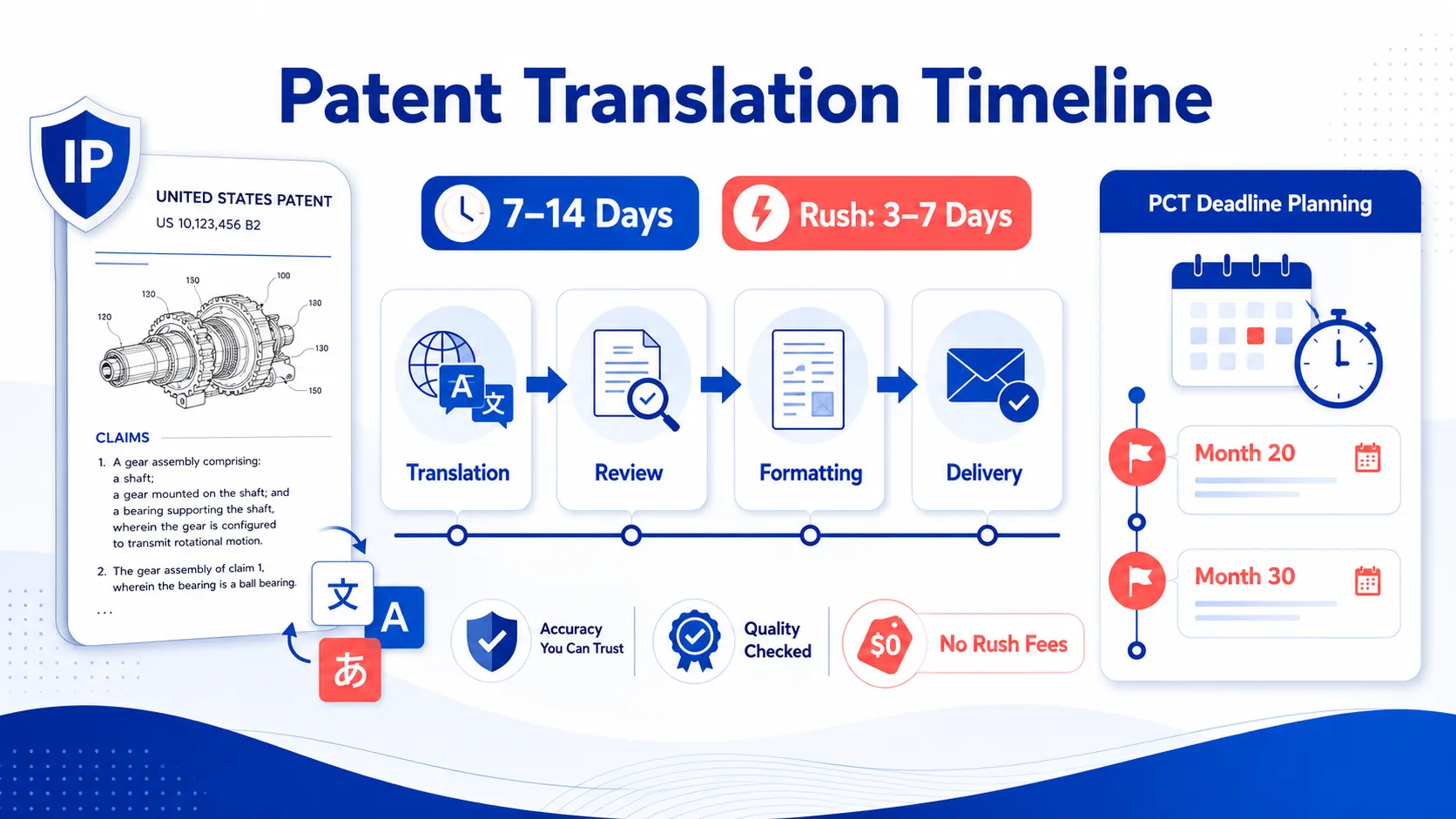
How long does patent translation take? For most standard national phase applications, professional delivery runs between 7 and 14 business days. For urgent PCT packages where deadlines are close, emergency workflows can compress that to 3 to 7 business days when the translation provider has the right structure in place. But neither number tells the whole story, and for IP attorneys working against filing deadlines, the whole story is exactly what you need.
The real question underneath this one is usually: “can I get it done in time without paying a significant rush surcharge, and will it be accurate enough to file?” This guide answers all three parts. It covers how delivery time is actually calculated, the factors that affect it, how rush translation works at the industry level, and why PCT deadline management should start far earlier than most applicants currently plan for.
What “Patent Translation Turnaround Time” Actually Includes
Patent translation turnaround time officially begins at project confirmation, not at the moment you send files to your vendor. That distinction is more practically significant than it sounds. Project confirmation means the scope is agreed, the quote is approved, and the schedule is locked by both parties. Before that point, the provider is still allocating specialist translators, preparing source files, and handling project onboarding. None of that preparation time counts toward the delivery window you were quoted.
What the quoted window does cover is substantial: translation by a subject-matter specialist, independent editing, technical accuracy review, document formatting to match the source structure, and final quality assurance before handoff. For a patent specification entering the national phase in Japan, that full cycle from confirmed project start to a delivery-ready document is the only planning window that matters. Vendors who quote only the translation stage without factoring in review and formatting steps are giving you an incomplete number, and your filing timeline will reflect that omission.
Patent Translation Benchmarks: How Long Should It Take?
Standard patent translation delivery depends primarily on document length. The following benchmarks represent realistic industry expectations for professional human-quality output with review included.
| Document Length | Standard Delivery |
| Up to 1,000 words | 1 to 2 business days |
| 1,000 to 3,000 words | 2 to 3 business days |
| 5,000 to 10,000 words | 4 to 6 business days |
| More than 15,000 words | 9 or more business days |
These windows assume a single translator handling the document. If the project requires a secondary peer review, which is best practice for any patent document where filing accuracy is the standard, add approximately 30 percent to the base translation time to account for that step.
Standard Delivery Windows by Document Size
For patent attorneys managing national phase portfolios, those delivery windows mean a 20,000-word pharmaceutical specification translated into Japanese and Simplified Chinese simultaneously is a multi-week project when handled to the standard those filings require. Understanding that volume before you need it is what separates a managed filing calendar from a reactive one.
Why Patent Documents Take Longer Than General Translation
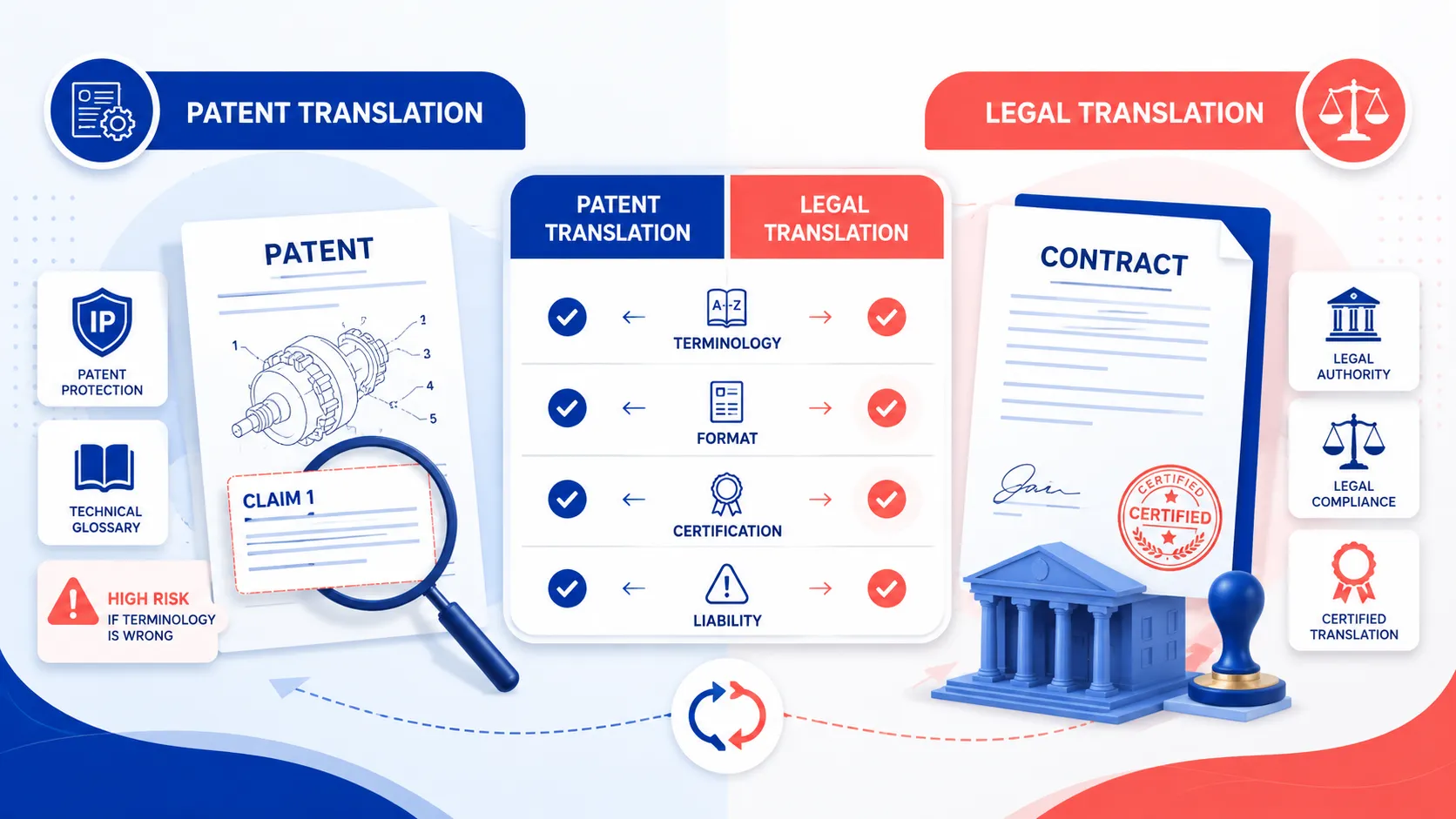
Patent translation takes longer than standard legal or business translation because it sits at the intersection of two demanding disciplines simultaneously. A general contract can be handled by a skilled legal translator. A patent specification requires a translator with deep technical expertise in the relevant field and familiarity with patent claim drafting conventions. Finding someone with a PhD in biochemistry who also understands claim structure and the terminology requirements of the JPO is not the same kind of staffing challenge as a contract review project.
The Output Rate Difference for Complex Patent Specifications
Professional translators working on general business content typically produce around 2,500 quality words per day. For patent specifications in complex technical fields, including biotechnology, semiconductor engineering, pharmaceutical chemistry, and artificial intelligence systems, that daily output rate drops to between 1,000 and 1,800 words. The reduction reflects the research required to handle field-specific terminology precisely. A translator working on a biopharmaceutical patent cannot approximate a term. They must verify it against the current technical literature in the relevant field, confirm the choice against the patent’s internal terminology, and apply it consistently throughout. That is slower, more deliberate work, and any realistic delivery timeline must reflect it.
The Factors That Affect Patent Translation Speed
Several key factors determine how quickly a patent translation project can realistically be completed. Understanding these before you engage a provider gives you a far more accurate picture of what is achievable for your specific application.
Subject Matter Complexity and Technical Specialisation
Subject matter complexity is the single biggest driver of delivery time. A patent covering a consumer packaging innovation translates faster than one covering a novel mRNA delivery mechanism. The more specialized the technical domain, the smaller the pool of qualified translators at the credential level the application requires, and the more research each translation session demands. This is not a cost variable that a general-purpose translation agency can solve by charging more. It is a structural constraint of the specialized talent the work requires.
Language Pair Availability and File Format
Language pair availability affects delivery speed in two practical ways. Some language pairs have large pools of qualified technical patent translators: English to German and English to French have deep rosters across most technical fields. English to Thai or English to Vietnamese for high-specialization semiconductor applications may draw from smaller available pools, which can extend timeline when multiple jurisdictions need simultaneous processing.
File format is a less obvious but equally real factor. Working from an editable Word document or Excel file is significantly faster than working from a scanned PDF or a bitmap image of a technical drawing. Scanned documents require manual text extraction and reconstruction before translation can begin, which can add two to three days to a project before any linguistic work starts. Providing editable source files is one of the simplest and most effective ways to improve delivery speed.
Rush Patent Translation: Industry Norms and What to Expect
Rush patent translation compresses the standard delivery window through additional resource allocation, typically by running parallel workflows where translation, editing, and technical review happen simultaneously rather than sequentially. Most professional translation agencies apply surcharges for expedited delivery: a 1.5x multiplier for 48-hour delivery and a 2x multiplier for 24-hour delivery on large-volume documents are common industry structures. For full PCT national phase packages, emergency parallel-team delivery typically runs 3 to 7 business days depending on jurisdiction count and document volume, at a surcharge of 30 to 50 percent above standard rates.
The financial cost of rush delivery is the visible part. The less visible cost is quality risk. Translators working under sustained deadline pressure produce more errors in nuanced technical terminology, and errors in patent claims are often irreversible once the application is filed. The more durable solution is not to find the cheapest rush option. It is to build the planning buffer that removes the need for rush delivery entirely.
PCT National Phase Deadlines and the Translation Timing Problem
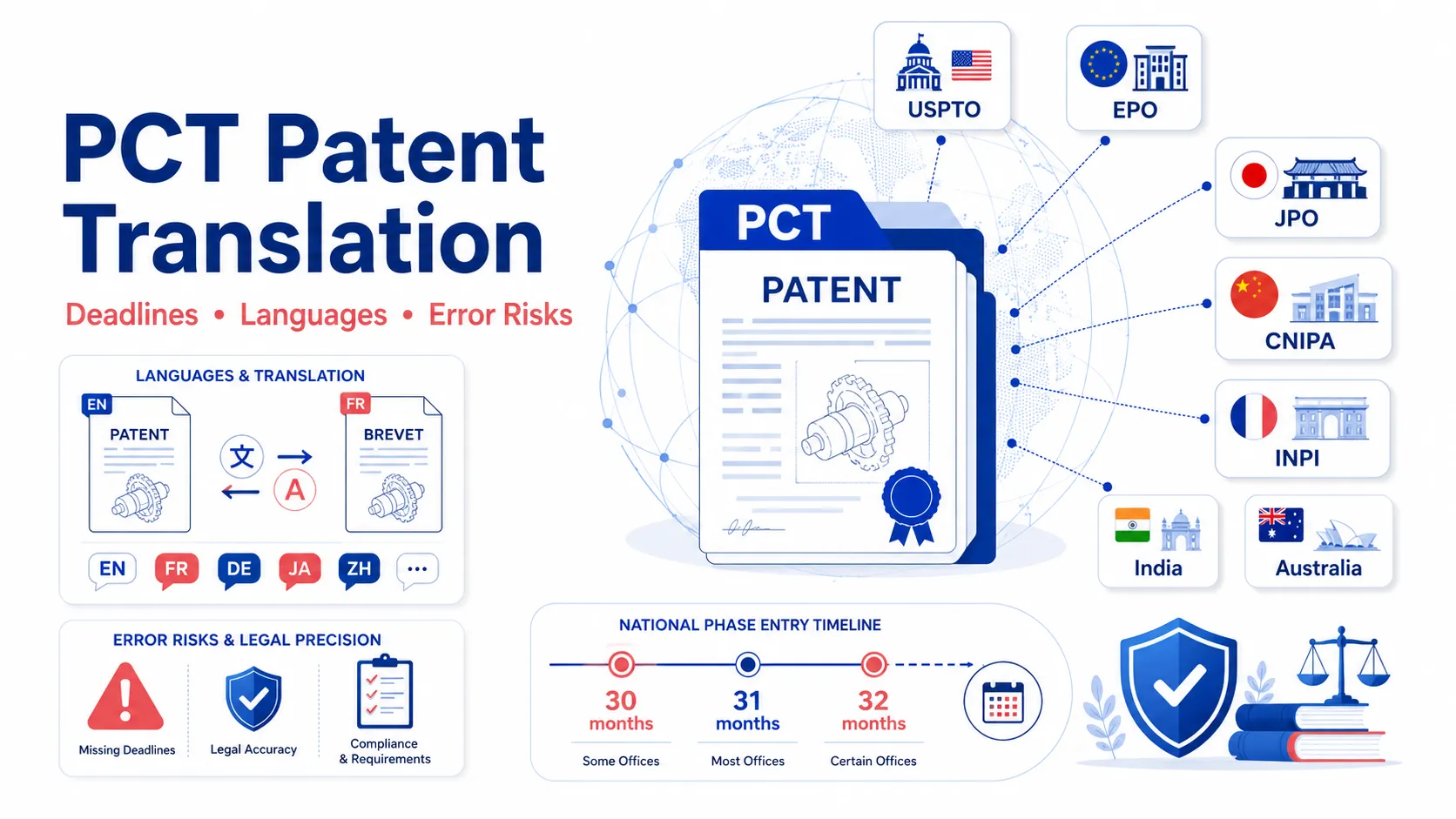
PCT national phase entry deadlines are the most common driver of urgent patent translation requests. The standard deadline is 30 months from the priority date for most major jurisdictions, including the USPTO, JPO, and INPI. India, Australia, the EPO, and Vietnam allow 31 months. The problem is that most applicants treat the 30-month mark as a target rather than an absolute limit, which leaves them commissioning translations at month 27 or 28 with no margin for complications.
Why Month 20 Is the Start Line, Not Month 28
Industry best practice places the start of national phase translation preparation at month 20 from the priority date. That 10-month buffer before the standard deadline covers the full translation cycle, attorney review in each target jurisdiction, jurisdictional formatting requirements, and administrative contingency for time zone differences or unexpected delays. Starting at month 28 compresses the entire process into a window where rush delivery is the only option and quality risk is highest. Starting at month 20 removes the urgency entirely and keeps the project inside standard delivery windows for every jurisdiction on the list.
Building Buffers Into Your Multi-Jurisdiction Filing Strategy
For portfolios entering eight or more national phase jurisdictions simultaneously, building a master translation timeline is the most practical way to avoid deadline pressure at the critical stage. Grouping filings by deadline cluster (30-month jurisdictions versus 31-month jurisdictions) allows a translation provider to sequence work efficiently without every language pair hitting the critical window at the same time. Establishing a single provider relationship for the full portfolio also eliminates the administrative overhead of onboarding multiple vendors under deadline pressure. For complex engineering, semiconductor, and mechanical portfolios with high technical translation volume, Circle Translations’ technical translation services apply the same academic-credential matching approach that patent translation requires.
The Tools That Support Faster, More Consistent Patent Translation
Two technology-driven approaches meaningfully improve patent translation speed and consistency without compromising the accuracy standards that patent filings demand.
Translation Memory and Terminology Management
Translation Memory (TM) is a database of previously approved translations stored at the segment level. When a new patent application contains technical descriptions, claim structures, or terminology that appeared in earlier work from the same client, the TM surfaces the approved version for the translator’s review rather than requiring a fresh translation from scratch. For organizations filing multiple related patents in the same technology area, TM can reduce translatable volume on subsequent applications by 20 to 40 percent, with a direct reduction in both cost and delivery time.
Terminology Management extends this by maintaining a structured, validated glossary of field-specific terms with jurisdiction-appropriate definitions. Because a single word choice, such as “comprising” versus “consisting of,” directly determines the legal scope of a patent claim, having pre-approved terminology validated by both technical specialists and in-country patent attorneys removes a major source of translation delay and legal exposure from every subsequent filing in the portfolio.
AI-Assisted Translation and the MTPE Workflow
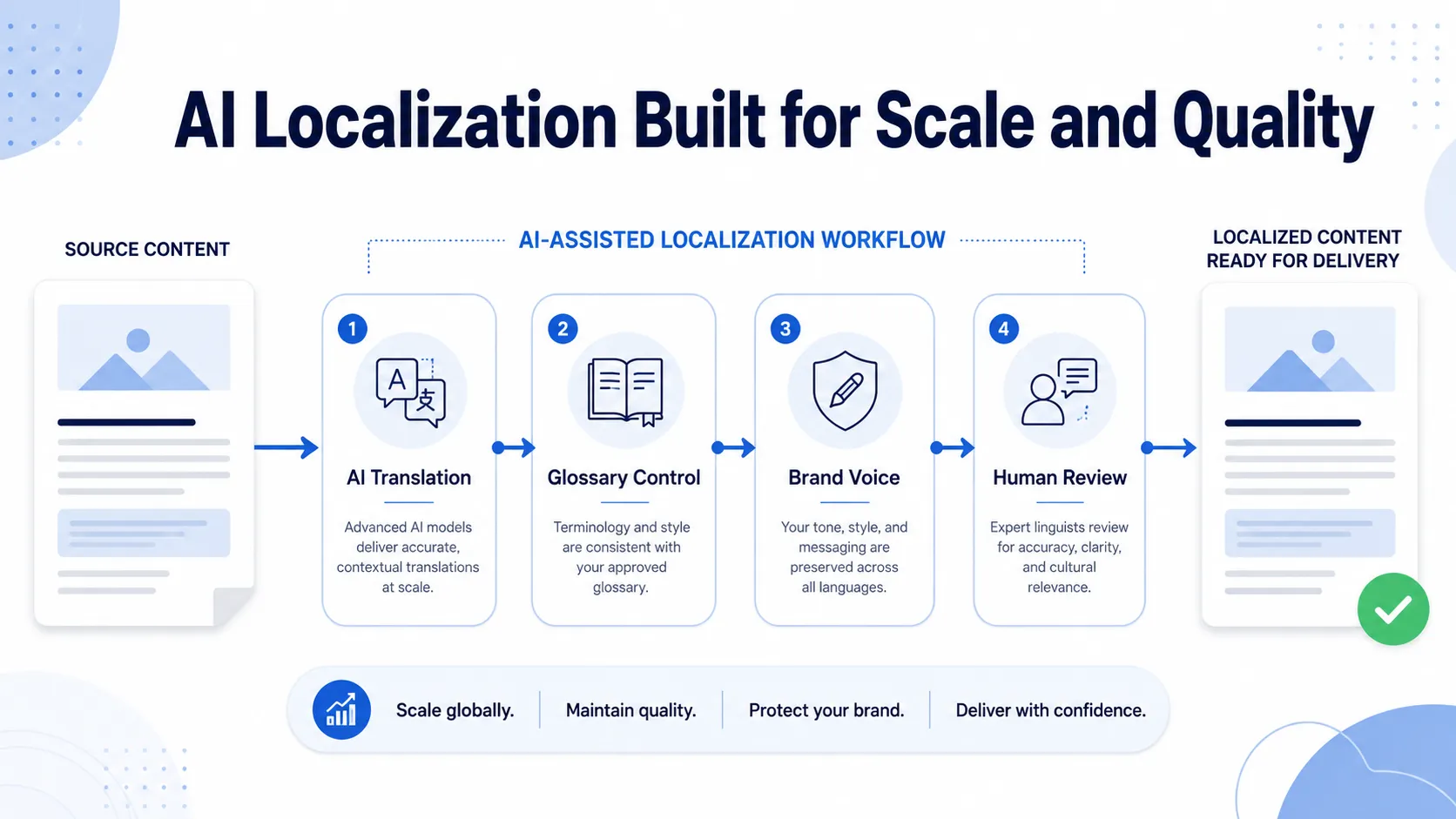
Machine Translation Post-Editing (MTPE) can accelerate initial drafts for high-volume or time-sensitive applications when applied within a properly governed workflow. In an MTPE approach, AI-generated output provides a technical foundation that a qualified human translator then reviews, corrects, and validates against the source document. For cost-sensitive or volume-intensive projects, Circle Translations’ machine translation post-editing services apply this model with the human oversight layer that patent-quality accuracy requires.
The governing constraint is clear: MTPE for patent filings must always include a qualified human final review. AI systems at the current state of development are not reliable enough for autonomous patent translation at the claims level. The MTPE workflow works because a human expert controls the final output, with AI handling volume processing in the background.
How Circle Translations Delivers Patent Translation Without Rush Fees
With over 200 IP firm partnerships built since 2008, Circle Translations handles patent translation across more than 74 languages and all major PCT filing jurisdictions, matching every project to a translator with academic credentials in the relevant technical field. Every project goes through qualified proofreading review before delivery.
The 99.97 percent on-time delivery rate is the direct result of planning delivery windows from project confirmation rather than file receipt, and building review time into the quoted timeline as a structural requirement rather than an optional add-on. For jurisdictions where translation errors are hardest to correct after grant, including China, Japan, and India, an optional attorney review of the translated claims by a local patent professional is available before the document goes to the patent office.
The most significant differentiator for IP attorneys managing filing deadlines is the no-rush-fee policy. While most translation providers apply 1.5x to 2x multipliers for expedited delivery, Circle Translations does not charge rush fees across any service tier. Christoph Siebmanns, Managing Director of Gotapatent AB Sweden, frames the value directly: “Swift and very competitive translation service. We highly recommend Circle Translations for patent translations.” For patent attorneys who need speed and accuracy without the financial penalty that usually comes with combining the two, Circle Translations removes the trade-off.
To review language coverage, delivery options, and pricing tiers for your filing requirements, visit the patent translation services page.
Conclusion
Patent translation turnaround time is a function of document length, subject matter complexity, language pair, file format, and how much buffer time is built into the filing calendar. For most national phase entries, 7 to 14 business days is the realistic window for professional-quality work that is accurate enough to file. The most reliable way to stay inside that window without paying rush surcharges is to start translation preparation at month 20 from the priority date, not month 28. Circle Translations is built for IP attorneys who cannot afford errors and should not be charged extra for needing work done promptly. Speed and accuracy are not a trade-off here.
Frequently Asked Questions
1. How long does patent translation typically take? Most patent translation projects for national phase entry run between 7 and 14 business days for professional-quality output with independent review included. Document length, subject matter complexity, and language pair all affect the final window. Emergency delivery in 3 to 7 business days is achievable through parallel-team workflows, and for short applications under 1,000 words, same-day or next-day delivery may be available.
2. When does patent translation turnaround time officially start? The turnaround clock starts at project confirmation, not when source files arrive. Project confirmation means the scope, quote, and delivery schedule have been agreed by both parties. File preparation, resource allocation, and terminology review all happen before the confirmed delivery window begins, so the quoted timeline reflects translation and review time only.
3. What factors slow down patent translation the most? Subject matter complexity is the primary factor: a highly specialized pharmaceutical or semiconductor application requires more research time per word than a general engineering application, and reduces the translator’s daily output to between 1,000 and 1,800 words. Other factors that slow delivery include rare language pairs with fewer qualified technical translators, scanned PDF source files that require manual extraction before translation starts, and the addition of secondary peer review, which adds roughly 30 percent to the base timeline.
4. Does Circle Translations charge rush fees for urgent patent translation? No. Circle Translations does not charge rush fees across any service tier. Most translation providers apply a 1.5x to 2x pricing multiplier for expedited delivery, but Circle Translations’ no-rush-fee policy means the per-word rate remains the same regardless of how tight the filing window is.
5. When should patent translation for PCT national phase entry be commissioned? Best practice is to begin national phase translation preparation at month 20 from the priority date, not month 27 or 28. This 10-month buffer before the standard 30-month deadline accommodates the full translation and review cycle, in-country attorney review, and administrative contingency for each jurisdiction without any need for emergency delivery.
6. How does Translation Memory reduce patent translation turnaround time? Translation Memory stores previously approved translations at the segment level, allowing a translator to reuse validated technical descriptions, claim structures, and terminology from earlier related applications rather than translating them from scratch. For organizations filing multiple patents in the same technical area, this reduces translatable volume on subsequent applications by 20 to 40 percent, cutting both cost and delivery time without affecting the accuracy of the final document.