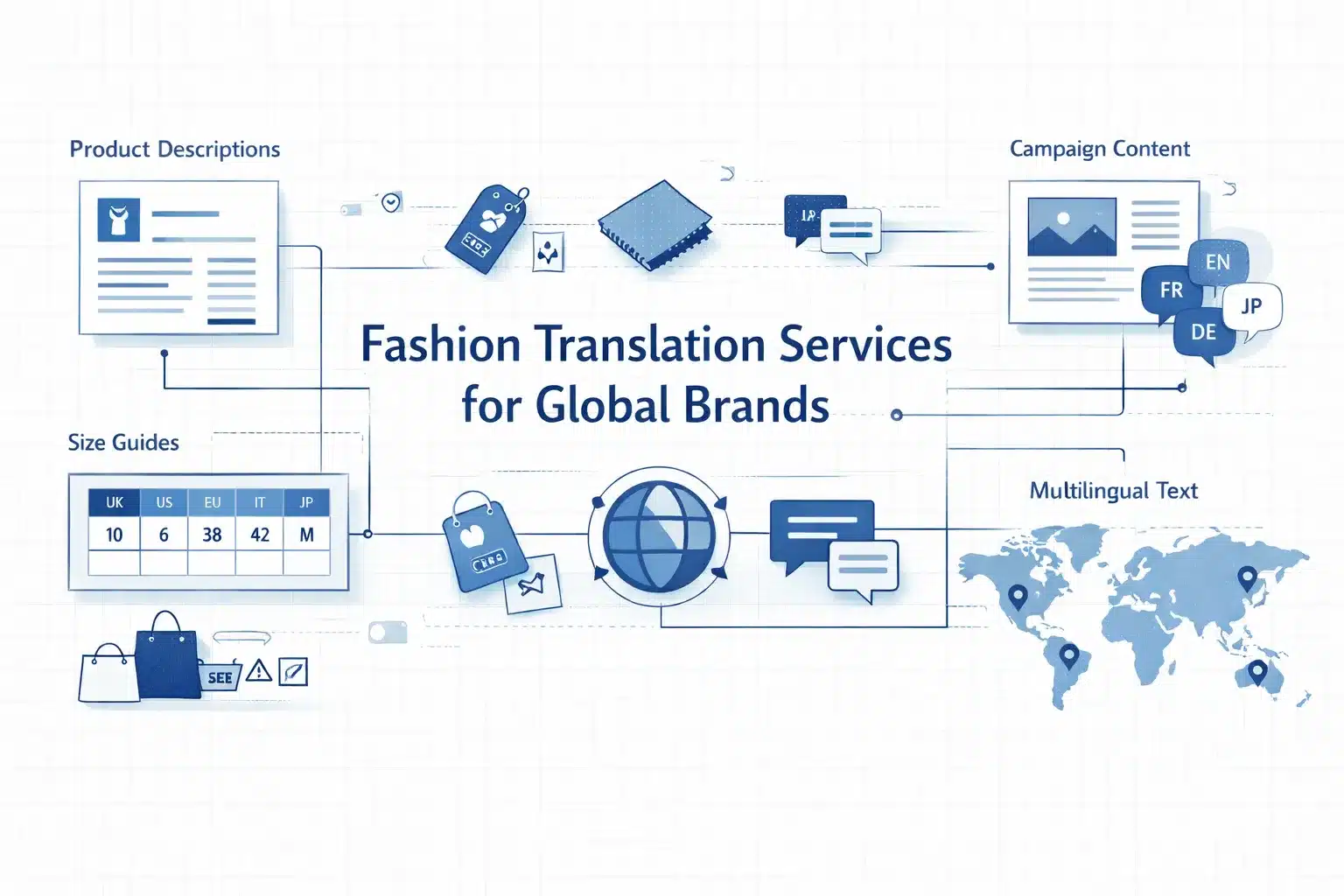
Fashion translation services deliver brand-accurate, conversion-focused translation of product descriptions, size guides, campaigns, and eCommerce content for global fashion markets. Effective fashion translation requires fashion-industry linguists, strict style guide enforcement, and seasonal workflows that protect brand voice while scaling across 200–5,000+ SKUs per launch.
As Minako O’Hagan and Carmen Mangiron (2013) explain in translation studies, “Translation quality is closely tied to its suitability for purpose and target audience,” highlighting that effective translation must align with brand voice and commercial objectives rather than focusing only on linguistic accuracy.
Fashion brands operate in a linguistically high-risk environment where brand tone directly impacts conversion rates, and size accuracy directly impacts returns. A generic translation programme produces technically correct but commercially weak content. A structured fashion translation programme preserves voice, enforces terminology, supports seasonal velocity, and converts consistently across every target market.
Fashion Translation Content Types: What Each Requires and Why Generic Translation Fails
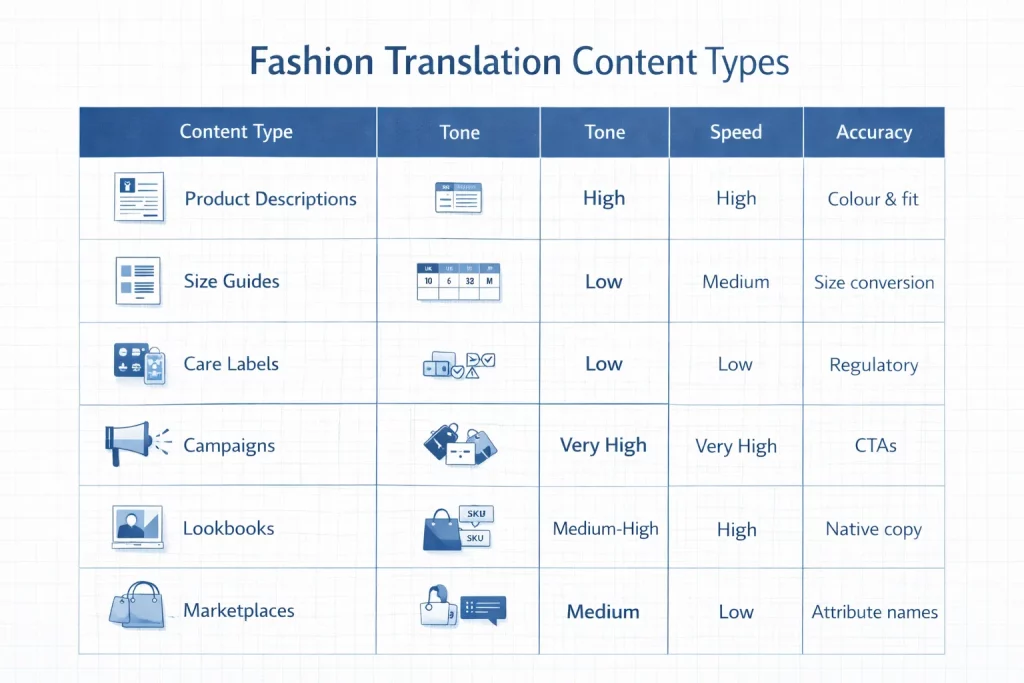
Fashion translation spans multiple content types, each with distinct tone, accuracy, and speed requirements — generic translation fails because it ignores these differences.
| Content Type | Translation Approach | Brand Tone Required | TM Leverage Potential | Seasonal Velocity | Key Accuracy Requirements |
| Product descriptions (PDP copy) | Human translation + style guide enforcement | HIGH — voice must match brand register (luxury / accessible / sporty / streetwear) | HIGH — consistent structures, colour/material naming | HIGH — 200–5,000+ SKUs per drop | Colour names; material names; fit descriptors; sizing vocabulary |
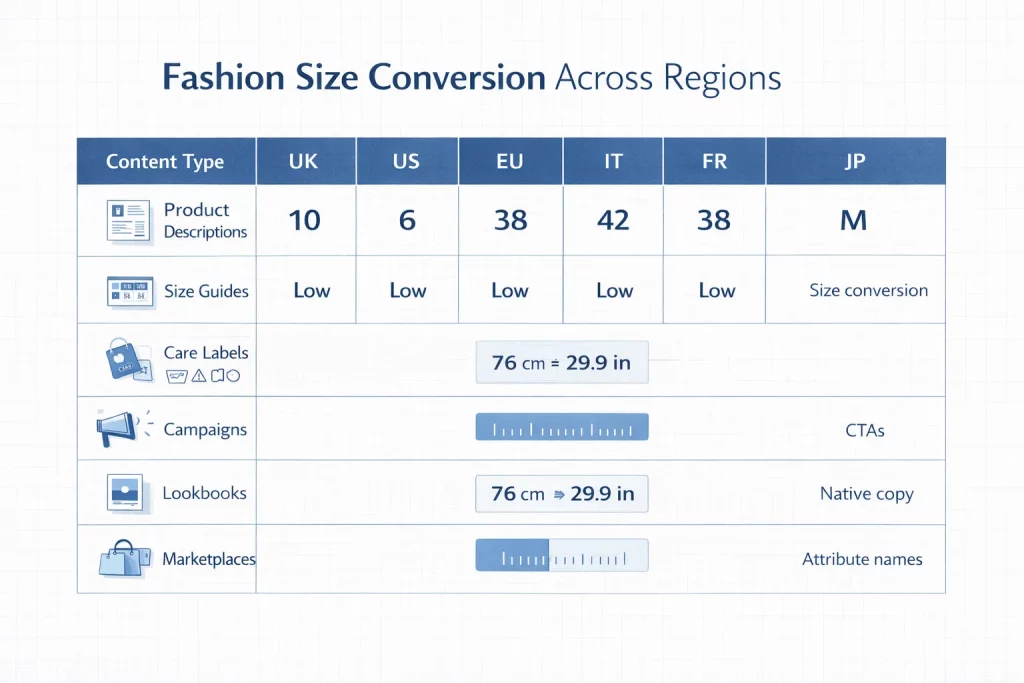
| Size guides | Translation + size conversion table | LOW — functional accuracy critical | MEDIUM — repeating tables | LOW — seasonal updates | Size conversion (UK/US/EU/IT/FR/JP); units (cm vs inches) |
| Care labels | Translation + ISO 3758 reference | LOW — regulatory accuracy | HIGH — repeated structures | LOW | Care symbols; Ginetex vs ASTM conventions |
| Lookbook/editorial | Transcreation | VERY HIGH — aspirational tone | LOW | HIGH — 2–6/year | Cultural resonance; native copy quality |
| Campaigns (email/social) | Transcreation | VERY HIGH — CTA + tone | LOW | VERY HIGH — weekly/monthly | CTA effectiveness; urgency language |
| Navigation/category pages | Translation + SEO localisation | MEDIUM | HIGH | LOW | Keyword accuracy; taxonomy alignment |
| Returns/shipping policy | Human translation | LOW-MEDIUM | HIGH | LOW | Legal clarity; jurisdiction terms |
| Customer service templates | Human + style guide | MEDIUM | HIGH | LOW | Tone consistency; resolution clarity |
| Marketplace listings (Zalando, ASOS) | Translation + SEO + format rules | MEDIUM-HIGH | HIGH | HIGH | Attribute naming; character limits |
Product Description Translation for Fashion: Colour Names, Fit Descriptors, and Conversion-Optimised Copy
Fashion PDP translation combines brand tone, specialised vocabulary, and SEO-driven conversion, making it the highest-impact content type. Product descriptions must match the brand register through a documented style guide with approved examples and enforced tone rules.
Fashion vocabulary introduces risk: colour names (“sage”, “blush”), materials (“French terry”, “crepe de chine”), and fit descriptors (“oversized”, “cropped”) require market-specific decisions. Conversion depends on target-language search behaviour, natural phrasing, and consistent CTAs (“Add to bag” vs “Buy now”).
As Chaffey, Dave and Ellis-Chadwick, Fiona (2019) explain in Digital Marketing, “Content must be tailored to the audience and context to be effective in driving conversion,” highlighting that language, tone, and localisation directly influence eCommerce performance and user response.
Size Guide Localisation: UK, US, EU, Italian, and Asian Sizing Conventions and Measurement Unit Conversion
Size guide localisation requires precise size conversion, unit adaptation, and clear measurement communication. Errors directly increase return rates.
Translators must align UK, EU, US, IT, and FR sizing systems while recognising category-specific variation. Example: UK 10 = EU 38 = US 6 = IT 42 = FR 38. Measurements require correct unit conversion (76 cm = 29.9 in).
Asian markets introduce separate systems (JP, CN, KR). Care labels follow ISO 3758 symbols with market-specific conventions (GINETEX vs ASTM).
Fashion Campaign and Lookbook Translation: When Transcreation Replaces Direct Translation
Fashion marketing content requires transcreation. Direct translation fails because it removes emotional and cultural impact. Campaign lines, lookbook copy, and social captions must read as native copy, not translated text.
Example: “Dress the life you want to live” becomes a culturally adapted message, not a literal sentence. Effective transcreation uses a structured brief: campaign concept, audience, tone examples, exclusions, and character limits. This ensures consistent brand resonance across markets.
Fashion Translation Style Guide: How to Enforce Brand Tone Across Languages and Prevent Voice Drift
Brand voice drift occurs when translated content loses consistency over time, weakening brand identity and reducing conversion performance across markets.
| Style Guide Section | What It Contains | Fashion-Specific Application | How It’s Enforced |
| Brand tone definition | Tone descriptors: “sounds like / not like” examples | Luxury vs streetwear vs activewear tone distinctions | Translator briefing; approved/rejected examples |
| Voice in the target language | Native-language tone definition | Market-specific tone adaptation (e.g., German more functional; French more understated) | Native stakeholder approval before rollout |
| Approved vocabulary | Preferred terms; colour/material naming; category terms | Colour policy (translate vs retain); fit descriptors; fabric naming | Termbase in CAT tools with real-time suggestions |
| Forbidden terms | Off-brand or generic expressions | Avoid generic sizing terms, incorrect fabric descriptions, and mistranslated slang | Flagged as hard errors in QA tools |
| Register and formality | Formal vs informal address; voice perspective | “Sie” vs “du”; “vous” vs “tu” based on brand positioning | Enforced via style guide and QA checks |
| Formatting conventions | Punctuation; capitalisation; number formats | Product naming conventions; emphasis styling; measurement formats | DTP and QA validation |
| Cultural adaptation notes | Localisation of references and campaigns | Seasonal events, sale periods, and cultural moments | Transcreation briefs and cultural QA |
How to Build a Fashion Translation Style Guide: A 5-Step Process
1. Define brand tone per language: Translate tone descriptors into actionable rules for each market using native fashion linguists.
2. Collect approved examples: Use 10–20 validated translations plus 3–5 rejected examples to define boundaries clearly.
3. Standardise vocabulary: Document 50–100 key fashion terms including colours, materials, and fit descriptors per language.
4. Set register rules: Define formal vs informal address (e.g., “vous” vs “tu”) as a fixed brand decision.
5. Update continuously: Review after each сезонal launch and refine based on feedback and new terminology.
How AI and Automation Enforce Style Guide Compliance in High-Volume Fashion Translation
AI enforces style guide rules at scale by controlling terminology, structure, and consistency during translation workflows. CAT tools integrate termbases to block forbidden terms and enforce preferred vocabulary in real time.
QA tools (Xbench, Phrase QA) check register, sentence patterns, and length limits. However, AI cannot assess brand tone quality.
Circle Translations combines automated enforcement with senior human review for final voice validation.
Multilingual Fashion SEO: Translating Product Descriptions for Search, Not Just for Comprehension
Fashion SEO translation aligns product content with target-language search behaviour, not literal wording. German, French, and Italian shoppers use different keyword structures and vocabulary.
Direct translation produces SEO-invisible pages. Circle Translations integrates keyword research, optimised PDP copy, metadata localisation, and hreflang implementation to ensure visibility across markets and platforms like Zalando and ASOS.
Fashion Translation Workflow for Seasonal Launches: Speed, Volume, and Consistency at Scale
Fashion translation operates on fixed launch deadlines where delays in translated PDPs, campaigns, or labels directly delay revenue in non-English markets.
| Season / Event | Content to Translate | Typical Word Volume | Lead Time Required | Translation Approach |
| Spring/Summer (SS) main drop | PDP copy; campaigns; emails; homepage; lookbooks | 30,000–150,000 words | 3–6 weeks | Human translation + style guide + SEO; transcreation |
| Mid-season drops | PDPs; emails; social | 5,000–30,000 words | 1–2 weeks | Human translation + TM + QA |
| Autumn/Winter (AW) main drop | Same as SS | 30,000–150,000 words | 3–6 weeks | Human translation + style guide + SEO; transcreation |
| Sale events | Landing pages; emails; ads; banners | 2,000–8,000 words | 1–7 days | Rush translation + TM; transcreation for campaigns |
| New market entry | Core site; size guides; policies | 10,000–40,000 words | 4–8 weeks | Full localisation + SEO + DTP |
| Ongoing new arrivals | PDPs; metadata; care labels | 1,000–10,000 words | 3–5 days | TM-driven batch translation |
How Translation Memory Reduces Cost and Maintains Consistency Across Fashion Seasons
Translation memory (TM) reduces cost by 20–50% while enforcing consistent product language across seasons. Fashion PDP structures repeat, creating exact and fuzzy matches.
After 3 seasons, TM match rates reach 35–50%. At £0.12/word, a 50,000-word catalogue with 35% matches saves ~£2,100 per season. QA controls prevent incorrect reuse in product names or fit descriptors.
Managing Multilingual Fashion Marketplaces: Zalando, ASOS, Myntra, and Platform-Specific Translation Requirements
Marketplace translation requires strict adherence to platform taxonomies, attribute fields, and character limits. Zalando requires local-language listings with correct colour taxonomy (“sage” → “Salbeigrün”).
ASOS uses structured English-first feeds with localisation layers. Myntra requires Indian sizing adaptation and optional Hindi content.
Circle Translations delivers marketplace-ready CSV/XML feeds with validated terminology and SEO-aligned attributes.
Fashion Translation for Luxury Brands vs Fast Fashion: How Quality Standards and Velocity Requirements Differ
Luxury and fast fashion require fundamentally different translation systems, one optimises for quality depth, the other for speed and scale.
Luxury uses transcreation, low volume (200–500 SKUs), and multi-stage review cycles. Fast fashion processes 1,000+ SKUs weekly using MTPE, high TM leverage (50–60%), and 24–48 hour turnaround.
Circle Translations deploys separate workflows to match each model’s risk, cost, and speed requirements.
Build a Fashion Translation Programme That Protects Your Brand Voice and Scales With Your Seasonal Calendar
Missed launch deadlines, inconsistent brand voice, and poor localisation reduce conversion and increase returns, especially across multi-market fashion rollouts. Circle Translations eliminates this risk with a structured, scalable translation system built for seasonal fashion cycles.
✓ Fashion-specialist translators — native linguists with category expertise in luxury, streetwear, and ecommerce fashion markets
✓ Translation style guide system — tone defined per language, approved examples, enforced register (formal vs informal)
✓ Fashion termbase control — 50–200 key terms standardised (colours, materials, fits, brand terms) with CAT tool enforcement
✓ Transcreation layer — campaign, lookbook, and editorial content adapted by native fashion copywriters, not directly translated
✓ High-volume PDP workflows — 200–5,000+ SKUs per drop delivered with TM leverage, QA, and SEO keyword alignment
✓ Size guide localisation — UK/EU/US/IT/FR/JP conversions verified; cm/inch conversion applied consistently
✓ Care label compliance — ISO 3758 symbols and market-specific wording validated (GINETEX / ASTM)
✓ Multilingual SEO integration — keyword research, meta localisation, hreflang guidance for ecommerce visibility
✓ Marketplace readiness — Zalando, ASOS, Myntra attribute mapping, colour taxonomy, and character limit compliance
✓ Seasonal retainer model — reserved capacity, faster turnaround, and predictable cost across SS/AW cycles
✓ Measurable efficiency — TM match rates (20–50%) and cost savings tracked across every season
Tell us your brand positioning, target markets, SKU volume, and launch calendar — Circle Translations will build a fashion translation programme aligned to your growth and release cycles.
Get a Fashion Translation Programme Quote →
View Translation and Localisation Services →
View Transcreation Services →
Fashion Translation Services — Frequently Asked Questions
What is the difference between fashion translation and fashion transcreation?
Fashion translation preserves meaning and structure, while transcreation recreates emotional impact and brand voice. Translation suits PDPs, size guides, and policies. Transcreation rewrites campaigns, lookbooks, and taglines for cultural resonance. Use translation for accuracy-driven content; use transcreation for conversion-driven messaging where tone and creativity directly affect engagement and sales.
How much does fashion translation cost per product description?
Fashion PDP translation costs £9–£22 per description per language, based on 80–150 words at £0.10–£0.15/word. A 500-SKU catalogue in 3 languages costs £13,500–£33,000 in season one. With 35% TM leverage by season two, costs drop to £8,775–£21,450. MTPE reduces cost further to £6–£15 per PDP for high-volume catalogues.
Which languages should a fashion brand prioritise for translation?
Prioritise languages based on revenue and traffic, starting with German, French, Spanish, and Italian for Europe. Germany drives the largest EU ecommerce revenue. French and Italian support strong fashion markets. Spanish expands into the EU and LATAM. Add Dutch, Polish, Japanese, and Chinese based on growth strategy and demand signals.
How does a translation style guide prevent brand voice drift over time?
A translation style guide enforces consistent tone, vocabulary, and register across all languages and seasons. It defines approved phrasing, forbidden terms, and formality (e.g., “tu” vs “vous”). Regular updates after each season ensure new vocabulary aligns with the brand voice. This prevents gradual dilution into generic e-commerce language.
Can MTPE (machine translation post-editing) be used for fashion product descriptions?
MTPE works for high-volume, functional fashion content but fails for premium or luxury brand copy. Use MTPE for fast-fashion PDPs where speed and cost matter. Avoid MTPE for luxury descriptions, campaigns, and brand storytelling. If output reads like generic e-commerce text, it is unsuitable for brand-led content.
How are size guides translated for different regional markets?
Size guide localisation combines language translation with accurate size and unit conversion. UK sizes convert to EU, US, or Asian systems depending on the market. Measurements convert between cm and inches where required. Model measurements and fit notes are adapted using local conventions. Incorrect conversion directly increases return rates.
What fashion content should a style guide cover that most brands overlook?
Four overlooked elements are colour naming, size labels, CTAs, and product name rules. Colour policy defines whether “sage” becomes “Salbeigrün” or stays English. Size labels (XS–XL vs numeric) must be standardised. CTA wording must stay consistent. Product names require rules for translation vs global consistency.
How long does it take to translate a full fashion season collection?
A full fashion season translation takes 3–6 weeks for 1,000–3,000 SKUs across 2–4 languages. Weeks 1–2 cover setup and PDP translation. Weeks 3–4 handle bulk content. Weeks 4–6 cover campaigns, SEO, and QA. Fast-fashion workflows deliver rolling batches in 3–5 days per drop.
Does Circle Translations offer ongoing retainer programmes for fashion brands?
Yes, Circle Translations offers seasonal retainer programmes aligned to fashion launch cycles. Retainers include reserved capacity, discounted rates, active TM, and priority turnaround for campaigns. Style guides and termbases remain active across seasons, improving consistency and reducing cost by 20–50% as the programme matures.