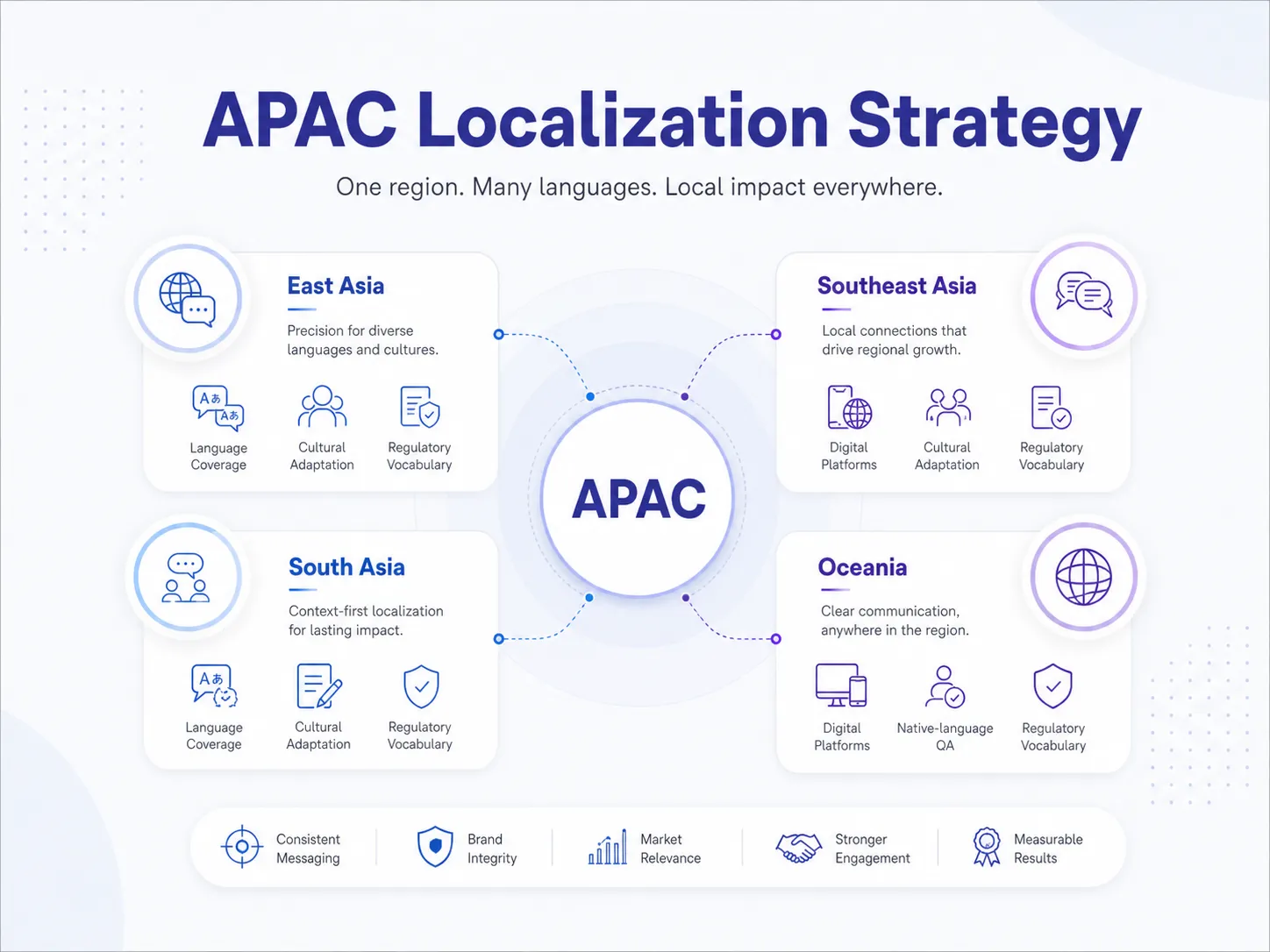
APAC stands for Asia-Pacific. This is the geographic and economic region encompassing East Asia, Southeast Asia, South Asia, Oceania, and parts of the Pacific. The APAC region includes over 50 countries and approximately 4.5 billion people, more than half the world’s population.
If you want businesses entering or expanding in Asia-Pacific markets, APAC localization means adapting content, products, and services to the specific languages, cultural norms, and regulatory requirements of each target market.
APAC is the most linguistically and culturally diverse major business region in the world. For businesses entering multiple APAC markets simultaneously, APAC localization is not a single program but a portfolio of market-specific strategies.
Circle Translations delivers APAC localization across Simplified Chinese, Traditional Chinese, Japanese, Korean, Bahasa Indonesia, Vietnamese, Thai, Hindi, Bengali, Tagalog, Bahasa Malay, and Australian English — with native-language translators per market, ISO 17100-aligned two-stage QA, and regulatory vocabulary competence across NMPA, PMDA, TGA, and BPOM submissions.
Here, we cover what APAC means and which countries it includes, the APAC language landscape and which languages to prioritize, cultural adaptation requirements by sub-region, digital platform, and regulatory considerations per market, how to build an APAC localization program in 5 steps, and how to evaluate translation and localization vendors for APAC.
What Is APAC?
APAC is the geographic and business classification covering more than 50 countries across 4 major sub-regions: East Asia, Southeast Asia, South Asia, and Oceania.
Understanding the APAC scope is just the starting point for any localization strategy. The countries within the regional definition determine which languages, regulatory frameworks, and digital platforms a program must handle.
APAC Core Markets and B2B Localization Priority
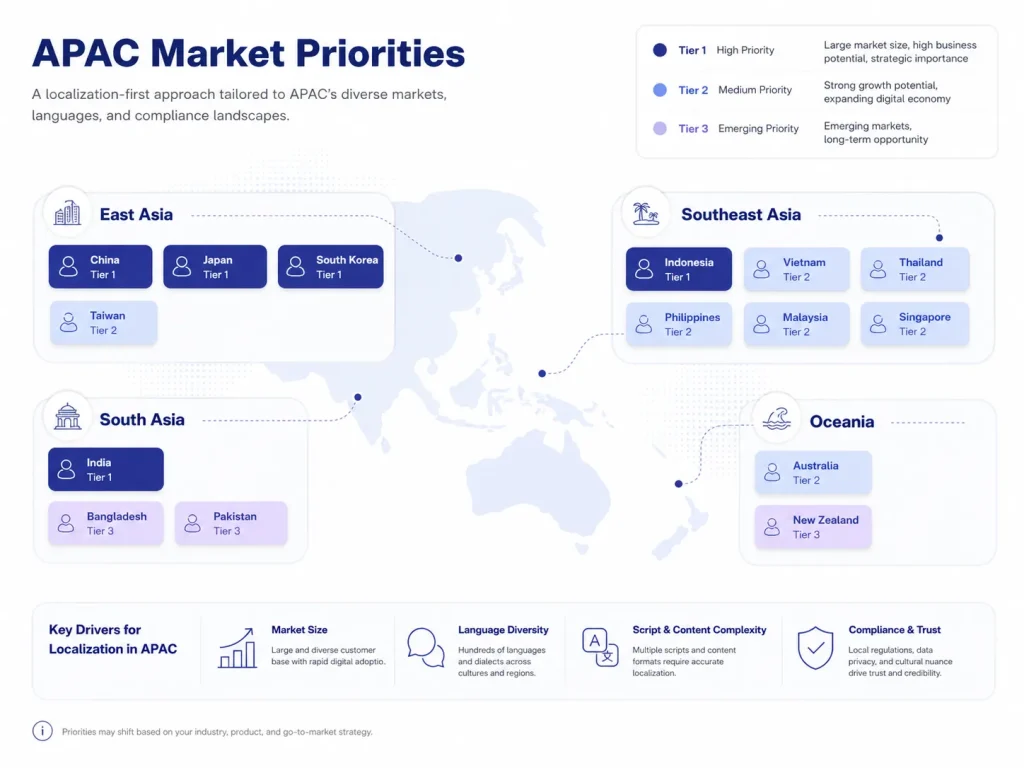
| Sub-Region | Country | Primary Language(s) | Script | Population | B2B Localization Priority | GDP Rank in APAC |
|---|---|---|---|---|---|---|
| East Asia | China | Mandarin Chinese (Simplified zh-CN) | Simplified Chinese (Hanzi) | 1.4B | TIER 1 — largest consumer market; ICP, PIPL, content review requirements | 1 |
| East Asia | Japan | Japanese | Hiragana / Katakana / Kanji | 125M | TIER 1 — world’s 3rd largest economy; unique content conventions; high purchase power | 2 |
| East Asia | South Korea | Korean (Hangul) | Hangul | 52M | TIER 1 — advanced digital economy; Naver and KakaoTalk platform requirements | 3 |
| East Asia | Taiwan | Mandarin Chinese (Traditional zh-TW) | Traditional Chinese | 24M | TIER 2 — distinct from PRC; Traditional vs Simplified Chinese; separate content regulation | — |
| South Asia | India | Hindi + 21 other scheduled languages; English in B2B | Devanagari (Hindi); Latin (English) | 1.4B | TIER 1 — most populous country; fast-growing digital economy; language diversity challenge | 4 |
| Southeast Asia | Indonesia | Bahasa Indonesia | Latin | 280M | TIER 1 — 4th most populous country; fastest-growing SEA digital economy | 5 |
| Southeast Asia | Vietnam | Vietnamese | Latin (with tone diacritics) | 100M | TIER 2 — fast-growing manufacturing and digital market | — |
| Southeast Asia | Thailand | Thai | Thai script | 72M | TIER 2 — major consumer market; local script required for consumer-facing content | — |
| Southeast Asia | Philippines | Filipino / English | Latin | 115M | TIER 2 — English-first B2B; Filipino localisation for consumer-facing | — |
| Southeast Asia | Malaysia | Bahasa Malaysia + English | Latin | 35M | TIER 2 — multilingual market (BM/English/Chinese/Tamil); B2B English functional | — |
| Southeast Asia | Singapore | English + Mandarin + Malay + Tamil | Latin / Chinese | 6M | TIER 2 — APAC B2B hub; English primary for B2B | — |
| Oceania | Australia | English | Latin | 26M | TIER 2 — major English-language market; AU English conventions; ACCC regulatory | 6 |
| Oceania | New Zealand | English + Māori | Latin | 5M | TIER 3 — English-language; Māori for public sector / certain consumer products | — |
| South Asia | Bangladesh | Bengali | Bengali script | 175M | TIER 3 — rapidly growing digital economy; Bengali script for consumer-facing content | — |
| South Asia | Pakistan | Urdu + English | Nastaliq (right-to-left) | 240M | TIER 3 — significant market; Urdu RTL script; growing digital economy | — |
APAC Countries: Which Countries Are Included and How Definitions Vary by Organization
APAC has no fixed list of countries. Different organizations draw the line differently, depending on how they run their businesses, and your company’s internal definition determines which markets fall within the localization program.
The broad definition covers: East Asia (China, Japan, South Korea, Taiwan, Hong Kong, Macao, Mongolia), Southeast Asia (Indonesia, Vietnam, Thailand, Philippines, Malaysia, Singapore, Myanmar, Cambodia, Laos, Brunei, Timor-Leste), South Asia (India, Pakistan, Bangladesh, Sri Lanka, Nepal, Bhutan, Maldives, Afghanistan), sometimes Central Asia, and Oceania (Australia, New Zealand, Papua New Guinea, Fiji, and the smaller Pacific Island nations).
The narrower business definition: is what most B2B companies mean by APAC: East Asia + Southeast Asia + Oceania + India — usually 15 to 25 countries.
APEC is different. APEC is a 21-member trade forum that includes Canada, Chile, Mexico, Peru, and the USA. Pacific Rim economies that are not APAC in the everyday business sense.
Is India in APAC?
Yes. India is the world’s most populous country (1.4+ billion people) and the 5th-largest economy. Older structures sometimes placed it under MEA, but in the 2024–2025 corporate definitions, India is firmly inside APAC.
APAC Sub-Regions and What They Mean for Localization Strategy
Treating APAC as one homogeneous region is the most expensive localization mistake brands make. APAC has 4 sub-regions, each its own world.
East Asia (China, Japan, South Korea, Taiwan, Hong Kong) is the richest and most demanding sub-region. It uses 3 unrelated languages and scripts, Chinese (Simplified and Traditional), Japanese, and Korean, and China runs its own internet ecosystem (WeChat, Weibo, Baidu, Alibaba, Douyin). Japan and Korea expect near-perfect translation quality.
Southeast Asia (Indonesia, Vietnam, Thailand, the Philippines, Malaysia, Singapore, and Myanmar) is the fastest-growing digital market in APAC and the most linguistically fragmented region. The 5 priority B2B languages are Bahasa Indonesia, Vietnamese, Thai, Filipino, and Bahasa Melayu. Markets outside Singapore are mobile-first and price-sensitive.
South Asia (India, Pakistan, Bangladesh, Sri Lanka) has the highest growth potential. English handles most B2B work in India; Hindi covers the Hindi belt; major regional languages reach consumer markets. Urdu and Bengali require right-to-left or complex script rendering.
Oceania (Australia, New Zealand) is English-language, with localization still needed. Australian spelling, ACCC regulatory terminology, and Te Reo Māori for New Zealand public sector content.
The APAC Language Landscape
APAC has more linguistic diversity than any other major business region. But a focused set of 12 languages covers the majority of commercial reach.
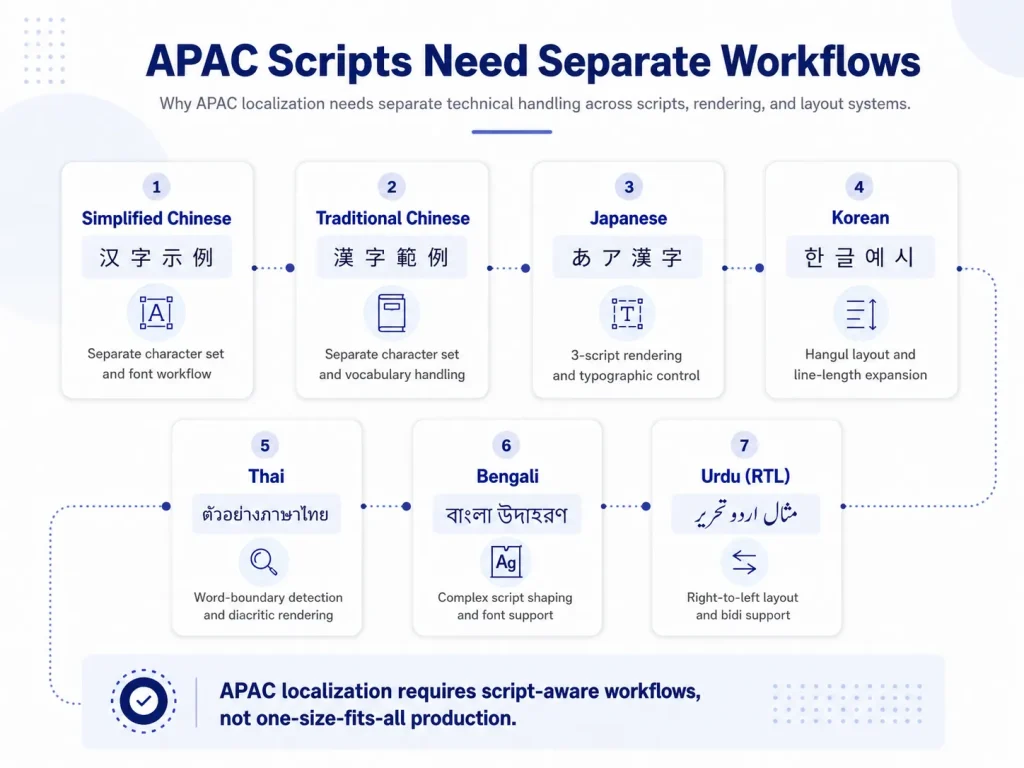
APAC languages use 6 fundamentally different script systems, each with distinct technical requirements for rendering, typography, DTP, and digital display. Unlike European languages, which all use Latin script with minor variations, APAC scripts cannot share a single technical workflow.
APAC script systems and what they mean for localization:
- Simplified Chinese (zh-CN): Hanzi characters used in PRC and Singapore; GB standard encoding; Chinese font licensing required for print materials; Simplified Chinese text is approximately 10–20% shorter than equivalent English text.
- Traditional Chinese (zh-TW / zh-HK): Traditional character set used in Taiwan and Hong Kong; different character forms; different vocabulary for many modern concepts; separate localization from Simplified Chinese despite shared origin.
- Japanese: Three overlapping scripts — hiragana (phonetic syllabary for grammatical words), katakana (phonetic syllabary for foreign loanwords), and kanji (Chinese-origin characters for nouns and verbs). Vertical text (tate-gumi) is used in some Japanese publishing contexts.
- Korean (Hangul): Alphabetic syllabic blocks; Korean text runs 10–30% longer than equivalent English text; hanja (Chinese-origin characters) are occasionally used in formal or legal Korean.
- Thai: Consonant-cluster script without word spaces; stacking diacritics above and below consonants; Thai font rendering requires correct Unicode support and word boundary detection for line wrapping.
- Arabic / Urdu / Pashto (right-to-left): Used in Pakistan, Bangladesh (Urdu community media), and Middle Eastern APAC-adjacent markets; RTL text direction requires full layout mirroring in digital interfaces; bidirectional text (BiDi) rendering for mixed LTR/RTL content.
12 APAC Priority Languages for B2B Localization
| Language | ISO Code | Script | Primary Markets | B2B Reach Tier |
|---|---|---|---|---|
| Mandarin Chinese (Simplified) | zh-CN | Simplified Chinese | China, Singapore | TIER 1 |
| Japanese | JA | CJK (3 scripts) | Japan | TIER 1 |
| Korean | KO | Hangul | South Korea | TIER 1 |
| Hindi | HI | Devanagari | India (Hindi belt) | TIER 1 |
| Bahasa Indonesia | ID | Latin | Indonesia | TIER 1 |
| Mandarin Chinese (Traditional) | zh-TW | Traditional Chinese | Taiwan, Hong Kong | TIER 2 |
| Vietnamese | VI | Latin + diacritics | Vietnam | TIER 2 |
| Thai | TH | Thai script | Thailand | TIER 2 |
| Filipino / Tagalog | TL | Latin | Philippines | TIER 2 |
| Bahasa Malay | MS | Latin | Malaysia, Brunei | TIER 2 |
| Bengali | BN | Bengali script | Bangladesh, India (West Bengal) | TIER 3 |
| Urdu | UR | Nastaliq (RTL) | Pakistan, India (Urdu speakers) | TIER 3 |
Simplified Chinese ≠ Traditional Chinese — the most common APAC localization error:
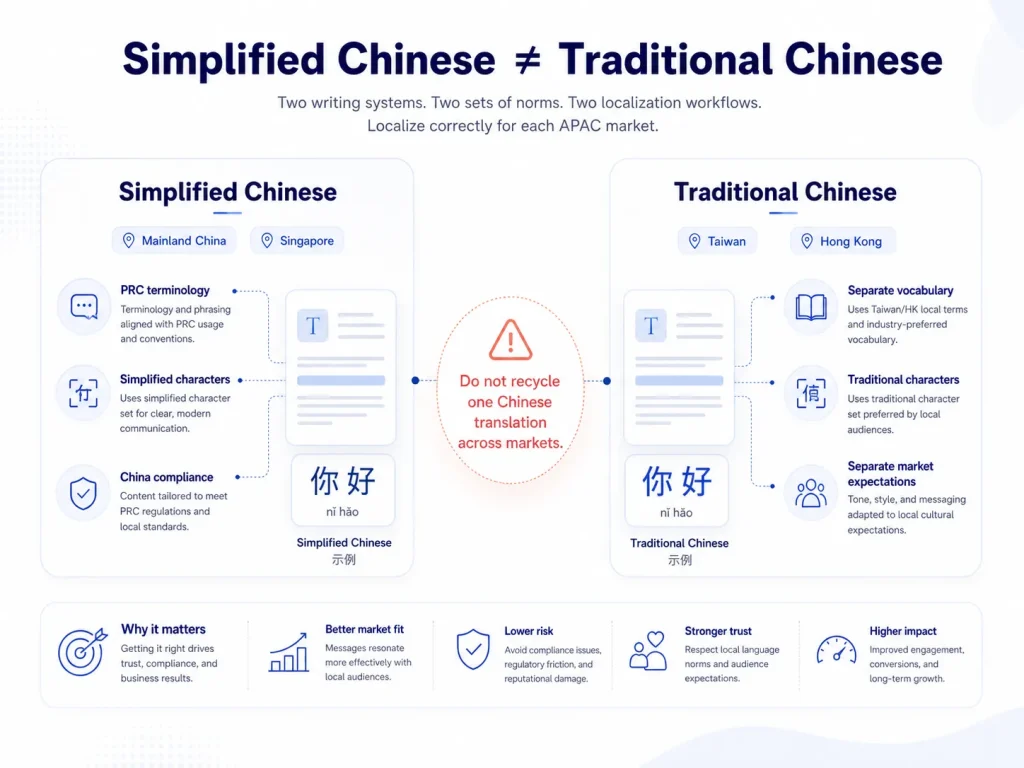
Treating Simplified Chinese and Traditional Chinese as variants of the same language is the single most common APAC localization mistake. They use different character sets, different vocabulary for many modern terms, different stylistic conventions, and operate in completely different regulatory environments (PRC vs Taiwan and Hong Kong). They require separate native-language translators and separate localization workflows.
APAC Cultural Adaptation: Beyond Language
Translation alone won’t get you into APAC markets. The same color, image, or word can mean opposite things across the region. So cultural adaptation has to be planned market by market.
The table below maps the cultural dimensions that matter most across 7 key APAC markets:
| Market | Colours | Formality | Aesthetic | Trust Signals | Digital |
| China | Red = luck; white = mourning | Formal; titles matter | Dense, aspirational | WeChat presence; social proof | WeChat, Weibo, Douyin; Baidu |
| Japan | White = purity | Very formal; keigo | Detailed, precise | Reputation; long-term ties | LINE; Yahoo Japan; high desktop |
| Korea | White = purity; red+blue = national | Formal; seniority | Polished, K-aesthetic | Quality; innovation | KakaoTalk; Naver |
| India | White = mourning (regional); green = Islamic in some communities | Varies by region | Vibrant; varied | Localness; Hindi in Hindi belt | Mobile-first; WhatsApp; Google |
| Indonesia | Green = positive; red+white = flag | Polite, formal | Clean, mobile-first | Local language; halal | WhatsApp, Instagram; Shopee |
| Thailand | Yellow = royalty (careful); red = patriotism | Polite; “kreng jai” | Friendly, visual | Localness; sanuk | Facebook, LINE |
| Australia | Western conventions | Direct, informal | Clean, Western | Social proof; transparency | Google, Meta |
China Localization: Simplified Chinese, Compliance, and a Separate Internet
China is APAC’s biggest opportunity and its hardest market. Localizing for China isn’t just translation into Simplified Chinese — it’s content compliance with PRC law, hosting compliance with the ICP regime, and a complete switch of digital channels.
Language: Simplified Chinese (zh-CN)
Simplified and Traditional Chinese share about 70% of characters but differ in modern vocabulary. They’re not the same language. Foreign concepts also have official PRC translations set by authorities like NMPA (medicines) and MIIT (technology) — use the approved version, not your own.
The Chinese Firewall and Digital Ecosystem
Sites hosted outside China often load slowly or get blocked entirely. A China-hosted mirror with an ICP licence from MIIT is essential. Search runs on Baidu, not Google.
The core channels:
- WeChat — the dominant chat, content, and commerce platform, with over 1 billion monthly active users since 2018 and around 1.4 billion monthly active users as of 2025 StatistaElectro IQ
- Weibo — Twitter-equivalent for public campaigns
- Douyin — TikTok China (separate from global TikTok)
- Xiaohongshu — lifestyle and product discovery
- Tmall, Taobao, JD.com, Pinduoduo — e-commerce giants
Regulatory Requirements
- PIPL — privacy notices must be in Simplified Chinese
- ICP license — required for China-hosted commercial sites
- Advertising Law (广告法) — since the 2015 amendment, the Advertising Law of the PRC prohibits superlative expressions like “state-level,” “highest level,” and “the best,” with fines ranging from 200,000 yuan (~US$31,000) to 1,000,000 yuan (~US$151,000) and the risk of having a business license revoked. Direct Chinese translations of phrases like “world’s best” and “most advanced” are also restricted.
- NMPA — pharma and medical content needs approved translations
Japan Localization: Keigo, Quality Standards, and LINE / Yahoo Japan
Japan punishes poor translation harsher than almost any other market. Sloppy localization reads as carelessness, and Japanese B2B buyers don’t forget.
Language Complexity
Japanese uses 3 scripts at once: hiragana, katakana, and kanji. All must render correctly. Broken characters are spotted instantly. UTF-8 is essential.
The harder challenge is keigo (敬語), Japan’s honorific system. B2B uses 2 forms:
- Sonkeigo — respectful (elevates the customer)
- Kenjōgo — humble (lowers yourself)
Casual Japanese in B2B signals ignorance. Wrong keigo is worse — it’s formality attempted and failed. See Japanese document translation services for document-level guidance.
Foreign words go into katakana following Japanese sound rules — “McDonald’s” becomes マクドナルド (Makudonarudo). Brand katakana must be verified against existing conventions.
Quality Expectations
In Japan, long-term relationships (kankei, 関係) drive business. First impressions stick. Bad localization kills credibility before the conversation starts.
Digital Environment
- LINE — dominant messenger; LINE Business Account for brands
- Yahoo Japan — real search share (unusual outside Japan)
- Rakuten — leading e-commerce
- Desktop browsing — higher than other APAC markets; can’t be ignored
Southeast Asia Localization: Mobile-First, Bahasa Indonesia First
Southeast Asia is APAC’s fastest-growing digital region. The decisions that matter: which languages to prioritize, which platforms dominate, and how to keep Bahasa Indonesia and Bahasa Malaysia separate.
Indonesia — the Top SEA Priority
Indonesia is the fourth most populous country in the world, after China, India, and the United States, with an official mid-2025 estimate of 284.44 million people. Bahasa Indonesia is the first SEA language most brands need. (World Bank World Population Review)
Bahasa Indonesia and Bahasa Malaysia are close but not the same. Indonesians say “mobil” for car; Malaysians say “kereta.” Native readers spot the swap immediately — separate translations required.
Two practical notes:
- B2B uses formal Bahasa Indonesia; consumer marketing reads better, slightly conversational
- Indonesia is also the world’s most populous Muslim-majority country, with just over 87% of the population identifying as Muslim. Content should reflect halal compliance, avoid pork and alcohol references, and use Idul Fitri (not Christmas) for seasonal campaigns, World Bank
Vietnam — High-Growth B2B
Vietnam’s manufacturing boom is pulling in supply chain investment. Vietnamese uses Latin script with 6 tones marked by diacritics — tone marks can’t be dropped. Northern Vietnamese (Hanoi) is the B2B standard.
Thailand, Philippines, Malaysia
- Thailand — Thai script for consumers; English works in premium B2B
- Philippines — English handles most B2B; Filipino for consumer marketing; cheapest SEA entry point
- Malaysia — Bahasa Malaysia + English; Jawi script appears in some Islamic and official contexts
Southeast Asia Digital Platform Map
| Market | Messaging | E-Commerce | Search |
| Indonesia | WhatsApp, Instagram | Shopee, Lazada, Tokopedia | |
| Vietnam | Zalo, Facebook | Shopee, Lazada, Tiki | |
| Thailand | LINE, Facebook | Shopee, Lazada | |
| Philippines | Facebook, Messenger | Shopee, Lazada | |
| Malaysia | WhatsApp, Messenger | Shopee, Lazada, Zalora |
For the data points, readers may want to verify directly:
- WeChat user base — Wikipedia (WeChat) confirming the 1 billion MAU milestone in 2018; SOAX research confirming 1.4 billion MAUs by 2025
- China Advertising Law (广告法) — Daxue Consulting on the 2015 amendment text and superlatives ban; Next Step Hub on fine ranges (200,000–1,000,000 yuan)
- Indonesia population and ranking — World Population Review confirming Indonesia as the 4th most populous globally; Wikipedia (Demographics of Indonesia) for the 284.44 million mid-2025 figure
- Indonesia’s Muslim majority — World Population Review, confirming the 87%+ Muslim share
Building an APAC Localization Programme: 5 Steps + How to Pick the Right Partner
Don’t try to enter every APAC market at once. Pick the markets that already show demand. Add languages in waves. Match the right quality level to the right content. Then choose a partner who can actually handle Asia-Pacific.
Here’s how to build it.
Step 1: Pick Your Top 3–5 Markets
Use real data, not guesses. Look at:
- Where revenue already comes from — even without local content, some APAC markets buy from you. Start there.
- Where traffic already comes from — Google Analytics shows which countries visit your English site. High traffic + no local language = unmet demand.
- Where competitors are localized, gaps in their coverage are openings for you.
- Where the law requires it — China (PIPL), Japan, Australia, and Indonesia have local-language rules you can’t ignore.
Output: a ranked list of 3–5 priority markets.
Step 2: Pick the Languages
Markets and languages aren’t 1-to-1. A few key calls:
- India — English handles most B2B. Add Hindi to reach the Hindi belt. Add Tamil, Bengali, Marathi, and Telugu later if data justifies it.
- China — Mainland China = Simplified Chinese + ICP licence + Baidu SEO. Taiwan and Hong Kong = Traditional Chinese + different platforms.
- Indonesia + Malaysia — Bahasa Indonesia and Bahasa Malaysia are different. Translate them separately.
Step 3: Decide What to Localize First
Not every page deserves the same effort. Localize in waves:
Wave 1 — Trust-critical (do this first):
- Homepage, product pages, pricing page, contact page
- Privacy notices, terms of service (required by PIPL, APPI, PDPA, Australian Privacy Act)
- Manuals and installation guides
Wave 2 — Revenue-generating:
- Product descriptions
- Marketing campaigns
- SEO content (research keywords in the target language — don’t translate them)
Wave 3 — Support content:
- FAQs and help articles
- HR documents for local staff
Step 4: Match Content to Quality Tier
| Content Type | Quality Tier | Why |
| Core website pages | Full human + ISO 17100 | Brand trust + SEO |
| Legal / compliance | Full human + certified | Legal risk |
| Product manuals | Full human | Safety |
| Marketing taglines | Transcreation | Cultural fit |
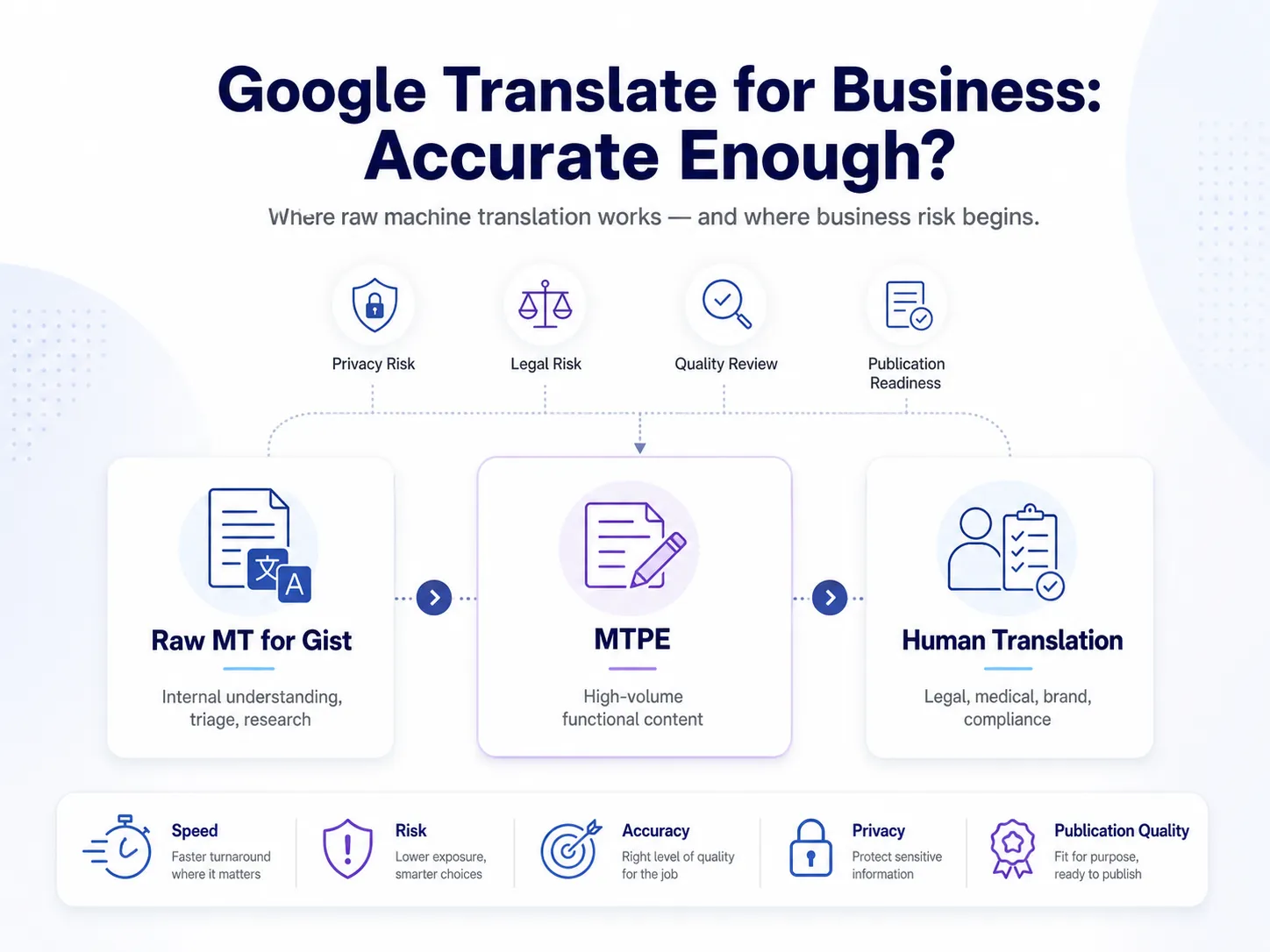
| Product descriptions | MTPE | Volume + efficiency |
| FAQs | MTPE | Functional only |
Translating everything as a full human is expensive. Translating everything as MTPE damages your brand. Match the tier to the job.
Step 5: Choose the Right APAC Partner — 8 Quick Checks
Use this as a buyer’s checklist:
- Native translators for each priority language? (Ask for CVs — Simplified Chinese, Japanese with keigo, Korean, Bahasa Indonesia, Northern Vietnamese)
- Script rendering for CJK, Thai, and right-to-left Urdu/Arabic — without garbled characters?
- Cultural adaptation flagged at brief stage — colours, platforms, taboos?
- Regulatory vocabulary for PMDA (Japan), NMPA (China), TGA (Australia), CDSCO (India), BPOM (Indonesia)?
- Simplified vs Traditional Chinese treated as separate languages? (If they offer one translator for both — red flag.)
- Translation memory and glossaries per language, owned by you?
- Digital platform formats — WeChat, Tmall, Shopee, Lazada, Naver?
- Time zone coverage — APAC spans 6.5 hours from India to New Zealand. Can they deliver in that window?
If a vendor can’t tick all 8, they’re not built for APAC.
Commission APAC Localization With Native-Language Expertise Across East Asia, Southeast Asia, South Asia, and Oceania
Asia-Pacific localization demands a partner who understands that China, Japan, Korea, and Indonesia each require native-language translators, specific cultural adaptation knowledge, and regulatory vocabulary competence.
Circle Translations delivers APAC translation programs built market by market, language by language.
Circle Translations delivers:
- 12+ APAC language pairs — Simplified Chinese, Traditional Chinese (separate from Simplified), Japanese, Korean, Bahasa Indonesia, Vietnamese, Thai, Hindi, Bengali, Tagalog, Bahasa Malay, Australian English localization
- Native-language APAC translators — verified L1 native speakers; not bilingual-only; Simplified Chinese and Traditional Chinese held in separate translator pools
- Keigo-competent Japanese translators — formal honorific language for B2B communications; PMDA and MHLW regulatory vocabulary for pharmaceutical and medical device content
- Cultural adaptation flagging — color symbolism, platform requirements, regulatory terminology, and quality-signal conventions identified at a brief stage per market
- Script rendering QA — CJK character encoding verified, Thai word boundary rendering, Vietnamese tone marks, and bidirectional text for Urdu and Arabic-script content
- Simplified vs Traditional Chinese — always treated as separate languages; separate native translators; separate vocabulary decisions; no cross-market recycling
- APAC regulatory vocabulary — NMPA (China), PMDA (Japan), TGA (Australia), BPOM (Indonesia), and MoHFW (India) regulatory submissions use authority-approved terminology
- TM and termbase per language pair — APAC-language TMs build fast on repetitive content; match discounts applied; client-owned and exportable
- MTPE for high-volume SEA content — native post-editors for Bahasa Indonesia, Vietnamese, and Thai at scale
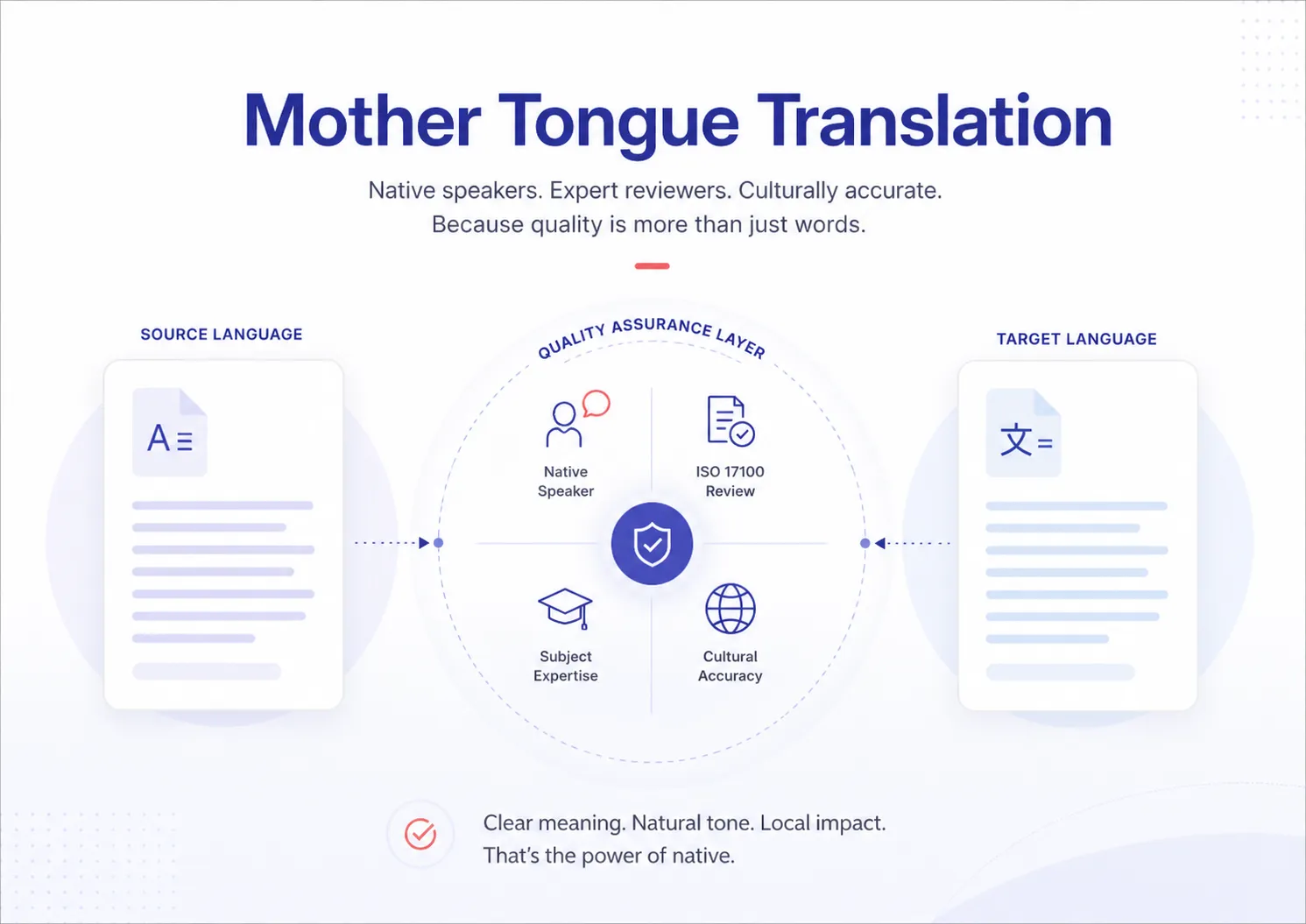
- ISO 17100 two-stage workflow — translator + independent native-language reviser on all APAC language pairs
- NDA as standard — APAC IP protection, particularly important for China market entry where IP is commercially sensitive
Tell us your target APAC markets, language pairs, content types, and timeline — we will provide a scoped APAC localization proposal within 1 business hour.
Get an APAC Localization Quote → View Translation and Localisation Services → View Language Coverage →
Frequently Asked Questions
What does APAC stand for?
APAC stands for Asia-Pacific, a business region covering East Asia, Southeast Asia, South Asia, and Oceania. It includes 15–25 countries, around 4.5 billion people, and 6 of the world’s 10 largest economies, typically managed from hubs like Singapore, Hong Kong, or Sydney.
Which APAC languages should a business prioritize first?
The top 4 APAC languages for B2B are Simplified Chinese, Japanese, Korean, and Bahasa Indonesia.
These 4 languages cover the world’s 2nd-largest economy (China), the 3rd-largest (Japan), an advanced digital market (South Korea), and the 4th-most populous country (Indonesia, with 284 million people).
Is Simplified Chinese the same as Traditional Chinese?
No. Simplified Chinese (zh-CN) is used in Mainland China and Singapore, while Traditional Chinese (zh-TW / zh-HK) is used in Taiwan and Hong Kong. They use different characters, different vocabulary for many modern terms, and operate under separate regulatory systems — which is why Circle Translations handles them as 2 separate language pairs.
What’s the difference between APAC and APEC?
APAC is a business region, while APEC is a trade organization. APAC (Asia-Pacific) covers East Asia, Southeast Asia, South Asia, and Oceania for corporate operations. APEC (Asia-Pacific Economic Cooperation) is a 21-member trade forum that also includes non-APAC countries like Canada, Chile, Mexico, Peru, and the USA.
What’s the biggest mistake companies make in APAC localization?
Treating APAC as one region. The 3 most common mistakes are merging Simplified and Traditional Chinese (they’re separate languages), merging Bahasa Indonesia and Bahasa Malaysia (different vocabulary, different markets), and using one “Asian” cultural template across East Asia, Southeast Asia, South Asia, and Oceania — regions with completely different cultures, colors, platforms, and trust signals. Each APAC market needs its own strategy.
How does APAC data protection law affect translation?
There is no single APAC data protection law. Each major APAC market has its own data privacy regulation, and each one requires privacy documents translated into the local language. China’s PIPL (Personal Information Protection Law) requires privacy notices in Simplified Chinese for users in Mainland China. Japan’s APPI (Act on the Protection of Personal Information) requires Japanese-language privacy notices for Japanese users.
Australia’s Privacy Act requires clear English privacy notices that comply with the Australian Privacy Principles. Singapore’s PDPA (Personal Data Protection Act) and India’s DPDP Act 2023 (Digital Personal Data Protection Act) impose additional translation obligations on Singaporean and Indian users. Compliance in any APAC market requires professional translation of privacy notices, consent forms, and data subject communications into the official language of that jurisdiction.