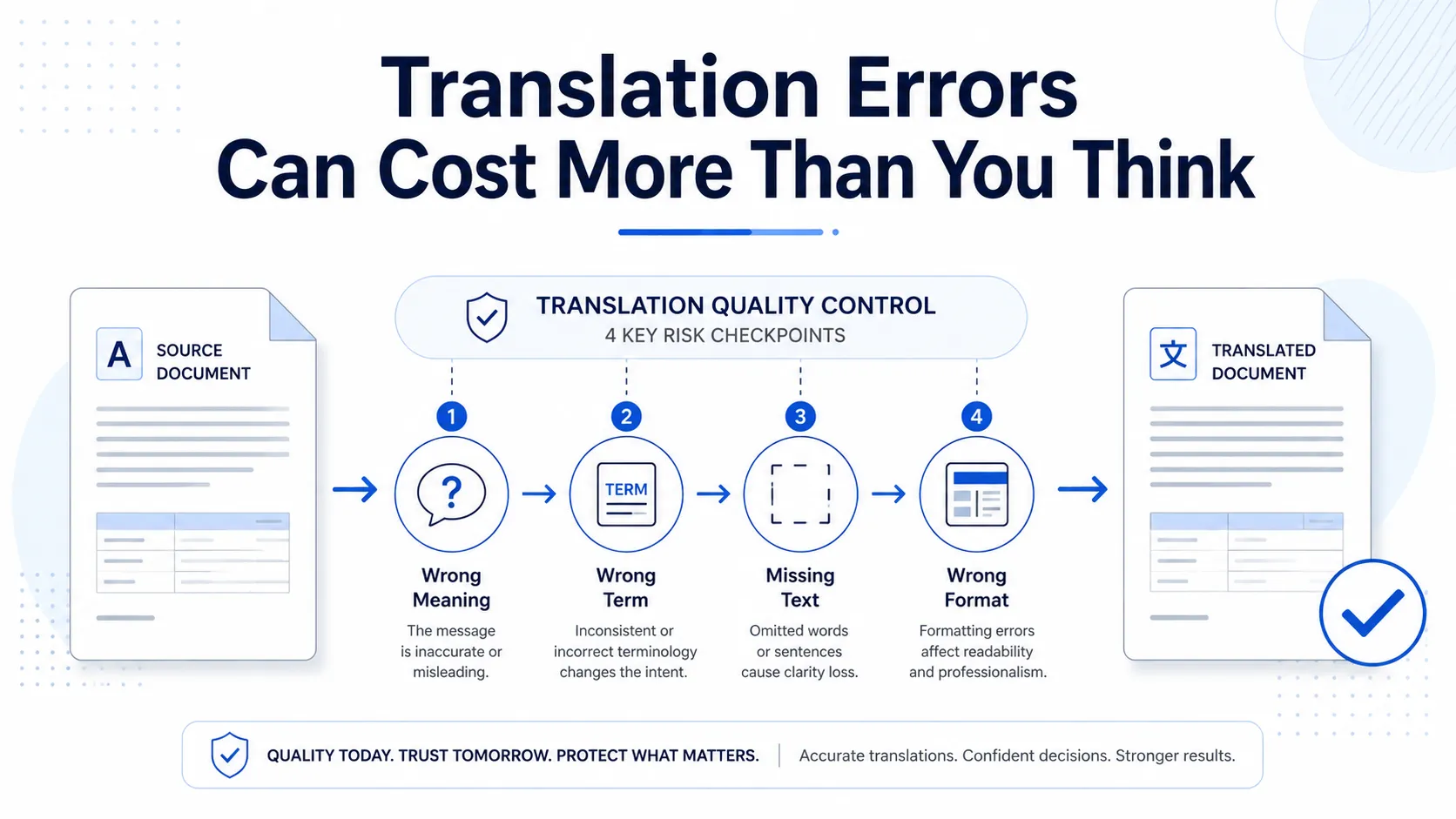
Translation errors in commercial, legal, and technical documents happen when a translation fails to accurately convey the source text’s meaning, terminology, register, or regulatory requirements. In B2B contexts, contracts, product labeling, regulatory submissions, marketing content, and technical documentation. Translation errors carry legal, financial, and reputational consequences ranging from contract disputes and regulatory rejections to product recalls and brand damage worth millions.
Translation errors are not academic curiosities. HSBC spent approximately €12 million rebranding after its “Assume Nothing” slogan was rendered as “Do Nothing” in several markets. A pharmaceutical company that submits a regulatory dossier containing a terminology error faces a health authority query letter and months of delay in submission. A supply contract with a mistranslated obligation clause creates enforceability risk that may only surface during a dispute, at which point the cost includes legal fees, lost commercial relationships, and the financial exposure of the misread clause itself.
Here, we cover four areas that procurement teams, legal counsel, regulatory affairs leads, and marketing managers need to understand before commissioning translation: the five-category classification system that defines translation quality; the root causes that produce translation errors even from qualified translators; the seven categories of economic consequence that translation errors create in B2B contexts; and the quality systems that reduce translation errors to commercially acceptable thresholds. Every section is anchored in commercial, legal, regulatory, and professional translation contexts.
Translation Error Classification: The Five Categories That Define Quality in Commercial Translation
Professional translation quality assessment uses a structured error typology. The MQM (Multidimensional Quality Metrics) framework, which classifies errors by type and severity. The MQM framework groups commercial translation errors into 5 categories: accuracy errors, fluency errors, terminology errors, locale convention errors, and register errors.
| Error Category | Definition | Commercial Impact | Severity Range | Examples in B2B Content |
|---|---|---|---|---|
| Accuracy errors | The target text does not correctly convey the meaning of the source text | High to critical — the translated document no longer says what the source says | Minor (slight meaning shift) to Critical (reversed meaning, safety risk) | Mistranslated contract clause reversing a liability limitation; omitted safety warning in a product manual; added qualifier that was not in the source |
| Fluency errors | The target text is grammatically incorrect, unnaturally phrased, or typographically wrong in the target language | Medium — affects credibility and professionalism; in regulated contexts (PIL readability testing) affects regulatory compliance | Minor (typo) to Major (unreadable sentence structure) | German contract with case agreement errors throughout; Polish PIL with missing diacritics (kat/kąt — “executioner” vs “angle”); French marketing copy that sounds translated |
| Terminology errors | A key term is translated incorrectly or inconsistently across a document | High — terminological inconsistency creates ambiguity in legal documents and regulatory non-compliance in pharmaceutical submissions | Major (inconsistent term) to Critical (wrong regulatory term) | Contract defined term rendered differently across sections; MedDRA Preferred Term replaced with clinical synonym in PSUR; INN translated using brand name |
| Locale convention errors | Target-language conventions for dates, numbers, currency, units, punctuation, or quotation marks are wrong | Medium — signals lack of cultural knowledge; creates data errors in tabular content; may affect regulatory compliance | Minor (wrong quotation marks) to Major (wrong decimal separator in financial tables) | German document using English decimal point (1.250 instead of 1,250); EU food label using FDA Reference Values; Japanese document with inconsistent honorific level |
| Register errors | The formality level, tone, or style of the translation does not match the intended audience and document purpose | High for brand and marketing content; Medium for most formal B2B content | Major for client-facing material | Legal contract in informal register; B2B email using incorrect formal/informal German address (Sie vs du); patient leaflet in technical medical register that patients cannot understand |
Why Mistranslation, Omission, and Addition Are the Most Commercially Dangerous Error Types
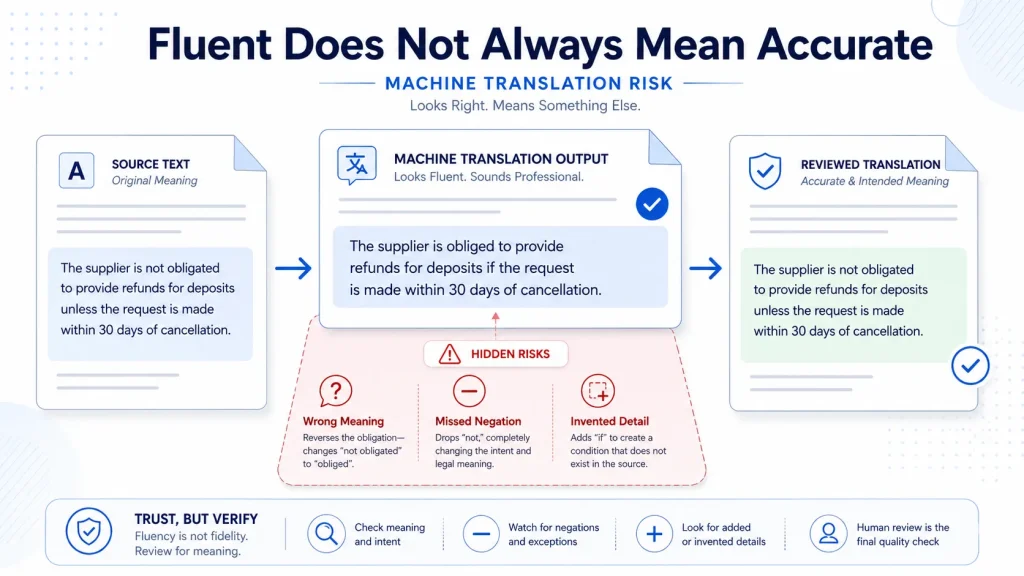
Accuracy errors are the most commercially consequential translation error category because they change what a document actually says, with potential legal, regulatory, safety, and financial consequences. Accuracy errors in B2B translation fall into 3 subtypes: mistranslation, omission, and addition.
Mistranslation
Mistranslation occurs when the source text’s meaning is incorrectly conveyed in the target text. Mistranslation ranges from subtle (a word choice that shifts emphasis) to catastrophic (a meaning reversal). The most dangerous commercial mistranslations are plausible-sounding ones. A reader who does not speak the source language cannot detect them. This is the “fluent but wrong” problem that neural machine translation has made more common: NMT produces output that sounds right in the target language but conveys a different meaning from the source.
Three documented mistranslation cases demonstrate the commercial range:
- HSBC’s “Assume Nothing” campaign slogan was rendered in several markets as “Do Nothing” — a mistranslation that required approximately €12 million in rebranding to correct.
- Coca-Cola’s early China market entry produced the brand name “Kekoukela” — a phonetic rendering that, in Chinese characters, roughly translates to “female horse stuffed with wax.” The brand damage was resolved only by finding a phonetically similar rendering with positive meaning.
- A pharmaceutical patient information leaflet containing a mistranslated dosage instruction (“twice daily” rendered as “twice weekly”) is a patient safety risk and a regulatory compliance failure simultaneously.
Omission
Omission occurs when required content is missing from the translation. Omission in legal documents produces an agreement that does not include the terms the parties intended. Omission of a safety warning in a product manual creates liability exposure. Omission of a mandatory allergen declaration from a food label is a regulatory compliance failure. The 4 most common causes of translation omissions are translator error, file format issues that drop content during import or export, automated QA tools not calibrated for completeness checking, and tight turnaround timelines that encourage skipping content.
Addition
Addition occurs when content not present in the source is added to the translation. Addition is less common than omission or mistranslation, but it creates accuracy problems when a translator adds an explanation or interpretation that was not authorized by the client, when a translator adds a qualifying clause to make an awkward source sentence more readable, or when automated term substitution tools insert content from the termbase incorrectly.
Terminology Errors: Why Inconsistent and Incorrect Technical Vocabulary Creates Legal and Regulatory Risk
Terminology errors are the most systematically preventable translation error category, and the category most directly addressed by professional quality infrastructure such as termbases, CAT tools, and QA tooling. In ordinary text, synonym variation is stylistically acceptable. In legal, pharmaceutical, regulatory, and technical documents, synonym variation creates ambiguity or non-compliance with direct commercial consequences.
Legal defined terms
A contract defines “Intellectual Property Rights” as a specific set of rights in a definitions clause. If a translator renders “Intellectual Property Rights” as “IP rights” in one section, “intellectual property” in another, and “intellectual and industrial property rights” in a third, three potentially different scopes have been created where the contract intends one. A dispute about a contract containing a terminological inconsistency leaves both parties arguing about which instance defines the actual obligation.
Pharmaceutical regulatory vocabulary
MedDRA (Medical Dictionary for Regulatory Activities) provides approved translations for Preferred Terms (PTs) and Lowest Level Terms (LLTs) in 11 official languages. A translator who renders the MedDRA PT “Chest discomfort” as “chest pain” (a clinical synonym) in a Periodic Safety Update Report codes the adverse event to a different MedDRA PT — affecting signal detection in pharmacovigilance. Regulatory vocabulary requires the approved authority-mandated term, not a clinically equivalent synonym.
Regulatory boilerplate phrases
EU food labeling under the FIC Regulation and pharmaceutical product information under the EMA QRD templates have authorized translations for standard phrases in all EU official languages. A translator who freely translates a QRD-authorized phrase instead of applying the approved equivalent creates a regulatory compliance failure that generates a health authority query during marketing authorization review.
Register and Locale Convention Errors
Register and locale convention errors are the translation quality failures that do not change the factual content of a document but undermine its credibility and appropriateness for the intended audience.
Register errors in commercial translation
Register refers to the level of formality, tone, and stylistic conventions appropriate for a specific document type and audience. Register errors occur when a translation’s tone is wrong for its context — a formal legal document rendered in conversational language; a consumer-facing health leaflet written in specialist medical register; an informal B2C marketing campaign translated in stiff, formal prose.
Three commercial examples demonstrate the register problem:
- German B2B email communications: German business correspondence uses the formal “Sie” register (third-person with a capital S — equivalent to the formal French “vous”). A German-market business communication translated using the informal “du” register signals cultural ignorance and undermines the professional relationship.
- Japanese keigo: Japanese B2B communications require the correct honorific register (sonkeigo for elevating the customer or partner; kenjōgo for lowering oneself). A translated Japanese business letter using casual language is as jarring to a Japanese business reader as a cold sales pitch addressing the recipient by first name would be to a British managing director.
- Consumer health communications: EU FIC Article 59 and GDPR Article 7 require that patient information leaflets and privacy notices be written in clear, plain language. A patient information leaflet translated into a technically accurate but specialist medical register may fail the EU plain-language readability test even though it contains no factual errors.
Locale convention errors
Locale conventions are the formatting rules that vary by language and market — date formats, decimal separators, number grouping, quotation mark styles, and currency formatting. These are not trivial style preferences. Locale convention errors in commercial documents change the meaning of a number (“1.000” in German means one thousand; in English it means one with three decimal places), create regulatory non-compliance (an EU food label translated for the US market using EU Reference Intake values instead of FDA Daily Values is a labelling violation), and damage professional credibility (wrong quotation mark conventions, incorrect date formats, and inconsistent currency symbol placement are immediately visible quality signals to native readers).
Why Even Qualified Translators Produce Poor Quality
Understanding the root causes of translation errors is more commercially valuable than cataloging error types — because root causes are what B2B buyers can verify and what quality workflows address. There are 8 documented root causes that produce translation errors in commercial projects.
| Root Cause | Errors Produced | How Common | Detectable by Buyer | Prevention Mechanism |
|---|---|---|---|---|
| Lack of subject-matter expertise | Terminology errors; accuracy errors on domain content | Common — translation marketplaces match by language pair without domain verification | Ask for translator CV and domain credentials | Subject-matter competence verification per ISO 17100; specialist translator assignment by document type |
| Non-native target translation | Fluency errors; register errors; cultural blind spots | Common in cost-cutting procurement | Ask which language is the translator’s native language | Native-language target translation (mother tongue principle) |
| No independent revision | All error types undetected and delivered | Very common for freelance and low-cost vendors | Ask whether ISO 17100 two-stage workflow is applied | Specify ISO 17100 in the contract; require named translator and reviser |
| No termbase or glossary | Terminology inconsistency errors | Very common — most freelancers and many agencies work without client-specific termbases | Ask whether a termbase is maintained; request to see one for an existing programme | Termbase construction at programme start; verify CAT tool integration |
| Ambiguous or poor source text | Accuracy errors from incorrect ambiguity resolution | Common — poor English source quality is a major root cause | Review source text quality before commissioning | Source text review step before translation begins; translator flagging of ambiguous segments |
| Tight turnaround and volume pressure | All error types — quality shortcuts under time pressure | Common in ad-hoc rush projects | Ask whether rush projects use the same workflow as standard projects | Pre-agreed rush workflow that maintains ISO 17100 even for expedited delivery |
| Machine translation without professional review | All error types, especially fluent-but-wrong accuracy errors | Very common — particularly free-tool MT used by in-house teams | Ask whether MT is used and at what quality tier | No raw MT for publication content; MTPE with ISO 17100 QA for MT-assisted content |
| Lack of contextual information | Accuracy errors from context-blind translation | Very common — many projects delivered as text strings without context | Provide context (screenshots, style guide, sample content) at brief stage | Context provision checklist in project brief; annotated translation style guide |
Source Text Problems
One of the most overlooked root causes of translation errors is not the translator — it is the source text. Ambiguous, inconsistent, or poorly written source content produces downstream translation errors regardless of the translator’s skill, because a translator cannot accurately translate meaning that the source has not clearly expressed. There are 5 source text problems most likely to produce translation errors in B2B content.
Problem 1 — Ambiguous pronouns and referents
English tolerates ambiguous pronoun reference more than many other languages. “The client contacted the supplier and asked them to confirm” — “them” is ambiguous in English and could refer to either party. In German, the noun’s grammatical gender determines pronoun gender; in French, the pronoun form varies by gender. A translator must resolve the ambiguity to produce a grammatically correct target-language sentence. Different translators may resolve the same ambiguity differently, creating inconsistent translations across a multilingual program.
Problem 2 — Inconsistent terminology in the source
If the source text uses “client,” “customer,” “purchaser,” and “buyer” interchangeably for the same contracting party, a translator must decide whether to use one consistent target-language term or to mirror the source inconsistency. The correct decision depends on whether the variation is intentional (the source intends different legal meanings) or accidental (the source is poorly edited). Without guidance, translators make their own decisions, which may not align with the client’s intent.
Problem 3 — Cultural references that do not translate
A marketing email that opens “As we head into the bank holiday weekend…” references a British cultural institution that does not exist in Germany, France, or Japan. A translator who renders this literally produces content that confuses target-language readers; a translator who adapts it creatively performs transcreation without a brief. Source content containing British or US cultural references requires a transcreation brief if it is to be localised effectively.
Problem 4 — Long, complex sentence structures
Very long source sentences (common in legal drafting and technical documentation) create accuracy risk in translation. A 120-word legal sentence with multiple subclauses, a double negation, and a conditional has more surfaces for accuracy error than a 25-word simple sentence conveying the same information. The translator must correctly identify all clause relationships, conditional structures, and negation markers in the complex sentence — every additional clause increases the probability of a meaning shift in the target.
Problem 5 — Undefined abbreviations and acronyms
If the source text uses undefined abbreviations, the translator must either guess or research their meanings. A translator who researches and correctly guesses produces an accurate translation; one who guesses incorrectly produces a terminology error. Providing a glossary of all defined terms, abbreviations, and acronyms as part of the project brief is one of the highest-ROI quality improvement actions available to B2B translation buyers.
Machine Translation Errors
Machine translation errors have a distinct profile from human translation errors — and understanding the specific patterns helps B2B buyers calibrate when MT output is and is not acceptable for professional use. 5 MT-specific error patterns are documented in commercial content.
The fluent-but-wrong accuracy error
Neural machine translation (NMT) produces output that sounds grammatically correct in the target language. This is its primary advantage over older MT approaches — and its primary danger. NMT can produce a semantically incorrect translation that reads naturally to a native speaker who does not know the source language. Unlike a grammar error (visible to any competent native reader) or a known false cognate (identifiable by a language professional), an NMT fluent-but-wrong error may only be detectable by someone who reads both source and target with domain expertise. For legal, pharmaceutical, and technical content, this means errors can pass through internal review and reach their intended audience undetected.
Hallucinated specifics
NMT systems occasionally generate content that was not in the source — a term, a number, or a proper noun that the model fills in based on statistical probability rather than the actual source text. For product descriptions and general content, this is a minor quality annoyance. For pharmaceutical dosage instructions, engineering specifications, or financial data, an invented specific is a critical error.
Negation errors
MT systems can misplace or drop negation markers in complex conditional structures. “The Purchaser shall not be liable for…” becoming “The Purchaser shall be liable for…” in MT output is a plausible error — one that reverses a liability limitation clause without any visible grammatical problem in the target text.
Pronoun inconsistency in long documents
MT processes content in segments, typically sentence by sentence. In a long document, pronoun reference (he/she/it/they; formal or informal address) may be inconsistent across segment boundaries. In German, where all nouns have grammatical gender, pronoun inconsistency across segments creates errors that a native reader notices immediately.
MT handling of cultural and idiomatic content
MT has no cultural knowledge. Idiomatic expressions, cultural references, and marketing wordplay are processed as literal text and rendered in the target language according to statistical probability — not cultural resonance. The output often sounds technically correct but culturally empty or absurd.
Circle Translations applies 4 controls that mitigate MT risk:
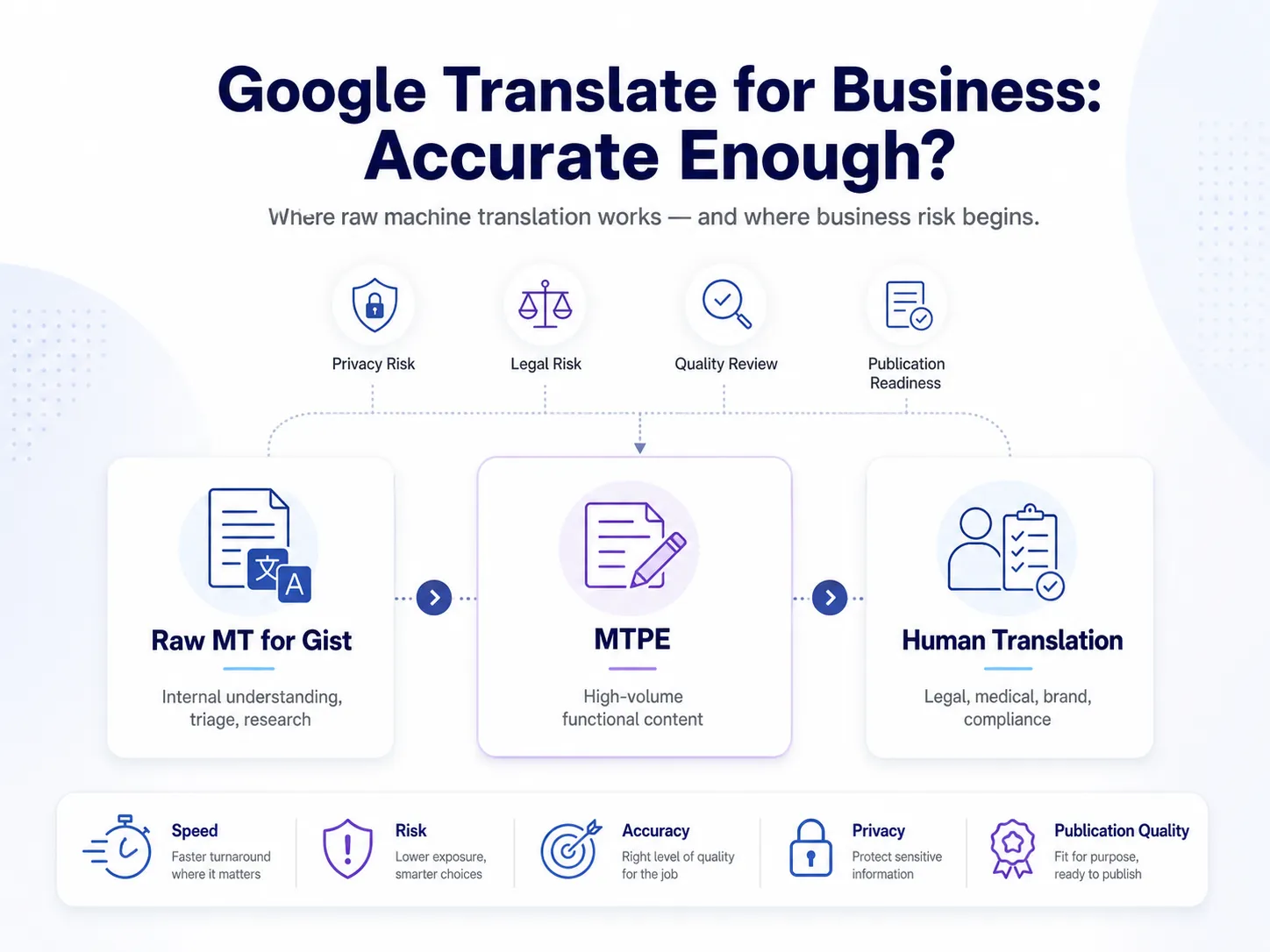
- No raw MT output is delivered for any content that will be published, filed with a regulatory authority, submitted to an external party, or used in legal proceedings.
- MTPE (machine translation with professional post-editing by a native-language expert) is reserved for qualifying high-volume functional content such as product descriptions, FAQ, and internal documentation.
- All MTPE output passes through the same automated QA (Xbench/Verifika) and human revision pass as full human translation.
- Enterprise MT engine only, no free-tool MT for client content; NDA and DPA protection as standard.
Financial Losses of Translation Errors in Business
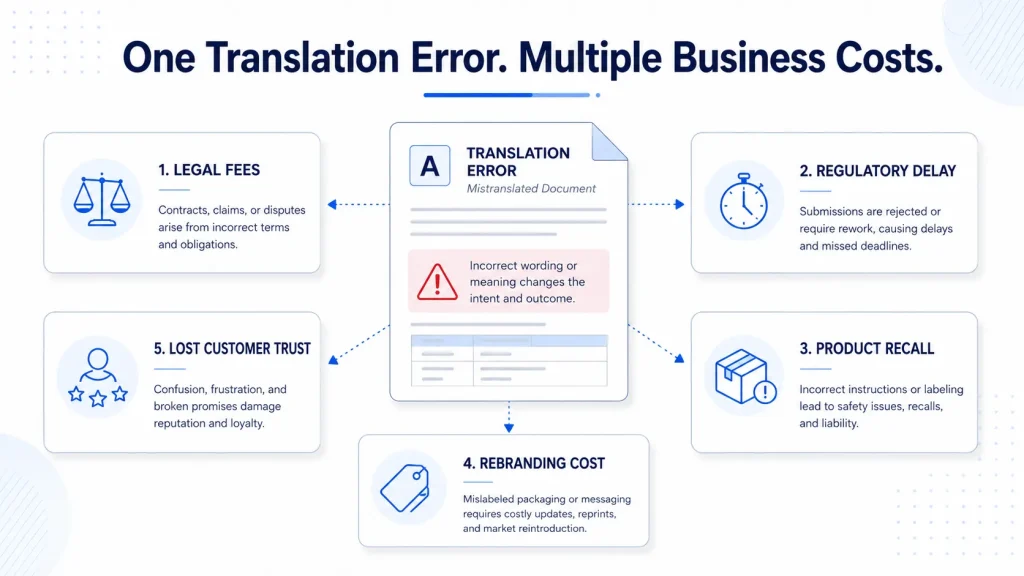
The economic consequences of translation errors in B2B contexts are rarely discussed with the specificity they deserve. Most organizations only discover the cost when something goes wrong. Translation errors result in 7 categories of economic consequences in commercial contexts.
1. Direct financial loss from contract misinterpretation
A poorly translated supply chain contract may contain pricing, delivery, or penalty clauses that the parties understand differently because the translation of the key clause is ambiguous or incorrect. The economic consequences only materialize when a dispute arises, at which point the costs include legal fees, potential litigation, and the commercial damage a dispute causes. A single mistranslated pricing clause in a multi-million-pound supply contract can create a liability many times the original translation cost.
2. Regulatory rejection and resubmission costs
For pharmaceutical, medical device, and food manufacturers seeking market authorization in new markets, a translation error in a regulatory submission generates a health authority query letter and a resubmission requirement. Market entry delay measured in months — at the cost of daily lost sales from a product that is approved but cannot be sold — dwarfs any translation cost. A pharmaceutical product with a daily sales potential of £100,000 facing a 3-month approval delay due to a translation terminology error represents £9 million in delayed revenue.
3. Product recall and market withdrawal costs
A mistranslated allergen declaration on a food label, or an incorrect dosage instruction in a pharmaceutical product insert, can trigger a regulatory recall. Direct recall costs include logistics of retrieving stock, disposal cost, replacement product cost, regulatory investigation compliance cost, and potentially class-action liability from consumers harmed by the error. FSANZ (Australia and New Zealand) and FDA recall costs commonly run into millions per event.
4. Rebranding costs
The HSBC “Assume Nothing” to “Do Nothing” mistranslation required approximately €12 million in rebranding to correct. Schweppes “Tonic Water” rendered as “Toilet Water” in Italy required rapid market intervention. Coca-Cola’s early China entry required a brand rebuild. These are large brand incidents — but the same pattern occurs at smaller scale for every company whose translated brand name, campaign slogan, or product name is poorly adapted for a new market.
5. Customer trust and conversion loss
Research consistently shows that native-language readers detect “sounds translated” content and respond with reduced confidence in the brand. CSA Research found that 76% of consumers prefer to buy in their native language; a poorly translated website or product description may be technically understandable but still suppress conversion compared with a professionally localised equivalent. The economic consequence is measurable in conversion-rate data but rarely attributed to translation quality.
6. Legal liability from mistranslated employment or compliance documents
An employment contract with a mistranslated obligation clause, or a GDPR privacy notice in incorrect Polish that fails the “clear and plain language” standard, creates legal liability exposure. The cost is the legal exposure — not just the retranslation cost.
7. Opportunity cost from delayed market entry
Every week that a product lacks a translation-complete, regulatory-compliant version for a target market is a week of zero revenue from that market. The opportunity cost of translation errors — delays caused by rework, regulatory resubmission, or brand repair — is typically the largest single economic consequence and the hardest to quantify in advance.
How to Prevent Translation Errors
Translation errors will never drop to zero — but with the right process in place, they stay well below the level that causes commercial damage. Here are 6 things that make the difference.
- Build a termbase, and enforce it. Your preferred terms, forbidden terms, and regulatory vocabulary should be locked into the translation tool from day one. That way, the translator sees the right term as they type — and the wrong one gets flagged before the file is even delivered.
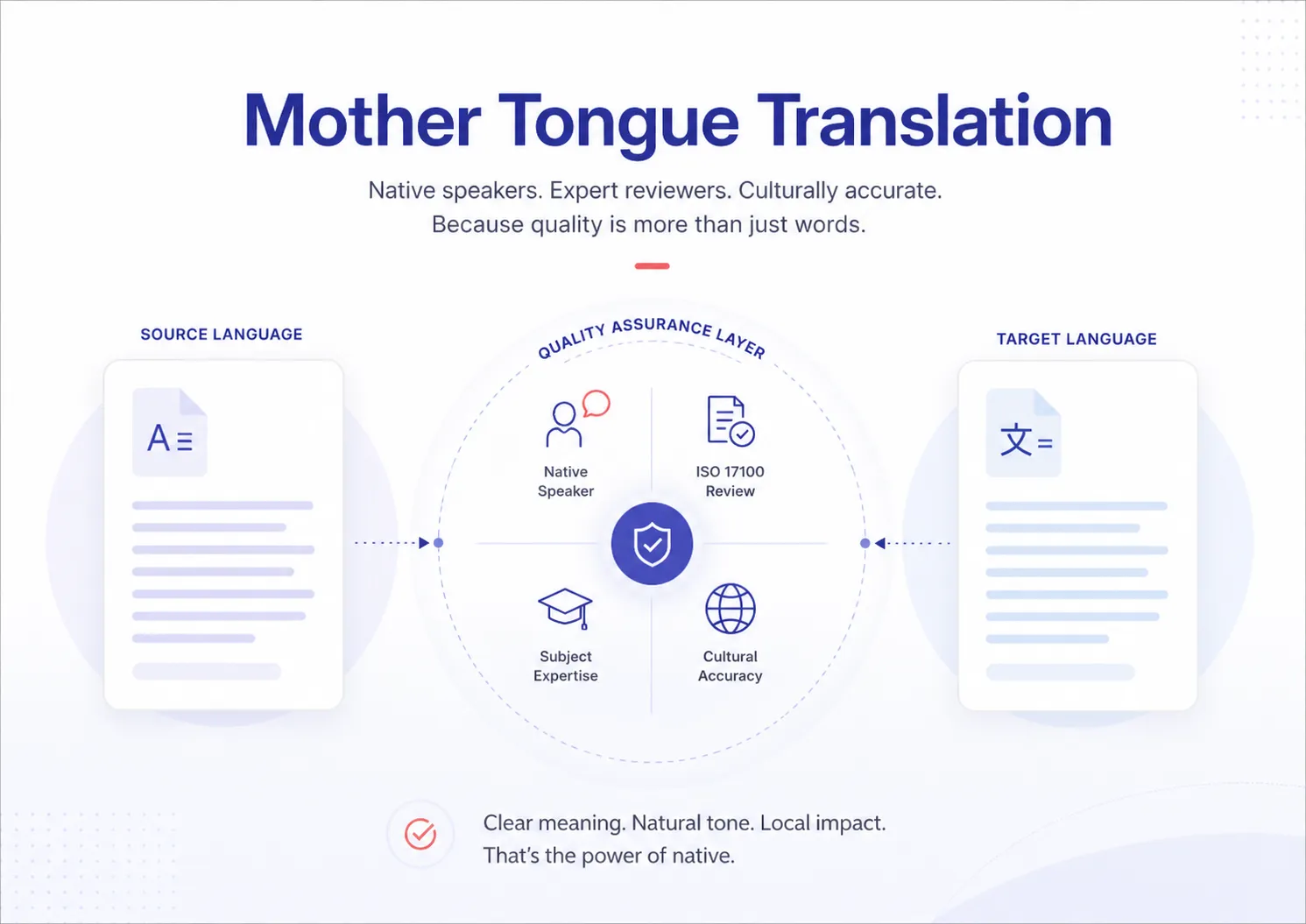
- Use two translators, not one. ISO 17100 calls this a “two-stage workflow.” In plain English: one native-language translator writes the translation, and a second qualified translator reviews it. The second pair of eyes catches what the first one missed — every time.
- Run automated QA on every delivery. Tools like Xbench and Verifika check for the small stuff that human eyes often miss: missing segments, incorrect numbers, broken tags, and terminology slips. It takes minutes and catches issues that would otherwise reach your inbox.
- Review the source text before translating it. If the English is ambiguous, the translation will be too. A quick review flags unclear pronouns, undefined abbreviations, and idioms that won’t travel. So they get sorted before they cause downstream errors.
- Give translators a style guide. Your brand has a voice. Your translators need to know what it sounds like in every language they work in — tone, formality, preferred words, things to avoid. Without a guide, every translator makes their own call, and consistency suffers.
- Agree on a quality threshold upfront. Write the standard into the contract. Something like “zero critical errors, no more than 2 major errors per 1,000 words.” Now quality is measurable, not a promise, but a number both sides can check.
How Circle Translations’ QA Workflow Prevents Each Category of Translation Error
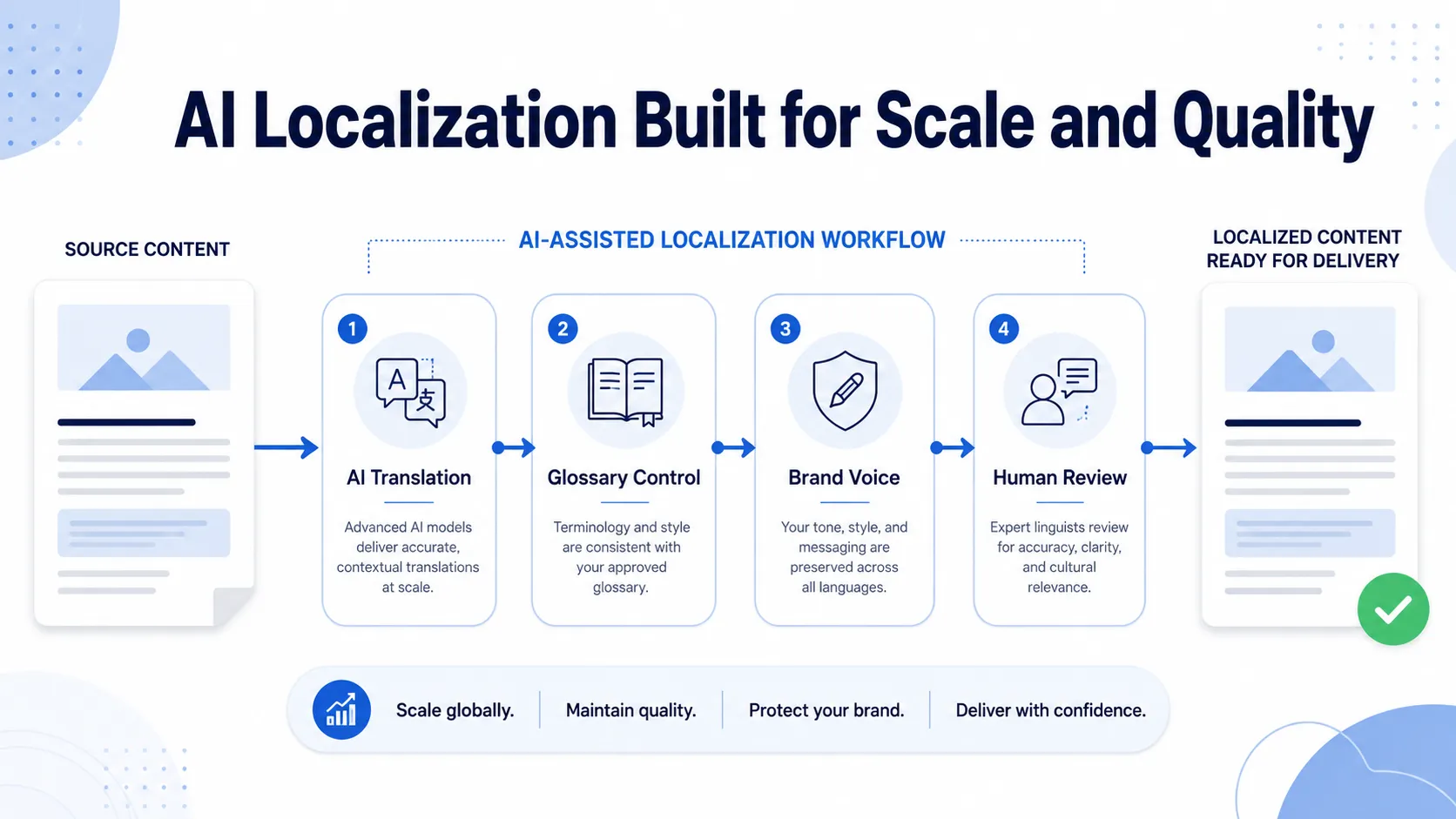
Instead of telling you we deliver “high-quality translation,” here’s how we actually stop errors from reaching you. We build a client-specific termbase and plug it into the translation tool, so the right terms appear as translators type and the wrong ones get flagged before delivery. Every translation goes through a second native-speaker translator who checks every segment against the source — that second pair of eyes isn’t optional.
For high-risk content like clinical trial instruments, we add back-translation. Automated checks catch the small stuff: missing segments, wrong number formats, broken locale conventions. And after every project, your feedback feeds back into the termbase and style guide, so the next job sounds even more like you.
Summary
Every translation error in this guide comes back to the same thing: a gap in the process. Close the gaps, and the errors stop reaching your audience.
That’s what we do at Circle Translations. Two native-speaker translators on every commercial project — one to translate, one to review. A client-owned termbase that locks your preferred and forbidden terms into the tool before work starts. The source text is reviewed for ambiguity before a single word is translated. Automated QA on every delivery. No raw machine translation for anything that gets published, filed with a regulator, or used in court. NDA in place before we receive your files.
Tell us your content type, language pairs, and quality requirements. We’ll confirm the right quality tier and send you an accurate quote within one business hour.
Get a Quality Translation Quote →
Frequently Asked Questions
What is a translation error in a business context?
It’s any failure to accurately convey the source meaning, use the right terminology, match the correct register, or follow the target market’s formatting conventions. Errors range from minor slips to critical mistakes, like a mistranslated contract clause with legal, financial, or safety consequences.
What are the most common types of translation errors in commercial documents?
There are 5 main categories: accuracy errors (wrong meaning), terminology errors (inconsistent technical vocabulary), fluency errors (grammar and phrasing), register errors (wrong tone or formality), and locale errors (incorrect number, date, or punctuation conventions).
How much can translation errors cost a business?
Costs vary widely. HSBC spent around €12 million rebranding after a slogan mistranslation, and a pharmaceutical product delayed by 3 months due to a regulatory translation error can lose £9 million in revenue at £100,000 in daily sales.
What is the difference between a translation error and a translation quality issue?
A translation error is a specific mistake. A wrong term or an omitted clause. A quality issue is broader and includes fitness-for-purpose problems, like a technically accurate translation written in the wrong register for its audience.
Can ISO 17100 certification guarantee zero translation errors?
No, but it significantly reduces them by requiring a two-stage workflow, qualified translators, and documented quality processes. The standard defines the framework; the output still depends on translator skill, termbase quality, and QA tooling.
How does machine translation produce different errors from human translation?
The most dangerous MT error is the “fluent but wrong” output. Grammatically correct text that conveys a different meaning from the source. MT also invents numbers and terms, drops negations, and loses pronoun consistency across long documents.
What is the MQM framework for translation error assessment?
MQM (Multidimensional Quality Metrics) is the standard framework for measuring translation quality. It classifies errors by category and severity, scored per 1,000 source words. A typical B2B threshold is 0 critical errors and ≤2 major errors per 1,000 words.
What should I do if I receive a translation that contains errors?
Document each error with the source, the incorrect target, and the correct version, then send it to your agency for correction. A professional agency fixes in-scope errors at no charge and updates the termbase to prevent repeats.
Are translation errors more common in legal or technical translation?
Both carry high risk for different reasons. Legal errors are usually terminology and register problems; technical errors are usually vocabulary, completeness, and locale issues. Both need specialist translators, not generalists.