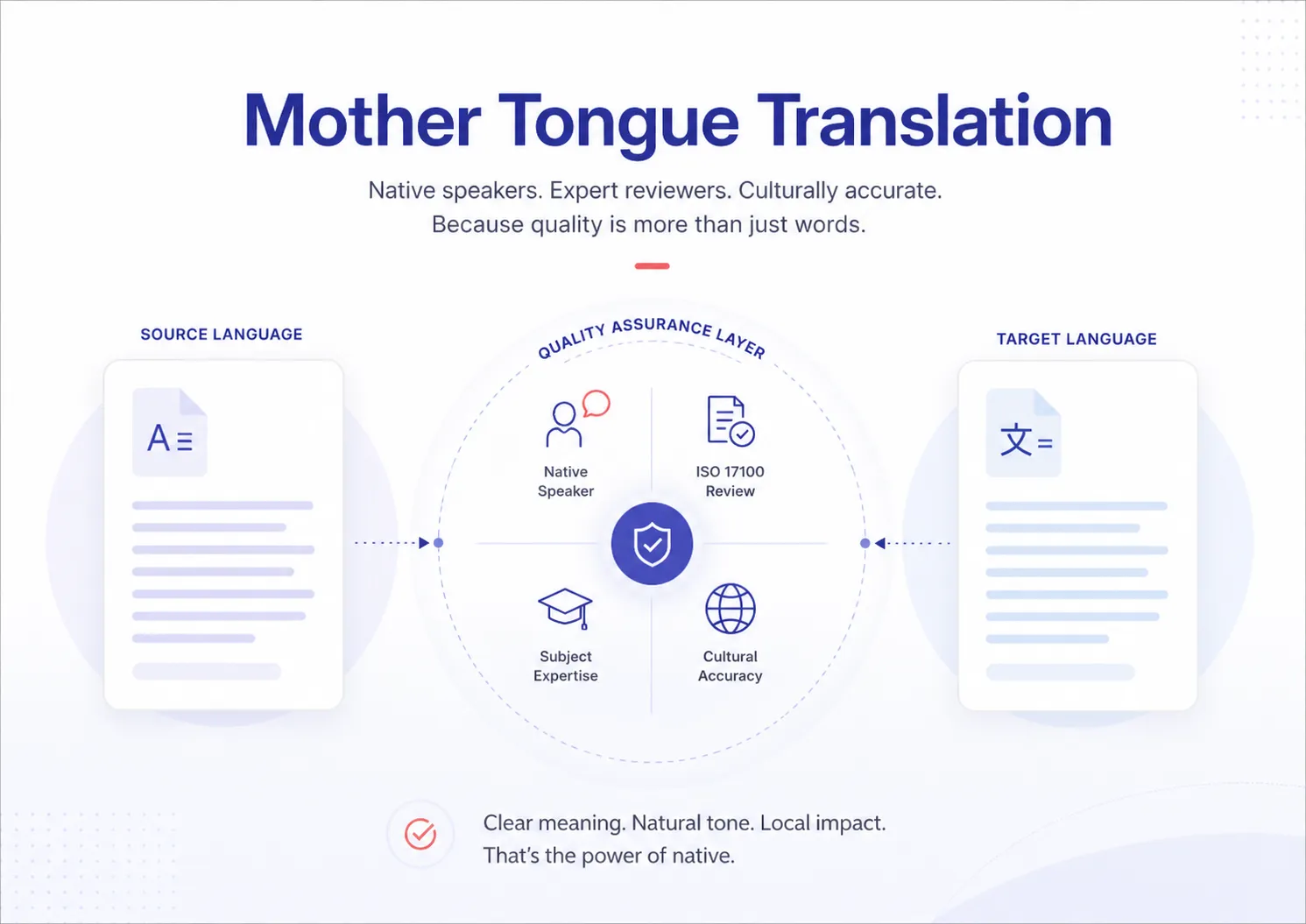
You may think, what’s the difference between mother tongue translation and normal translation? It sounds almost the same, right? But mother tongue translation means translating content into the translator’s native language, the language they grew up speaking, thinking in, and acquired naturally from childhood.
The mother tongue principle holds that translators should always work into their native language as the target, not out of it. This rule is the professional standard for commercial B2B translation because native speakers have an intuitive command of idiom, register, and cultural resonance that second-language proficiency cannot fully replicate.
Our native-language translators have the standard for all client-facing production translation. The target-language translator must be a native speaker of the target language. This is a minimum quality requirement, it’s not our marketing claim—and it is combined with subject-matter competence verification and a documented ISO 17100 quality process.
What Mother Tongue Translation Means and How It’s Defined in Professional Standards
The mother tongue principle has a detailed professional definition, and understanding it helps B2B buyers evaluate what translation agencies actually mean when they claim to use “native speakers.”
How Mother Tongue Translation Is Defined in Professional Standards
| Standard / Organisation | How Native-Language Competence Is Defined | Relevance to B2B Buyers |
| ISO 17100:2015 | Requires translators to have “competence in the target language” as a minimum qualification element; specifically notes that translation “into the target language” (typically the translator’s native language) is the professional standard | ISO 17100 compliance requires native-language target competence; B2B buyers can specify ISO 17100 in contracts to enforce this |
| FIT (International Federation of Translators) | FIT’s model curriculum states translators should translate primarily into their A-language (mother tongue or language of equivalent native-level competence) | FIT model is the basis for most university-level translator training programmes |
| ATA (American Translators Association) | ATA certification exams test translation into the candidate’s dominant language—typically (but not exclusively) their mother tongue | ATA certification is a credible quality indicator; the ATA’s published debate on the mother tongue principle introduces useful nuance |
| EU DGT (Directorate-General for Translation) | DGT translators work exclusively into their mother tongue; this is a defining requirement of EU institutional translation | For companies translating EU-regulatory content, DGT-standard translation = native-language target translation |
| ISO 17100 “Subject-matter competence” | Beyond language competence, ISO 17100 requires translators to demonstrate competence in the subject matter of the content—legal, medical, technical, etc. | Native language alone is not sufficient under ISO 17100—it must be combined with domain expertise |
What It Means to Be a Native Speaker: L1, L2, and Language Competence
The meaning of “native speaker” is more detailed than common usage suggests—and understanding the spectrum of language competence helps the buyers evaluate translation quality claims more accurately.
L1—First language (mother tongue):
L1 is the language people learn naturally in early childhood through immersion, hearing it spoken by parents and caregivers. Absorbing its grammatical patterns before they can be consciously described. It is developing native-level phonological, morphological, and pragmatic intuition. L1 speakers have what linguists call “implicit knowledge” of the language, an automatic, intuitive command that does not require conscious rule application.
L2—Second language (learned language):
L2 is a language learned after L1 acquisition. People learn it typically in formal education settings. Even very high-level L2 speakers (C2 on the Common European Framework of Reference for Languages—”Mastery” level) typically retain some characteristics that distinguish them from true L1 speakers:
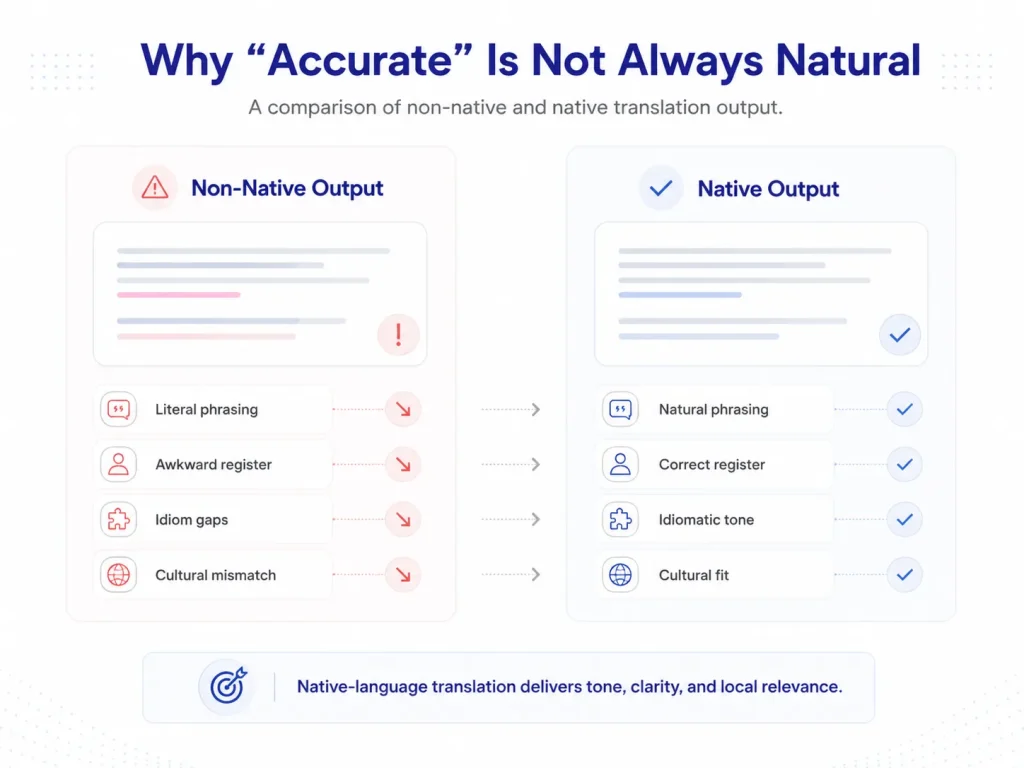
Idiom gaps: Very high-level L2 speakers may use idioms correctly but have fewer idiomatic options. They know the common expressions but may miss the subtler, more contextually precise alternatives.
Register blind spots: L2 speakers may apply register rules correctly in general but miss the subtle register signals that mark, say, a slightly too formal legal formulation or an advertising headline that would sound slightly “off” to native readers.
Reduced creative range: In creative writing, transcreation, and marketing copy, L2 speakers tend to have a narrower active vocabulary than L1 speakers. They can recognise a wider range than they actively produce.
Bilingual and heritage speaker competence:
Some individuals grow up bilingual from birth. They acquired two L1 languages simultaneously. True simultaneous bilinguals have native-level competence in both languages and can translate in either direction at L1 quality. Heritage speakers (individuals who grew up in a diaspora community speaking a heritage language at home and the dominant community language at school) have partial L1 competence. It is basically strong in informal contexts. Generally weaker in formal, technical, or literary registers. Heritage speakers need careful evaluation for professional translation work.
Why Professionals Translate Into Their Native Language
The mother tongue rule is translating into the target language rather than out of the source. It is not simply a convention. It reflects a well-understood asymmetry in language competence that has direct practical consequences for translation quality.
The source of the asymmetry—reception vs production:
Language competence has two parts: understanding (receptive) and producing natural output (productive). Professional translators can understand a second language very well, but writing naturally in it is much harder, even highly skilled non-native speakers produce text that native readers recognise as slightly “off.”
This is why translators work INTO their native language FROM a foreign source. A German translator reads English accurately and writes German naturally, leveraging strength in both directions.
Example of what “sounds translated” means:
A B2B buyer reviewing a translated website often says “it sounds translated” without being able to specify exactly what is wrong. The symptoms:
- Word order that follows the source language’s logic rather than the target language’s natural pattern
- Sentence length and rhythm that doesn’t match the register conventions of the target language’s business writing
- Prepositional choices that are technically correct but not idiomatic (e.g., German “in bezug auf” where a native speaker would write “was X betrifft”)
- Metaphors and fixed expressions that are literal translations of English idioms rather than the natural target-language equivalent
- Titles and headings that are accurately translated but have less energy than native-language copywriting equivalents
These are all symptoms of translation-out-of-the-target-language—content produced by someone who understood the source well but produced the target in their non-native language.
The ATA’s Challenge to the Mother Tongue Principle—and What It Means the Buyers
The American Translators Association (ATA) challenges the idea that native speaker status alone guarantees quality. Their argument: language competence is a spectrum, not a binary. Some native speakers are poor writers. Some highly proficient non-natives (who lived in a country for years or studied there) produce output indistinguishable from native quality.
When the principle doesn’t apply universally:
Rare languages: When few translators exist, a proficient non-native may be the best option.
Bilingual translators: Near-native speakers in both languages excel in both directions, especially in related pairs (Spanish-Portuguese; Danish-Norwegian).
Technical content: A bilingual engineer may outperform a native translator with no engineering knowledge—precision matters more than idiom.
The practical standard for B2B buyers:
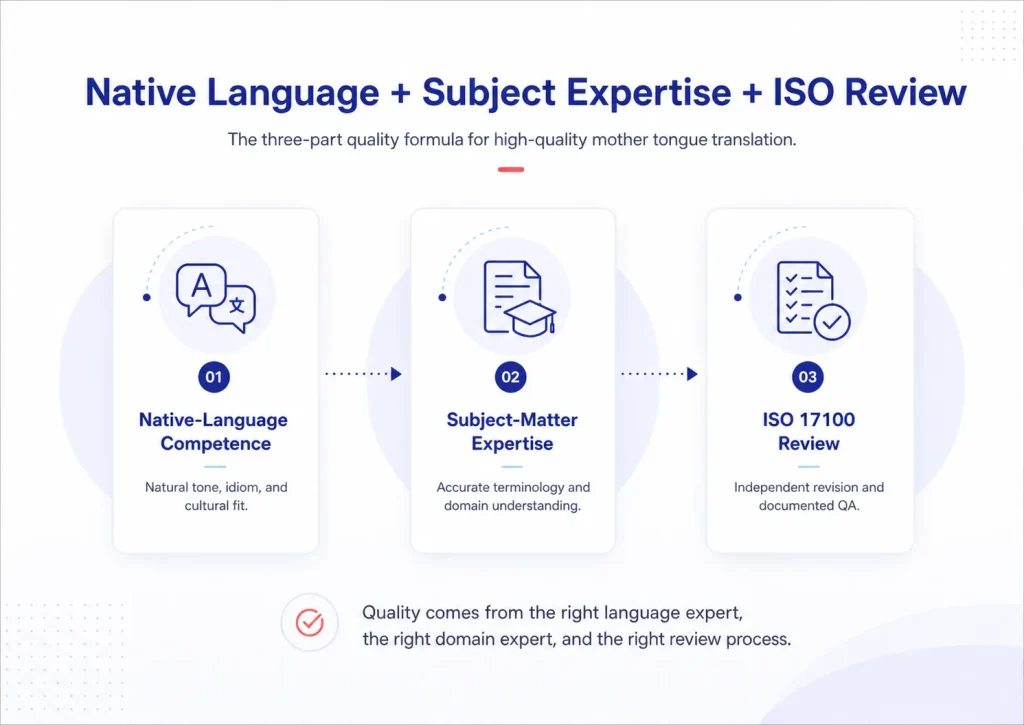
The ATA’s position refines the principle rather than undermining it. Quality requires three elements: native-language competence PLUS subject-matter expertise PLUS documented quality process (ISO 17100 revision; termbase; style guide).
Native language alone isn’t enough. A native speaker without domain knowledge produces natural but inaccurate output. A subject expert without native competence produces accurate but unnatural output.
When Native-Language Translation Is Essential vs. Preferred
The commercial consequence of non-native translation varies significantly by content type. Some content types are severely damaged by non-native production; others are less sensitive.
Native-Language Translation Requirements by Content Type
| Content Type | Native Language Requirement | Consequence of Non-Native Production | B2B Examples |
| Legal contracts and agreements | CRITICAL | Unenforceable or ambiguous clauses; register fails legal standard; defined terms inconsistently applied | Commercial contracts; employment agreements; NDAs; JV agreements |
| Marketing and brand communications | CRITICAL | “Sounds translated”; brand voice damage; reduced conversion; cultural tone deaf | Campaign headlines; website copy; product descriptions; email campaigns |
| Patient Information Leaflets (PILs) / consumer-facing regulatory docs | CRITICAL | Fails EU FIC/GDPR plain language requirement; readability testing failure; regulatory rejection | Drug labelling; food label translations; GDPR notices |
| Transcreation content | CRITICAL | The fundamental purpose of transcreation (native creative resonance) is unachievable without native-language production | Campaign taglines; brand stories; emotional marketing copy |
| Technical documentation sold to native-speaker end users | STRONGLY PREFERRED | “Sounds translated”; user frustration; support costs | CE marking instructions; product manuals for consumer products |
| HR and employment communications | CRITICAL | Legal register failures; unnatural tone damages employer-employee relationship | Employee handbooks; redundancy notices; performance review documentation |
| Clinical trial documents (patient-facing) | CRITICAL | ICF plain-language failures; patient comprehension issues; ethics committee rejection | Informed consent forms; patient diaries; study participant materials |
| Scientific and technical peer exchange (internal B2B) | Strongly Preferred | Reduced precision; colleagues notice awkwardness; may affect scientific credibility | Research reports; internal technical briefings between expert parties |
| High-volume functional eCommerce (product descriptions) | Strongly Preferred | Generic output suppresses conversion; catalogue inconsistency accumulates | Fashion PDPs; product catalogue entries |
Why different Niche Need Mother Tongue Translation:
Every industry needs content to promote their industry or some other purposes. Because of those reasons they need mother tongue translations. Let’s learn some of the common industry content that frequently needs translations.
Brand Voice and Marketing Translation: Why Non-Native Copy Damages Conversion and Credibility
Brand voice is one of the most valuable assets a company can translate and the content type most damaged by non-native translation.
Why native language matters for brand voice:
Marketing copy works on two levels: what it says (explicit content) and how it sounds (register, rhythm, idiom, cultural tone). Non-native translation preserves the message but loses the feel. The result: accurate but flat copy that says the right things in the wrong way.
Native language requirements for marketing content:
Campaign headlines and taglines need native-speaker creativity. They depend on wordplay, cultural references, rhythm, and emotional resonance, competencies second-language proficiency rarely matches. A non-native translator may accurately render the English headline but won’t produce a German or French version with the same creative force.
Website copy (homepage, about page, brand manifesto) is your most visible content. Non-native translation introduces a “foreignness” that native readers detect immediately. Brand credibility requires copy that sounds written in that language, not translated into it.
For email subject lines and CTAs are small units where idiom matters disproportionately. “Last chance to grab yours” translated literally into German becomes “Letzte Chance, sich Ihres zu schnappen”, accurate but awkward. A native German copywriter produces “Jetzt zugreifen—solange der Vorrat reicht”—the same urgency, naturally expressed.
Native-language translation is the foundation. A style guide is the structure. Even native translators need the guide to understand your brand’s specific register, aspirational vs accessible; formal vs informal. The style guide operationalizes brand voice.
Legal Register and the Mother Tongue Requirement
Legal documents have a specific pattern. These are conventions for expressing legal concepts, obligations, and conditions, that’s deeply culture-embedded and requires native-language legal reading experience.
Why legal register Need native-language competency:
Legal register isn’t just vocabulary. It’s understanding how obligations are grammatically structured in the target legal system (modal verb hierarchy; conditional constructions). How legal formality is expressed (German “Sie-Form” vs informal address; French legal register that differs from both formal and everyday French), and how legal prose sounds to a practicing lawyer in that jurisdiction.
A non-native translator may know “shall” is a strong obligation and “may” is permission. But not whether “soll” or “muss” fits a specific German contractual context, or whether “devra,” “est tenu de,” or “s’oblige à” is the right French-law equivalent.
Practical consequences for B2B legal translation:
- A contract translated into German by a proficient non-native may be linguistically correct but legally awkward—a German lawyer immediately notices the wrong register, undermining confidence in the substantive content
- An employment contract translated into French by a non-native may render “reasonable notice” with the wrong equivalent—this isn’t a vocabulary question but a legal register question requiring knowledge of how French employment law frames dismissal obligations
- A GDPR privacy notice translated into Polish by a non-native may fail the “clear and plain language” requirement not from inaccuracy, but from unnatural phrasing to Polish native readers
Technical and Scientific Translation
Technical and scientific translation is where the ATA’s challenge to the mother tongue principle has the most practical weight, and where the buyers must consider the quality trade-off carefully.
When expertise > native status:
In highly specialized domains such as, advanced engineering specs, cutting-edge clinical research, specialized legal sub-domains, the pool of native-language translators with required expertise may be very small. Sometimes the best option is a bilingual subject-matter expert (a native German software engineer with strong English) rather than a native-German translator with limited technical knowledge.
Quality management for these cases:
When bilingual experts translate highly technical content, quality risk is managed through: (a) native-language revision, output is revised by a native-language trained translator; (b) specific briefs about register and output quality; (c) style guide enforcement at the revision stage.
Circle Translations’ always follows the standard: native-language target translator for all production translations. In edge cases where a bilingual expert is the best resource, output undergoes mandatory native-language revision by an ISO 17100-qualified independent reviser. The result is always native-quality output, regardless of whether the initial draft came from a native translator or a native-revised bilingual expert.
How Native Translators Use Cultural Knowledge to Prevent Mistakes
Native-language competence includes cultural knowledge. The embedded understanding of social norms, business conventions, humour, historical references, and taboos inseparable from genuine fluency. This cultural dimension is where the most visible non-native translation failures occur.
False cognates and cultural blind spots: A translator working in their second language may use a word structurally similar to the source but with different cultural connotations in the target market. Common failures: a product name that sounds childish in the target language; a company slogan with unintended associations; a business letter opening that sounds inappropriately informal (or stiff) for that market’s business culture.
Register and business culture conventions: Business communication conventions differ significantly between cultures. Native translators absorb these naturally. German business correspondence is more formal than British English. French business communication uses specific formal openings and closings not found in English. Japanese business communication follows strict register hierarchies with no English equivalent. Non-native translators applying their own culture’s formality conventions produce communications that feel wrong to native readers, technically correct but culturally misaligned.
Date, number, and measurement conventions: Formatting conventions for dates (DD/MM/YYYY vs MM/DD/YYYY), numbers (decimal separator: comma vs point), and currency are embedded in language conventions and often cause non-native errors. A native German translator automatically renders “1.250,50” for what English renders as “1,250.50”. This isn’t a vocabulary question but a native convention non-native translators must consciously remember to apply.
Summary
The mother tongue principle is not a slogan; it is a standard that Circle Translations enforces at every step: verified through application screening, test translation assessment, ongoing QA monitoring, and a documented ISO 17100 revision passed by a second native-language translator.
Tell us your language pairs, content type, and brand positioning, we will match you with native-language translators with the right domain expertise for your programme.
Frequently Asked Questions
What is the Difference Between a Native Language and a Mother Tongue?
“Mother tongue” and “native language” mean the same thing in translation. The language you learned naturally from birth. Linguists use “first language” (L1) as the technical term. For professional translation, these terms are interchangeable: the language you command at an intuitive, automatic level.
Why Do Translation Agencies Insist on Translators Working Into Their Native Language?
Writing naturally in a second language is much harder than reading and understanding it. Even highly proficient second-language speakers produce output with subtle register and idiom differences that native readers detect. ISO 17100, the international professional standard—requires native-language competence for commercial translation.
Can a Bilingual Person Who is Not a Native Speaker Translate Professionally?
Yes, with qualifications. High-level bilinguals with near-native proficiency in both languages can produce excellent translation in both directions, especially in related language pairs (Spanish-Portuguese). Professional agencies screen for output quality, not just declared native status. The critical requirement: someone with native-language competence must review the output.
Does Mother Tongue Status Guarantee Translation Quality?
No. Native status is necessary but not sufficient. A native speaker who writes poorly or lacks subject-matter expertise produces lower-quality output than a proficient second-language speaker with strong writing skills and domain knowledge. Quality requires: native-language competence + subject-matter expertise + documented ISO 17100 quality process.
How Does Circle Translations Verify That Its Translators Are Native Speakers?
Multi-stage screening: CV review (education in target language; native country); test translation assessed by senior native reviewer; portfolio review; ongoing QA monitoring (style guide compliance; output naturalness; absence of interference patterns). Declared native status without demonstrated output quality doesn’t qualify translators.
What is the Relationship Between Mother Tongue Translation and Brand Voice?
Native-language competence is the prerequisite; a translation style guide is the framework. A native translator without a style guide produces natural output in their own register, which may not match your brand. Native competence + style guide = output that’s both idiomatic and brand-specific.
Is Machine Translation a Substitute for Native-Language Human Translation?
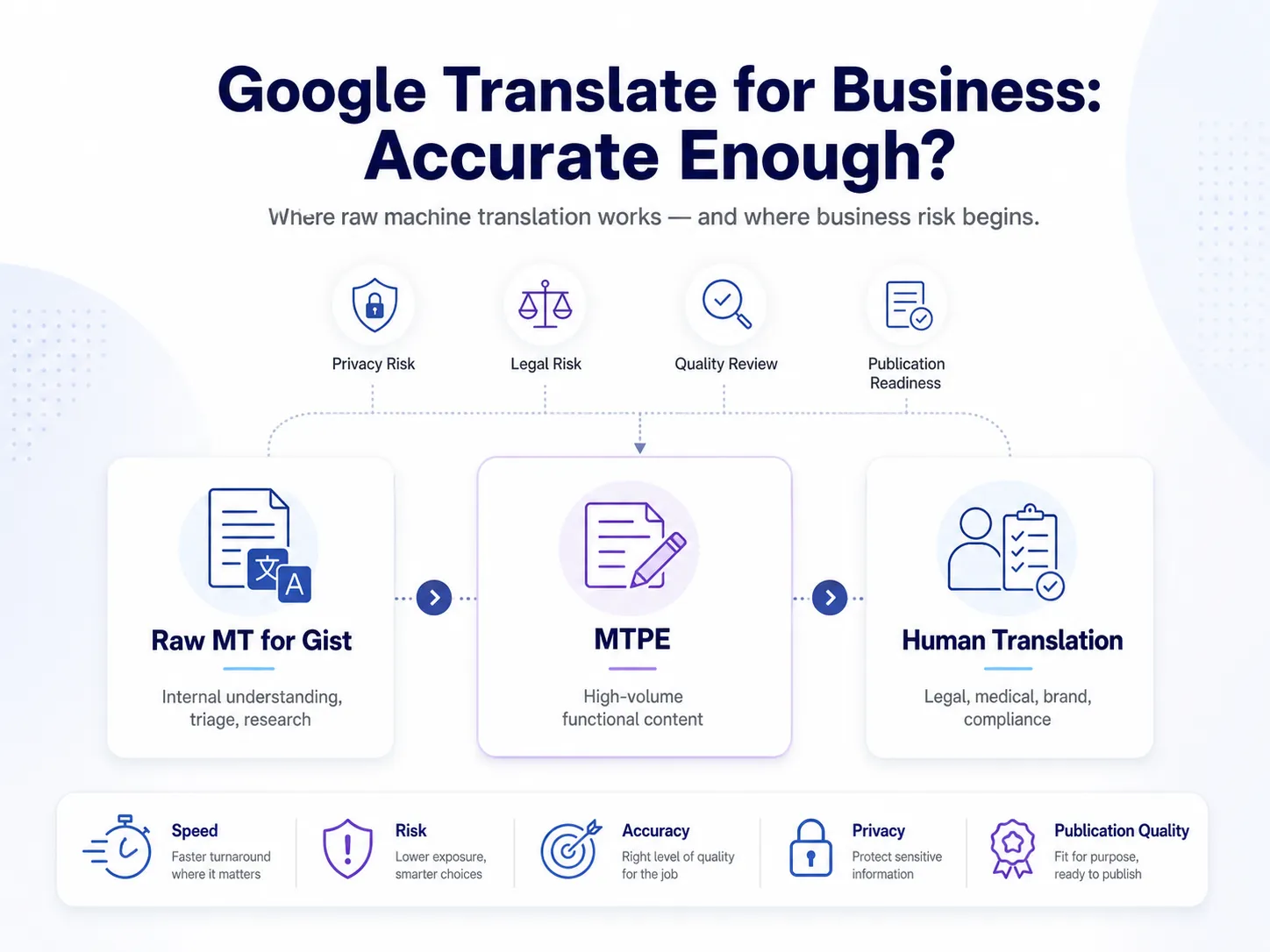
No. MT is automated pattern matching, not a native-speaker substitute. MT lacks native intuition, cultural knowledge, and brand voice competence. It consistently produces register inconsistencies, idiom failures, and cultural blind spots. MTPE (MT + native post-editing) can work for high-volume functional content, but the post-editor must be a native speaker.
Why is the Mother Tongue Principle Particularly Important for Legal and Regulated Content?
Legal and regulated content (contracts, GDPR notices, pharmaceutical labels) requires “clear and plain language” under EU FIC Article 59, GDPR Article 7(2), and EU Machinery Directive. Regulatory reviewers and courts assess whether content reads naturally to native speakers, which requires native-language translators.
What is the ‘Mother Tongue Principle’ in ISO 17100?
ISO 17100:2015 defines translators as those who “translate into a target language of which [they have] full command.” Full command means native-level competence in professional practice. ISO 17100 also requires subject-matter competence separately, recognizing native language and domain expertise are both required, not interchangeable.