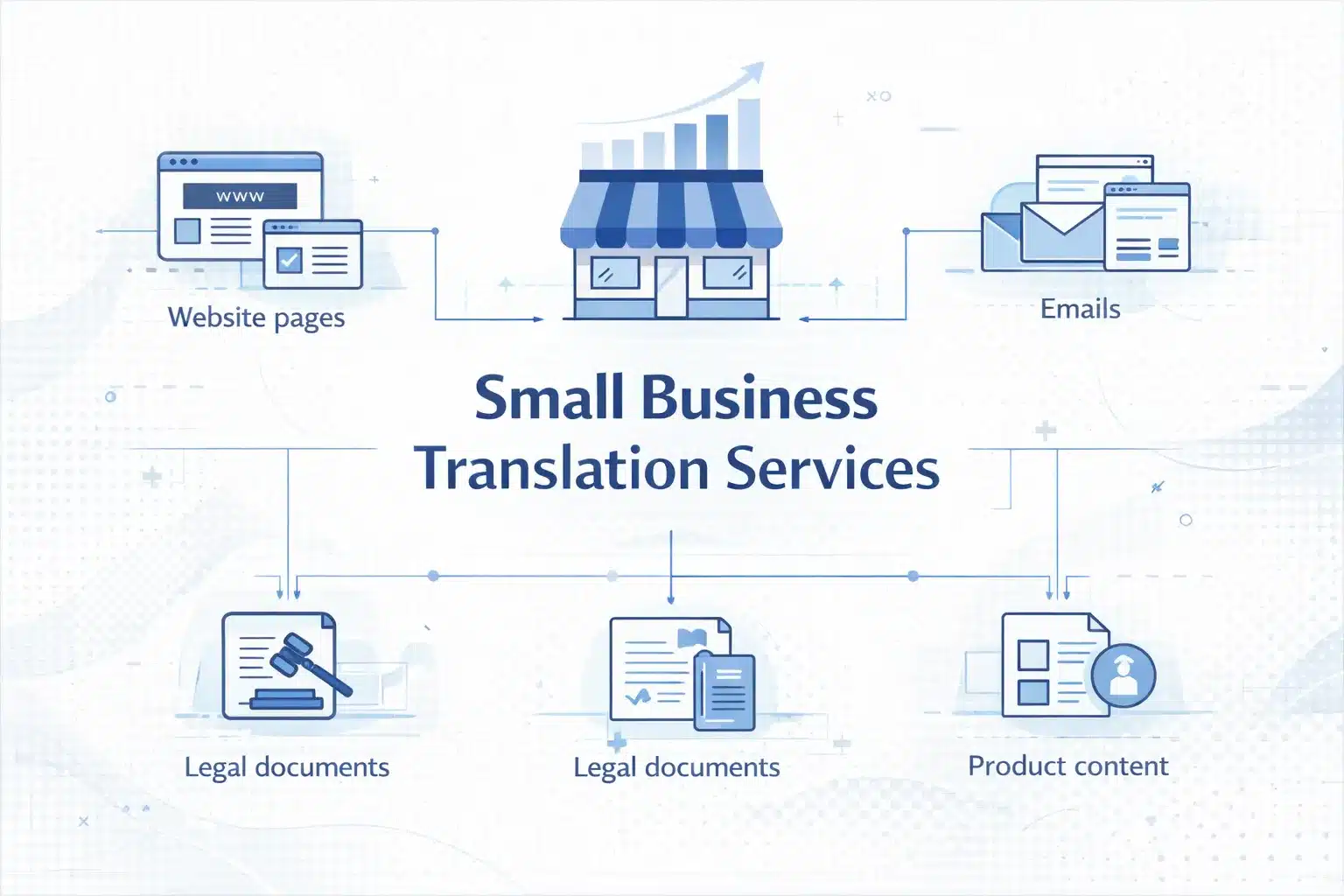
Translation services for small businesses work best when you prioritise core content first, website, legal documents, and customer communications, using structured packages and translation memory to control cost.
Professional translation does not require enterprise budgets; SMBs achieve high-quality multilingual output by starting small, applying the right quality tier, and scaling into a repeatable programme.
Small businesses entering new markets, serving multilingual customers, or managing international suppliers need translation, but without dedicated localisation teams, the challenge is deciding what to translate first, how much to spend, and how to avoid wasted budget.
This guide defines exactly what SMBs should prioritise, what starter packages cost, how translation memory reduces spend, and when to move to a retainer model for long-term efficiency.
What Translation Services Small Businesses Actually Need (and What They Can Skip)
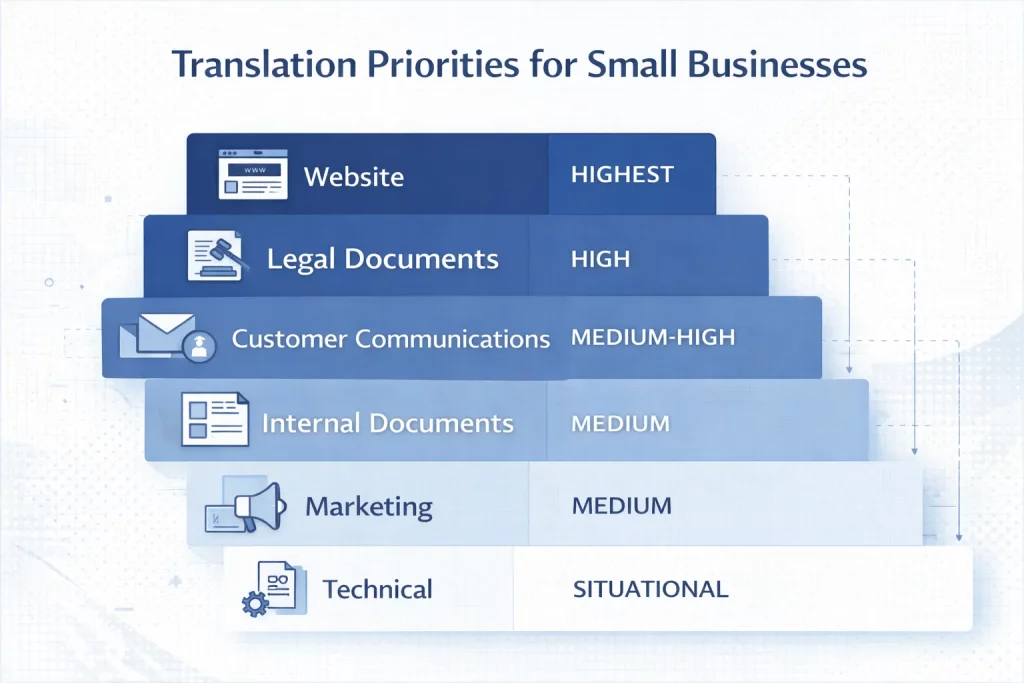
Small businesses need to prioritise website, legal, and customer-facing translation first, while avoiding over-investment in low-impact content early. Most SMBs overspend on non-essential translation and underinvest in content that directly drives revenue or reduces legal risk.
| Content Type | Priority | Why It Matters for SMBs | Translation Approach | Budget Tier | When to Upgrade |
| Website (core pages: home, services, about, contact) | HIGHEST | First impression in new market; SEO visibility; conversion driver | Human translation + SEO keyword research | $800–$2,500 per language (10–15 pages) | Add blogs/landing pages → move to retainer |
| Legal and compliance documents (contracts, NDAs, employment agreements, T&Cs, privacy policy) | HIGH | Legal exposure and regulatory requirement | Human translation + certified where required | $200–$600 per document | Increase volume → batch monthly |
| Customer-facing communications (emails, support, product descriptions, invoices) | MEDIUM-HIGH | Direct impact on customer trust and retention | Human or MTPE (high volume) | $0.07–$0.15/word | Scale volume → TM-driven MTPE |
| Internal and operational documents (HR, SOPs, training) | MEDIUM | Required for multilingual teams and compliance | MTPE or human (for HR/legal) | $0.07–$0.18/word | New office/team → prioritise HR docs |
| Marketing content (ads, social, campaigns) | MEDIUM | Brand perception and conversion quality | Transcreation (not direct translation) | $0.15–$0.25/word | Market expansion → formal transcreation briefs |
| Technical documentation (manuals, specs, SDS) | SITUATIONAL | Compliance requirement for regulated products | Human technical translation | $0.15–$0.22/word | Required for EU/product compliance |
Website Translation: The Highest-ROI Starting Point for Most Small Businesses
Website translation delivers the highest ROI because it directly affects visibility, SEO rankings, and conversion in new markets.
A standard 10–20 page project includes core pages (home, services, about, contact), target-language keyword research, metadata localisation, hreflang guidance, and CMS-ready delivery, while excluding blogs and ad copy.
Typical delivery takes 7–13 business days end-to-end, making it a fast, one-time investment that immediately enables multilingual customer acquisition.
Legal and Compliance Document Translation: What Small Businesses Can’t Afford to Get Wrong
Legal translation is non-negotiable because errors create direct legal and financial risk.
Small businesses require accurate translation for contracts, NDAs, supplier agreements, employment contracts, GDPR privacy notices, and terms of service.
Certified translation is only required for official submissions such as courts, immigration, or regulatory authorities.
However, internal documents still require professional human translation to ensure enforceability, compliance, and clarity across jurisdictions.
Customer-Facing Content and Marketing Translation: Matching Quality Tier to Content Risk
The correct approach is to match translation quality to content risk.
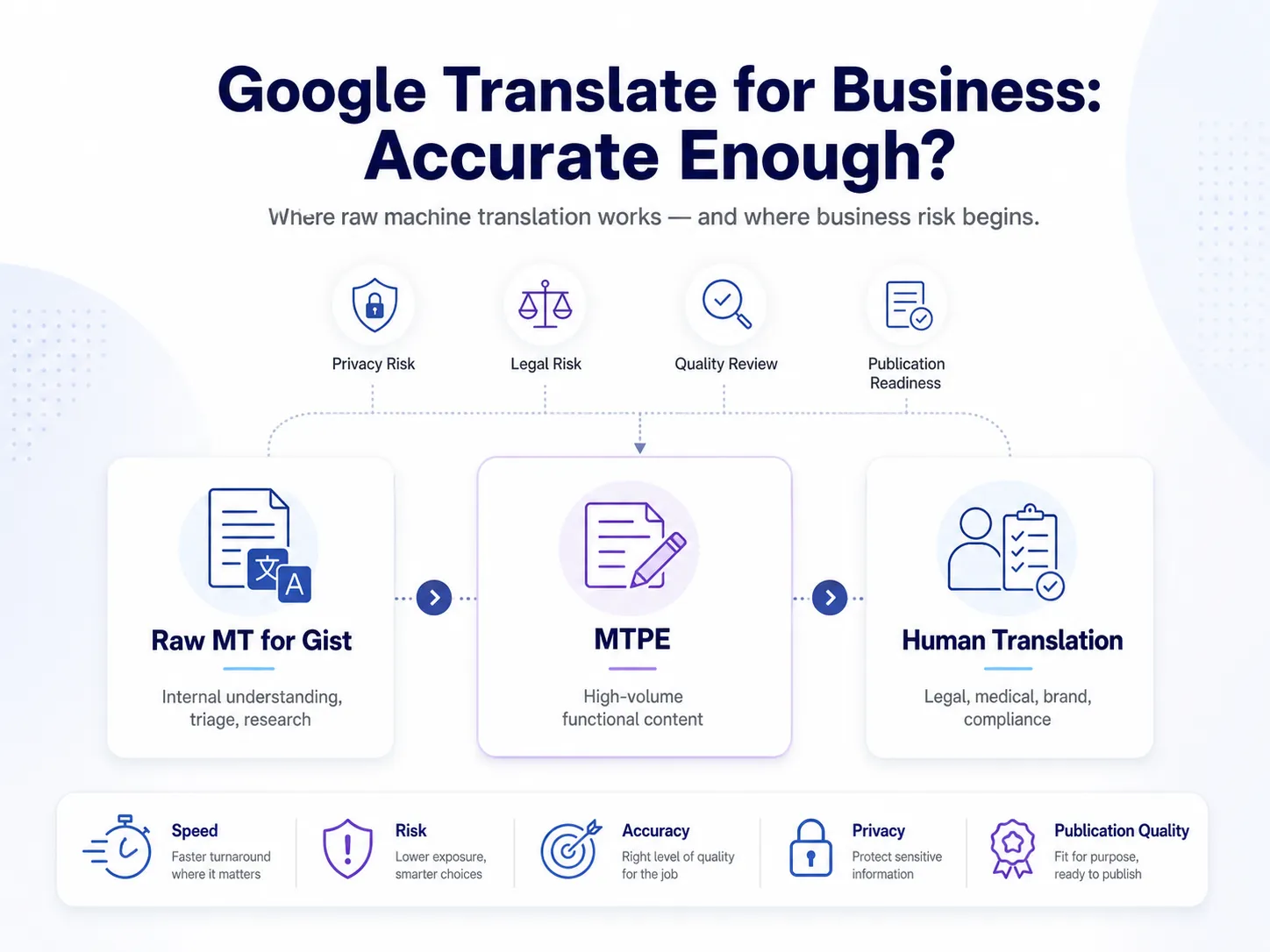
Use full human translation ($0.12–$0.22/word) for websites and legal content, MTPE ($0.07–$0.12/word) for scalable content like product descriptions and support materials, and never use raw machine translation externally.
For marketing, transcreation replaces translation entirely, ensuring campaigns resonate culturally and commercially rather than failing due to literal, ineffective messaging.
How to Commission Your First Small Business Translation Project: A 5-Step Process
Commission your first translation project by defining scope, matching quality tiers, setting up TM, planning timelines, and capturing feedback to build long-term consistency. This process prevents overspending, delays, and quality issues from the start.
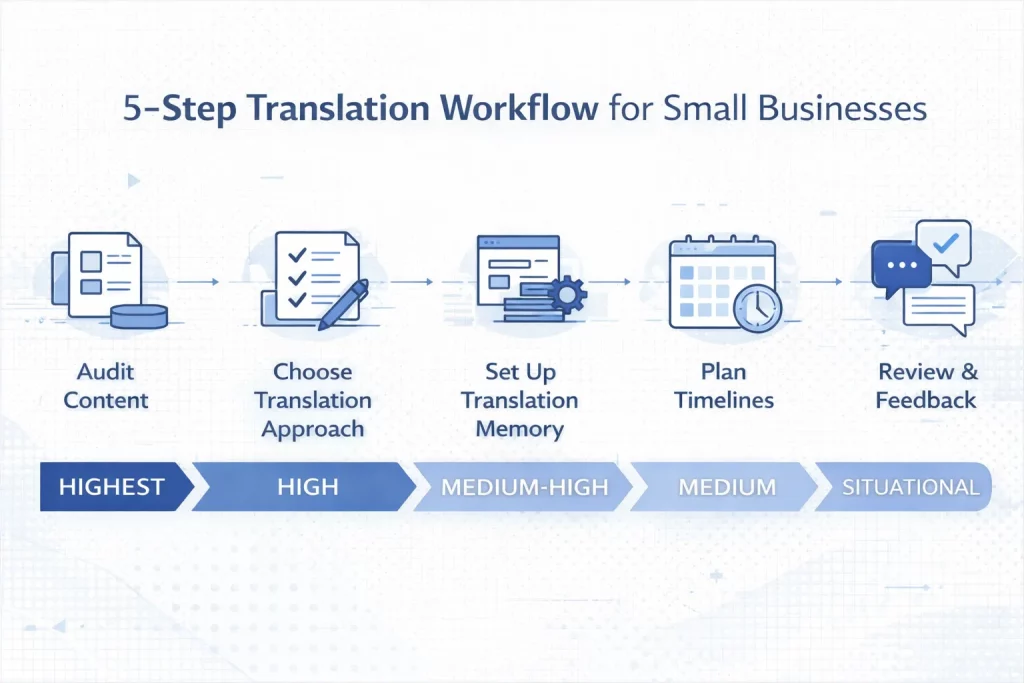
Step 1: Audit Your Content and Define the Priority Scope
Audit all business content, assign languages, and prioritise what actually needs translation before requesting quotes to avoid scope creep and inaccurate pricing.
List website pages, legal documents, customer communications, and marketing assets; define language pairs; flag risky existing translations (Google Translate, ad hoc freelancers).
Prioritise using the SMB framework and estimate word counts. The output is a simple spreadsheet covering content type, language, word count, and priority.
Step 2: Choose the Right Translation Approach for Each Content Type
Match each content type to the correct quality tier to avoid overspending or under-quality output.
Use human translation for websites and legal content, MTPE for scalable content like product descriptions and FAQs, and transcreation for marketing.
Provide clear inputs at the briefing stage like file format, language pair, word count, intended use, deadline, and any reference materials to receive an accurate quote quickly.
Step 3: Set Up Your Translation Memory and Termbase — Even on a Small Budget
Set up translation memory (TM) from the first project because it reduces costs immediately on future work through match reuse and consistency. TM stores approved segments and applies discounts on repeated content, with typical SMB match rates reaching 20–35% within 6–12 months.
This produces measurable savings (e.g., $375 per update cycle on a $1,500 batch) while improving consistency across all translated materials.
Step 4: Manage Turnaround Expectations and Build a Content Calendar for Translation
Plan translation timelines based on realistic benchmarks to avoid costly rush fees and operational friction. For example, a 2,500–4,000-word website takes 5–8 business days, while contracts (800–1,500 words) take 1–2 days.
Replace ad-hoc requests with a simple quarterly content calendar to secure standard pricing and predictable delivery instead of paying 25–50% rush premiums.
Step 5: Review Your First Delivery and Establish Quality Feedback for Long-Term Consistency
Review the first delivery for terminology, tone, domain accuracy, and formatting because this feedback defines all future output quality.
Approved terms are stored in the termbase, and style preferences become part of your translation guidelines, ensuring every subsequent project improves without repeating corrections, turning a one-off project into a scalable, consistent translation programme.
Small Business Translation Budgets: Starter Packages, Ongoing Costs, and When to Move to a Retainer
Small business translation budgets typically start at $500–$2,500 for initial projects and scale to $350–$750/month retainers as volume becomes consistent.
This phased approach avoids overcommitment while building a cost-efficient, long-term programme.
Starter Translation Packages for Small Businesses
| Package Type | What’s Included | Indicative Price Range | Best For |
| Website starter (1 language) | 10–15 core pages, SEO keywords, meta content, hreflang guidance | $800–$2,500 | First market entry |
| Legal document starter (3–5 docs) | Contracts, NDAs, employment agreements | $600–$1,500 | International operations |
| Product catalogue (100 SKUs, MTPE) | Product descriptions, TM setup, termbase | $500–$1,200 | eCommerce expansion |
| HR and compliance starter | Contracts, handbook, privacy notice | $800–$2,000 | Multilingual workforce |
| Monthly retainer (light) | Up to 3,000 words/month | From $350/month | Ongoing small-volume needs |
| Monthly retainer (standard) | Up to 7,000 words/month | From $750/month | Regular multi-content translation |
How to Compare Translation Quotes: What the Price Differences Actually Mean
Translation quotes differ because they reflect risk, quality control, and accountability, not just word count. A $120 freelance quote typically includes a single translator with no revision, no QA tools, and no confidentiality safeguards; a $280 agency quote adds basic QA and project coordination.
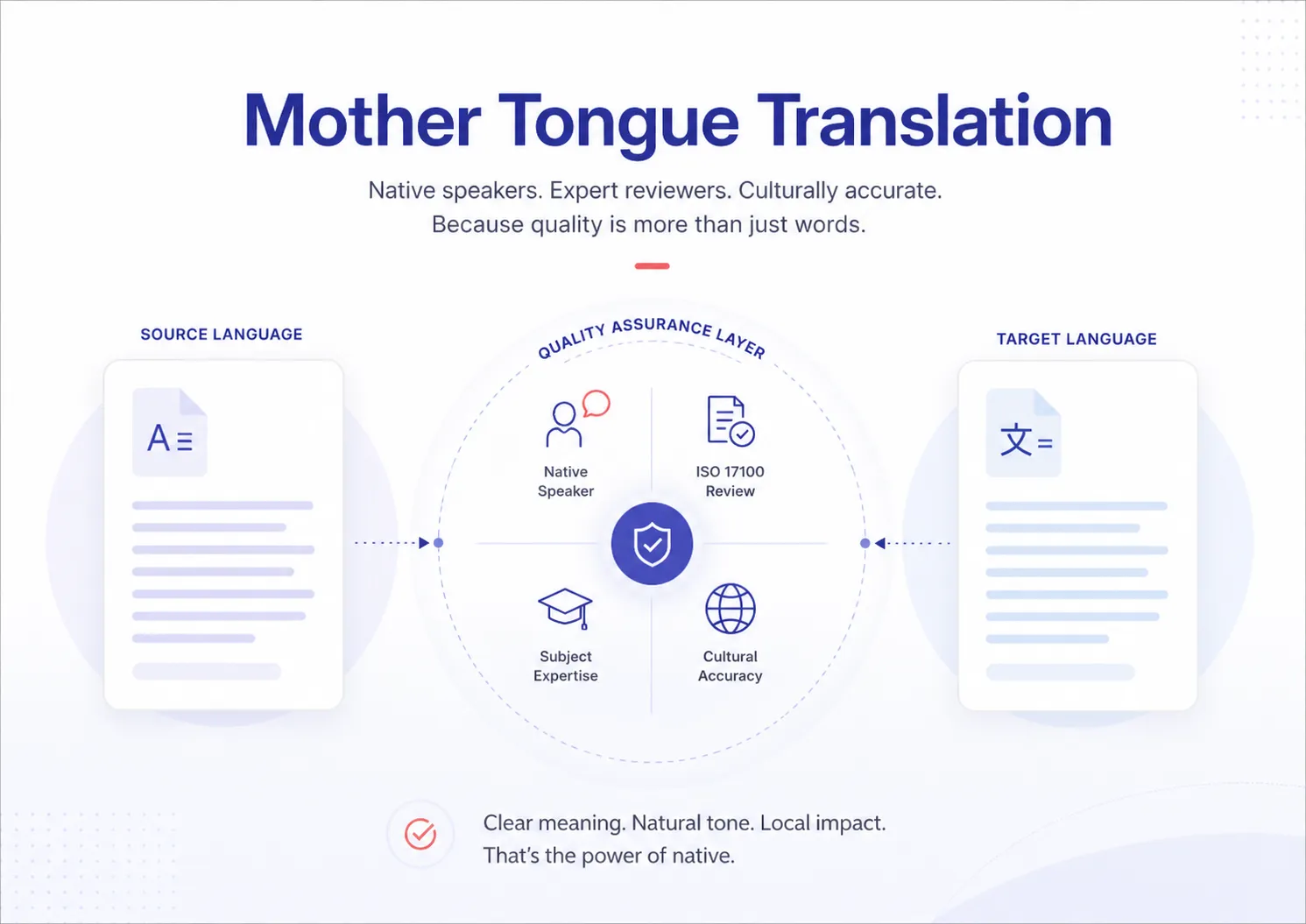
A $420 specialist provider includes domain experts, a two-stage review (ISO 17100), termbase management, TM ownership, and NDA-backed security.
For SMBs, low-cost options suit internal content, while contracts, websites, and compliance documents require higher-tier quality to avoid legal and commercial risk.
When Ad-Hoc Translation Projects Should Become a Monthly Retainer
Move to a retainer when translation becomes frequent, predictable, and multi-language, because retainers reduce cost and operational friction.
Key triggers include requesting quotes more than once per month, paying repeated rush fees, achieving 20%+ TM match rates, expanding into multiple languages, or entering a market requiring ongoing content.
A retainer secures discounted rates, reserved translator capacity, continuous TM updates, and priority turnaround, turning reactive translation into a structured workflow.
Data Security and Confidentiality: What Small Businesses Need to Know Before Using Any Translation Service
Translation workflows expose sensitive business data unless proper safeguards are in place, especially when using free tools. Submitting contracts, pricing, or product specs to tools like Google Translate can allow data storage or reuse under their terms.
SMBs must verify NDA availability, data retention policies, subcontractor confidentiality, MT training usage, and GDPR compliance before engaging any provider. Professional agencies mitigate this risk through signed NDAs, controlled data handling, and explicit non-use of client data in training models.
Start Your Small Business Translation Programme — Practical, Transparent, and Built to Grow With You
Whether you need one contract translated this week or a structured monthly programme across website, legal, and customer content, Circle Translations delivers scalable solutions from day one.
✓ No minimum volume — start with a single document or full website
✓ Starter packages designed for SMB needs with clear pricing
✓ Translation memory created from project one — cost savings begin immediately
✓ Quality tier matched to content — human translation or MTPE as appropriate
✓ NDA before file transfer — full confidentiality protection
✓ GDPR-compliant data processing available
✓ Transparent pricing with no hidden costs
✓ 1-hour quote turnaround for fast decision-making
✓ Dedicated project manager from day one
✓ Seamless transition to retainer as your needs grow
Tell us your content, language, and deadline — receive a fast, accurate quote today →
Translation Services for Small Business — Frequently Asked Questions
How much should a small business budget for translation services annually?
A small business should budget £2,000–£6,000 per year for one language and mixed content. This covers website updates, a few legal documents, and basic operational content. MTPE reduces costs by 30–50% for high-volume, lower-risk content. Once monthly volume exceeds ~2,000 words, a retainer of £350–£750/month delivers better cost control and consistency.
Can I use a bilingual employee instead of a professional translation agency?
A bilingual employee is not a substitute for professional translation in business-critical content. Internal, low-risk communication is acceptable in-house, but contracts, websites, and compliance documents require trained translators. Professional translation includes revision by a second linguist, QA tools, and terminology control—none of which exist in informal in-house translation.
What is the difference between translation and localisation for small businesses?
Translation converts language; localisation adapts content for a specific market. Localisation adjusts currency, tone, cultural references, and SEO keywords to match how customers actually search and buy. SMBs should use translation for legal documents and localisation for websites, marketing, and customer-facing content where conversion and relevance matter.
How long does it take to translate a business website into one language?
A 10–20 page small business website takes 5–10 business days to translate professionally. This includes translation, revision, SEO keyword alignment, and CMS-ready delivery. Rush delivery (3–4 days) is possible with a 25–50% surcharge. Larger websites (50+ pages) require phased delivery, prioritising core conversion pages first.
Should a small business translate into multiple languages at once or one at a time?
Start with one language, then scale. A single-language launch validates demand, builds a translation memory, and keeps execution manageable. Expanding to multiple languages too early increases cost and complexity without proven ROI. Add new languages only after the first market shows measurable traction.
What does “certified translation” mean and when does a small business need it?
Certified translation includes a signed accuracy statement from the translator or agency. It is required for government, immigration, court, and regulatory submissions. SMBs do not need certification for internal contracts or operational documents—standard professional translation is sufficient unless a formal authority explicitly requires certification.
Can Circle Translations handle multiple document types in one project?
Yes—mixed-content projects are standard. A single brief can include website pages, contracts, HR documents, and product descriptions, each handled at the correct quality tier. One project manager coordinates delivery, reducing vendor overhead and ensuring consistent terminology across all content types.
What is the minimum project size for a professional translation agency?
There is no minimum word count, but a minimum fee applies. Small projects under ~200 words typically cost £45–£75 to cover setup, QA, and delivery. This allows SMBs to translate single-page documents or short updates without committing to large volumes.
How do I know if my translation quality is good enough for my target market?
Use a native-speaker review with market knowledge. Ask a local partner or customer to check for unnatural phrasing, incorrect terminology, or tone mismatch. Feed that feedback into your translation provider to refine your termbase and style guide, improving quality over time with each project.