Polish translation services provide professional English-to-Polish and Polish-to-English translation for business documents, legal contracts, websites, and compliance content. Professional Polish translation requires native Polish translators with subject-matter expertise.
Polish’s grammatical complexity (seven cases, gender, aspect) prevents accurate output from machine translation or generalist linguists.
Poland is the EU’s 6th-largest economy, with ~45 million Polish speakers globally and 2–3 million in diaspora markets like the UK and Germany.
This creates consistent B2B demand across contracts, HR documentation, compliance, and e-commerce localisation. Polish translation directly supports supply chains, corporate expansion, and revenue growth in Polish-language markets.
Circle Translations delivers native Polish specialists across legal, technical, financial, and marketing domains, with certified translation, CMS-ready website localisation, translation memory cost reduction, and NDA-secured workflows as standard.
Polish Translation for Business: Key B2B Use Cases, Document Types, and Industry Contexts
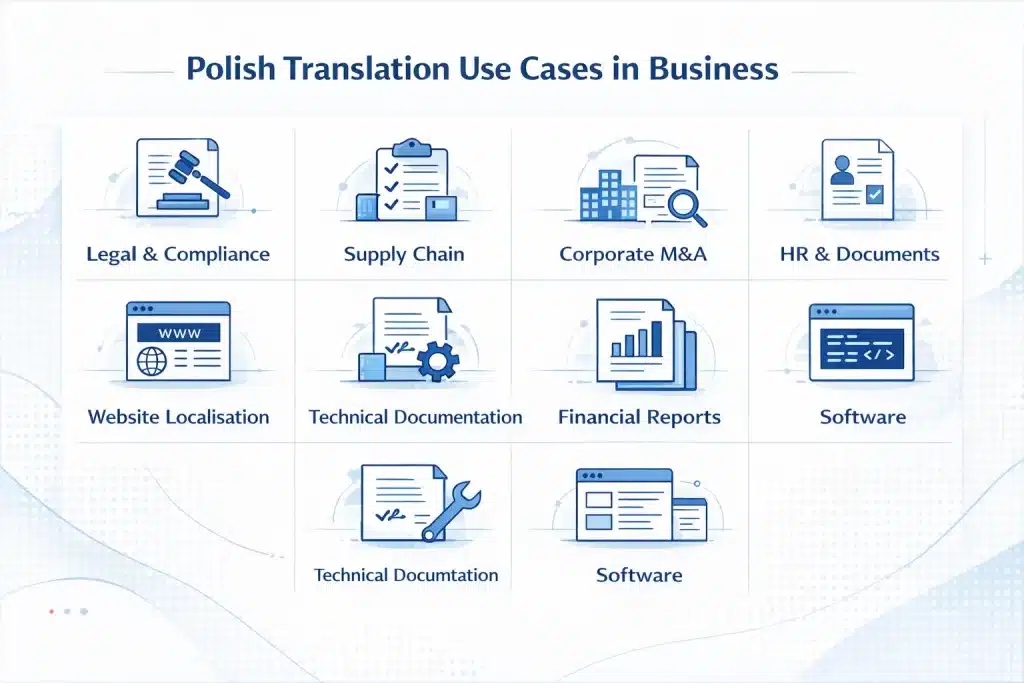
Polish B2B translation covers four primary commercial contexts — supply chain, legal/compliance, corporate expansion, and digital localisation, each with distinct accuracy, certification, and volume requirements.
| Context | Document Types | Direction | Translation Approach | B2B Stakes | Notes |
| Supply chain and procurement | Supplier contracts, purchase orders, RFQs, product specifications, and inspection reports | EN→PL or PL→EN | Human translation + termbase | Legal + commercial | Poland is a major manufacturing and nearshoring hub |
| Legal and compliance | Employment contracts, NDAs, GDPR notices, corporate governance documents, court filings | EN→PL or PL→EN | Human translation + certified where required | Legal accuracy-critical | Sworn translation (tłumacz przysięgły) required for courts |
| Corporate expansion and M&A | Articles of association, KRS extract, due diligence docs, shareholder agreements | PL→EN primarily | Human translation + certified | Due diligence accuracy | KRS = Polish Companies House equivalent |
| HR and employee communications | Employment contracts, handbooks, work regulations, payslips | EN→PL primarily | Human translation | Legal/HR accuracy | Must align with Polish Labour Code |
| Website and e-commerce localisation | Website copy, product pages, checkout, blog content | EN→PL | Human translation + SEO | Conversion + SEO | Polish e-commerce ~€17–20B market |
| Technical documentation | Manuals, engineering specs, safety datasheets | EN→PL or PL→EN | Human + MTPE (volume) | Safety + accuracy | CE marking may require Polish |
| Financial and regulatory | Financial statements, annual reports, KNF filings | PL→EN primarily | Human translation + certified | Regulatory + financial | Requires Polish financial terminology |
| IT and software | UI strings, SaaS platforms, API docs | EN→PL | Human + MTPE | UX + SEO | Fast-growing Polish IT sector |
Polish Legal Translation: Employment Contracts, GDPR Notices, and Certified Document Requirements
Polish legal translation requires strict adherence to the Polish Labour Code, GDPR terminology, and certification standards, because small terminology errors create enforceability risks.
Employment contracts (umowa o pracę) must include legally defined elements such as working time, remuneration, and leave (20–26 days), while distinct contract types (umowa o dzieło vs umowa zlecenia) must never be conflated.
GDPR content must follow UODO-approved terminology in Polish. For official use, sworn translators (tłumacz przysięgły) are required for Polish courts and KRS filings, while certified translations suffice for UK/US authorities.
Polish Corporate and M&A Translation: KRS Extract, Articles of Association, and Due Diligence Packages
Polish corporate translation centres on KRS extracts, articles of association, and due diligence documents, where naming accuracy and legal equivalence are critical.
The KRS extract confirms company identity, directors, share capital, and PKD activity codes, and is routinely translated for KYC and M&A. Articles of association (statut / umowa spółki) must use correct legal equivalents (sp. z o.o. = Ltd.; S.A. = joint stock company).
Due diligence packs include contracts, shareholder lists, financials, and licences, often exceeding 10,000 words and requiring TM-driven consistency.
Polish Website and E-Commerce Translation: SEO Localisation, hreflang, and the Polish Online Market
Polish website translation requires SEO localisation, correct hreflang implementation, and strict handling of Polish diacritics to achieve ranking and conversion. Poland’s e-commerce market exceeds €17–20 billion with ~15% annual growth, and users strongly prefer native-language content.
Effective localisation includes Polish keyword research (e.g., genitive search forms like “buty damskie”), hreflang=”pl” setup, and expanded meta content (Polish text is ~15–20% longer).
Missing diacritics (ą, ć, ę, ł, ń, ó, ś, ź, ż) are immediate quality failures for native users.
Why Polish Is One of the Most Demanding European Languages to Translate Accurately
Polish is one of the most grammatically complex European languages, with case inflection, gender agreement, and aspect systems that directly affect translation accuracy and quality outcomes.
| Feature | Polish characteristic | Translation implication | Quality risk if missed |
| Grammatical cases | 7 cases (nominative, genitive, dative, accusative, instrumental, locative, vocative) | All nouns, adjectives, pronouns, and numerals inflect | Case errors change the meaning and sound unnatural |
| Grammatical gender | 3 genders + animate/inanimate distinctions | Affects adjectives, verbs, and pronouns | Gender mismatch is immediately visible |
| Verbal aspect | Perfective vs imperfective verbs | Indicates completed vs ongoing actions | Wrong aspect changes meaning |
| Numeral agreement | Different forms for 2–4 vs 5+ | Impact quantities and pricing text | Errors visible in commercial content |
| Formal/informal register | Pan/Pani vs ty | Requires structural sentence changes | Wrong tone damages professionalism |
| Word order flexibility | Multiple valid structures (SVO, SOV, etc.) | Emphasis carried by structure | Literal translation sounds unnatural |
Polish Grammatical Cases and Why They Matter for Contract and Legal Document Translation
Polish grammatical cases directly affect legal meaning, making them critical in contract translation. Every noun changes form based on function, preposition, and verb structure, and legal clauses rely on precise case usage (e.g., genitive after “do”, instrumental for agency).
Errors alter obligations, parties, or liability interpretation. In contracts, incorrect case usage signals low-quality translation and creates enforceability risk, so professional workflows include revision checks specifically targeting case agreement in key legal clauses.
False Friends, False Cognates, and Polish-English Translation Traps in Business Content
Polish-English false friends create high-risk meaning errors in business documents because similar-looking words often carry different meanings. Examples include “aktualny” (current, not actual), “ewentualny” (potential, not eventual), and “kontrola” (inspection, not control).
In contracts, finance, and compliance content, these errors distort obligations, costs, or regulatory meaning.
Professional translators rely on domain knowledge and termbases to avoid systematic mistranslation of these high-frequency traps.
Polish Formal Register vs Informal Register: Getting Tone Right in B2B and Consumer Communications
Polish formal register (Pan/Pani) requires third-person grammar, making it structurally different from English and critical for B2B communication accuracy. Formal business and legal texts use Pan/Pani constructions (“Pan/Pani jest zobowiązany/a”), not direct “you,” requiring full sentence restructuring.
Informal “ty” appears in consumer or startup contexts but must be applied consistently.
Incorrect register signals unprofessionalism and cultural inaccuracy, especially in HR, legal, and corporate communications.
Commission Professional Polish Translation That B2B Buyers Can Rely On — Circle Translations
Polish business documents fail when translation is treated as a language task instead of a risk-control process.
Contracts, HR policies, and website content require precise case agreement, correct legal terminology, and consistent formal register. Errors create legal exposure, compliance issues, and lost conversions.
Circle Translations eliminates that risk with native Polish subject-matter specialists, ISO 17100 two-stage review on every project, enforced terminology via translation memory, and zero-tolerance QA on diacritics and formatting. Submit your document and receive a production-ready translation, accurate, compliant, and ready for immediate business use.
Submit your Polish document today and receive a precise, compliant, business-ready translation →
Polish Translation — Frequently Asked Questions
What is the average cost of Polish translation per word in the UK?
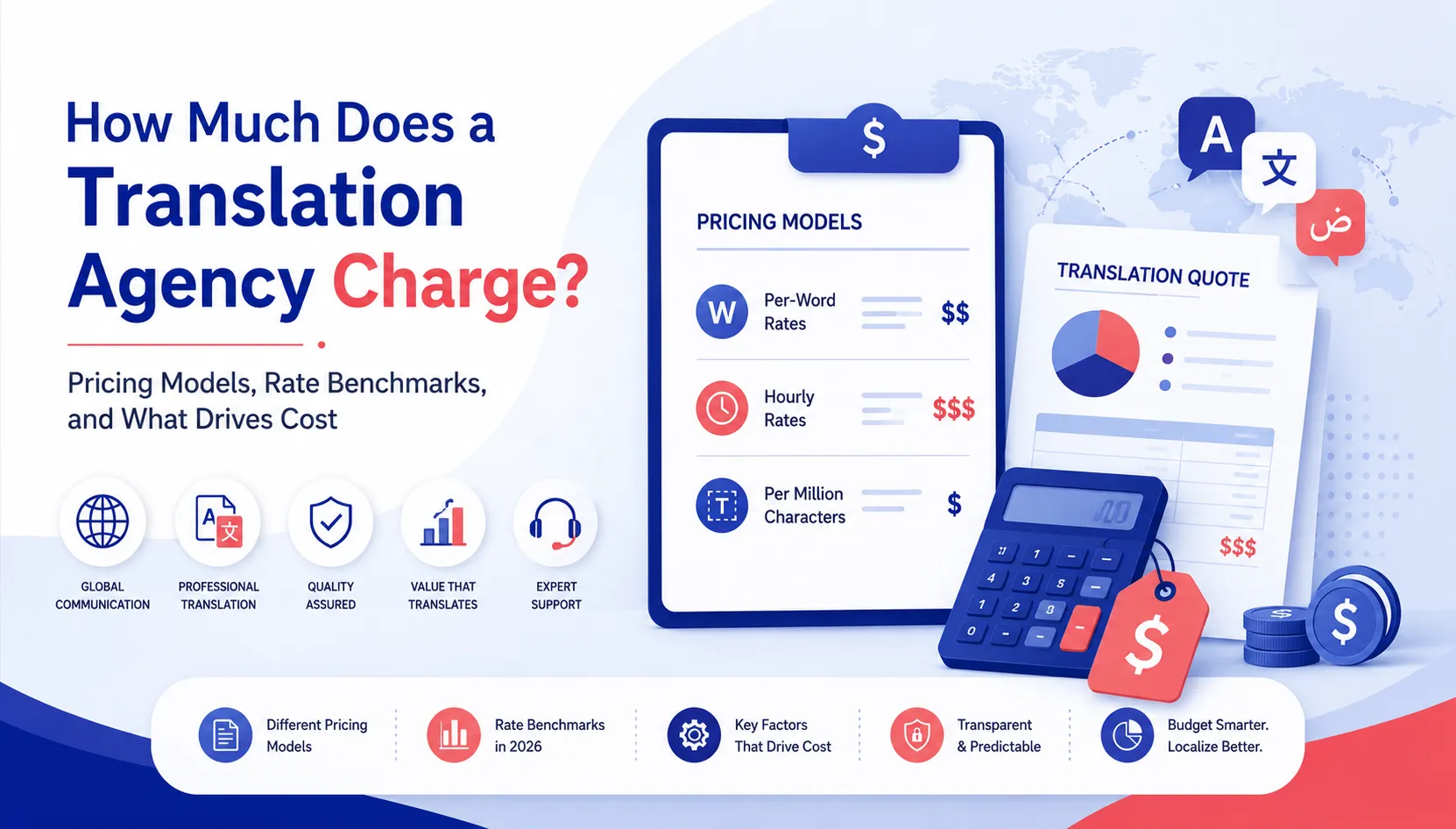
Professional Polish translation in the UK costs £0.12–£0.25 per word through agencies and £0.08–£0.15 via freelancers. Agency pricing includes ISO 17100 two-stage review, QA tools, and project management, which directly improves accuracy and consistency. Legal, technical, and certified translations sit at the higher end, while MTPE ranges from £0.06–£0.10 per word for high-volume, low-risk content.
Is Google Translate or DeepL good enough for Polish business documents?
No, Google Translate and DeepL are not suitable for professional or legal Polish business documents. Both tools produce readable output but fail on case agreement, legal terminology, and formal register (Pan/Pani), and may omit diacritics that change meaning. These errors create contractual, compliance, and reputational risk, making professional human translation mandatory for any business-critical use.
What is a sworn (przysięgły) Polish translator, and when do I need one?
A sworn Polish translator (tłumacz przysięgły) is legally authorised to produce translations accepted by Polish courts and authorities. You need one for KRS filings, court submissions, and official Polish government processes. For UK or US submissions (UKVI, USCIS), a certified translation with an accuracy statement is sufficient and sworn translation is not required.
How much does it cost to translate a 10-page Polish document?
A 10-page Polish document (≈2,500 words) costs £300–£625 depending on complexity and subject matter. Standard business documents fall at £300–£450, while legal or technical content reaches £400–£625. Certification adds £25–£50, and rush delivery adds 25–50%. MTPE reduces cost to £150–£250 but is unsuitable for legal or official documents.
How long does a Polish translation take for business documents?
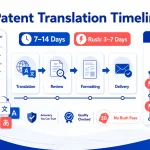
Polish translation takes 1–4 business days for most documents, depending on length. Under 1,000 words: 1 day; 1,000–3,000 words: 1–2 days; 3,000–7,000 words: 2–4 days; larger projects: 4–7+ days. Rush delivery covers up to 2,000 words in 24 hours. Certified translation adds no extra time because certification is issued alongside delivery.
Can I translate my Polish website using a plugin or does it require professional translation?
Plugins like WPML or Weglot manage workflows but do not replace professional translation. Machine-translated Polish content fails SEO, produces unnatural phrasing, and reduces conversion rates. Professional translation with Polish keyword research, correct morphology, and localisation is required to rank and convert in Polish-language search.
What Polish translation quality standard should B2B buyers specify?
B2B buyers should require ISO 17100 as the baseline quality standard. This mandates translation plus independent revision, ensuring error detection and consistency. For legal or regulatory content, add subject-matter expert review. For high-volume content, define MTPE levels clearly. Single-translator workflows are not acceptable for business-critical documents.
What is the difference between Polish to English and English to Polish translation costs?
Polish↔English translation costs are broadly equal, with only a 0–10% variation. Both directions require native Polish expertise for accuracy. English-to-Polish requires native Polish output for correct grammar and tone, while Polish-to-English may involve bilingual specialists, but agencies typically use native Polish linguists in both directions to maintain consistency.
Does Circle Translations offer Polish translation for ongoing retainer programmes?
Yes, Circle Translations provides retainer programmes for ongoing Polish translation needs. These include translation memory setup, volume-based pricing, reserved translator capacity, priority turnaround, and quarterly reporting on cost savings and TM performance. This model supports continuous workflows such as e-commerce updates, contract cycles, and marketing campaigns.