
Traditional Chinese and Simplified Chinese are 2 different writing systems for the Chinese language. Traditional Chinese uses the full historical character forms. This language is used in Taiwan, Hong Kong, Macau, and many overseas Chinese communities. Simplified Chinese uses reduced-stroke characters introduced by the People’s Republic of China in the 1950s and 1960s. This is used in Mainland China, Singapore, and Malaysia. They are not interchangeable. Each market needs its own professional translation.
This is the most important thing any business entering Chinese-speaking markets needs to understand. Simplified Chinese and Traditional Chinese are not 2 versions of the same translation. They are 2 separate localization targets, different scripts, different vocabulary, and different cultural and regulatory expectations.
We’ll cover here the real differences between Traditional and Simplified Chinese, character and vocabulary examples you can see for yourself, the political and cultural context that affects business decisions, the Mandarin vs Cantonese question, market-by-market script choices for China, Taiwan, Hong Kong, Singapore, and Malaysia, the technical setup for hreflang and SEO, and a clear B2B decision matrix to help you pick the right Chinese for your project.
Traditional vs Simplified Chinese: 8 Key Differences Every Translator and Localization Buyer Needs to Know
The differences between Traditional and Simplified Chinese go far beyond stroke count. Once you see all 8 dimensions, the localization decision becomes much clearer.
Here’s the full comparison:
| Dimension | Simplified Chinese (zh-CN) | Traditional Chinese (zh-TW / zh-HK) | What It Means for Your Business |
|---|---|---|---|
| Character forms | Reduced-stroke simplified forms; ~2,500 common characters cover most text | Full historical character forms; more complex strokes; ~5,000 common characters | Different rendering; fonts not interchangeable; DTP and design assets recreated per script |
| Character set standard | GB 18030 (PRC national standard) | Big5 (Taiwan) / HKSCS (Hong Kong) | Wrong encoding produces garbled output; web and software must use the right standard for the target market |
| Vocabulary | PRC-influenced; loanwords often Mandarin phonetic (e.g., 巧克力 chocolate) | Taiwan and HK words often differ; native or Cantonese-influenced (e.g., 朱古力 chocolate in HK) | Same concept, different word; PRC vocabulary in Taiwan/HK reads wrong to native speakers |
| Punctuation | Western-style ” ” and ‘ ‘ | 「 」 and 『 』 in Taiwan; HK mixed | Punctuation is a readability signal — not just style preference |
| Text direction | Horizontal left-to-right (standard in PRC) | Horizontal or vertical; print media (newspapers, books) often vertical | Print DTP for Taiwan/HK may need vertical text capability |
| Locale code | zh-CN | zh-TW (Taiwan), zh-HK (Hong Kong), zh-MO (Macau) | hreflang, software, CMS — all must use the right code; zh-CN ≠ zh-TW in any system |
| Regulatory terminology | PRC: NMPA (pharma), MIIT (tech), SAMR (markets) | Taiwan: MOHW; Hong Kong: DHPD | Pharma, medical devices, food labels — vocabulary mandated by the local authority |
| Cultural and political | Avoid politically sensitive references in PRC content | Taiwan uses ‘Republic of China’ framing; PRC framing damages credibility | Political and cultural fit matters as much as language accuracy |
Traditional and Simplified Chinese Character Examples
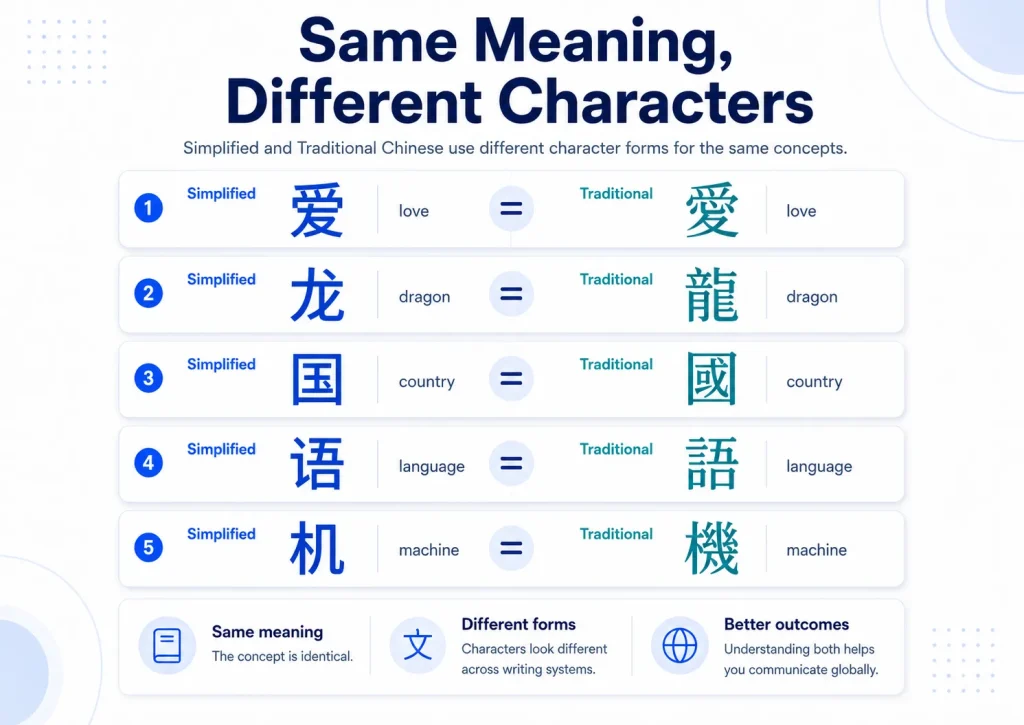
Some Traditional and Simplified Chinese characters look similar. Some look completely different. The visual difference ranges from a small stroke change to characters that share almost nothing.
Here are 9 common concepts shown side by side:
Traditional vs Simplified Chinese Character Examples
| English | Simplified | Traditional | Notes |
|---|---|---|---|
| Love (love/like) | 爱 (ài) | 愛 (ài) | Simplified form removes 心 (heart radical) — often noted in debates |
| Dragon | 龙 (lóng) | 龍 (lóng) | One of the most visually dramatic differences |
| China / Chinese | 中国 / 中文 | 中國 / 中文 | 国 vs 國 — Traditional 國 contains 或 (a complex character) |
| Language | 语 (yǔ) | 語 (yǔ) | Simplified removes inner complexity of right component |
| Machine / Mechanical | 机 (jī) | 機 (jī) | Traditional has 16 strokes; Simplified has 6 |
| Body | 体 (tǐ) | 體 (tǐ) | Traditional 體 is among the most complex common characters |
| Learn / Study | 学 (xué) | 學 (xué) | Simplified removes the upper 臼 component |
| Business / Industry | 业 (yè) | 業 (yè) | Significant stroke reduction |
| Welcome | 欢迎 (huānyíng) | 歡迎 (huānyíng) | 欢 vs 歡 — Simplified reduces left component |
What this means for B2B buyers
Simplified Chinese and Traditional Chinese are visually distinct writing systems. A native reader spots the difference instantly. Sending Simplified Chinese content to a Taiwan or Hong Kong audience, or sending Traditional Chinese to Mainland China, isn’t a small quality issue. It’s an obvious mismatch that signals you didn’t invest in the market.
Why the Same Chinese Characters Can Mean Different Things in Different Markets
Even when the script difference is handled, vocabulary still varies between Mainland China, Taiwan, and Hong Kong. PRC, Taiwan, and HK have spent decades developing different words for the same modern concepts.
Here are some of the vocabulary differences:
Technology vocabulary
- Software — Mainland: 软件 (ruǎnjiàn); Taiwan: 軟體 (ruǎntǐ) — different words
- Network / WiFi — Mainland: 无线网络 (wúxiàn wǎngluò); Taiwan: 無線網路 (wúxiàn wǎnglù) — different characters for “network”
- Computer — Mainland: 电脑 (Simplified); Taiwan: 電腦 (Traditional, same word) — same concept, different script
Marketing and business vocabulary
- Marketing — Mainland: 营销 (yíngxiāo); Taiwan: 行銷 (xíngxiāo) — different words entirely
- Specialised business terms — diverge more in formal written contexts than in everyday usage
Food and consumer vocabulary
- Chocolate — Mainland: 巧克力 (qiǎokèlì, Mandarin phonetic); HK: 朱古力 (zhūgūlì, Cantonese phonetic) — completely different words
- Pineapple — Mainland: 菠萝 (bōluó); Taiwan: 鳳梨 (fènglí) — different words
Medical and pharmaceutical terms
Drug names and active substance terminology follow different official references in PRC (NMPA), Taiwan (MOHW), and Hong Kong (DHPD). These aren’t script differences — they’re entirely separate regulatory vocabulary frameworks.
Why this matters
A Simplified Chinese translation used in Taiwan or Hong Kong contains mainland-specific words that read as “wrong” to local readers. Think of it like sending US English content (“sidewalk,” “gas,” “closet”) to a UK audience that expects “pavement,” “petrol,” and “wardrobe.” The grammar works. The meaning lands. But the brand looks like it copy-pasted from another market.
The Traditional vs Simplified Chinese Debate: Political, Cultural, and Historical Context for Business Buyers
The Traditional vs Simplified Chinese debate has political and cultural layers. You don’t need to take sides. But you do need to know that picking the wrong script in the wrong market can look like taking a side, even when you didn’t mean to.
Where Traditional Chinese came from
Traditional Chinese characters developed over more than 3,000 years. The earliest evidence of Chinese writing is the Shang Dynasty oracle bone script from around 1200 BCE. The Traditional character forms used today are the result of calligraphic development through the Han, Tang, Song, and Ming dynasties. They aren’t “more complex” versions — they’re the original forms that Simplified characters were derived from.
How Simplified Chinese was created
The People’s Republic of China introduced Simplified Chinese in 2 main rounds of reform — 1956 (around 500 simplified characters) and 1964 (consolidating about 2,235 simplified characters). The goal was to raise literacy by reducing the complexity of Chinese writing. The reform used 3 methods: reducing stroke count, merging variant characters, and standardising cursive forms.
The political dimension
Simplified Chinese is associated with the PRC government and Communist Party administration. Traditional Chinese is used in Taiwan (Republic of China) and Hong Kong — both with distinct political identities from the PRC. In Taiwan especially, using Traditional Chinese isn’t just a writing choice. It carries cultural and political identity. Using Simplified Chinese for a Taiwan audience can read as political insensitivity, not just a localisation shortcut.
Overseas Chinese communities
Chinese communities in the UK, US, Australia, and Canada split by migration history. Earlier waves (pre-1949 emigration; Hong Kong and Taiwan emigration in the 1970s–1990s) read Traditional Chinese. More recent emigration from Mainland China (post-1980) reads Simplified. For consumer brands targeting Chinese diaspora communities, audience age and migration history affect script choice.
Mandarin vs Cantonese vs the Written System
The biggest confusion in Chinese translation isn’t Traditional vs Simplified. It’s mixing up spoken language (Mandarin vs Cantonese) with written script (Traditional vs Simplified). These are 2 separate dimensions.
Here’s how spoken and written Chinese actually map:
Mandarin vs Cantonese vs the Written System
| Feature | Mandarin | Cantonese | Translation Implication |
|---|---|---|---|
| Official status | Official in PRC, Taiwan, Singapore; UN official language | Spoken in Hong Kong, Macau, Guangdong; no official writing system of its own | Translation almost always goes into written Mandarin (Simplified or Traditional), not written Cantonese |
| Script used | Simplified in PRC; Traditional in Taiwan / Singapore | Traditional Chinese in Hong Kong documents | HK uses Traditional script; the spoken language is Cantonese, but written standard is Mandarin grammar with HK vocabulary |
| Native speakers | ~920 million (most spoken first language in the world) | ~85 million (Guangdong, HK, Macau, overseas) | Most Chinese-market content goes into Mandarin; Cantonese-specific content is for HK or community targeting |
| Tones | 4 tones + neutral | 6 tones (some analyses count 9) | Affects pronunciation guides, not standard written B2B content |
| Names for Mandarin | Putonghua (普通话) in PRC; Guoyu (國語) in Taiwan; Huayu (华语) in Singapore | Not officially standardised as a written language | Same spoken language, 3 different official names — a clear sign ‘Chinese’ is not one unified standard |
Which Chinese Should You Use? A B2B Market Entry Decision Guide
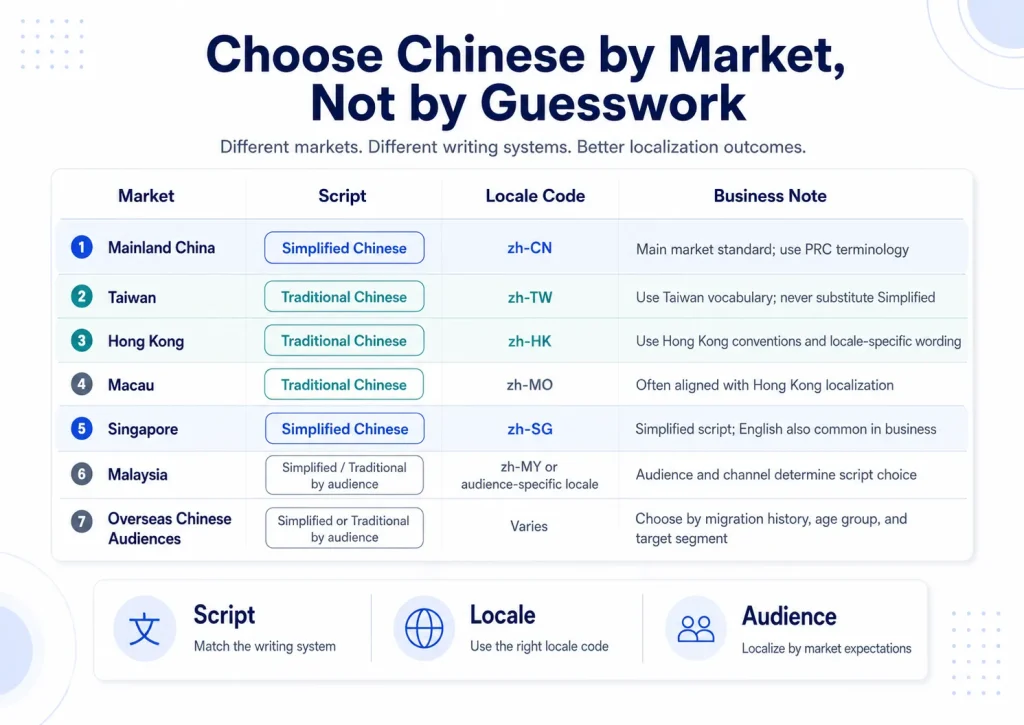
The answer to “which Chinese should I use?” depends on which markets you’re entering, and whether you need 1 translation or 2.
Use this market-by-market matrix to decide:
Traditional vs Simplified Chinese — B2B Market Decision Matrix
| Market | Script | Locale Code | Spoken Language | Notes |
|---|---|---|---|---|
| Mainland China (PRC) | Simplified Chinese | zh-CN | Mandarin (Putonghua) | ICP licence, PIPL, Great Firewall; Advertising Law restricts superlatives |
| Taiwan | Traditional Chinese | zh-TW | Mandarin (Guoyu) | Never use Simplified for Taiwan; Taiwan-specific vocabulary; political sensitivity |
| Hong Kong | Traditional Chinese | zh-HK | Cantonese (spoken), Traditional (written) | Use zh-HK, not zh-TW; HK vocabulary; HKSCS character encoding |
| Macau | Traditional Chinese | zh-MO | Cantonese (spoken), Traditional / Portuguese | Small market; often served by HK localisation |
| Singapore | Simplified Chinese | zh-SG | Mandarin (Huayu) + English dominant | Singapore Chinese has minor vocabulary differences from zh-CN; B2B mostly in English |
| Malaysia | Simplified (modern) / Traditional (community) | zh-MY / zh-TW for community | Mandarin | English + Bahasa Malaysia for formal B2B; Chinese is supplementary |
| Overseas Chinese (UK / US / AU / CA) | Traditional (older) / Simplified (recent PRC) | zh-TW or zh-CN by audience | Varies | Audience research needed by migration era and age group |
| Global Chinese audiences (SaaS, B2B, digital) | Both Simplified AND Traditional | zh-CN + zh-TW / zh-HK | Mandarin | Both locales required; never substitute one for the other |
Does Business Need Both Simplified and Traditional Chinese
No. You cannot use a single Chinese translation for all Chinese-speaking markets. You need separate localizations.
This is the most commercially important question for B2B buyers entering multiple Chinese markets. Here’s what “separate” actually means at 3 levels:
Level 1 — Script: separate localizations are non-negotiable
Simplified Chinese (zh-CN) and Traditional Chinese (zh-TW / zh-HK) use different character sets. There’s no single Chinese rendering that works for both PRC and Taiwan / HK at the same time. You need 2 separate translated files — 1 in each script.
Some translation tools claim to “convert” Simplified to Traditional or vice versa. The conversion produces Traditional-looking characters, but it doesn’t fix vocabulary differences, cultural fit, or locale-specific requirements. Character conversion is not localisation. It’s a shortcut that produces substandard Traditional Chinese from a Simplified source.
Level 2 — Vocabulary: separate localizations strongly recommended
Even where characters overlap, vocabulary diverges. “Marketing” is 营销 in PRC and 行銷 in Taiwan. “Software” is 软件 in PRC and 軟體 in Taiwan. A converted document carries the wrong vocabulary into the wrong market.
Level 3 — Cultural and regulatory adaptation: required for regulated and consumer brands
Pharmaceutical and medical device vocabulary is mandated by different authorities (NMPA vs MOHW vs DHPD). Consumer brands face different cultural references, seasonal events, and platform choices. Tech products encounter completely different digital ecosystems — WeChat / Alipay / Baidu in PRC vs LINE Pay / Apple Pay / Google in Taiwan and HK.
Practical example
A SaaS product entering both Mainland China and Taiwan needs zh-CN (Simplified, PRC vocabulary, ICP compliance) and zh-TW (Traditional, Taiwan vocabulary, MOHW compliance for health products) as 2 separate localization projects. Not 1 translation and a character conversion. The same applies to e-commerce, pharmaceutical, and any regulated content.
Technical Setup: hreflang, Locale Codes, and Chinese Character Encoding for Websites and Digital Products
Multilingual websites and digital products serving Chinese markets need correct hreflang tags, locale codes, and character encoding. Get this wrong and search engines serve the wrong content to the wrong audience.
hreflang for Chinese markets
- Mainland China: hreflang=”zh-CN” — Simplified Chinese for PRC users
- Taiwan: hreflang=”zh-TW” — Traditional Chinese for Taiwan users
- Hong Kong: hreflang=”zh-HK” — Traditional Chinese with HK conventions
- Avoid generic “zh”: hreflang=”zh” alone doesn’t distinguish between Simplified and Traditional, or between PRC, Taiwan, and HK audiences
Baidu SEO vs Google SEO
For Mainland China (Baidu, not Google):
- Baidu indexes Simplified Chinese; Traditional Chinese is searchable but penalised for PRC SEO
- Baidu’s ranking factors differ from Google; do keyword research in PRC Simplified Chinese terms
- Sites hosted outside China may load slowly behind the Great Firewall — ICP-licensed China hosting or a CDN with mainland nodes is recommended
For Taiwan and Hong Kong (Google, not Baidu):
- Google dominates search in Taiwan (~94% market share) and HK (~97%)
- Correct zh-TW and zh-HK hreflang ensures Google serves the right version to each market
- SEO keyword research has to be done in Traditional Chinese for Taiwan and HK — don’t translate English keywords
Character encoding
- Simplified Chinese: GB18030 (PRC national standard, superset of GBK) or UTF-8 (universal Unicode — recommended)
- Traditional Chinese: Big5 (Taiwan legacy) or UTF-8; HKSCS for HK-specific characters
- For all modern web and digital content: UTF-8 handles both Simplified and Traditional Chinese correctly. It’s the universal recommendation.
Simplified vs Traditional Chinese for Regulated Industries: Pharma, Medical Devices, and Food Labelling
For pharmaceutical, medical device, food, and other regulated industries, the Traditional vs Simplified Chinese decision is a regulatory compliance requirement — not a localization preference.
Each Chinese market has its own regulatory authority with its own mandated vocabulary. Get this wrong and your product won’t pass approval.
Pharmaceutical translation
Mainland China — NMPA (国家药品监督管理局, National Medical Products Administration)
- Active substance names follow NMPA’s Chinese Pharmacopoeia (ChP) naming
- Dosage forms use NMPA-standardised Simplified Chinese terminology
- Package insert (说明书, shuōmíngshū) follows NMPA format requirements
Taiwan — MOHW (衛生福利部, Ministry of Health and Welfare)
- Active substance names follow the Taiwan Standard Pharmacopoeia and Medication Regulations — Traditional characters; vocabulary may differ from NMPA
- The package insert format follows MOHW requirements — different structure and section headings from NMPA
Hong Kong — DH / DHPD (衛生署, Department of Health)
- HK pharmaceutical products follow DHPD-mandated labelling
- Traditional Chinese with HK-specific regulatory vocabularyThe
- Medicines Ordinance (Cap. 138) governs registration and labelling
What this means
A pharmaceutical company registering in all 3 markets needs 3 separate Chinese translations of the package insert — zh-CN (NMPA vocabulary and format), zh-TW (MOHW vocabulary and format), and zh-HK (DHPD vocabulary and format). A single “Chinese translation” used across all 3 won’t comply with any of them.
Food labelling
- PRC: GB 7718 (General Rules for Food Labelling) — Simplified Chinese; mandatory nutrient declarations per China standards
- Taiwan: Food Safety and Sanitation Act — Traditional Chinese; Taiwan-specific nutrient values and labelling requirements
- Hong Kong: Food and Drugs (Composition and Labelling) Regulations (Cap. 132W) — Traditional Chinese with HK conventions
Summary
Whether you’re entering Mainland China, Taiwan, Hong Kong, or several Chinese-speaking markets at once, Circle Translations delivers separate, market-appropriate localization for each one. We use separate native translator pools for Simplified Chinese (zh-CN) and Traditional Chinese (zh-TW / zh-HK) , never automatic conversion. Every project includes the right regulatory vocabulary (NMPA, MOHW, or DHPD), correct hreflang setup, ISO 17100 two-stage workflow, and NDA as standard. Tell us your markets, content type, and volume. We’ll send a scoped proposal within 1 business hour.
Get a Chinese Translation Quote → View Translation and Localisation Services → Contact with us
Frequently Asked Questions
What is the main difference between Traditional and Simplified Chinese?
Simplified Chinese uses reduced-stroke characters introduced by the People’s Republic of China in the 1950s and 1960s to increase literacy. Traditional Chinese uses the full historical character forms that have been used for thousands of years.
Can Simplified Chinese readers understand Traditional Chinese, and vice versa?
In simple words, yes, it’s possible. But it’s not reliable for professional content.
Traditional Chinese readers (Taiwan and Hong Kong-educated) can usually read Simplified Chinese with moderate difficulty. The simplified forms are mostly recognisable as derived from traditional ones. Simplified Chinese readers (Mainland-educated) often find Traditional Chinese significantly harder.
Is Mandarin the same as Simplified Chinese?
No. Mandarin is a spoken language. Simplified Chinese is a writing system.
Mandarin (spoken) can be written in either Simplified Chinese (standard in PRC and Singapore) or Traditional Chinese (standard in Taiwan). Cantonese (spoken) is written in Traditional Chinese script in Hong Kong. The spoken language and writing system are 2 separate dimensions.
Which Chinese should I use for my website — Simplified, Traditional, or both?
It depends on the markets you’re targeting. Mainland China only uses Simplified Chinese (zh-CN) with Baidu SEO. Taiwan only, use Traditional Chinese (zh-TW) with Google SEO and Taiwan vocabulary. Hong Kong only uses Traditional Chinese (zh-HK) with HK-specific vocabulary.
If your website targets all Chinese-speaking markets, you need separate zh-CN and zh-TW or zh-HK versions with correct hreflang configuration.
Is Singapore Traditional or Simplified Chinese?
Singapore uses Simplified Chinese. The locale code is zh-SG.
Mandarin Chinese, called Huayu (华语) in Singapore, is one of 4 official languages, and the standard written form is Simplified Chinese, following the PRC character set. Singapore adopted Simplified Chinese in the 1970s as part of its Speak Mandarin Campaign.
Is Traditional Chinese better than Simplified Chinese?
Neither is “better.” They are appropriate for different markets and audiences.
Does Circle Translations provide both Simplified and Traditional Chinese translation?
Yes. Circle Translations provides professional human translation into both Simplified Chinese (zh-CN for PRC, zh-SG for Singapore) and Traditional Chinese (zh-TW for Taiwan, zh-HK for Hong Kong, zh-MO for Macau) as separate, independent translation projects.