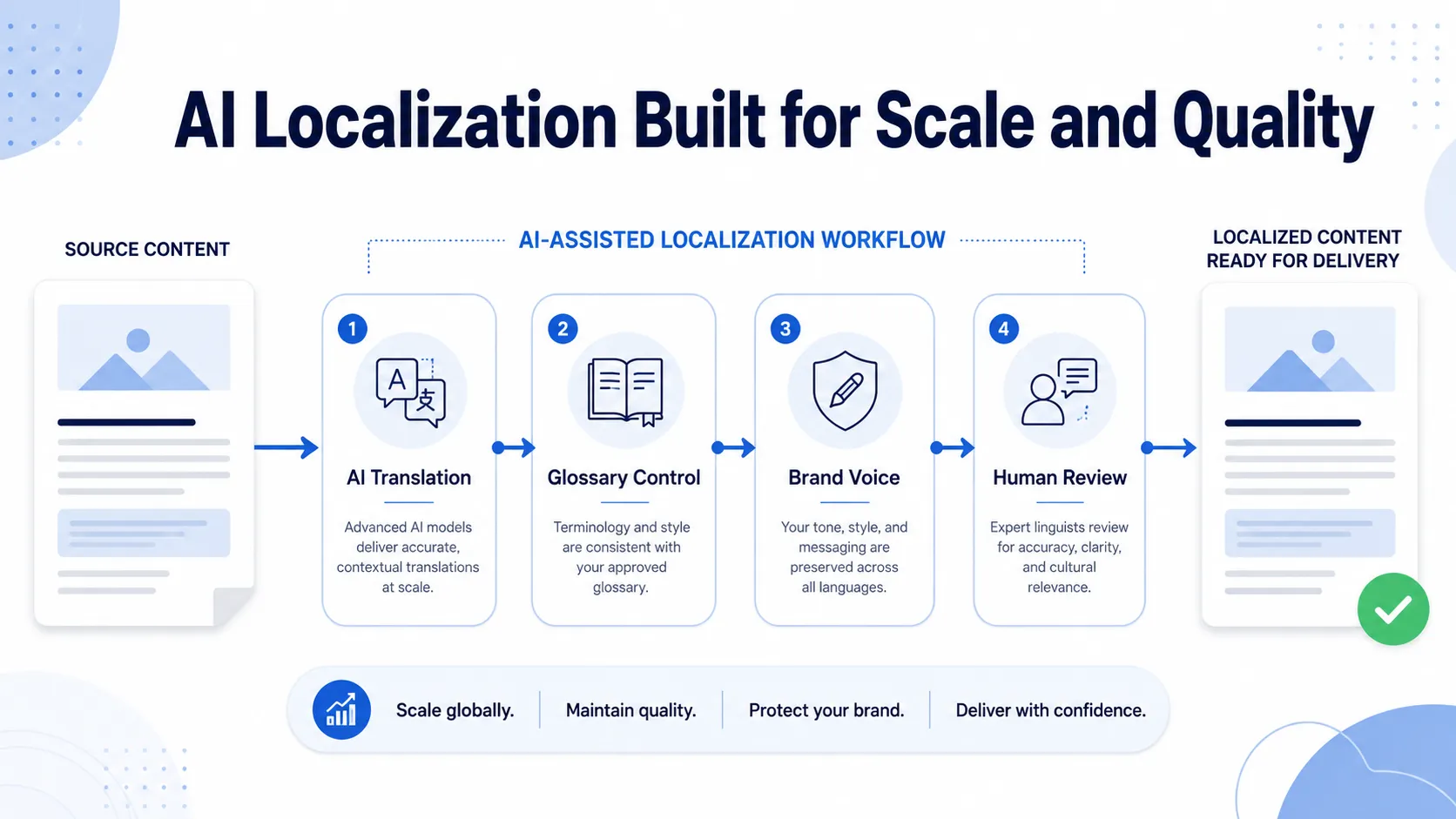
AI localization uses Large Language Models. The technology behind tools like ChatGPT and Claude, etc. for translating and adapting business content at scale. The shift from old-school machine translation is real, and it’s bigger than just better accuracy.
Traditional MT reads sentence by sentence and swaps words based on probability. AI localization reads the whole document, understands the context, and can be told to match a brand voice, apply a glossary, or flag content that won’t translate culturally. The result needs far less editing to reach publication quality.
But AI isn’t magic. LLMs handle general business content and marketing copy well, but they still struggle with regulatory submissions, legal contracts, and niche technical content. The right approach for B2B isn’t AI replacing humans — it’s AI working alongside them.
That’s how we work at Circle Translations. We use AI to speed up the delivery of the right content, but every word that reaches you is reviewed by a native-speaking professional under ISO 17100 quality control.
What Is AI Localization?
AI localization is a meaningfully different technology from traditional machine translation, and the difference matters when you’re choosing the right workflow for your business. Traditional MT reads sentence by sentence, ignores everything around the segment it’s translating, and can’t account for brand voice, glossaries, or cultural context. AI localization, powered by LLMs, reads at the document level (32K–200K tokens of context), accepts brand voice profiles and glossaries as part of the prompt, handles cultural adaptation, and generalizes across language pairs without needing parallel training data. The result: better coherence across long content, output that sounds like your brand in every language, and significantly less post-editing on qualifying content. The catch. It narrows the quality gap relative to human translation for general business content, but it doesn’t close it for high-stakes work such as legal contracts, regulated submissions, or technical documentation.
The Three Core Technologies Behind AI Localization: NMT, LLMs, and TMS Automation
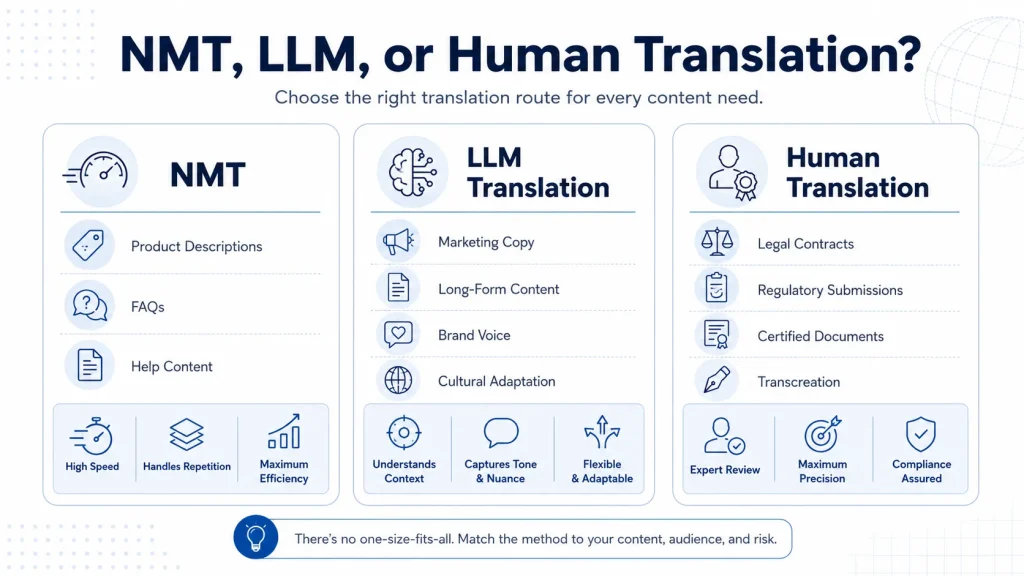
AI localization is not a single technology but a stack of 3 complementary components. Each with a distinct function in the business translation workflow.
Technology 1 — Neural machine translation (NMT) engines
Modern NMT engines (Google Cloud Translation, DeepL API, ModernMT, SYSTRAN) are the foundational translation component in most AI localization workflows. NMT has been the standard MT approach since 2016. NMT engines in 2025 AI localization workflows are typically used for:
- High-volume, lower-stakes functional content (product descriptions, FAQ, help documentation) where speed and per-word cost are primary drivers.
- MTPE workflows where a professional post-editor corrects and refines NMT output.
- Domain-adapted NMT — enterprise MT providers offer fine-tuning of the NMT engine on a client’s existing parallel translation data, improving performance on domain-specific vocabulary.
Technology 2 — Large language models (LLMs)
LLMs (GPT-4o, Claude 3.5 and 3.7, Gemini 1.5 Pro, Llama 3, Mistral, Qwen) represent the newer generation of AI translation technology. LLMs differ from dedicated NMT engines in 4 key ways: a much larger context window (32K–200K tokens versus sentence-level NMT); prompt engineering capability (LLMs receive brand voice profiles, style guides, and glossaries as part of the translation prompt); instruction-following (LLMs can be instructed to adapt tone, maintain a specific register, flag culturally problematic content, and suggest alternative translations for review); and broad multilingual capability without domain-specific fine-tuning.
Technology 3 — Translation management system (TMS) automation
A TMS (Lokalise, Phrase, SDL Trados, XTM, Crowdin) is the orchestration layer that connects content sources, translation workflows, translators, AI engines, and delivery channels. The TMS in an AI localization workflow performs 5 functions: routes content to the correct AI engine or human translator based on content type and quality tier; applies translation memory (TM) before AI pre-translation to save cost on exact and fuzzy matches; enforces terminology (termbase) in the AI output and post-editing environment; manages review and approval workflows defining who reviews AI output and at what quality standard; and tracks quality metrics (post-edit rate, BLEU scores, MQM error density) over time.
How the three technologies interact
A production AI localization workflow uses all three components in sequence: the TMS receives content, applies TM, and routes to AI pre-translation; NMT or LLM produces the pre-translated draft; professional post-editors in the TMS environment review, correct, and approve the AI draft; approved translations are added to the TM; the termbase is updated with any new approved terms.
LLM Translation vs NMT: When to Use Each in a B2B Localization Programme
Not all business content should be routed to the same AI system. Choosing between NMT and LLM pre-translation depends on content type, required quality, and the cost/speed/quality trade-off.
When NMT is the right choice
- High-volume, structurally repetitive content (eCommerce product descriptions, FAQ strings, UI text, help-centre articles) where TM leverage is high and per-word cost is the primary driver.
- Content where existing domain-adapted NMT engines perform well due to training on parallel data from the same domain.
- Content that will receive full MTPE regardless — NMT is cheaper per word than LLM API calls for high volumes, where the post-editor will correct everything anyway.
When LLM is the better choice
- Content where brand voice, tone, and register matter — marketing copy, brand communications, campaign content — where LLM prompt engineering with a brand voice profile produces better drafts than NMT.
- Longer-form content with complex discourse structure (white papers, long-form articles, detailed reports) where LLM document-level context produces better coherence than NMT’s sentence-level approach.
- Content with complex cultural adaptation requirements — LLMs can be instructed to flag or adapt cultural references; NMT treats them as literal text.
- Low-resource language pairs where LLM generalization outperforms NMT, which requires parallel training data.
Content where neither NMT nor LLM is appropriate alone
- Regulated submissions (pharmaceutical MAA, CE marking documentation, food label regulatory content) — AI pre-translation can produce a draft, but regulatory vocabulary, authority-mandated terminology, and compliance requirements cannot be verified by AI alone; qualified human review with regulatory domain expertise is mandatory.
- Legal contracts — defined terms, jurisdictional concept equivalence, and legal register require human legal translation expertise.
- Certified translations — require a named human translator with professional accountability; AI output cannot be certified.
Brand Voice in AI Localization
Brand voice prompt engineering is the LLM capability that most clearly differentiates AI localization from traditional MT and has the greatest commercial impact for marketing-led B2B organizations.
Traditional NMT produces the statistically most probable translation of a source text. It has no concept of brand identity, tone of voice, or the specific register a company wants to maintain in the target language. Every brand’s content reads the same in NMT output: generic, neutral, statistically correct.
LLM-based AI localization accepts brand voice instructions as part of the translation prompt. There are 5 prompt elements that shape LLM output for brand-aligned translation:
- Tone descriptors: “Translate in a confident but accessible tone — avoid corporate jargon; prefer active voice; short sentences.”
- Register specification: “Use formal address (Sie in German; vous in French) throughout; the brand addresses business professionals formally.”
- Vocabulary preferences: “Use ‘Schulung’ not ‘Training’ for the German equivalent of ‘training sessions’ — the client’s preferred term.”
- Cultural adaptation flag: “Flag any cultural references, idioms, or wordplay in the source that may not translate directly — propose alternatives or flag for human review.”
- Style guide examples: “The brand voice reference examples are the following 3 approved source/target pairs — produce output consistent with this register and vocabulary.”
The result vs traditional MT
A traditional NMT translation of marketing copy produces accurate but tone-deaf output. Correct vocabulary, wrong energy. An LLM translation with a brand voice prompt produces output that is both accurate and tonally appropriate to the brand. The post-editing task on brand-voiced LLM output is dramatically smaller than on standard NMT output. Because the LLM has already resolved most register and tone issues in the pre-translation.
Honest limitation
LLM brand voice output exceeds NMT output for most marketing content. But it is not as good as a dedicated human transcreation by a native-language copywriter-transcreation who has internalized the brand voice. For campaign headlines, taglines, and high-creativity brand content, transcreation remains the quality standard. LLM brand voice prompting is appropriate for website copy, email communications, product descriptions, and social content at scale.
The AI+Human Localization Workflow
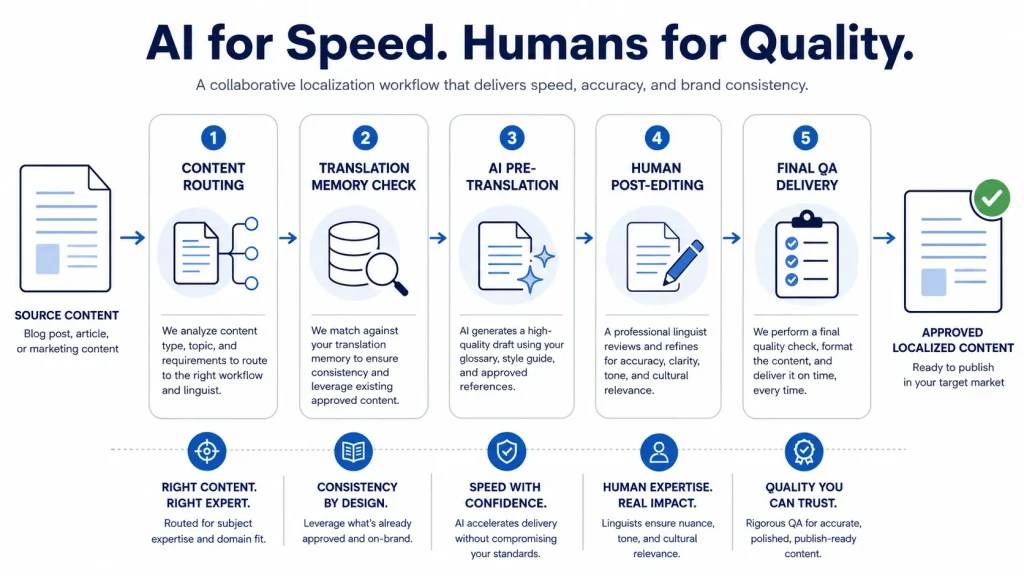
The commercially effective AI localization workflow is not AI replacing humans. It is AI handling first-draft volume while human expertise handles quality validation, specialized domains, and brand-critical content. The 8 content types below define how to route work between AI and human translators in a mature B2B program.
| Content Type | AI Involvement | Human Role | Quality Output | Cost Index | Speed |
|---|---|---|---|---|---|
| High-volume functional content (product descriptions, FAQs, help articles) | NMT or LLM pre-translation | MTPE — native post-editor corrects and approves | Publication quality | 40–60% saving vs full human | 2–3× faster |
| Website core pages and marketing content | LLM pre-translation with brand voice prompt | Human review and brand adaptation | Near-human to human quality | 25–40% saving | 1.5–2× faster |
| Legal contracts and compliance documents | AI as reference or draft only | Full human translation by legal domain expert; ISO 17100 two-stage | Human-quality | No cost saving | Standard |
| Pharmaceutical and regulatory submissions | AI as reference draft for review | Pharmaceutical translator + regulatory QA; authority-vocabulary verification | Regulatory-compliant human quality | No cost saving | Standard |
| Campaign and brand transcreation | AI as creative starting point only | Dedicated transcreation brief; native-language copywriter-translator | Transcreation quality | No cost saving | Standard |
| Technical documentation (manuals, specifications, SDS) | NMT with domain adaptation | MTPE by technical domain specialist | MTPE quality | 35–50% saving | 2× faster |
| Clinical trial documents (ICFs, protocols) | AI as draft only | Qualified clinical translator; back-translation for COA/PRO; ISO 17100 QA | Clinical/regulatory quality | No cost saving | Standard |
| APAC complex language pairs (Japanese, Chinese, Korean) | NMT or LLM with lower quality ceiling | Higher post-editing ratio required; native review essential | MTPE quality (higher editing ratio) | 20–35% saving | 1.5× faster |
The 5-Step AI-Augmented Localization Workflow
A production AI localization workflow follows 5 sequential steps from content ingestion to final delivery. Each step has a defined function and a quality control purpose.
Step 1 — Content analysis and routing
Content analysis routes each piece of content to the correct quality tier before any AI translation begins. This step determines what content type each piece represents, what quality tier applies (AI-only pre-translation with MTPE; LLM pre-translation with brand voice; full human translation), what language pairs are involved, and whether any content requires regulatory vocabulary verification (pharmaceutical, food labeling, medical device). Content routing in a mature AI localization program is partially automated — TMS rules route content based on metadata such as file type, source module, and content tag — but the routing rules themselves must be human-designed and regularly reviewed.
Step 2 — Translation memory pre-check
The TMS applies the translation memory to the content before any AI pre-translation is triggered. Any segment with a high-confidence TM match (exact match or high fuzzy match) is auto-populated from the TM without invoking the AI engine — saving cost and maintaining consistency with previously approved translations. New content only flows to the AI pre-translation step.
Step 3 — AI pre-translation
New segments are pre-translated by the appropriate AI engine. NMT pre-translation uses the enterprise MT API (Google Cloud Translation, DeepL API, ModernMT) with active termbase and domain adaptation settings applied. LLM pre-translation sends a structured prompt containing source text, brand voice profile, glossary, style guide examples, and cultural adaptation instructions to the LLM, and the output is returned to the TMS as the pre-translated draft.
Step 4 — Human post-editing and review
A qualified native-language post-editor reviews the AI draft in the TMS environment. Post-editing performs 5 tasks: correct accuracy errors (particularly the “fluent but wrong” NMT error type); enforce termbase compliance for any terms the AI failed to render correctly; adjust register and brand voice where the AI output does not match the style guide; adapt cultural references flagged by the LLM; and verify completeness so no segments are omitted. For regulated content (pharmaceutical, legal), a second qualified translator performs an independent full revision — the ISO 17100 two-stage workflow applies regardless of whether AI was used for the first draft.
Step 5 — TM update, quality recording, and delivery
Approved translated segments are added to the TM — ensuring that identical or similar content in future projects benefits from TM leverage. Any new terminology decisions are added to the termbase. Quality metrics (post-edit distance, error density, MQM scores where applied) are recorded. The final translated content is delivered in the client’s required format and platform.
AI Localization Quality Risks
AI localization failure modes differ from human translation failure modes in predictable ways. and professional human review targets exactly these patterns. 5 failure modes are documented in production AI localization workflows.
Failure mode 1 — The “fluent but wrong” accuracy error
LLMs produce output that sounds grammatically correct and natural in the target language while conveying a different meaning from the source. Unlike a grammar error (visible to any native reader), an LLM fluent-but-wrong error may only be detectable by someone who reads both source and target with domain expertise. This is the most commercially dangerous AI output error type — it passes casual review but fails specialist review. Prevention: post-editor with domain expertise; comparative source-target review (not just target readability review).
Failure mode 2 — Terminology hallucination
LLMs occasionally generate plausible-sounding but incorrect terminology. Particularly in specialized domains (pharmaceutical, legal, engineering), where training data is sparse relative to general language content. A hallucinated pharmaceutical term may sound medically plausible but be incorrect for the specific regulatory context. Prevention: termbase integration; regulatory vocabulary verification; pharmacovigilance-specific MedDRA and QRD compliance check.
Failure mode 3 — Register drift across long documents
LLMs may start a long document in formal register and gradually shift toward informal register as the document progresses — particularly when the context window fills, and earlier prompt instructions have reduced weight in the model’s attention. Prevention: section-by-section register audit; style guide consistency check across the full document.
Failure mode 4 — Cultural blind spots
LLMs have cultural knowledge embedded in their training data, but cultural nuance in brand and marketing content often exceeds what training data can capture for specific brand contexts. A brand’s specific cultural positioning in the target market — the associations, the competitive landscape, and the audience expectations. It is not in any LLM’s training data. Prevention: human review by a culturally embedded native translator with knowledge of the brand’s target market.
Failure mode 5 — Data privacy and IP risk
Submitting commercially sensitive content to a public LLM API (consumer tiers of OpenAI, Google Gemini, and Anthropic Claude) may expose it to the provider’s data retention and model training policies, similar to the risk posed by the free MT tool. For pharmaceutical pre-launch data, undisclosed financial information, and legally privileged content, content governance policies must specify which AI systems are permitted. Prevention: enterprise API agreements with zero data retention; GDPR Data Processing Agreement; explicit no-model-training-on-client-content clause.
Where Human Expertise Remains Non-Negotiable in AI Localization Programs
AI handles qualifying content brilliantly, but for these 4 categories, human expertise can’t be replaced:
- Pharmaceutical and medical device submissions — AI can draft, but only a qualified pharmaceutical translator can verify MedDRA terminology, EMA QRD compliance, and ICH-governed clinical content. AI cannot verify regulatory compliance.
- Legal contracts and commercial agreements — defined terms, modal language (shall/may/must), and jurisdictional equivalence (think “consideration” in common law vs. civil law) — require a human legal translator. AI drafts are useful for review, not for signing.
- Transcreation and high-creativity brand content — taglines, brand manifestos, and emotive campaign copy depend on cultural feel and creative skill that AI consistently falls short on.
- Linguistic validation for COA and PRO instruments — FDA and EMA require a documented, multi-stage process (forward translation, back-translation, cognitive debriefing, reconciliation) that only qualified human translators can deliver.
How we work at Circle Translations: AI-assisted translation for the right content. High-volume functional copy, websites, marketing — with native-speaker professional post-editing and full QA. Full human translation for legal, pharmaceutical, regulatory, and certification work. The right tool for each job. Human oversight on every delivery.
AI Localization Business Impact
The commercial case for AI-augmented localization is measurable — but the headlines matter less than the numbers behind them. Here are the 6 dimensions worth tracking:
- Translation velocity — 2–3× faster delivery on MTPE-tier content, with a near-instant first draft ready for review. Speed gains are biggest on pre-translation, not on regulated content that still needs human time. Track: time-to-delivery; percentage of projects hitting deadline.
- Per-word cost reduction — 40–60% cheaper than full human translation on qualifying content. No savings on legal, pharmaceutical, or regulated work, where AI is only a reference. Track: cost per word by content type; total program cost trend.
- Translation memory leverage — AI pre-translation builds approved TM faster, and TM savings compound over time. The catch: AI-generated TM still needs human approval before it counts. Track: TM match rate growth; cost per word as TM matures.
- Terminology consistency — termbase-enforced AI pre-translation keeps vocabulary consistent across long documents and large programs. Still needs human verification for regulated terms. Track: terminology error density in QA; client feedback on consistency.
- Brand voice at scale — LLMs with a brand voice prompt hold tone more consistently across high-volume content than MT ever could. Output still needs human sign-off, and the prompt needs to be recalibrated periodically. Track: post-edit rate for tone issues; brand team sign-off rate; first-pass approval rate.
- Time-to-market in new markets — enables simultaneous multi-language launches at a price point that sequential human translation can’t match. Quality thresholds still apply in regulated markets — speed isn’t worth a compliance failure. Track: language launch date vs source launch; post-launch conversion rates.
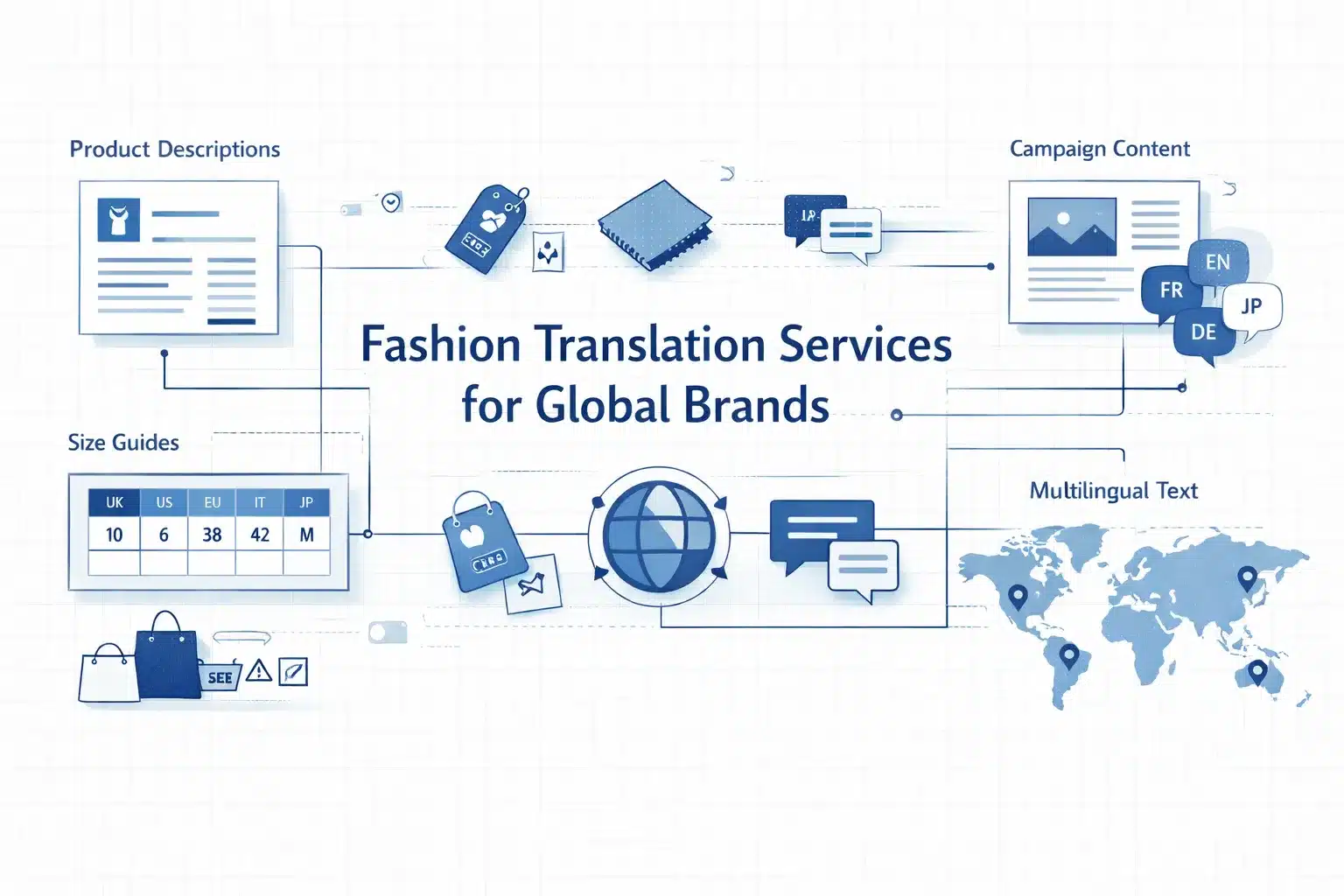
Circle Translations’ eCommerce AI workflow follows 5 stages:
- LLM pre-translation with brand voice prompt and fashion termbase active.
- Native-language fashion translator reviews and post-edits the pre-translated draft.
- Automated QA (Xbench) checks for terminology compliance, number accuracy, and completeness.
- TM updated with approved translations — TM leverage grows season by season.
- Delivery in the client’s CMS format (Shopify, Magento, Zalando data feed, WooCommerce).
AI Localization Data Privacy
AI localization introduces a specific data governance risk that B2B buyers must address before deploying any AI-assisted translation workflow for content that is commercially sensitive, legally privileged, or contains personal data.
The core data risk
Public-facing LLM APIs (consumer tiers of OpenAI, Google Gemini, Anthropic Claude) may retain submitted content and use it for model training under their default terms of service — the same risk documented for free MT tools. A pharmaceutical company submitting pre-approval drug data, a financial services firm submitting undisclosed merger information, or a law firm submitting client-privileged documents may constitute a confidentiality breach.
There are 4 verification points before deploying AI localization for sensitive content:
Verification 1 — Enterprise API agreement: ensure the AI engine is accessed under an enterprise API agreement that explicitly states “customer data is not used for model training.” OpenAI Enterprise and Anthropic Enterprise API both offer this commitment as of 2025; consumer free tiers do not.
Verification 2 — Data Processing Agreement (DPA): for content containing personal data of EU or UK data subjects (HR documents, customer communications, clinical trial data with participant information), the AI provider must be able to sign a GDPR Article 28-compliant DPA.
Verification 3 — Data residency: regulated industries (pharmaceutical, financial services, healthcare) have data residency requirements specifying that data must be processed within specific geographic regions. Verify the AI provider’s data processing location and whether it meets the organisation’s residency requirements.
Verification 4 — Sub-processor disclosure: if the translation agency uses a third-party AI engine as a sub-processor for client content, the agency must disclose this under GDPR Article 28 and ensure the sub-processor has equivalent data protection commitments.
Conclusion
AI localization isn’t a trade-off between speed and quality. It’s about using AI for the right content and keeping human experts on the work that needs them. That’s how we do it at Circle Translations.
We use enterprise-grade AI (never free tools) to pre-translate qualifying content like websites, marketing copy, and product catalogs, with your brand voice and termbase built into the prompt before a single word is generated. Every output is then reviewed by a native-speaker professional under ISO 17100 quality control. For high-stakes work such as legal contracts, regulatory submissions, certified translations, and clinical trial documents, we skip AI shortcuts and go straight to full human translation. Your data is protected with enterprise API agreements, GDPR-compliant DPAs, and an NDA before we even receive your files.
Tell us your content types, languages, and volume. We’ll design a workflow that delivers the right quality at the right cost.
Design Your AI Localization Workflow →
Frequently Asked Questions
What is AI localization, and how does it differ from standard machine translation?
AI localization uses Large Language Models (LLMs) to translate content with context, tone, and brand voice awareness. Traditional machine translation processes one sentence at a time using statistical probability. AI localization processes full documents with glossaries and style guides built into the prompt, producing more coherent and on-brand output.
Can AI localization replace human translators?
No. AI handles general B2B content, marketing copy, and high-volume functional content well, but fails on regulated submissions, legal contracts, and creative transcreation. The right model is AI+human. AI for speed, humans for quality, and complex content.
What is MTPE, and how does it fit into an AI localization workflow?
MTPE (machine translation post-editing) is the workflow where a qualified native-speaker translator reviews and corrects AI or MT output. It catches “fluent but wrong” errors, enforces terminology, fixes register, and adds the brand voice, turning AI drafts into publication-ready content under ISO 17100 quality control.
Is AI localization safe for confidential business content?
Only if you use enterprise-tier APIs. Free tools like ChatGPT, Gemini, or Claude.ai may retain your content for model training. Enterprise APIs explicitly exclude customer data from training, and a GDPR-compliant DPA plus an NDA from your translation agency are non-negotiable.
Which content types benefit most from AI localization?
The 5 strongest use cases are eCommerce product descriptions, website and marketing copy, help-center and FAQ content, UI strings and software localization, and internal operational documentation.
How does AI localization handle languages like Japanese, Chinese, and Korean?
Performance is lower than for European languages. Japanese has three scripts and complex honorifics; Simplified and Traditional Chinese require separate localisations; and Korean grammar creates segmentation challenges. LLMs outperform older MT for APAC, but you’ll need more post-editing and native-speaker reviewers with market expertise.
How much does AI localization cost compared to full human translation?
AI localization with professional MTPE costs roughly 40–60% less per word than full human translation on qualifying content. At £0.12 per word for human translation, MTPE typically runs £0.06–0.08 per word, and savings grow as your translation memory builds.
What should B2B buyers ask a translation agency about their AI localization workflow?
Ask these 5 questions:
(1) Are you using enterprise-tier APIs with no-model-training commitments?
(2) Can you provide a GDPR-compliant DPA?
(3) Who are your post-editors and what are their qualifications?
(4) Do you apply ISO 17100 to AI-assisted content?
(5) Which content types do you exclude from AI? A credible agency will have specific answers to all 5.