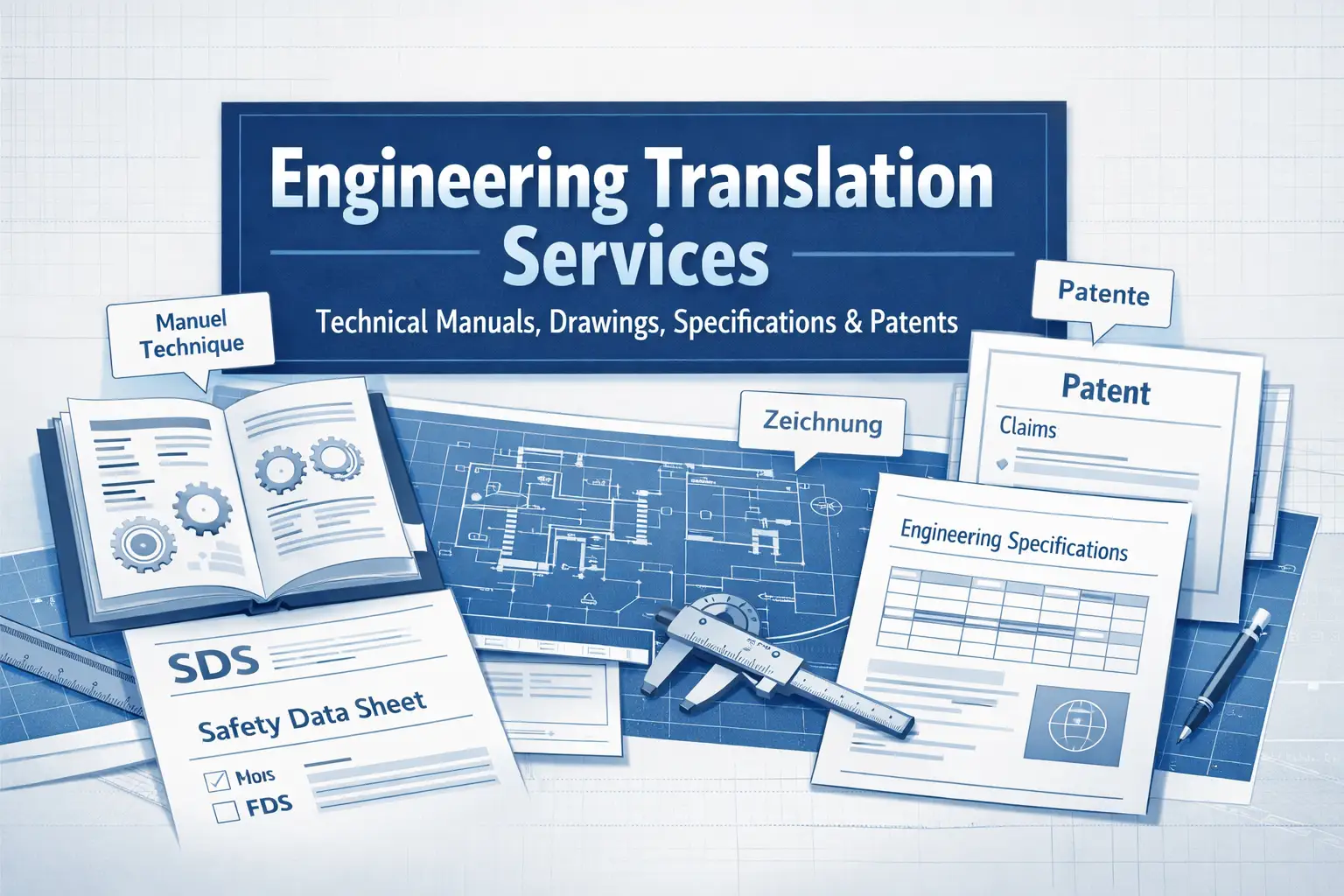
Engineering translation services are professional translation services specialising in engineering documentation, technical manuals, CAD drawings, specifications, safety datasheets, patents, and regulatory submissions, delivered by translators with engineering expertise, not general linguists.
Engineering translation requires absolute precision because errors create real-world consequences. A mistranslated tolerance affects manufacturing. An incorrect safety instruction creates injury risk. A poorly translated patent claim weakens IP protection. Unlike general translation, engineering content demands strict terminology control, correct units of measurement, and compliance with standards such as ISO, ASME, DIN, and CE marking frameworks.
These services are used by engineering firms, project managers, procurement teams, and technical documentation departments operating across multiple markets. They require translation for equipment installation, regulatory approval, international tenders, and technology transfer.
Circle Translations delivers engineering translation through domain-qualified translators across mechanical, electrical, civil, chemical, and software engineering. Every project includes termbase management, ISO 17100-aligned two-stage review, multilingual DTP for complex layouts, and secure handling under NDA.
Engineering Documents That Require Professional Translation: Types, Formats, and Accuracy Requirements
Engineering translation covers manuals, specifications, drawings, patents, and safety documents, each with distinct formats, accuracy risks, and required translator expertise.
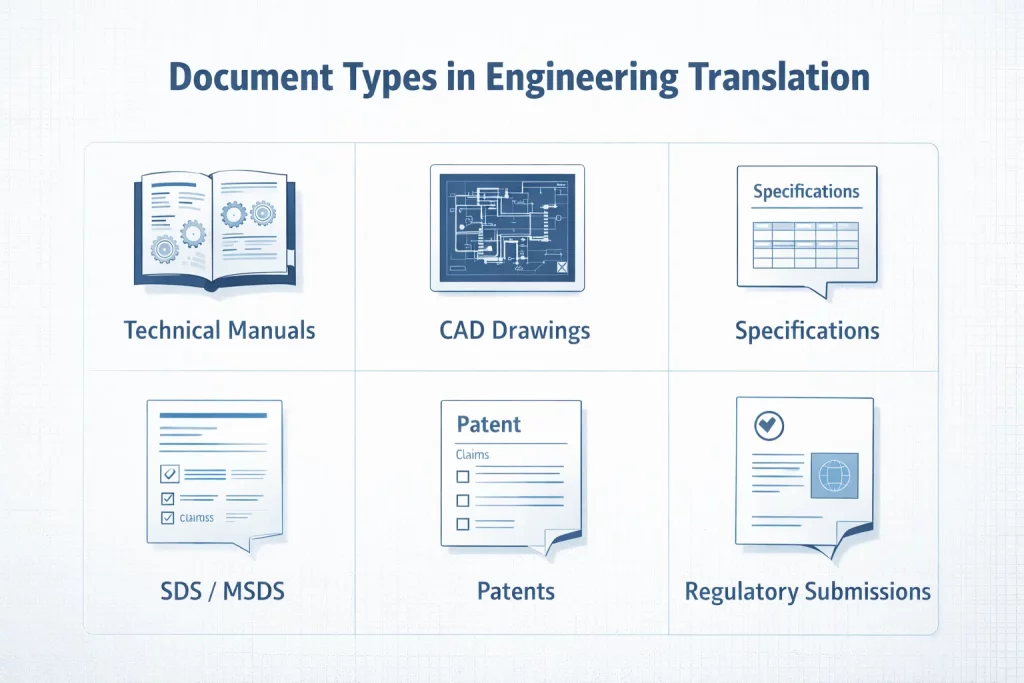
Each document type carries different consequences. Manuals are safety-critical. Specifications are contractually binding. Drawings require terminology alignment. Selecting the correct workflow and translator profile directly impacts operational safety, compliance, and project success.
| Document Type | Format | Primary Use | Translator Requirement | QA Risk |
| Technical manuals | DOCX, PDF, InDesign | Operation, maintenance | Engineering + domain expertise | Safety-critical |
| Specifications | DOCX, PDF | Design, procurement | Engineering + contractual language | Legal + technical |
| CAD drawings | DWG, DXF, PDF | Manufacturing, installation | Mechanical/civil background | Medium–high |
| Patents | DOCX, PDF | IP protection | Patent + engineering expertise | Legal |
| SDS/MSDS | DOCX, PDF | Safety compliance | Chemical engineering | Regulatory |
B2B implication
Each document requires a different translator profile and QA workflow. Using generalist translators increases safety risk, contractual exposure, and rework cost.
Transition
The highest-risk documents, manuals, drawings, and specifications—require specific handling due to safety, format, and contractual precision.
Technical Manual and User Guide Translation: EN 82079-1, Safety-Critical Wording, and Format Preservation
Technical manual translation requires strict compliance with safety standards, precise procedural language, and layout preservation to ensure usability and legal compliance.
Manuals contain safety instructions, operational steps, and technical data. Safety sections must follow standards such as EN 82079-1 and Machinery Directive 2006/42/EC. Signal words (DANGER, WARNING, CAUTION) must match target-language regulatory equivalents. Incorrect wording creates liability.
Procedural instructions require:
- Consistent terminology aligned with parts lists and drawings
- Imperative verb forms for clarity
- Accurate units (Nm, bar, mm) with correct locale formatting
DTP is mandatory because translated text expands by 15–35% in most European languages, breaking layouts without adjustment.
Incorrect manuals lead to misuse, safety incidents, and compliance failure. Professional translation combines engineering expertise, terminology control, and DTP.
CAD Drawing and Technical Drawing Translation: Title Blocks, Drawing Legends, Part Labels, and Annotation Text
CAD drawing translation focuses on translating embedded text elements, title blocks, legends, labels, and notes, while preserving geometry and dimensions.
Engineering drawings are not language-neutral. Critical translatable elements include:
- Title blocks (project, revision, units)
- Legends and symbol keys
- Part labels and callouts
- General notes and BOM tables
| Element | Translated | Not Translated |
| Title block text | ✓ | – |
| Drawing notes | ✓ | – |
| Part labels | ✓ | – |
| Geometry/dimensions | – | ✓ |
Consistency is critical. Part names must match manuals, specifications, and procurement documents exactly. Termbase enforcement ensures alignment across all assets.
B2B implication:
Inconsistent drawing terminology causes assembly errors, procurement mistakes, and production delays.
Engineering Specification Translation: Standards References, Units of Measurement, and Contractual Precision
Engineering specification translation requires exact handling of standards, units, and modal verbs because specifications are legally binding documents.
Three critical risk areas:
- Standards references
Standards such as ASTM, ISO, DIN, and ASME must be correctly maintained or mapped to target-market equivalents where required. - Units of measurement
| Scenario | Risk |
| No conversion | Misinterpretation in target market |
| Incorrect conversion | Engineering failure |
| Dual units missing | Procurement errors |
Client instruction is required before translation.
- Modal verbs (contractual meaning)
- SHALL = mandatory
- SHOULD = recommended
- MAY = permitted
Incorrect translation changes legal obligations.
B2B implication:
Specification errors create contractual disputes, compliance failures, and financial liability.
Transition:
Manuals, drawings, and specifications demonstrate that engineering translation is not linguistic—it is a controlled technical process requiring domain expertise, terminology systems, and structured QA.
Engineering Translation by Sub-Discipline: Mechanical, Electrical, Civil, Chemical, and Software
Different engineering disciplines require translators with specific domain expertise, standards knowledge, and terminology control. Cross-discipline translation introduces accuracy and compliance risk.
Each discipline uses distinct vocabulary, document types, and regulatory frameworks. Matching translator expertise to discipline ensures technical accuracy and regulatory compliance.
| Engineering Discipline | Key document types | Specific terminology domains | Standards knowledge required |
| Mechanical engineering | Manuals, assembly drawings, maintenance procedures | GD&T, materials, thermodynamics, fluid systems | ISO, ASME, DIN, ASTM |
| Electrical engineering | Schematics, wiring diagrams, control manuals | Power systems, PLC logic, circuit terminology | IEC 60617, NEC, IEC 61439 |
| Civil & structural | Drawings, geotechnical reports, tenders | Soil mechanics, structural analysis | Eurocode, ACI, AISC |
| Chemical & process | SDS, P&ID, HAZOP reports | Chemical nomenclature, reaction systems | REACH, GHS, ATEX |
| Environmental | EIA, EHS reports, ESIA | Emissions, ecological systems | ISO 14001, EPA |
| Petroleum & energy | Drilling manuals, reservoir reports | Offshore systems, geology | API, NORSOK |
| Software & control | HMI, SCADA, PLC documentation | UI labels, control logic | IEC 61508, IEC 61511 |
Mechanical Engineering Translation: Assembly Drawings, Maintenance Manuals, and Machinery Directive Compliance
Mechanical engineering translation requires compliance with CE marking rules, correct GD&T interpretation, and strict terminology alignment across manuals and drawings.
Key requirements:
- Machinery Directive 2006/42/EC mandates manuals in the local language
- EN 82079-1 defines instruction structure and safety wording
- GD&T standards (ISO 1101, ASME Y14.5) require correct interpretation of symbols and notes
- Spare parts catalogues must align with part naming systems
Business impact:
Incorrect terminology leads to assembly errors, incorrect spare part orders, and compliance failures.
Chemical and Process Engineering Translation: SDS, P&ID, HAZOP, and ATEX Documentation
Chemical translation requires strict adherence to regulatory frameworks and standardised terminology due to direct safety and environmental risk.
Key requirements:
- SDS must follow 16-section GHS format
- H- and P-statements must use official standardised translations
- P&ID diagrams require distinction between tags (non-translatable) and notes (translatable)
- HAZOP guidewords (NO, MORE, LESS) must use established equivalents
- ATEX documentation requires correct explosion protection terminology
Business impact:
Errors in chemical documentation create regulatory violations, safety incidents, and legal liability.
Civil, Structural, and Environmental Engineering Translation: Tender Documents, Geotechnical Reports, and EIA Submissions
Civil engineering translation requires contractual precision, correct classification systems, and alignment with national standards.
Key requirements:
- FIDIC contracts must preserve clause structure and defined terms
- Geotechnical reports require correct soil classification (USCS, Eurocode 7)
- EIA/ESIA reports must balance technical accuracy with public readability
- Eurocode references must match target-country National Annex
Business impact:
Translation errors lead to contract disputes, design misinterpretation, and regulatory rejection.
B2B takeaway:
Engineering translation is discipline-specific. Using non-specialist translators increases risk across safety, compliance, and project execution.
The Engineering Translation Quality System: Terminology Control, Two-Stage Review, and Technical Accuracy Verification
Engineering translation quality is achieved through three control layers: terminology management, multi-stage human review, and technical validation aligned with engineering standards.
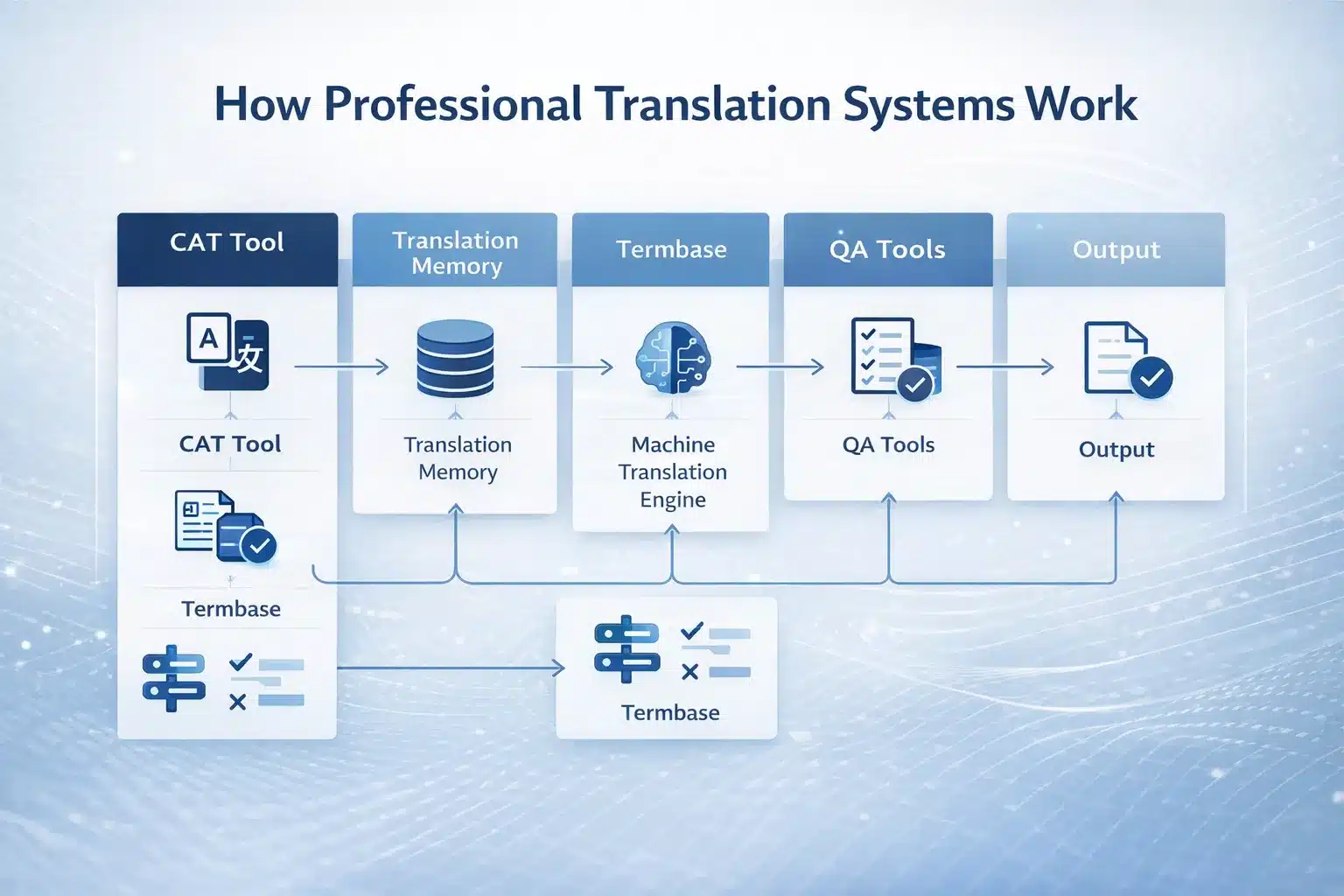
Tools alone do not ensure accuracy. Quality depends on structured workflows that prevent terminology errors, enforce consistency, and verify technical correctness before delivery.
Engineering Termbase Management: Why Consistent Technical Vocabulary is Non-Negotiable
Engineering termbases enforce consistent technical vocabulary across manuals, drawings, and specifications, eliminating ambiguity and preventing operational errors.
Engineering terminology is not interchangeable. A single term can affect assembly, safety, and compliance.
| Risk Area | Without Termbase | With Termbase |
| Part names | Inconsistent labels | Standardised across all documents |
| Safety terms | Misinterpretation | Controlled wording |
| Technical terms | Synonym variation | Approved terminology only |
Key features:
- Preferred and forbidden terms
- Domain tagging (mechanical, electrical, chemical)
- Alignment across manuals, drawings, and BOMs
Business impact:
Terminology inconsistency causes incorrect assembly, procurement errors, and safety risks.
Two-Stage Review Workflow for Engineering Translations: Translator, Reviser, and Technical Reviewer Roles
Engineering translation requires a minimum two-stage human review process to ensure accuracy, consistency, and compliance.
| Role | Responsibility | Outcome |
| Translator | Produces initial translation using CAT tools, TM, and termbase | Accurate draft |
| Reviser | Reviews for correctness, consistency, and terminology | Error-free version |
| Technical reviewer (SME) | Validates engineering accuracy and standards alignment | Domain validation |
Workflow sequence:
- Translation (domain-qualified translator)
- Revision (independent linguist)
- Technical validation (engineer/SME if required)
Benchmark:
ISO 17100 requires at least translation + revision. Engineering workflows often add SME validation for high-risk content.
Business impact:
Single-stage translation increases error rates. Multi-stage review reduces risk in safety-critical and contractual documents.
ASD-STE100 Simplified Technical English and Controlled Language in Engineering Documentation
ASD-STE100 standardises technical writing using controlled vocabulary and grammar rules to improve clarity and translatability.
It is widely used in aerospace, defence, and manufacturing.
Key principles:
- Limited vocabulary with approved meanings
- Short sentences (typically <20 words)
- One instruction per sentence
- Consistent terminology
Translation impact:
- Reduces ambiguity in source text
- Improves MT and CAT tool performance
- Increases consistency across languages
Business impact:
Controlled language reduces translation cost and improves accuracy, especially in large-scale documentation programmes.
Multilingual DTP for Engineering Documents: Layout Restoration After Translation Across InDesign, FrameMaker, Word, and PDF
Multilingual DTP ensures translated engineering documents maintain correct layout, formatting, and readability after text expansion.
Engineering documents rely on structured layouts:
- Tables, diagrams, callouts
- Safety labels and warnings
- Cross-references and numbering
| File Type | DTP Requirement | Risk Without DTP |
| InDesign | Full layout rebuild | Broken layouts |
| FrameMaker | Structured document control | Incorrect formatting |
| Word | Style and numbering fixes | Inconsistent structure |
| PDF (editable) | Text layer adjustment | Misaligned content |
Text expansion benchmarks:
- German: +20–35%
- French: +15–25%
- Spanish: +15–20%
Business impact:
Poor DTP leads to unreadable manuals, misaligned diagrams, and compliance issues in safety documentation.
Final takeaway:
Engineering translation quality is not a single step—it is a system combining terminology control, structured review, controlled language, and layout precision.
Patent Translation and Regulatory Submissions in Engineering: IP Protection, EP Validation, and Standards Compliance
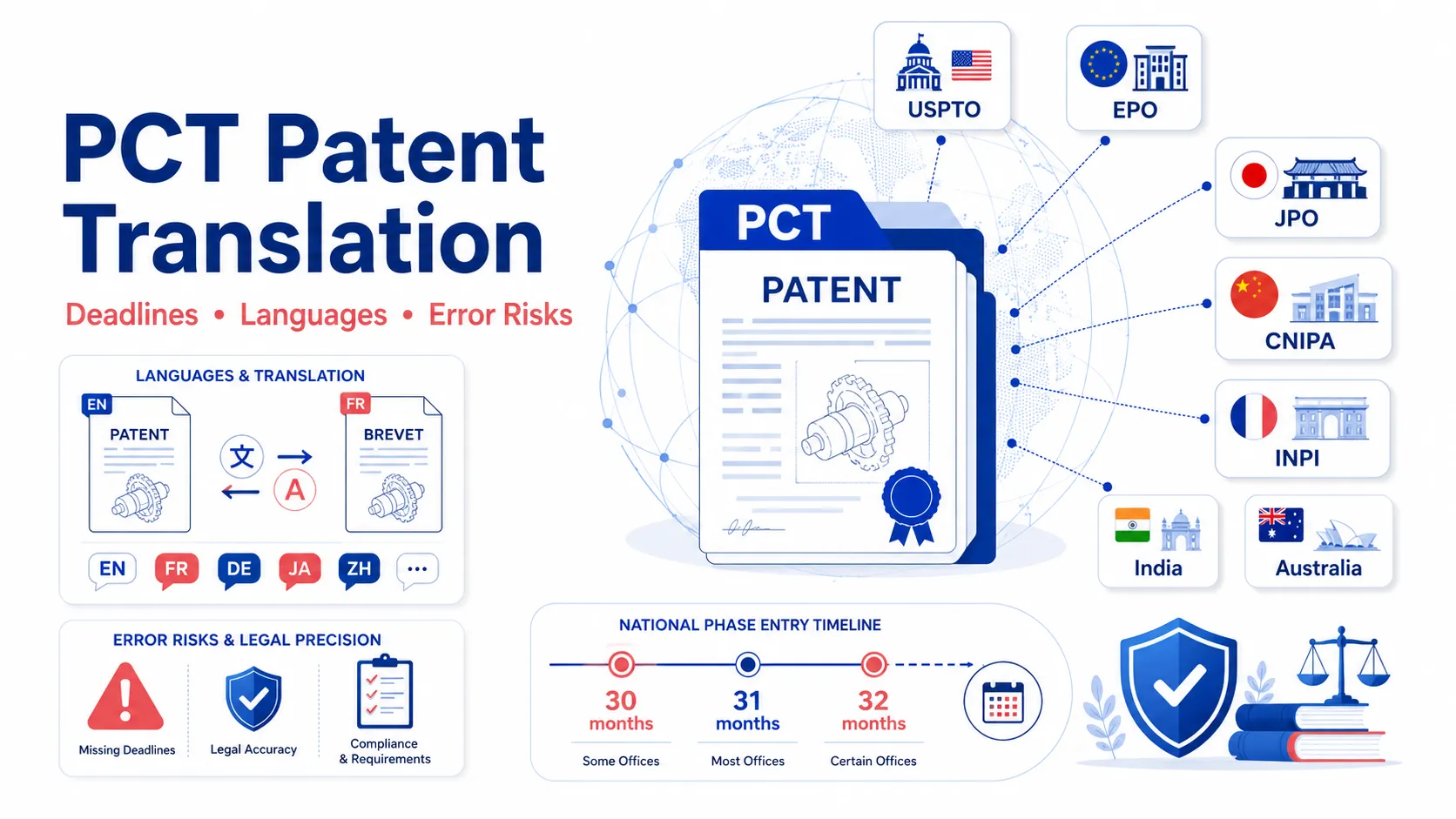
Patent translation and regulatory submissions require absolute terminology precision because errors directly affect IP protection, market access, and legal compliance.
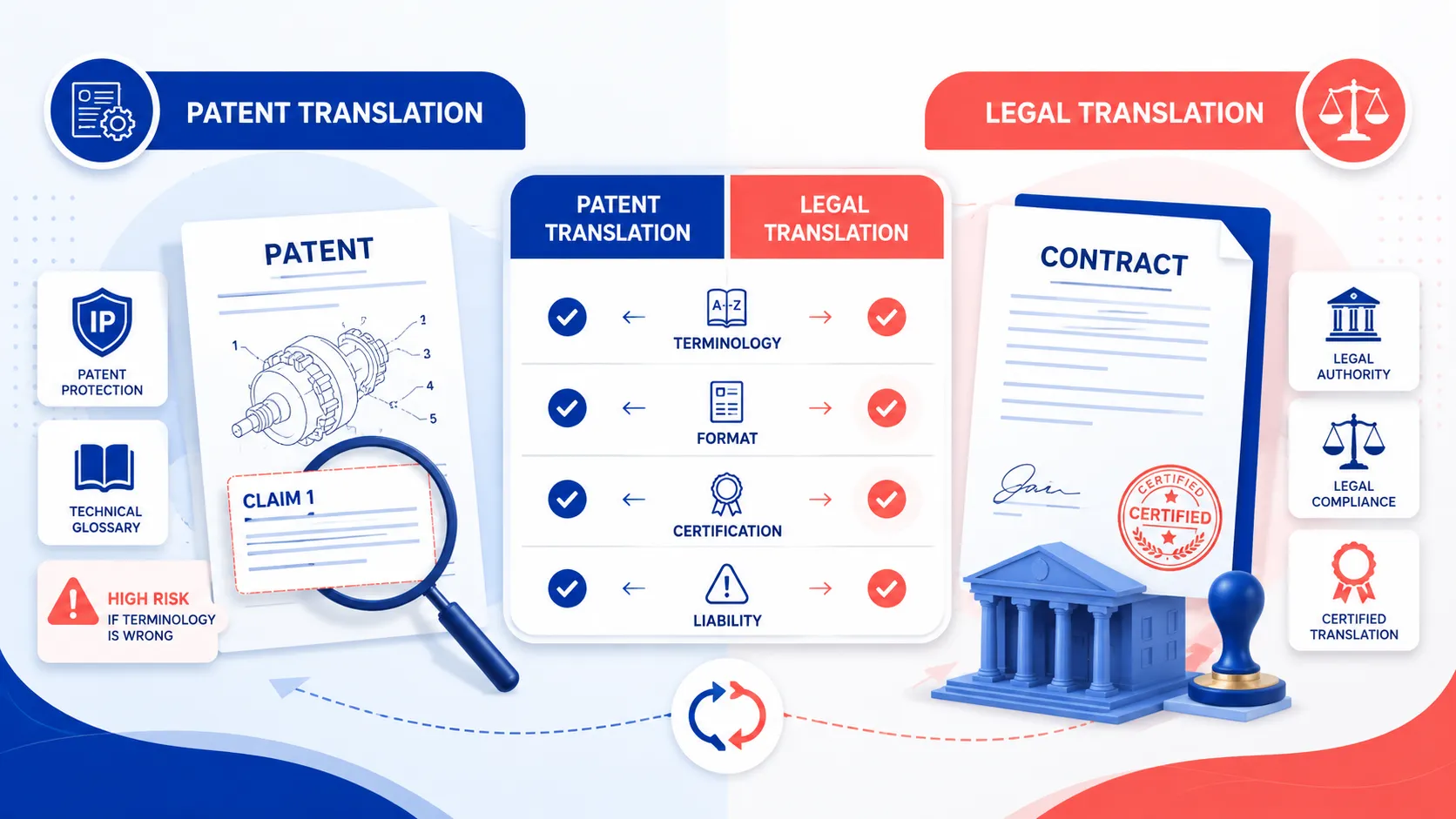
These documents represent the legal layer of engineering. Unlike manuals or specifications, inaccuracies here create enforceability gaps, rejected filings, or loss of protection.
Engineering Patent Translation: Claims, Descriptions, and EP Validation Requirements
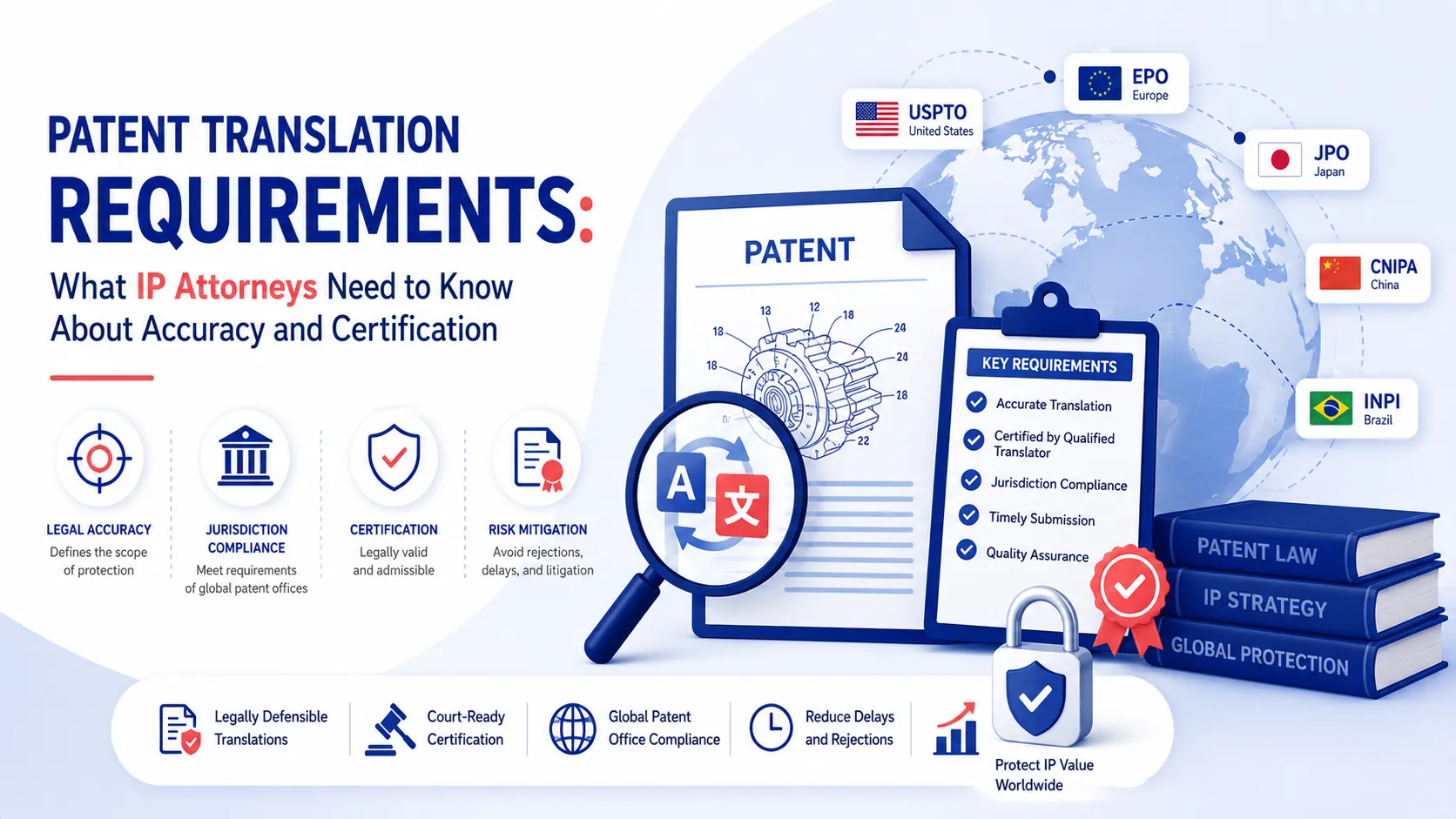
Patent translation requires precise handling of claims, descriptions, abstracts, and drawings to preserve the legal scope of protection.
Patent structure and translation requirements:
| Section | Function | Translation risk | Requirement |
|---|---|---|---|
| Claims | Define legal protection scope | Scope distortion | Exact legal + technical wording |
| Description | Explains invention | Technical inaccuracy | Domain expertise |
| Abstract | Summary | Terminology mismatch | Consistency with claims |
| Drawings | Visual reference | Label inconsistency | Terminology alignment |
Key requirements:
- Claims must not broaden or narrow scope
- Terminology must match patent law conventions (EPO, USPTO, WIPO)
- Drawings and reference terms must align with description
EP validation:
European patents must be translated into required national languages within strict deadlines. Failure results in loss of protection in those jurisdictions.
Business impact:
Incorrect patent translation weakens IP protection and creates legal exposure.
Regulatory Compliance Translations for Engineering: CE Marking, REACH, ATEX, and International Standards Submissions
Regulatory translation ensures engineering products meet language and documentation requirements for market access in each jurisdiction.
| Regulation | Document requirement | Language requirement | Risk if incorrect |
| CE Marking | Declaration of Conformity, IFU | Official EU languages | Market rejection |
| REACH | SDS (16-section format) | Local language per country | Legal non-compliance |
| ATEX | Safety documentation | Local language | Safety risk |
| Certification bodies (TÜV, SGS, DNV) | Certificates | Certified translation | Contract rejection |
Key requirements:
- SDS must use official GHS H/P statements
- CE documentation must match target market language
- Technical files may require translation for audits
Business impact:
Non-compliant translations lead to product recalls, blocked market entry, and regulatory penalties.
Technology Transfer and Cross-Border Engineering Project Documentation: Language Requirements for International Collaboration
International engineering projects require continuous translation across design, procurement, construction, and handover phases.
| Project phase | Documents | Translation requirement | Risk |
| Design | Drawings, specs | High accuracy | Design errors |
| Procurement | RFQs, bids | Contract precision | Commercial disputes |
| Construction | Site instructions | Fast + accurate | Execution errors |
| Commissioning | Test procedures | Technical accuracy | System failure |
| Handover | Manuals, as-built docs | Long-term clarity | Maintenance risk |
Technology transfer includes:
- Licensing agreements (legal precision)
- Technical documentation (engineering accuracy)
- Training materials (operational clarity)
Translation errors disrupt collaboration, delay projects, and create long-term operational risk.
Translating Technical Content Where Errors Aren’t an Option
Circle Translations works with domain-specialist engineering translators to handle manuals, technical drawings, specifications, and patents — with terminology precision and QA built in at every stage.
Frequently Asked Questions – Engineering Translation Services
What are engineering translation services and what documents do they cover?
Engineering translation services cover manuals, drawings, specifications, patents, SDS, HAZOP reports, and regulatory documents. They require translators with engineering expertise to ensure accuracy, compliance, and correct terminology across all content types.
How much do engineering translation services cost per word?
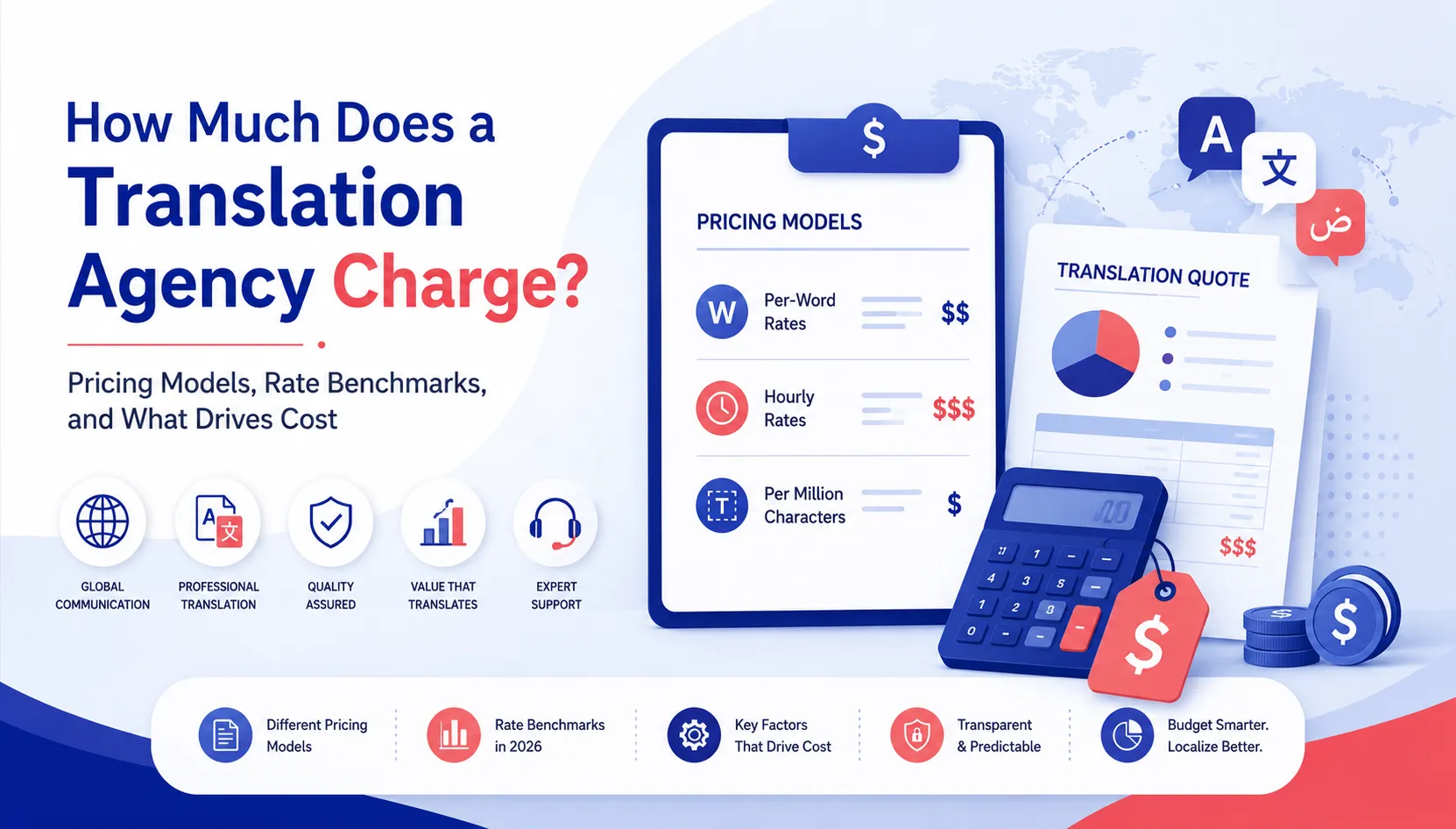
Engineering translation costs $0.18–$0.35 per word, depending on complexity and discipline. Specialised content costs more, while translation memory and MTPE reduce overall costs.
Do engineering translators need to be qualified engineers?
Engineering translators require domain expertise or engineering backgrounds to ensure technical accuracy. They must understand standards, systems, and terminology used in real engineering contexts.
What is the turnaround time for engineering manual translation?
Engineering manual translation takes 2–10 business days, depending on volume and complexity. Large projects and multilingual DTP increase turnaround time.
Can machine translation be used for engineering documents?
Machine translation is suitable only with MTPE and not for safety-critical or legal content. It works for repetitive text but fails on high-risk documentation.
What is multilingual DTP and why is it needed?
Multilingual DTP restores layout after translation expands text by 15–30%. It ensures manuals and technical documents remain readable and compliant.
How is confidential engineering content handled?
Confidential content is protected through NDAs, encrypted transfer, and secure storage. All contributors operate under strict data protection protocols.
What languages are most common in engineering translation?
German, French, Spanish, Chinese, Japanese, Arabic, Russian, and Portuguese are the most common. EU projects often require multiple official languages.
What is the difference between engineering and technical translation?
Engineering translation is discipline-specific and high-risk, while technical translation is broader and less specialised. Engineering requires stricter accuracy, standards compliance, and domain expertise.