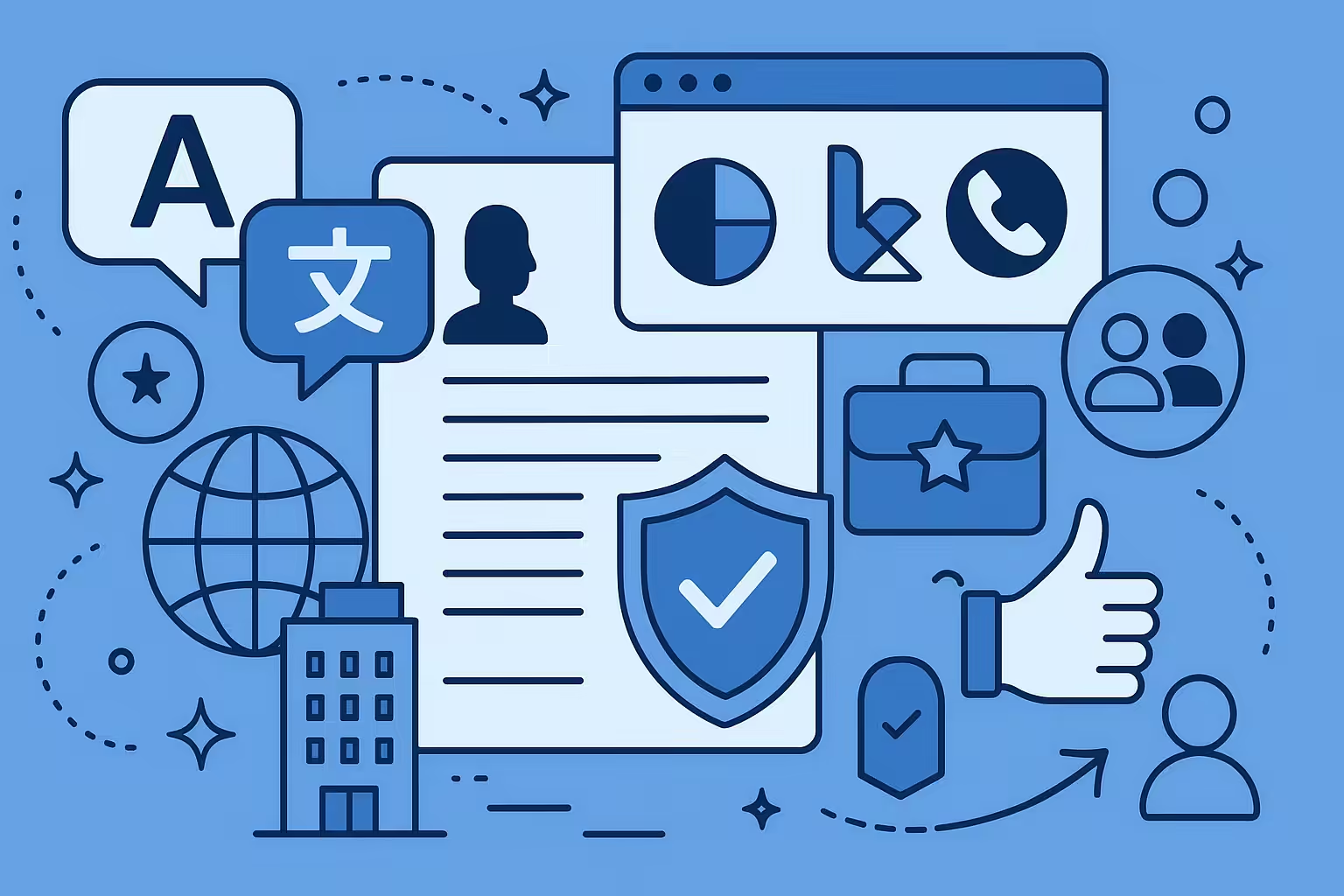
Organizations operating internationally require professional translations. This, however, is not the same as using free AI tools and generating instant translations. They need an auditable, standardized translation process that reduces risk, shortens cycle time, aligns with compliance requirements, and protects intellectual property.
Professional translation workflows must coordinate all layers efficiently, prevent errors, and reduce turnaround times.
To achieve this, a formal translation lifecycle coordinates multiple controlled stages: intake → scoping → governance → production (human/MTPE) → LQA → DTP → release → post-release QA, driven by PM ownerships, and multiple levels of audit logs.
The translation process is delicate. A single mistake can lead to compliance issues and costly rework.
This article breaks down the entire professional translation process so procurement teams, compliance leaders, and product stakeholders can understand how each step contributes to risk control, cost efficiency, and global scalability.
What Happens at Intake? (Files, Objectives, Risk, Compliance)
The translation process begins here with intake. The project requirements, risks, and scope is defined here. This evaluation is crucial as this step identifies the compliance exposure, regulatory context, content sensitivity, target locale specifications, and brand voice expectations, along with deadlines.
A Complete Translation Intake Package Includes:
- Source files & file formats: Determine engineering needs, DTP requirements, and technical constraints.
- Target languages & markets: Identify regional requirements, cultural expectations, and compliance risks.
- Style guide & tone requirements: Control brand voice, formality level, punctuation rules, and linguistic register.
- Glossary/termbase: Ensure terminology consistency for legal, technical, medical, or product-specific vocabulary.
- Regulatory context: Align translation with industry compliance frameworks (e.g., IFRS, SEC, MDR, HIPAA, GDPR).
- Data privacy restrictions: Enforce secure handling under NDA, encrypted transfer, and GDPR or confidentiality obligations.
- Deadline & urgency rating: Set staffing levels, workflow selection (Human TEP vs. MTPE), and project milestones.
Scoping & Estimation: How We Size Work Before Kickoff
This step is a big chunk of the intake process, where PMs and linguists assess effort, risk, and workflow needs.
This includes content auditing, TM/repetition analysis, glossary readiness, and file engineering checks, followed by risk tiering and workflow selection (Human-Only TEP vs. MTPE).
Circle Translations uses structured scoping and defined deliverables, ensuring predictable pricing, lower rework, and compliance-aligned workflows.
Governance: Glossary, Style Guide, and Decision Log
Before production starts, three core assets are finalized: a well-defined glossary for consistent terminology, a style guide for consistent tone and formatting, and a decision log to reduce ambiguity. Locking these elements early reduces revision cycles, translator interpretation risk, and total cost of ownership.
Production Tracks: Human-Only vs MTPE (When and Why)
After intake is done, your translation teams move on to production. There are two well-defined translation pathways
- Human Only
- MTPE(Machine Translation Post Editing)
Based on the scope and sensitivity, production follows one of the workflows.
Human-Only TEP: Translator → Editor → Proofreader
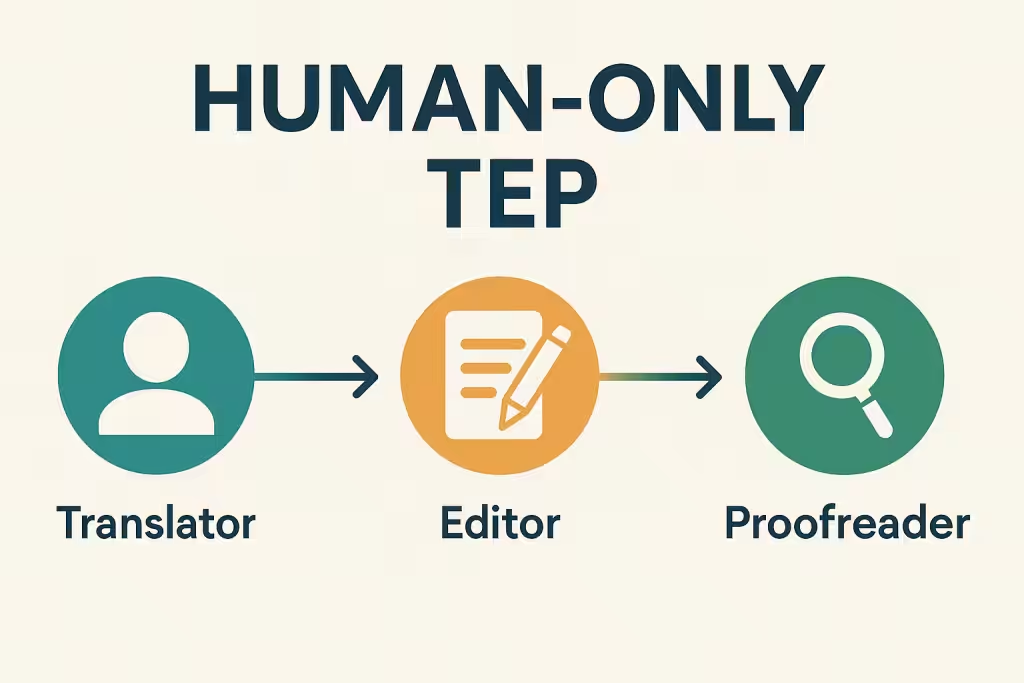
human-only TEP(translator, Editor, Proofreader) workflow is the gold standard for risk-sensitive and compliance content.
This workflow consists of three basic steps:
- Translation: Native specialist linguist
- Editing: Second linguist reviewing accuracy & context
- Proofreading: Final linguist confirming style, tone, and formatting
Human-only TEP is recommended when accuracy is non-negotiable. This includes projects such as, Contracts & agreements, Medical or clinical documentation, Technical product manuals, etc.
Typical throughput is ~2,000 words/day per linguist for specialized content, with additional time allocated for editing, proofreading, and engineering.
MTPE: Where Automation Helps and Where It Doesn’t
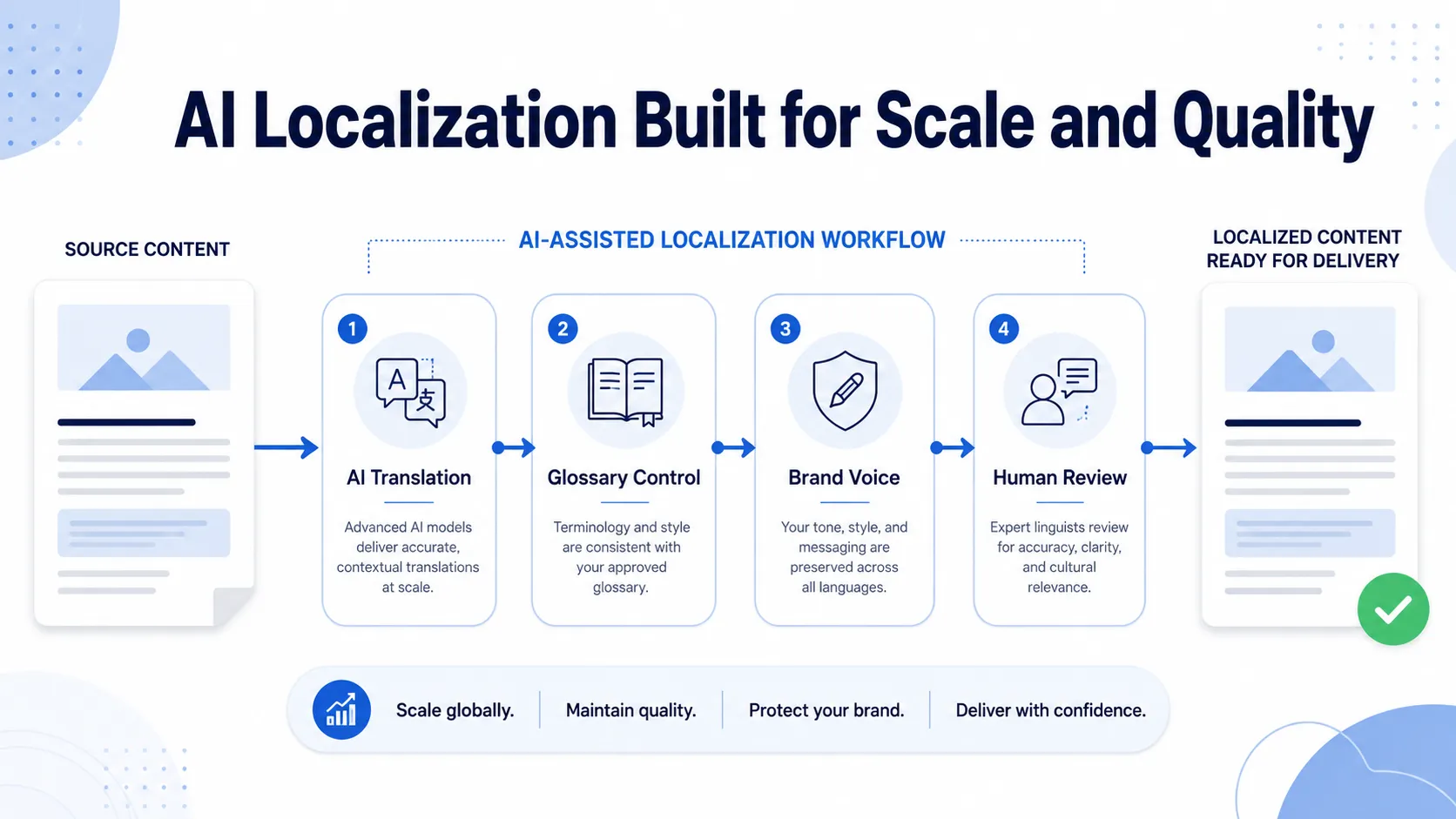
MTPE is a hybrid process in which the bulk of the work is automated, with linguists performing QA checks for accuracy and consistency.
The workflow includes:
- Pre-processing (cleaning source content)
- Neural machine translation (NMT output)
- Post-editing by SMEs
- LQA check
- Delivery + TM update
Using MTPE in the wrong context increases risk and cost due to rework. The decision must be driven by content risk, not budget pressure alone.
Here’s a comparison snapshot of when to use or avoid MTPE:
| Good Fit for MTPE | Avoid MTPE For |
| Knowledge base articles | Contracts |
| Internal documentation | Safety-critical instructions |
| FAQs | Compliance documentation |
| Training manuals | Research or clinical material |
| Product descriptions | Brand-critical marketing |
LQA & Accuracy Checks: How Quality Is Measured
Language Quality Assurance ot LQA, is a crucial process that judges the quality of the projects. It uses metrics such as, MQM (Multidimensional Quality Metrics) and DQF (Dynamic Quality Framework).
LQA evaluates a translation process based on Accuracy, consistency in terminology, Fluency, Layout, and Formatting.
LQA assigns severity weighting (critical, major, minor), ensuring translation errors are treated according to risk level and document purpose.
Review Layers: Self-Review, Second Linguist, Stakeholder Sign-Off
After the initial draft is made, a series of Linguistic QAs are done to minimize errors in the document. Its’ a multilayered process, and goes like this:
Review Layers: Self-Review → Second Linguist → Stakeholder Sign-Off
On the LQA ladder, the first step is for the tranlator who translated the document, the, a second linguist validates the accuracy and consistency, and finally client SMEs check it one more time before the final delivery.
Nowadays, LQAs can be automated as well. Providers such as, Lokalise, Crowdin, and Circle Translations deploy a hybrid model for this to reduce turnaround and drive ROI.
Back Translation & Reconciliation (When to Use It)
This process is essentially translating the target text back into its source language, comparing discrepancies, and reconciling them.
Back translation is expensive and should not be used for every project. It is valuable only for high-risk content such as: Clinical research materials, Legal surveys, Government submissions, Safety instructions.
DTP & Engineering: Making the Target File Production-Ready
After the translation process is finished, the document needs to be prepared for release. This is a bilayered DTP and Engineering process, delivered on platforms such as InDesign, Illustrator, and QuarkXPress, with ISO certification.
Before any translated content is formatted, localization engineers run pseudo-localization to stress-test software or UI components. This step artificially expands text, simulates non-Latin scripts, and protects variables, allowing teams to catch layout failures, encoding issues, or truncation before translation even begins. By validating UI structure early, organizations avoid costly redesign and post-release fixes.
After which, the DTP workflow comes into play. This is done through: Layout QA to check for text overflow, Font & encoding checks for special characters, RTL & CJK support, Link & footnote validation, etc.
Localization of Multimedia & Structured Content
DTP also covers structured content types, such as subtitles, Voice-over scripts, UI strings, and XML/JSON with variables, among others.
Pseudo-localisation is often recommended for testing UI length expansion, variable protection, and script compatibility.
Release & Post-Release: What Happens After Delivery
An enterprise-grade translation process does not end with delivery. Circle translations team handovers final foles, full LQA reports, updated Glossary, Decision logs, and DTP proofs, ensuring every deliverable is traceable and compliant.
Post-release support then verifies the published content, addresses any stakeholder feedback, and folds approved edits back into the Translation Memory (TM) and style assets. This continuous loop protects long-term consistency, reduces rework in future releases, and ensures multilingual content remains aligned with evolving regulatory, brand, or product changes.
SLA & Communication Cadence
A predictable communication framework keeps stakeholders aligned throughout the translation process. Typical cadence includes a kickoff call to confirm scope, a mid-sprint QA checkpoint to validate terminology and formatting choices, final delivery with complete documentation, and a post-release review to incorporate live feedback.
A strong SLA clearly defines escalation paths, expected response times, and availability beyond standard business hours—including weekend coverage when urgent releases or compliance deadlines demand it.
Why This Process Works for B2B Buyers
Organizations need a stable, predictable output to maintain large content bases across multilingual markets.
A structured translation process delivers predictable value for enterprises, such as a predictable timeline to prevent launch delays, a proper Audit trail and a decision log for compliance and reputational risk.
With this structure, providers, such as Circle Translations, ensure lower reworks, controlled cost, secure workflows, and long-term scalability
Why Choose Circle Translations for Process-Driven Enterprise Localization
Circle Translations applies a workflow designed for organizations that require measurable quality, secure data handling, and translation outputs aligned with compliance requirements. Our approach emphasizes transparency, controlled governance, and fully documented decision trails across every stage of the translation lifecycle.
- PM Ownership + Auditable Workflows
We assign a dedicated project manager who oversees intake, scoping, terminology validation, production routing (Human-Only TEP vs MTPE), LQA compliance, and handover. Every decision, such as tone, terminology, unit conventions, and formatting rules, is captured in a trackable decision log to prevent rework and ensure consistency across future projects.
- Hybrid AI + Human Model With Risk Controls
We use secure AI engines only where they bring value, supported by expert linguists trained in MTPE for eligible content. High-risk documents (legal, clinical, safety, regulatory filings) are routed to human-only TEP by default. This matrixed approach reduces cost and turnaround while maintaining accountability for compliance-critical content.
- Enterprise-Grade Security & NDA Coverage
All content is processed in encrypted environments with GDPR-aligned data controls, NDA-vetted linguists, and role-based access. Sensitive documents—financial statements, regulatory submissions, patient materials, IP documentation—never enter public MT systems. Secure workflows protect both confidential data and intellectual property.
- Governance Assets Included: Glossary, Style Guide, Decision Log
Unlike vendors who treat glossaries and decision logs as optional, Circle Translations includes them standard. Termbases, style guides, and revision logs are version-controlled and returned during handover so they can be reused internally or with multiple vendors—protecting long-term cost efficiency and brand consistency.
- Post-Release QA + Feedback Integration
We maintain a post-release QA window (7–14 days) to capture SME feedback, improve terminology, and update TM/TB assets. This ensures the translation process does not end at delivery but evolves with your regulatory environment, product updates, and market conditions.
Conclusion
A structured translation process is an absolute must for enterprises operating globally. This predictive process shines when your brand needs to maintain a timeline and user expectations.
A formal translation workflow is designed for maximum efficiency and minimum errors or rework. Services like Circle translations leverage a hybrid formula where the bulk of the translation process is delegated AI systems and manual labour is reserved for LQAs.
A structured translation process reduces legal exposure, accelerates global release cycles, lowers long-term translation cost, and ensures consistent messaging across products, documents, and markets.
Visit Circle Translations to understand translation workflows better and make informed decisions for your enterprise.
FAQs
When is back translation worth it?
Use back translation for high-risk clinical, legal, or research material where text accuracy affects liability, decision-making, or patient safety. It is a validation method, not a default step.
How do intake forms fit into the process?
Intake forms collect critical metadata, such as compliance requirements, terminology preferences, deadlines, and regulated audience details. They reduce ambiguity and improve speed, especially for medical or immigration paperwork.
Where does MT/AI fit vs. human-only?
Use MTPE for eligible content such as KB articles or internal documents. Use human-only translation for anything legally binding, safety-critical, or brand-sensitive.
What’s included in the final delivery?
Final delivery includes translated files, DTP outputs, updated glossary, termbase updates, LQA report, and a decision or change log. Some vendors provide an audit trail for added visibility.
Circle Translations includes these governance assets as part of its standard workflow, ensuring that every project remains traceable, revision-ready, and compliant for future releases or audits.
How do you check numbers, tables, and footnotes?
They’re checked through bilingual table validation, cross-references, layout QA checks, and numeric inspection to verify units, decimal formats, dates, and legal citation accuracy.