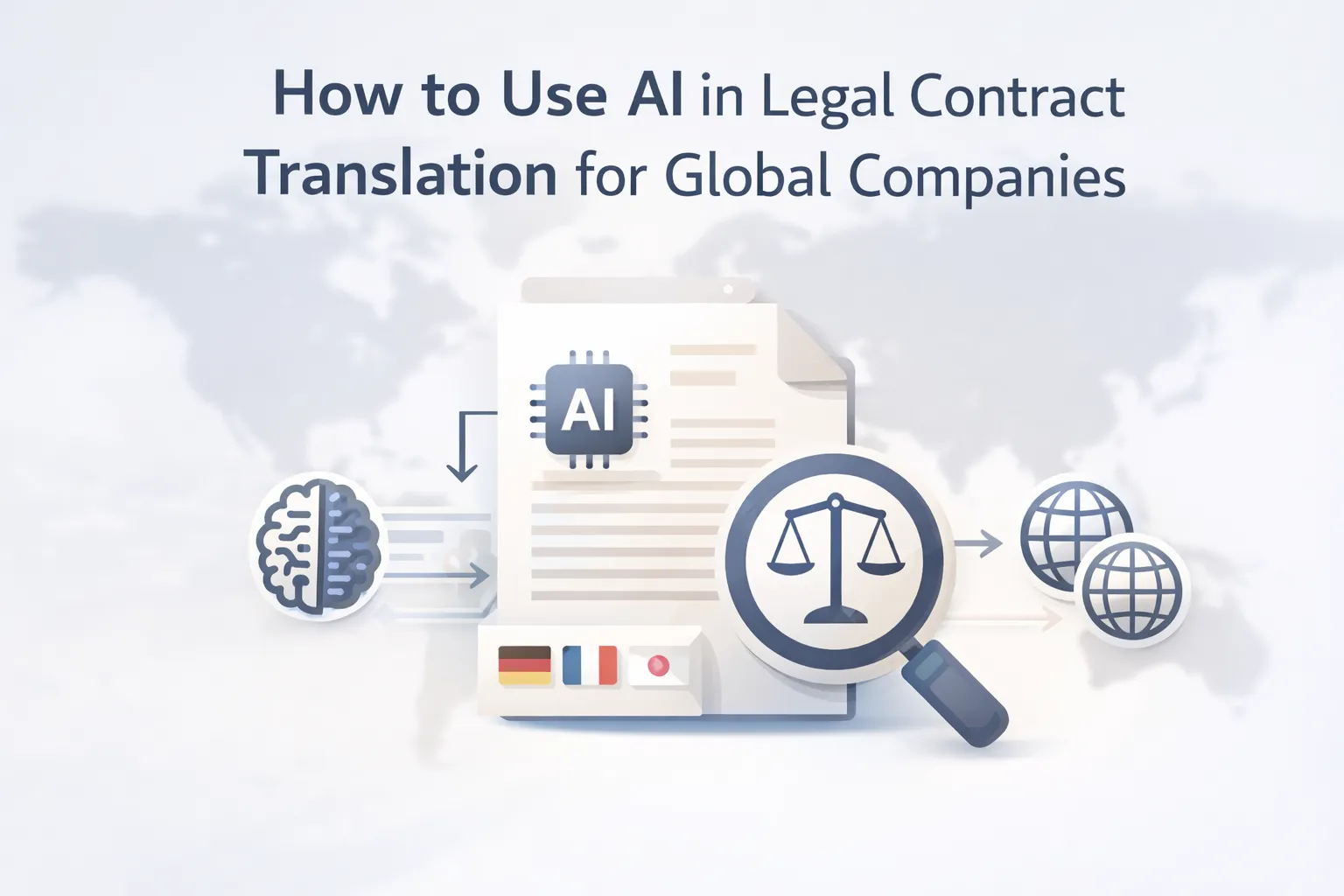
Most multinational companies face a common problem: legal contract translations. It sounds easy, but once the real work began, it became complicated due to the rules and policies. If your company operates in multiple countries, contracts quickly become a scaling pr oblem. You need speed, but you also need accuracy, confidentiality, and consistency across languages. That’s where people began using AI for legal contract translation for multinational companies. AI helps produce faster first drafts, improves clause consistency, and supports a controlled workflow that still includes human legal verification.
Here we will get to know how AI works for legal documentations, some benefits, and of-course risks. So stay with us till the end.
What is AI-Assisted Legal Contract Translation?
AI-assisted legal contract translation uses neural machine translation (NMT) and large language models fine-tuned on legal phrasing to accelerate contract translation. These AI models are trained on millions of legal documents. They are also learning how to handle clause structures, obligations, risk language, and legal terminology across different jurisdictions.
The technology analyzes source contracts and generates target-language drafts that preserve the legal structure and terminology. Advanced systems, such as DeepL’s legal translation tools, use dedicated legal dictionaries and secure handling protocols to protect confidential information while delivering accurate first drafts.
But here’s the critical part: AI accelerates the process, but it doesn’t replace human legal review. Legal contracts contain nuanced obligations, jurisdiction-specific requirements, and risk-sensitive language that AI can misinterpret. That’s why the best approach combines AI speed with human legal expertise.
How Does AI Handle Legal Clauses, Definitions, and Obligations?
AI processes legal-sensitive segments differently from general text. When translating contracts, the system identifies specific elements like definitions sections, governing law clauses, indemnity provisions, liability limitations, and data protection requirements.
For example, if your contract defines “Confidential Information” in Section 1, the AI preserves that exact definition throughout the document and in all translations. This clause symmetry is essential to enforceability, and AI excels at maintaining it.
However, AI struggles with ambiguous legal intent. Consider an indemnity clause that says “The Supplier shall defend, indemnify, and hold harmless…” — the word “shall” creates a mandatory obligation. If AI mistranslates this as “may” or “should,” you’ve fundamentally changed the legal commitment. That’s where human legal linguists validate every critical clause to ensure the translation carries the same legal weight as the original.
What Document Types Work Best with AI + Human Review?
Not all legal documents are equally suited for AI-assisted translation. The approach works best when you match document complexity with the right level of human oversight.
Documents suitable for AI + human review:
- NDAs (non-disclosure agreements) — these follow standardized structures that AI handles well, with human review ensuring confidentiality obligations are correctly stated.
- Vendor agreements — routine purchase contracts and supplier agreements benefit from AI’s speed, especially when you’re onboarding multiple vendors across regions.
- Purchase contracts — standard terms and conditions, order forms, and procurement documents work well with AI drafts and legal linguist refinement.
- HR agreements — employment contracts, offer letters, and workplace policies typically use consistent language that AI can translate reliably with human verification.
Documents not suitable for AI-first workflows:
- Litigation filings — court submissions require jurisdiction-specific legal reasoning and should be translated entirely by qualified legal translators.
- Court submissions — any document filed with a court needs human-only translation to ensure procedural compliance.
- Highly ambiguous provisions — contracts with intentionally vague language, complex negotiation clauses, or unique legal structures require full human translation.
- Complex commercial agreements — high-stakes deals with significant financial exposure or regulatory implications should use human-only workflows.
Benefits of AI-Driven Contract Translation for Global Companies
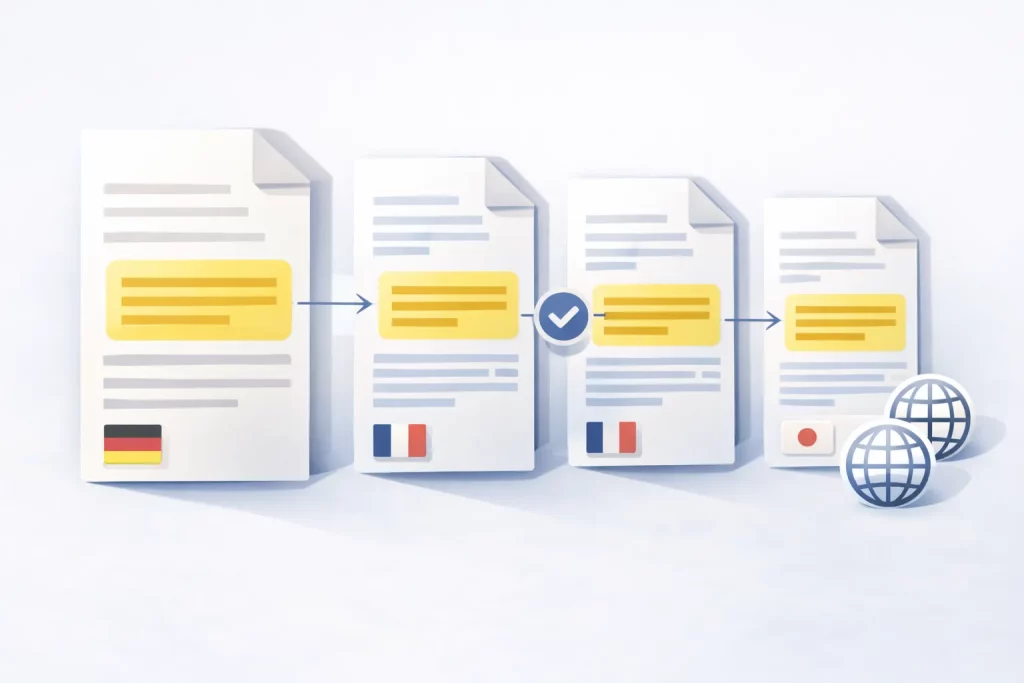
AI-driven contract translation delivers measurable advantages for multinational companies managing cross-border legal operations. The technology transforms how legal teams handle translation workloads while maintaining quality and compliance.
Key benefits include:
- Speed — AI generates complete first drafts in minutes instead of days, allowing legal teams to review and approve contracts faster.
- Lower per-unit cost — reducing manual translation time significantly reduces costs, especially for high-volume contract workflows.
- Standardized clause language — AI maintains consistent terminology across all language versions, reducing interpretation disputes.
- Multilingual compliance updates — when regulations change, you can update your master contract and quickly generate revised versions in all required languages.
According to NetDocuments, integrating AI translators directly into legal workflows improves contract turnaround times without sacrificing accuracy. Legal teams can review and approve more contracts in less time, accelerating business operations.
How Does AI Reduce Cost and Turnaround Time?
The AI + human workflow dramatically reduces translation time through instant draft generation. Here’s how it works:
- Step 1: Instant draft generation — AI translates your entire contract in minutes, creating a structured first draft that preserves formatting, clauses, and legal terminology.
- Step 2: Human legal linguist refinement — a legal translator reviews the draft, focusing on high-risk clauses, obligations, definitions, and jurisdiction-specific requirements. This targeted review takes far less time than translating from scratch.
- Step 3: Quality assurance — a second reviewer checks clause alignment, terminology consistency, and enforceability.
For multilingual versioning, the efficiency compounds. Update your English master contract, and AI generates revised Spanish, French, German, and Japanese versions in minutes. Human reviewers then verify only the changed sections, not the entire document. This approach reduces translation cycles from weeks to days.
Does AI Improve Consistency Across Contract Versions?
Yes. AI excels at maintaining repeated phrasing, definitions, and clause symmetry when combined with legal glossaries and translation memory.
If your master contract defines “Intellectual Property” as “all patents, trademarks, copyrights, trade secrets, and proprietary information,” AI ensures that exact definition appears identically in every language version. Manual translation might introduce slight variations between your French and German contracts, creating interpretation issues. AI eliminates this risk.
For enterprise contract lifecycle management, this consistency is invaluable. Your procurement team knows that “payment terms,” “delivery obligations,” and “warranties” mean exactly the same thing across all markets. This standardization reduces disputes and simplifies contract administration.
Translation memory stores previously translated segments, so when you translate a new vendor agreement that uses similar clauses to existing contracts, the system automatically applies your approved translations. This creates a self-reinforcing feedback loop in which your contract translations become more consistent over time.
How Does AI Help with Large Contract Volumes in Global Operations?
Companies managing hundreds of vendor agreements, partner contracts, or employee documents across multiple countries face a scaling problem. Traditional translation can’t keep pace with business growth.
AI solves this through batch translation pipelines. Upload 200 vendor agreements, and the system processes all of them simultaneously, generating drafts in your target languages. Legal linguists then review contracts in priority order, focusing their expertise where it matters most.
Smartcat’s centralized editor workflows allow multiple translators to work on different contracts simultaneously while maintaining terminology consistency through shared glossaries. This parallelization means your translation capacity scales with your business needs.
For procurement teams onboarding suppliers across Asia, Europe, and Latin America, AI-assisted translation means you’re not bottlenecked by translation capacity. You can move at business speed while maintaining legal quality.
Risks: Where AI Alone is Unsafe for Legal Contract Translation
AI cannot fully interpret legal intent, enforceability requirements, or jurisdiction-specific nuances. While the technology has advanced dramatically, it lacks the legal reasoning ability that human experts bring to contract translation.
Consider a simple example: an English contract states, “This agreement shall be governed by the laws of Delaware.” AI might translate “shall be governed” correctly into Spanish as “se regirá,” but it won’t know whether Delaware law has specific requirements for contract formation, choice-of-law clauses, or enforceability standards that affect how the translation should be worded.
Legal contracts are enforcement mechanisms. A mistranslated obligation can void a contract, create unintended liability, or fail to protect your rights. That’s why relying on AI alone for legal contracts is unsafe.
Dialzara’s research on AI translation emphasizes that legal documents need human validation specifically because AI can’t assess legal safety. The stakes are too high to accept machine-generated translations without expert review.
Where Can AI Mistranslations Cause Legal Exposure?
Certain contract sections carry disproportionate risk if mistranslated. AI errors in these areas can create serious legal consequences:
Indemnity clauses — mistranslating who indemnifies whom or the scope of indemnification can expose your company to unexpected liability.
Limitation of liability — errors in translating liability caps or exclusions can leave you unprotected or expose you to claims you thought were limited.
Warranty clauses — incorrect translation of warranty scope, duration, or exclusions changes your legal obligations.
Penalty clauses — mistranslating penalty calculations or trigger events can cost significant money.
Confidentiality obligations — errors in defining what’s confidential or how long obligations last can compromise trade secrets.
Data protection sections — GDPR and other privacy laws require precise language. Mistranslations can create compliance violations.
Here’s a micro example that shows why human review matters: an English contract says “Supplier shall provide” (mandatory obligation) versus “Supplier may provide” (optional). If AI translates both as the same modal verb in German or Japanese, you’ve lost the legal distinction between required and optional performance. That single word changes enforceability.
Another common error: translating “reasonable efforts” versus “best efforts” versus “commercially reasonable efforts.” These terms have different legal meanings and performance standards. AI might treat them as synonyms, but courts don’t.
Why Human Legal Linguists Are Required in the Final Workflow
Human legal linguists bring three critical capabilities that AI lacks:
Legal reasoning — understanding how contract clauses interact, what makes a provision enforceable, and how to preserve legal relationships between sections.
Enforceability checks — knowing whether a translated clause will be upheld in the target jurisdiction’s courts and adjusting language to meet local legal standards.
Local jurisdiction alignment — adapting contract language to comply with local laws, regulations, and legal conventions without changing business intent.
Leading language service providers use hybrid workflows precisely because AI accelerates processing while humans ensure accuracy. The AI handles mechanical translation, freeing legal linguists to focus on legal validation, risk assessment, and enforceability review.
This division of labor is efficient. Instead of spending hours translating routine clauses, legal translators focus on the 20% of contract language that accounts for 80% of legal risk.
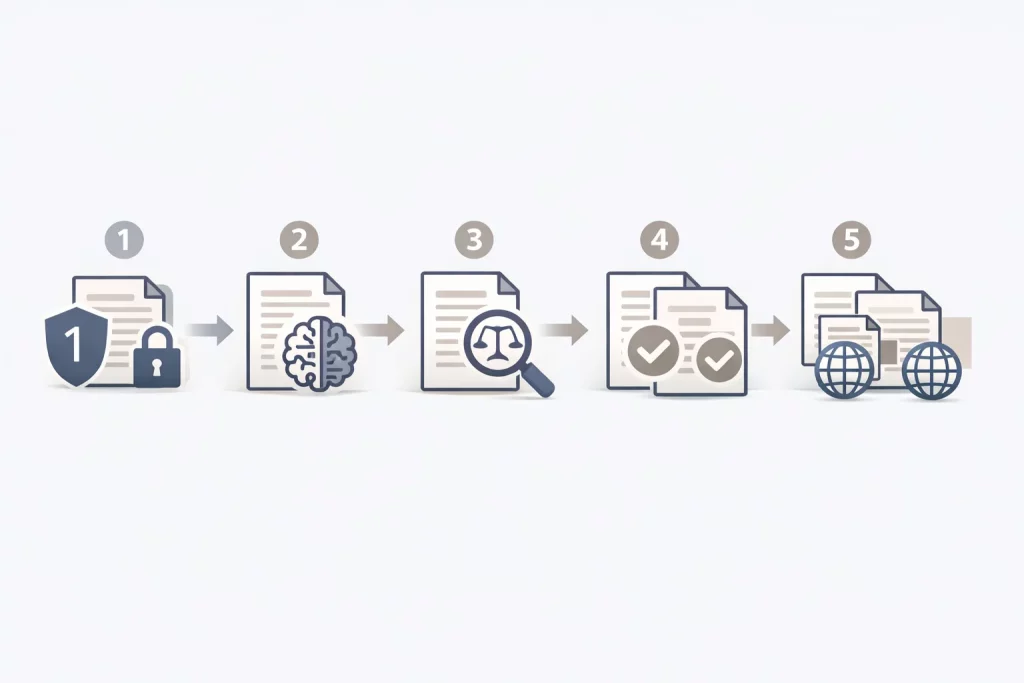
How AI + Human Hybrid Workflow Works (Step-by-Step)
Understanding the workflow helps you know what to expect when working with an AI-assisted legal translation provider. Here’s the complete process from contract upload to final multilingual delivery.
Step 1: Secure Upload & Confidentiality Screening
Your contracts contain confidential business information, trade secrets, and sensitive commercial terms. The workflow starts with secure file intake through encrypted portals.
Enterprise-grade systems use:
End-to-end encryption for file transfer and storage. Limited-access workflows where only authorized personnel see your contracts. Audit trails track who accessed documents and when confidentiality agreements with all translators and reviewers
DeepL emphasizes advanced encryption as a core security feature, ensuring your contracts remain confidential throughout the translation process. When evaluating providers, confirm they use a secure infrastructure that meets your compliance requirements.
Step 2: Legal AI Draft Generation
Once your contract is securely uploaded, the legal-domain AI model analyzes the document structure and generates the initial translation.
The system performs several tasks simultaneously:
Clause tagging — identifying definitions, obligations, warranties, and other legal elements. Glossary injection — applying your company’s approved legal terminology.
Structure preservation — maintaining numbering, cross-references, and formatting.
Context analysis — understanding how clauses relate to each other
Legal-trained models perform better than general translation AI because they’ve learned legal phrasing patterns. They know that “force majeure,” “indemnify and hold harmless,” and “at law or in equity” are legal terms of art that shouldn’t be translated literally.
The result is a draft that appears to be a professional legal translation but hasn’t yet been validated by human legal judgment.
Step 3: Human Legal Review + Clause Alignment
This is where legal expertise ensures enforceability and accuracy. A qualified legal linguist reviews the AI-generated draft with a specific focus on:
Risk-sensitive clauses (indemnity, liability, warranties, penalties), Legal obligations (what each party must, may, or cannot do), Definitions that create specific legal meanings, Jurisdiction-specific requirements, Cross-references between contract sections
Step 4: Clause Alignment
The linguist compares the source and target versions clause by clause, verifying that:
Mandatory obligations remain mandatory. Optional provisions remain, and the liability limitations are correctly stated. Definitions are used consistently throughout Legal relationships between clauses are preserved
A second reviewer often conducts clause alignment checks to confirm that the translated contract maintains the same legal structure and relationships as the original. This quality control step catches any errors the first reviewer might have missed.
Step 5: Multilingual Versioning & Compliance Updates
After human review and approval, you receive the final translated contract. But the value extends beyond the initial translation.
When you need to update contracts across all markets, the AI + human workflow shines. Change a warranty clause in your English master’s, and the system:
Identifies which sections changed. Generates updated translations of only the modified clause.s Routes those changes to legal linguists for verificatio.n Produces revised multilingual contracts within days
This quick propagation of updates means your global contracts stay synchronized. When GDPR requirements changed, companies using AI-assisted translation updated their data protection clauses across all European language versions in a fraction of the time manual translation would have required.
When Should Companies Choose AI + MTPE vs Human-Only Translation?
Choosing the right approach depends on your specific contract’s risk profile and business requirements. Here’s a practical framework for deciding.
AI + MTPE = Best for Speed & Scale
Machine Translation Post-Editing (MTPE) works best when you need fast, consistent translations for medium or lower-risk contracts where speed and volume matter more than absolute perfection.
Typical use cases:
Procurement agreements with standard terms, Cross-border vendor onboarding documents, Internal compliance policies and procedure,s Standard employment offer letters, Routine purchase orders and sales agreement,s Non-disclosure agreements using your standard template
These contracts share common characteristics: they follow established templates, use standardized legal language, and involve moderate business risk. AI generates excellent drafts, and human review ensures legal accuracy.
The economics make sense for high-volume scenarios. If you’re signing 500 vendor agreements per year across 10 languages, that’s 5,000 translations. AI + MTPE can reduce costs by 30-40% compared to full human translation while maintaining quality through legal linguist oversight.
Human-Only = Best for Enforceability & Litigation Alignment
High-stakes contracts with significant financial exposure or complex legal structures require human-only translation from qualified legal translators.
Use human-only translation for:
Complex commercial agreements (joint ventures, mergers, strategic partnerships), Contracts with financial exposure exceeding your risk tolerance Litigation documents and court filings Jurisdiction-specific regulatory filings Contracts involving unique or novel legal provisions, and agreements where ambiguous language was intentionally negotiated
The difference comes down to risk tolerance. If a translation error could cost your company millions in liability or void a critical agreement, the cost of human-only translation is insignificant compared to the risk.
Many companies use a tiered approach: AI + MTPE for the majority of routine contracts and human-only for the critical 10-20% that carry the highest stakes.
Why Choose Our Agency for AI-Assisted Legal Contract Translation?
Circle Translations combines legal-trained linguists, secure AI technology, and compliance-first workflows to deliver enterprise-ready contract translation services. Our approach balances speed with safety, giving you fast turnaround without sacrificing legal accuracy.
Our Approach: Secure, Compliant, Enterprise-Ready
We’ve built our AI-assisted legal translation service specifically for companies that can’t afford translation errors. Here’s what makes our approach different:
Secure infrastructure — enterprise-grade encryption, restricted-access workflows, and strict confidentiality protocols, protects your sensitive contracts. Every team member signs comprehensive NDAs, and our systems maintain audit trails of all document access.
Native legal linguists — our translators aren’t just language experts; they have legal training and experience in contract translation. They understand indemnity clauses, limitation of liability, governing law provisions, and jurisdiction-specific requirements.
Fast response times — AI draft generation happens in minutes, not days. Human review typically adds 24-48 hours, depending on contract length and complexity, giving you complete multilingual contracts faster than traditional translation.
Glossary-first approach — we build custom legal glossaries for your company, ensuring your preferred terminology appears consistently across all contracts and languages. This one-time investment delivers consistent quality.
Our compliance-first workflows follow ISO-like quality processes, giving you confidence that every contract receives appropriate oversight based on its risk profile.
Industry Coverage & Language Expertise
Circle Translations serves multinational companies across industries where contract accuracy matters:
Technology & SaaS — licensing agreements, terms of service, data processing agreements.
Finance — banking contracts, investment agreements, and regulatory compliance documents.
Energy — supply agreements, joint venture contracts, regulatory filings.
Manufacturing — supplier agreements, distribution contracts, and quality standards.
Our language coverage includes the most common business language pairs:
English ↔ Spanish English ↔ French English ↔ German English ↔ Japanese English ↔ Chinese (Simplified & Traditional) English ↔ Korean
We also support additional European, Asian, and Latin American languages based on your specific requirements.
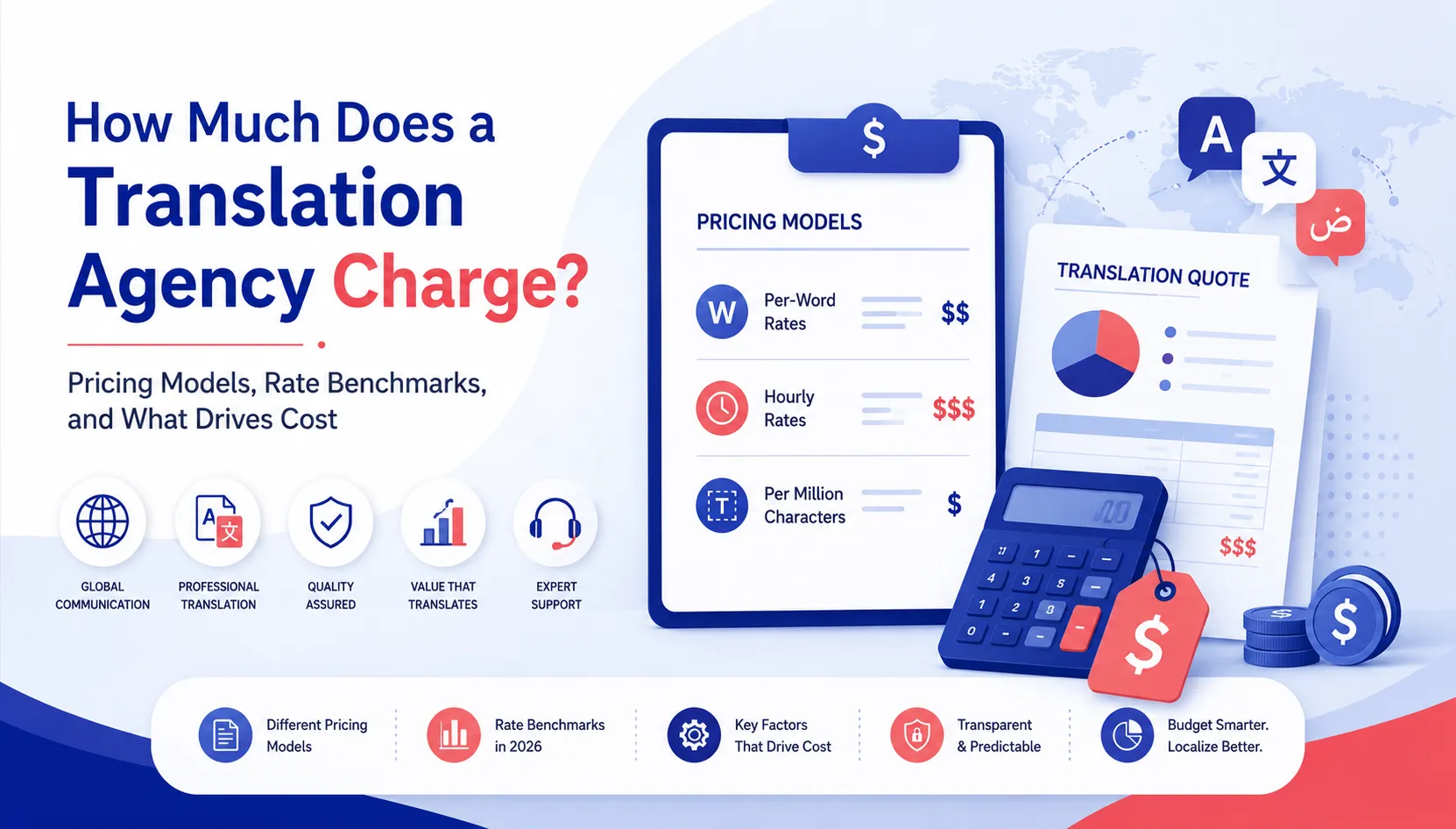
Pricing Factors for AI-Assisted Contract Translation
Several variables affect the cost of AI-assisted legal contract translation:
Document length — longer contracts require more review time, though AI significantly reduces the per-page cost compared to full human translation.
Complexity — highly technical contracts with unique provisions need deeper human review, affecting turnaround time and cost.
Revision depth — straightforward contracts need minimal AI output correction, while complex agreements require more extensive human refinement.
Urgency — rush requests can be accommodated through dedicated translator assignment and expedited review workflows.
Number of language versions — translating into multiple languages simultaneously often qualifies for volume pricing.
We provide transparent quotes based on your specific requirements, with no hidden fees or rush charges for standard timelines. Contact us for a detailed estimate based on your contract portfolio.
Conclusion
AI-assisted legal contract translation gives multinational companies the speed and scale they need while maintaining the accuracy and enforceability their legal teams require. The hybrid approach. AI for instant drafts plus human legal linguists for validation—delivers the best of both worlds.
For companies managing cross-border operations, the benefits are clear: faster contract turnaround, lower per-unit costs, consistent terminology across markets, and quick multilingual compliance updates. But the technology works only when paired with human legal expertise to verify obligations, check enforceability, and ensure jurisdiction-specific compliance.
Don’t let translation bottlenecks slow your global operations. Contact Circle Translations for a free consultation on AI-assisted legal contract translation. We’ll review your contract portfolio, recommend the right workflow approach, and provide transparent pricing based on your specific requirements.
Your contracts deserve both speed and safety. Let us show you how AI + human expertise delivers both.
Frequently Asked Questions
How Accurate is AI for Legal Contract Translation?
AI provides fast draft accuracy for structured legal texts, typically achieving 85-90% accuracy on standard contract language. However, enforceable phrasing and jurisdiction nuances require human validation to reach the 99%+ accuracy needed for legal documents. DeepL and Smartcat highlight hybrid workflows as the safest model, combining AI speed with human legal expertise.
Can AI Translate Entire Contracts Without Human Review?
No. AI can produce high-quality drafts that save significant time, but risk clauses, obligations, and definitions require legal linguist review to avoid misinterpretation. The legal consequences of mistranslated indemnity, liability, or warranty clauses are too serious to accept machine-generated output without expert validation.
Which Contract Types Are Safe for AI + Human MTPE?
NDAs, HR agreements, vendor agreements, purchase contracts, and internal compliance documents work well with AI + MTPE workflows. These contracts typically follow standardized structures and use consistent legal language that AI handles reliably.
Litigation documents, court filings, or jurisdiction-sensitive contracts should be translated by humans only. The legal stakes are too high, and the language is often too specialized or ambiguous for AI to handle safely.
Does AI Reduce Translation Cost for Global Companies?
Yes. AI reduces drafting time by 60-70% and speeds multilingual updates, lowering overall cost for high-volume contracts when paired with MTPE workflows. The savings companies realize from compounding translate into hundreds of contracts annually.
How Does AI Maintain Consistency Across Multiple Languages?
Through legal glossaries, termbases, and translation memory. AI preserves repeated clauses and definitions across versions when supervised by legal reviewers who ensure the glossaries are correctly applied.
For example, if your English contracts consistently use “Confidential Information” as a defined term, the AI ensures your Spanish contracts always use “Información Confidencial,” your French contracts use “Informations Confidentielles,” and your German contracts use “Vertrauliche Informationen.” This consistency is maintained across thousands of contracts without manual effort.
Is AI Translation Secure for Confidential Contracts?
Enterprise-grade tools use encryption and strict access controls, making the AI translation process itself secure. However, human-reviewed workflows add an additional layer of security through confidentiality agreements, limited access, and audit trails.
How Fast Can AI-Assisted Contract Translation Be Delivered?
AI creates immediate drafts, a 20-page contract can be translated in minutes. With human review, typical delivery cycles range from 24-72 hours, depending on complexity and volume, significantly faster than the 5-10 days required for fully manual translation.
Rush requests can often be accommodated through a dedicated translator assignment. The exact timeline depends on your contract’s length, complexity, and the number of target languages.