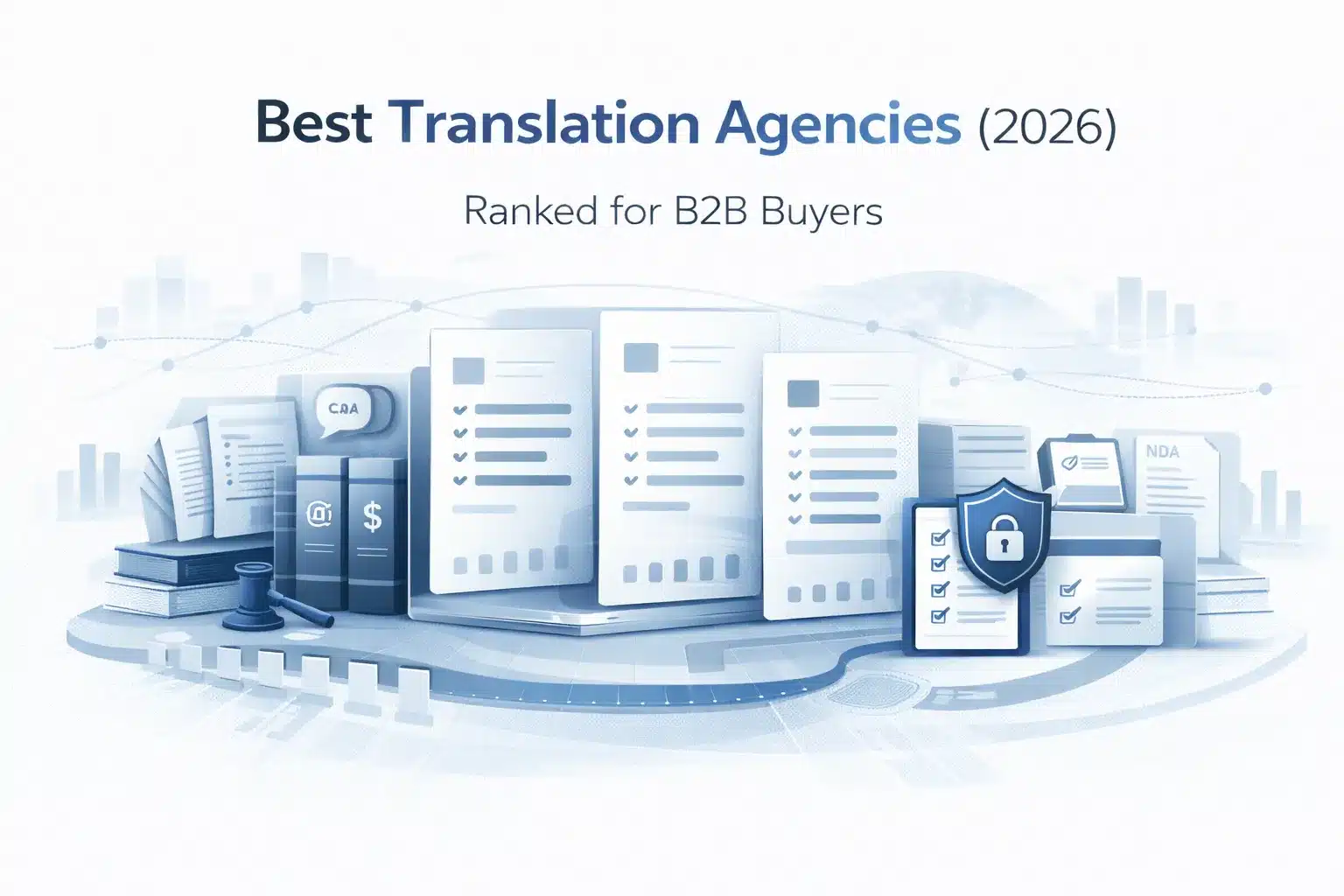
Choosing the wrong translation agency costs more than the translation itself. Rework cycles, regulatory delays, compliance exposure, and brand damage quickly outweigh any short-term savings on per-word rates.
In 2026, there are hundreds of agencies, from freelance marketplaces to global enterprise language service providers (LSPs). The challenge for B2B buyers is not finding a vendor, but selecting one whose quality assurance, data security, subject-matter expertise, and SLA commitments align with business risk.
This guide ranks the top 10 translation agencies for B2B decision-makers, then provides an 8-criterion evaluation framework, a 20-question procurement checklist, and 10 red flags to avoid. If you’re actively vetting vendors, skip straight to the checklist.
Top 10 Best Translation Agencies in 2026 (Ranked for B2B Buyers)
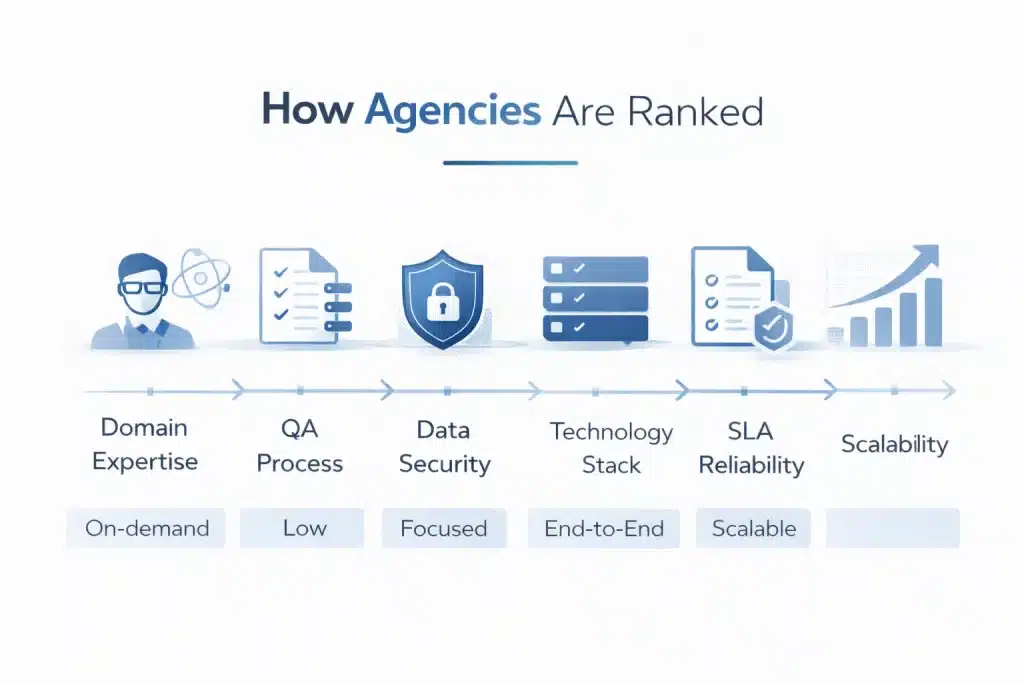
These ten translation agencies represent the strongest performers across core B2B buyer criteria in 2026: domain expertise, documented quality assurance, data security standards, technology infrastructure, and scalability.
Each profile outlines what the agency does best, who it is ideal for, and any notable limitations, helping procurement, legal, compliance, technical, and SaaS teams select a partner aligned to their operational risk profile.
#1. Circle Translations — Best B2B Translation Agency for Quality-Critical and Multi-Domain Projects
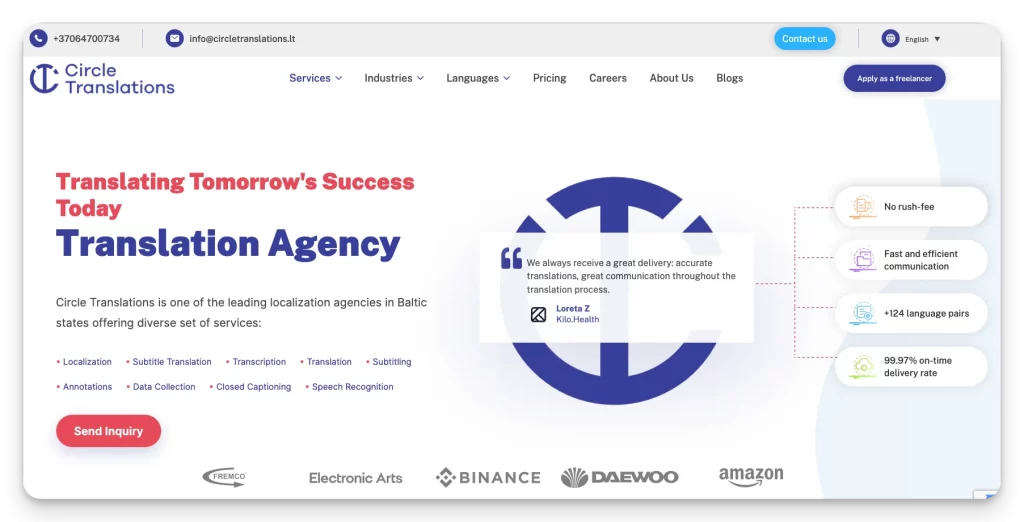
Circle Translations is a B2B-focused professional translation agency delivering legal, technical, financial, medical, HR, and SaaS documentation across 124+ language pairs.
Its QA framework is ISO 17100-aligned and structured around multi-stage review, subject-matter matching, and documented accountability.
The agency positions itself as a mid-market full-service LSP built for organisations where translation quality directly affects compliance, contracts, safety, or regulatory approval.
What they do best:
- Domain-matched translators: Every project is assigned to a linguist with verified subject-matter credentials in the client’s industry
- Full TEP QA process: Translation → Editing → Proofreading by separate qualified linguists
- Client-owned TM from project 1: Translation Memory remains the client’s transferable asset
- NDA + GDPR DPA at quote stage: Confidentiality is standard, not optional
- Transparent itemised pricing: No hidden DTP fees, no automatic rush surcharges, dedicated project manager per account
Ideal for: B2B companies in legal, technical, financial, medical, compliance, and SaaS sectors requiring professional-grade, multi-language documentation.
Language coverage: 124+ languages including European, CJK, Arabic, and rare language pairs.
Notable limitation: Not the lowest-cost per-word option; pricing reflects domain expertise and full QA stack.
See Why B2B Buyers Choose Circle Translations
Ranked among the top translation agencies for accuracy, turnaround, and scalability — get a free quote and find out what we can do for your business.
#2. Lionbridge — Best Enterprise Translation Agency for Global Fortune 500 Scale
Lionbridge is one of the world’s largest language service providers, headquartered in Waltham, Massachusetts. It supports Fortune 500 companies across technology, life sciences, legal, and consumer sectors with a global translator network and proprietary AI-assisted translation platforms.
What they do best:
- 350+ language coverage
- Enterprise TMS integration (SDL, Phrase, Contentful)
- AI-assisted translation at scale (GeoFluent, Language Cloud)
- Strong life sciences and regulated content capability
- Global account teams with industry leads
Ideal for: Enterprise clients with multi-million-word annual volumes, CMS integration requirements, or FDA/regulatory documentation needs.
Notable limitation: Mid-market buyers may face account deprioritisation; premium pricing and less bespoke QA for smaller projects.
#3. TransPerfect — Best Translation Agency for Legal, Financial, and Regulated Industries
TransPerfect is the largest privately held language services company globally, headquartered in New York. It operates across legal, financial, pharmaceutical, and technology sectors, supported by divisions such as TransPerfect Legal Solutions and the GlobalLink enterprise platform.
What they do best:
- Legal translation and eDiscovery leadership
- Financial and regulatory compliance translation (MiFID II, Dodd-Frank, FDA)
- GlobalLink workflow and CMS integration
- Life sciences and clinical trial support
- Extensive global office footprint
Ideal for: Law firms, financial institutions, and pharmaceutical companies requiring regulated or litigation-grade translation.
Notable limitation: Premium pricing; mid-market buyers may receive standardised rather than bespoke workflows.
#4. SDL (RWS Group) — Best Translation Agency for Technical Documentation and IP
RWS Group, incorporating SDL, is a UK-headquartered language technology and services provider. As the developer of Trados Studio and a global leader in patent translation, RWS has strong positioning in technical and IP-heavy content.
What they do best:
- Patent and IP translation leadership
- Engineering manuals and technical specifications
- Native Trados Studio integration
- Pharmaceutical and regulated documentation
- Enterprise MT platforms (Language Weaver)
Ideal for: Engineering, R&D, patent departments, and regulatory teams managing high-volume technical content.
Notable limitation: Enterprise pricing model; less agile for standalone mid-market projects.
#5. Welocalize — Best Translation Agency for Marketing, SaaS, and Digital Content at Scale
Welocalize is a global language services provider specialising in marketing localisation, SaaS product localisation, and digital retail content. It serves major technology brands and global consumer companies with AI-augmented workflows.
What they do best:
- Marketing transcreation and brand adaptation
- SaaS and software localisation with CMS/API integration
- Retail and e-commerce content at high volume
- AI-assisted translation workflows
- 100+ language coverage
Ideal for: Technology companies and e-commerce brands localising digital content at scale.
Notable limitation: Less suitable for highly regulated or legally sensitive documentation requiring full TEP and strict accountability.
#6. Berlitz Language Services — Best Translation Agency for Corporate Training and HR Content
Berlitz operates a B2B translation arm focused on corporate L&D, HR communications, and internal training materials. It combines cultural adaptation expertise with structured translation delivery.
What they do best:
- eLearning and training localisation
- HR documentation and policy translation
- Internal corporate communications
- Cultural adaptation expertise
- Strong HR and L&D brand recognition
Ideal for: HR and global L&D teams localising workforce-facing content.
Notable limitation: Not designed for technical, legal, or compliance-heavy documentation.
#7. Lingo24 — Best Mid-Market Translation Agency for European B2B Buyers
Lingo24 is a UK-based agency serving mid-market B2B clients across Europe and North America. It is particularly strong in European language pairs and professional TEP quality processes.
What they do best:
- EN↔DE/FR/ES/IT/NL and EU language depth
- Financial and legal translation
- Transparent mid-market pricing
- EU-certified document translation
- Responsive account management
Ideal for: UK and European mid-market businesses needing professional European language coverage.
Notable limitation: Limited CJK and emerging-market language capacity compared to enterprise LSPs.
#8. One Hour Translation — Best Online Translation Platform for Fast-Turnaround Non-Critical Content
One Hour Translation is a tech-enabled platform that assigns projects through automated systems. It prioritises speed and accessibility over bespoke QA workflows.
What they do best:
- Rapid turnaround
- Broad language coverage
- Competitive pricing
- API integration
- Self-serve portal access
Ideal for: Startups and SMBs translating non-critical internal or marketing content.
Notable limitation: Platform-controlled TM; variable translator matching; not suitable for regulated or safety-critical documents.
#9. CESCO Linguistic Services — Best Certified Translation Agency for US Legal and Government Documents
CESCO is a US-based certified translation agency specialising in USCIS and government document translation. It serves law firms, immigration attorneys, and agencies requiring officially accepted translations.
What they do best:
- USCIS-certified translation
- Legal contracts and court filings
- Government document translation
- Notarisation and apostille support
- Fast certified turnaround
Ideal for: US law firms and HR legal teams requiring certified translation accepted by courts or government bodies.
Notable limitation: US-focused; not designed for large-scale multilingual localisation programmes.
#10. Milengo — Best Translation Agency for Tech Startups and SaaS Localisation
Milengo focuses on SaaS and technology localisation, aligning translation cycles with agile development environments. It blends professional human translation with CAT tool automation.
What they do best:
- SaaS UI and help documentation localisation
- GitHub, CMS, and API integration
- Startup-friendly scalability
- Strong European language depth
- Agile sprint-aligned workflows
Ideal for: SaaS companies expanding into European markets.
Notable limitation: Limited non-European language coverage; less suited for regulated non-software documentation.
Top 10 Translation Agencies: Summary Comparison Table
The table below provides a side-by-side comparison of the ten highest-ranked translation agencies for B2B buyers in 2026.
It summarises each agency’s core strength, QA standard, language coverage, and overall B2B suitability. Use this as a quick decision-support tool before moving into deeper vendor evaluation and procurement discussions.
| Agency | Best For | QA Standard | Language Coverage | B2B Fit | Notable Strength |
| Circle Translations | B2B multi-domain (legal, technical, financial, medical) | Full TEP + ISO 17100 aligned | 124+ languages | ★★★★★ | Domain-matched translators + client-owned TM |
| Lionbridge | Enterprise / Fortune 500, life sciences | Enterprise QA + AI-assisted | 350+ languages | ★★★★☆ | Global scale + TMS platform integration |
| TransPerfect | Legal, financial, regulated | High QA + specialist divisions | 170+ languages | ★★★★☆ | Legal/eDiscovery + GlobalLink platform |
| RWS (SDL) | Technical docs, patent/IP | High QA + Trados native | 200+ languages | ★★★★☆ | World’s #1 patent translation |
| Welocalize | Marketing, SaaS, e-commerce | AI-augmented + review | 100+ languages | ★★★★☆ | Digital content at scale |
| Berlitz | Corporate L&D, HR communications | Professional + cultural | 50+ languages | ★★★☆☆ | Corporate training and culture localisation |
| Lingo24 | European mid-market B2B | Professional TEP | European pairs | ★★★★☆ | Transparent mid-market pricing |
| One Hour Translation | Fast-turnaround, non-critical | Platform QA | 100+ languages | ★★★☆☆ | Speed + self-serve portal |
| CESCO | US legal/government certified | Certified + notarised | US language pairs | ★★★☆☆ | USCIS/legal certification specialist |
| Milengo | Tech startups, SaaS | Professional + agile | European + EN pairs | ★★★★☆ | Developer-friendly workflows |
What Separates a Good Translation Agency from a Bad One: 8 Non-Negotiable Criteria
Knowing the best agencies is half the battle. Knowing how to evaluate any translation agency against your specific B2B requirements is the other half.
These eight criteria separate professional language service providers from budget vendors who ultimately cost more in rework, missed SLAs, compliance exposure, and reputational risk than they save in per-word rate.
Criterion 1: Subject-Matter Expertise — Does the Translator Understand Your Industry?
This is the most critical B2B evaluation point. An agency may claim 500 translators yet have none qualified in your domain.
Ask: Do you have translators with verified credentials in legal, technical, medical, or financial content? Can you share CVs for the linguists assigned? Do you match by language only, or by language plus subject expertise?
Red flag: assigning any available translator to any project. A legal contract, engineering manual, or pharmaceutical submission requires domain knowledge, not just bilingual fluency.
Circle Translations assigns domain-matched translators with verified subject-matter credentials for every project.
Criterion 2: Quality Assurance Process — Can They Describe It Without Hesitation?
Minimum professional standard: Translation → Editing → Proofreading (TEP) by separate linguists, plus project manager oversight.
Stronger processes include automated QA tools such as QA Checker, Xbench, or MQM frameworks before human review. Best practice is an ISO 17100–aligned workflow with documented stages, optional LQA scoring, and a written revision policy.
Ask: What happens between first draft and final delivery?
Red flag: “We use native speakers” as the only quality claim. Native fluency is a baseline, not a QA process.
Criterion 3: Translator Vetting — Employees, Vetted Contractors, or an Anonymous Network?
Ask whether translators are employees or vetted contractors. What is the vetting process, qualifications only, or test translation plus ongoing performance review? Do translators work exclusively with the agency?
Red flag: “We have 10,000 translators worldwide” without explaining screening or assignment logic. That signals a marketplace model driven by availability, not expertise.
For regulated, legal, or safety-critical content, insist on named translator assignment with verifiable credentials before project start.
Criterion 4: Data Security and Confidentiality — What Happens to Your Documents After Delivery?
Every document shared with a translation agency contains sensitive information. Verify the following before sharing files:
✓ NDA signed before project start
✓ GDPR-compliant Data Processing Agreement (DPA) provided
✓ Secure server storage with defined retention periods
✓ Translators and project managers under confidentiality agreements
✓ ISO 27001-aligned infrastructure or equivalent
✓ Encrypted file transfer, not plain email attachments
Circle Translations signs NDAs at quote stage, provides GDPR DPAs as standard, and uses encrypted file transfer protocols.
Criterion 5: Technology Stack — TM, CAT Tools, Termbase Ownership
Professional agencies use CAT tools to enforce consistency, build Translation Memory (TM), and maintain client termbases. Agencies working only in Word without TM cannot guarantee consistency or long-term cost savings.
Non-negotiable: client-owned TM. Your TM is built from your approved content and must remain your asset. Confirm this in writing.
Ask which CAT tools are used, how terminology is managed, and whether your termbase is maintained across projects.
Criterion 6: Language Coverage and Scalability Aligned to Your Roadmap
Your translation partner must support current languages and scale with your expansion.
Ask how many languages are supported with dedicated linguists, whether consistent QA can be maintained across 10 or more languages simultaneously, and whether capacity is guaranteed within agreed SLAs.
Red flag: quoting every language pair but unable to identify a qualified translator for a rare pair. That indicates marketplace dependency rather than genuine language depth.
Criterion 7: SLA Transparency — Turnaround, Revision Policy, and Accountability in Writing
A professional agency documents turnaround time based on actual word count and complexity, defines revision scope in writing, clarifies error accountability, and discloses rush fee policies.
Red flag: promising 24-hour turnaround for any project regardless of scope. Complex, domain-specific, multi-language content requires realistic scheduling.
Circle Translations provides project-specific turnaround commitments in writing, a documented revision policy, and no automatic rush-fee surcharge under agreed SLAs.
Criterion 8: Track Record — Industry-Specific References and Verifiable Proof
General testimonials are not sufficient for B2B procurement. Request named reference clients or case studies from your industry, domain-specific sample translations where confidentiality permits, and third-party reviews with detailed context.
Ask directly: Can you share a case study from a client in my industry who required this document type?
If the agency cannot provide industry-relevant proof, they may lack real experience in your sector, regardless of how polished their website appears.
The B2B Translation Agency Procurement Checklist: 20 Questions to Ask Before You Sign
Before committing budget, run through this four-category procurement checklist. It covers the areas where B2B buyers most commonly encounter problems after contract signature: quality breakdowns, unclear translator assignment, data security gaps, and hidden commercial terms. Treat this as a pre-signature control framework, not a courtesy conversation.
Quality and Process: 5 Questions to Ask About How the Work Gets Done
- What is your end-to-end QA process? How many linguists review each document before delivery? Why: Single-translator delivery without a structured review stage is a quality risk regardless of translator seniority.
- Are you ISO 17100 certified, can you share documentation?
Why: Certification verifies a documented, audited QA process. Its absence removes an important accountability layer. - How do you handle domain-specific terminology, do you build and maintain a client termbase?
Why: Terminology inconsistency in legal, technical, or medical content creates revision cycles and compliance exposure. - What is your revision and liability policy if errors are found post-delivery?
Why: If the policy is not documented in writing, disputes are typically resolved in the agency’s favour. - Can you provide a short test translation before I place a full order?
Why: A credible agency with genuine domain capability will support a reasonable test under defined conditions.
People and Expertise: 5 Questions to Verify Who Is Actually Translating Your Documents
- Who specifically will translate my documents — can I review their CV or domain credentials?
Why: Allocation to the cheapest available translator is the most common quality failure point. - Are your translators native speakers of the target language with qualifications in my subject domain?
Why: Native fluency alone is insufficient for regulated or specialised content. - How do you assign translators — by language only, or language plus subject domain?
Why: Language-only assignment produces technically inaccurate output in specialised industries. - What is your vetting and performance review process for translators?
Why: One-time qualification checks are not enough; ongoing LQA monitoring is the professional standard. - Do you maintain continuity of translator assignment for ongoing projects?
Why: Switching linguists mid-programme leads to terminology drift and inconsistent tone.
Data Security and Legal: 5 Questions to Protect Your Organisation Before Sharing Documents
- Do you sign an NDA before I share any source documents, as standard, not on request?
Why: Agencies that treat NDAs as optional do not operate at B2B security standards. - Can you provide a GDPR-compliant Data Processing Agreement for projects involving personal data?
Why: Required under GDPR when instructing a data processor. - Where are my documents stored, who has access, and how long are they retained?
Why: Data minimisation and controlled access are regulatory obligations, not preferences. - Are translators and project managers under written confidentiality agreements?
Why: An agency-level NDA without linguist-level agreements creates a weak chain of custody. - What is your documented chain-of-custody process for legal or regulatory documents?
Why: Court or regulatory use may require an audit trail of document handling.
Commercial and SLA: 5 Questions to Get Commitment in Writing Before Budget Is Committed
- Can you provide an itemised quote and per-word rate, QA tier, DTP charges, and minimum fees shown separately?
Why: Bundled pricing hides cost components that appear after approval. - What is the realistic turnaround for my word count and document type, confirmed in writing?
Why: Verbal timeline assurances are unenforceable; written SLAs are the standard. - Do you charge rush fees — under what circumstances and at what rate?
Why: Undisclosed rush surcharges frequently inflate final invoices beyond budget. - Who owns the Translation Memory from my projects — is this explicitly stated in the contract?
Why: Agency-retained TM creates vendor lock-in and increases switching costs. - What is your escalation process for quality, deadline, or confidentiality issues?
Why: Without a documented escalation pathway, disputes default to the agency’s internal policy rather than your contractual protection.
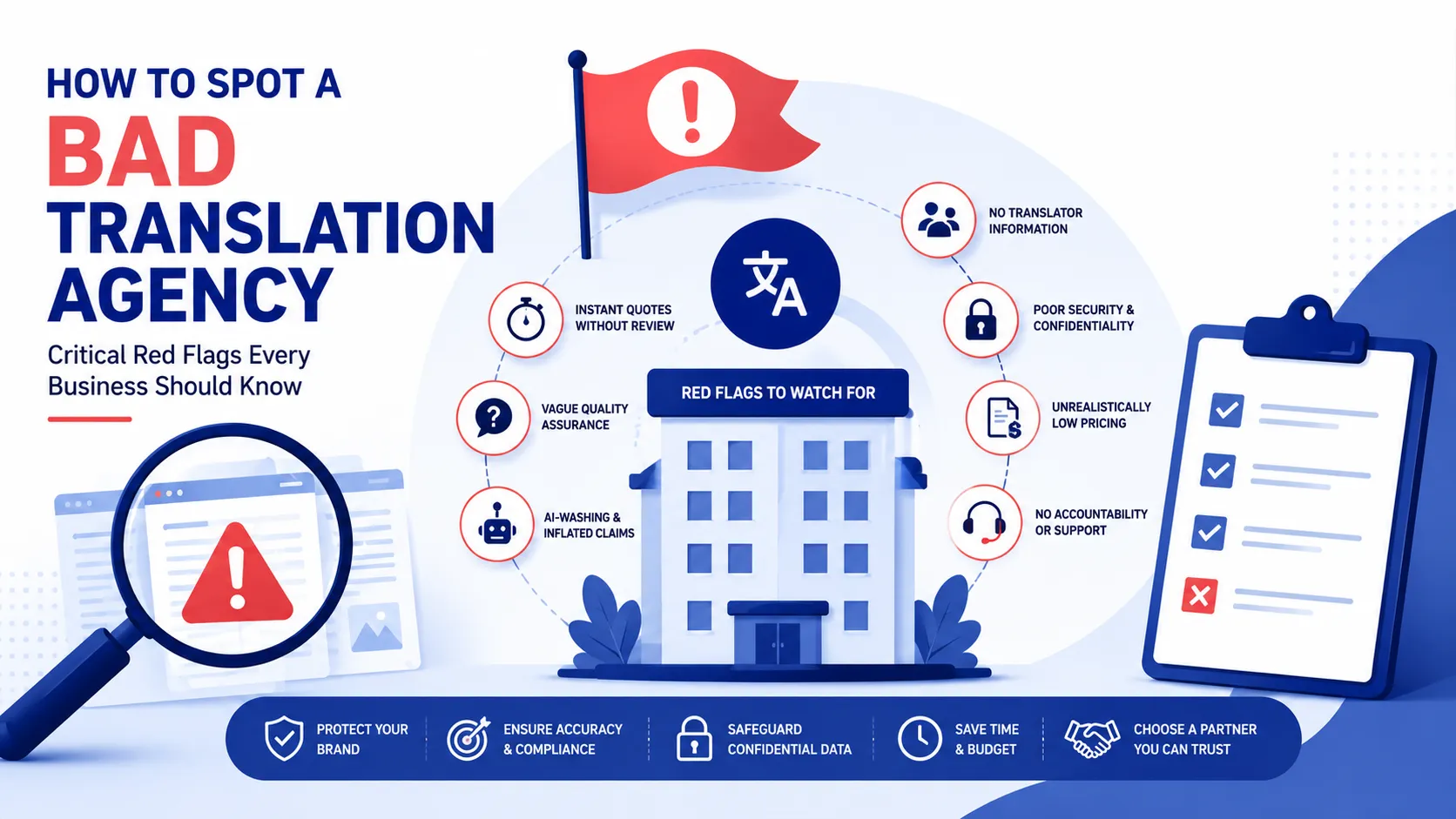
10 Red Flags That Tell You to Walk Away from a Translation Agency
Identifying a poor vendor early saves rework costs, missed deadlines, and, in regulated environments, legal or compliance exposure. If you encounter three or more of the following warning signs from the same translation agency, treat it as a procurement risk and look elsewhere.
Red Flag 1: Instant Quotes for Any Language Pair and Any Domain Without a Single Question
A professional agency needs context before quoting: document type, domain, language pair, file format, QA tier, and deadline. An instant quote for any language into any technical domain, without clarifying questions, signals pricing based on availability rather than expertise. Credible agencies qualify projects first.
If you receive a blanket quote in under a minute, question what quality process sits behind it.
Red Flag 2: “We Use Native Speakers” Is the Only Quality Statement
Native fluency is a prerequisite, not a QA framework. A native speaker without domain expertise cannot accurately translate pharmaceutical submissions or patent claims.
If “native speakers” is the agency’s only quality claim, they lack a documented process. A professional translation agency can clearly describe its TEP workflow, QA tools, and revision policy without being prompted.
Red Flag 3: They Cannot Confirm the Name or Credentials of the Translator Assigned to Your Project
“We have 10,000 translators worldwide” is a marketplace pitch, not proof of quality. If the agency cannot identify the translator assigned to your project, including domain credentials and relevant experience, your work is likely routed to the first available linguist. For B2B, regulated, or confidential content, named translator assignment with verifiable qualifications is a minimum standard.
Red Flag 4: NDA Is Not Standard — You Have to Ask for It
Any agency that treats NDAs as optional, charges extra for confidentiality, or waits for you to request one does not operate at enterprise security standards.
NDAs and GDPR Data Processing Agreements should be standard before a single file is shared. For legal, HR, financial, or compliance documents, this is non-negotiable. Hesitation here is a disqualifier.
Red Flag 5: Translation Memory Is Owned by the Agency, Not the Client
Your Translation Memory (TM) is built from your approved content. It is your intellectual asset. An agency that retains TM ownership creates vendor lock-in, switching providers means losing accumulated cost savings and terminology consistency.
Confirm client-owned TM in writing before project start. Any resistance indicates commercial self-interest over long-term client value.
Red Flag 6: Per-Word Rates Appear Too Low for the Domain and Language Pair
If an agency quotes extremely low rates for legal, medical, or technical translation into complex language pairs, the work likely relies on raw machine translation or unvetted marketplace translators.
Regulated, domain-specific translation requires qualified human linguists. Any unusually low rate for specialised content should prompt a detailed breakdown of what QA stages are actually included.
Red Flag 7: No Industry References or Case Studies on Request
Generic testimonials about “fast delivery” do not prove domain competence. For legal, pharmaceutical, financial, or compliance translation, industry-specific references are essential.
If an agency cannot provide a relevant case study or reference from your sector, even after initial engagement, they may not have genuine experience at professional level in your field.
Red Flag 8: “Perfect” Translation Guarantee or Unlimited Free Revisions
No responsible agency guarantees perfection. Translation involves judgment and contextual decisions. Promises of “perfect translation” or unlimited free revisions signal unrealistic sales positioning.
Professional agencies define accuracy standards, document revision scope, and specify correction procedures in writing. Vague guarantees often collapse when a real dispute arises.
Red Flag 9: Slow Response to a Quote Inquiry
Sales-stage responsiveness predicts operational responsiveness. A multi-day delay responding to a quote request suggests similar delays when deadlines shift or quality concerns arise.
B2B translation involving compliance, contracts, or regulatory deadlines requires named project management and fast escalation pathways. If communication is slow before contract signature, it will not improve afterward.
Red Flag 10: The Contract Is Vague on IP, Liability, and Dispute Resolution
Translation contracts that omit clear clauses on IP ownership (including TM and translated output), liability limits, and dispute resolution are drafted primarily to protect the agency.
Before signing, confirm who owns the translated content and TM, what liability applies if an error causes business loss, and how disputes are resolved. If terms are ambiguous, involve legal review before proceeding.
Types of Translation Agencies: Which Model Best Fits Your Business?
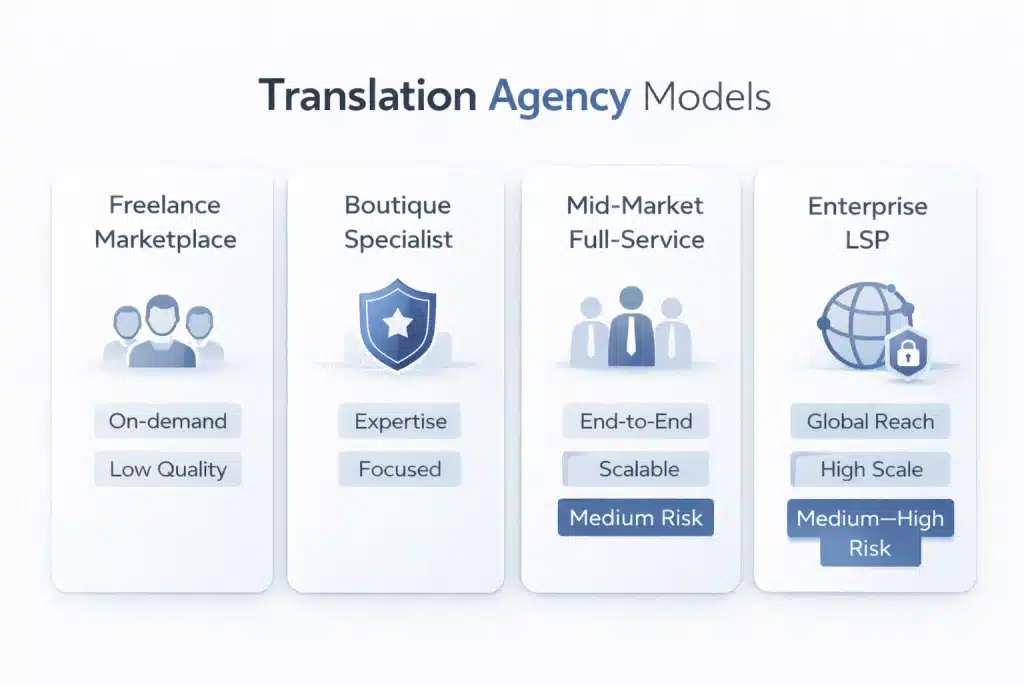
“Translation agency” covers several distinct operational models, each with different quality controls, security standards, and long-term value profiles. Choosing the right model based on your volume, domain sensitivity, compliance exposure, and international growth roadmap matters far more than brand recognition or headline per-word rate alone.
| Agency type | Model | Avg rate | Best for | Key risk |
| Freelance marketplace | On-demand gig model | Lowest | Non-critical, consumer content | Inconsistent quality, weak security |
| Boutique specialist | Dedicated team in specific domain | Medium | Legal, medical, technical SME content | Limited volume capacity |
| Mid-market full-service | Permanent team + vetted contractors | Medium–High | B2B multi-language, multi-service programmes | No significant structural risk |
| Global enterprise LSP | Large internal staff + tech platform | Highest | Fortune 500, very high volume | Cost, account deprioritisation |
| Online translation platform | Tech-first, human/AI hybrid | Low–Medium | Fast-turnaround, lower-stakes content | Quality ceiling, platform dependency |
Boutique, Mid-Market, and Enterprise LSP: Which Fits Your B2B Translation Volume and Risk Profile?
For mid-market B2B organisations (50–2,000 employees; 10,000–500,000 words per year; 5–30 language pairs), the mid-market full-service agency typically delivers the strongest balance of quality, scalability, and cost control.
You gain a documented TEP QA process, structured TM and termbase management, DTP capability, and named project management without enterprise-level pricing or account deprioritisation risk.
Boutique specialists offer deep domain expertise and direct senior translator access. They are ideal for legal, medical, or highly regulated content but may struggle with multi-language or high-volume programmes.
Enterprise LSPs provide global scale and TMS integration suited to Fortune 500 environments. The trade-off is cost, process standardisation, and lower agility for mid-market clients.
Online Translation Platforms vs Traditional Agencies: Where the Quality and Security Gap Matters for B2B
Online translation platforms such as One Hour Translation, Gengo, or Translated.com rely on automation to assign work to available translators. This increases speed and lowers cost, but reduces domain matching precision and process oversight.
| Dimension | Online platform | Traditional agency |
| Pricing | Lower | Higher |
| Domain match | Availability-based | Credential-matched |
| QA process | Platform-level review | Full TEP + project manager oversight |
| Data security | Platform terms of service | NDA + GDPR DPA standard |
| TM ownership | Platform-controlled | Client-controlled |
Verdict: Online platforms suit non-critical, internal, or speed-driven content. For legal, compliance, medical, regulated, or client-facing B2B documentation, a traditional agency with documented QA, NDA protection, and client-owned TM is essential.
Ready to Work With a Translation Agency That Meets Every Standard on This List?
Circle Translations is a B2B translation agency built for organisations where accuracy, security, and subject-matter expertise are non-negotiable.
Every client relationship includes:
✓ Domain-matched translators with verifiable credentials — legal, technical, financial, medical, SaaS
✓ Full TEP quality assurance — ISO 17100 aligned, separate linguists at each stage
✓ NDA and GDPR DPA signed at quote stage — standard, not on request
✓ Client-owned Translation Memory from project one
✓ Transparent, itemised pricing — no hidden fees, no automatic rush surcharges
✓ Dedicated project manager for every account
Send your document or describe your project scope →
See Why B2B Buyers Choose Circle Translations
Ranked among the top translation agencies for accuracy, turnaround, and scalability — get a free quote and find out what we can do for your business.
Frequently Asked Questions – Best Translation Agencies
What is the difference between a translation agency and a language service provider (LSP)?
The terms are often used interchangeably. A Language Service Provider (LSP) is the broader term, covering translation, localisation, interpreting, and related services, while a translation agency typically focuses on written translation. For B2B buyers, what matters more than terminology is documented QA, robust technology (TM, CAT tools), and strong data security standards.
How do I verify that a translation agency is ISO 17100 certified?
Ask for a copy of the ISO 17100 certificate and check the issuing body and expiry date. Confirm the scope of certification, as some agencies are certified only for specific services. Many certification bodies provide public registries for verification. ISO 17100 confirms a documented QA process and qualified translator requirements.
Is a local translation agency better than an online translation agency for B2B?
Not necessarily. For B2B buyers, QA standards, domain expertise, and data security matter more than location. A remote agency with ISO-aligned processes and NDA-protected workflows can outperform a local agency without structured QA. Local presence is mainly relevant for sworn translation or jurisdiction-specific notarisation.
What certifications should a professional B2B translation agency hold?
ISO 17100 is the primary quality certification. ISO 27001 indicates strong data security practices. GDPR compliance and a signed Data Processing Agreement are essential for EU-related projects. ATA or equivalent professional memberships add credibility. For regulated sectors, industry-specific compliance knowledge is also important.
Can a translation agency guarantee accuracy for regulated industries?
No agency can guarantee zero errors. What they should guarantee is a documented multi-stage QA process, a defined accuracy standard, and a written revision policy. For regulated industries, liability terms and correction procedures must be clearly stated in the contract before work begins.
How many words can a professional translator translate per day for technical or legal content?
A professional, technical, or legal translator typically produces 1,500–2,500 words per day. Highly complex content such as patents or regulatory submissions may reduce output to 1,000–1,500 words per day. Use this range for realistic project timeline planning per language.
What is the typical onboarding process when starting with a new B2B translation agency?
Standard onboarding includes a discovery call, NDA and DPA signing, possible test translation, TM and termbase setup, and a written SLA covering turnaround and pricing. A dedicated project manager should be assigned. If these steps are skipped, process maturity may be limited.
How do I compare translation agency quotes when rates differ significantly?
Compare fully loaded cost, not just per-word rate. Check whether pricing is per source or target word, which QA tier is included, whether DTP or minimum fees are itemised, and who owns the TM. A slightly higher rate with full TEP and transparent terms often delivers lower long-term cost and risk.