Technical translation costs between $0.15 and $0.35 per word in 2026, significantly more than general content translation, reflecting the domain expertise, terminology management, and QA rigour required.
Final pricing varies by language pair, document type (engineering manual, patent, safety data sheet, CAD drawing, SaaS documentation), regulatory complexity, source file format, and whether machine translation post-editing (MTPE) is used.
For procurement teams, engineering managers, and technical writers budgeting the translation of technical documents such as specifications, operating manuals, patents, and compliance records, understanding these variables is essential.
This guide breaks down benchmark per-word rates, pricing models, seven key cost drivers, document-type cost ranges, MTPE savings potential, and a practical framework to calculate your technical translation budget accurately.
Technical Translation Cost in 2026: Benchmark Rates at a Glance
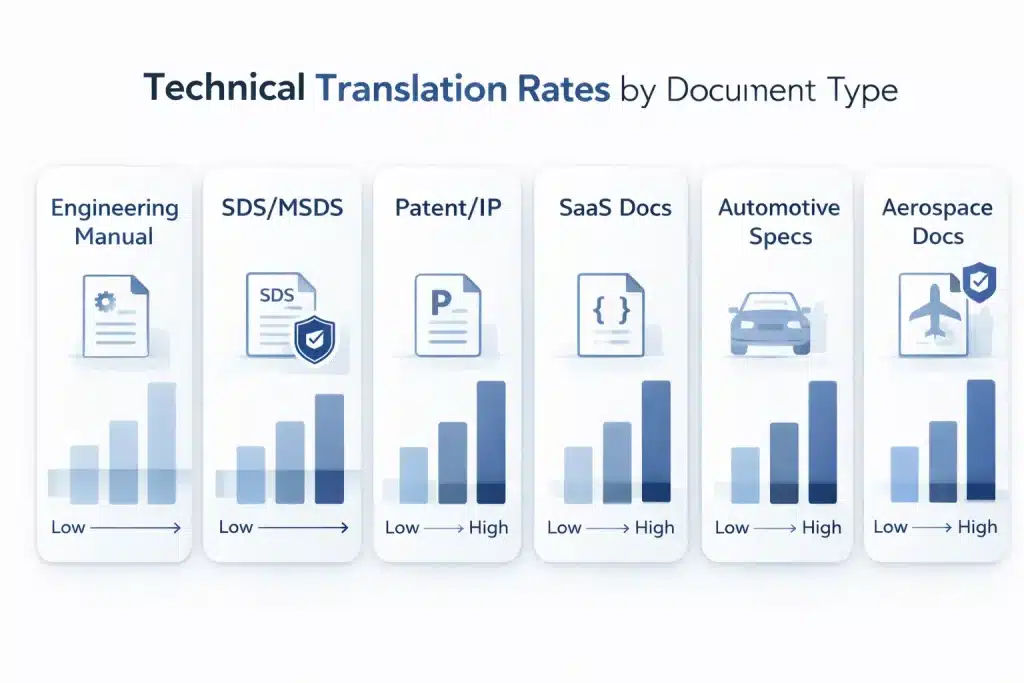
Before diving into cost drivers, here are the current market rates for technical translation in 2026. These benchmarks reflect professional agency pricing for qualified technical translators, not machine-only output. Rates assume standard QA and common Western European language pairs. Higher regulatory complexity, specialist review, or less common language pairs increase pricing accordingly.
| Document Type | Per-Word Rate | Per-Page Estimate* | Notes |
| Engineering manual (general) | €0.15–€0.22/word | €37–€55/page | Standard complexity |
| Operating procedures / SOPs | €0.15–€0.22/word | €37–€55/page | Process-critical |
| Safety data sheets (SDS/MSDS) | €0.18–€0.28/word | €45–€70/page | Regulatory compliance required |
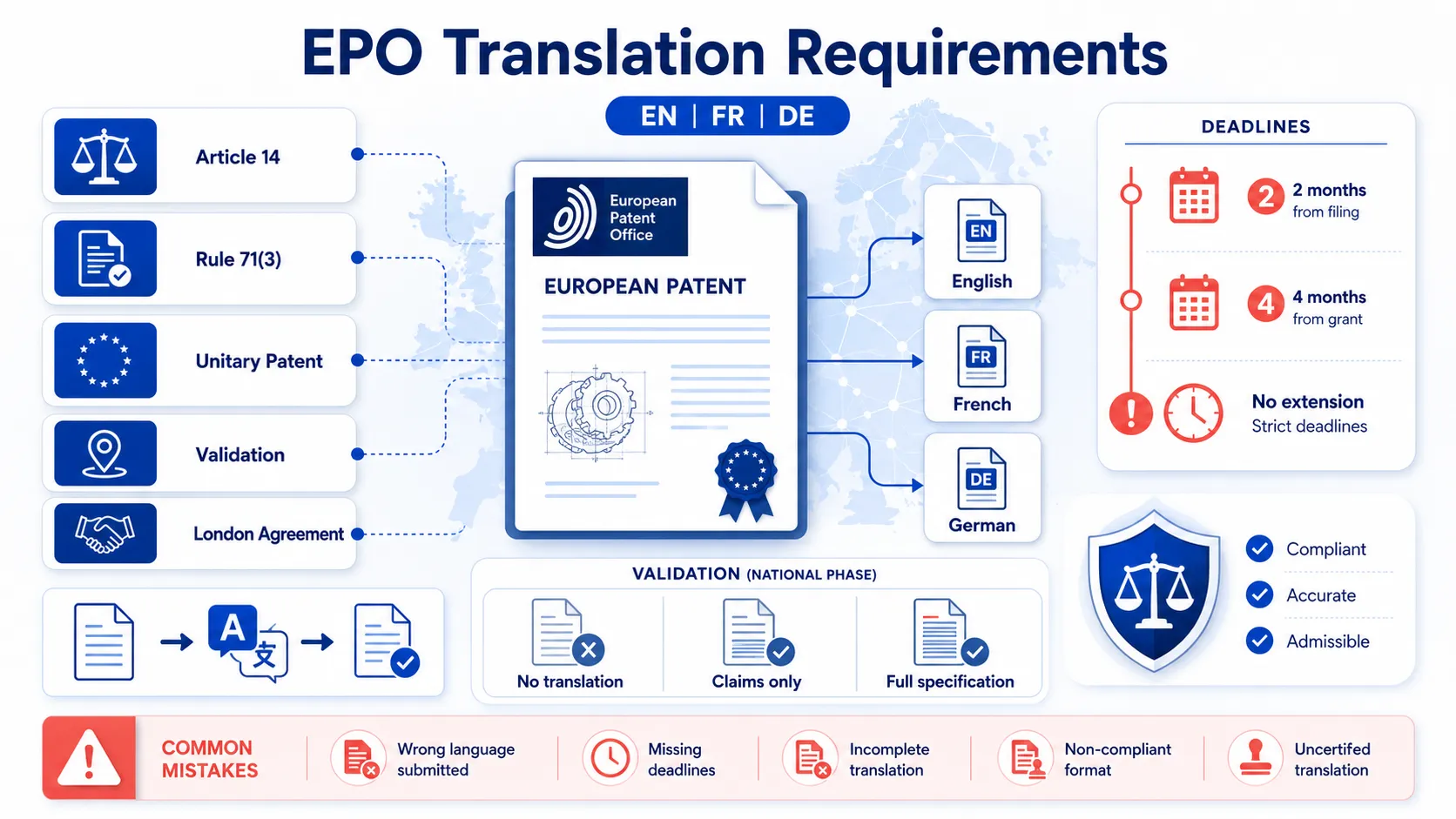
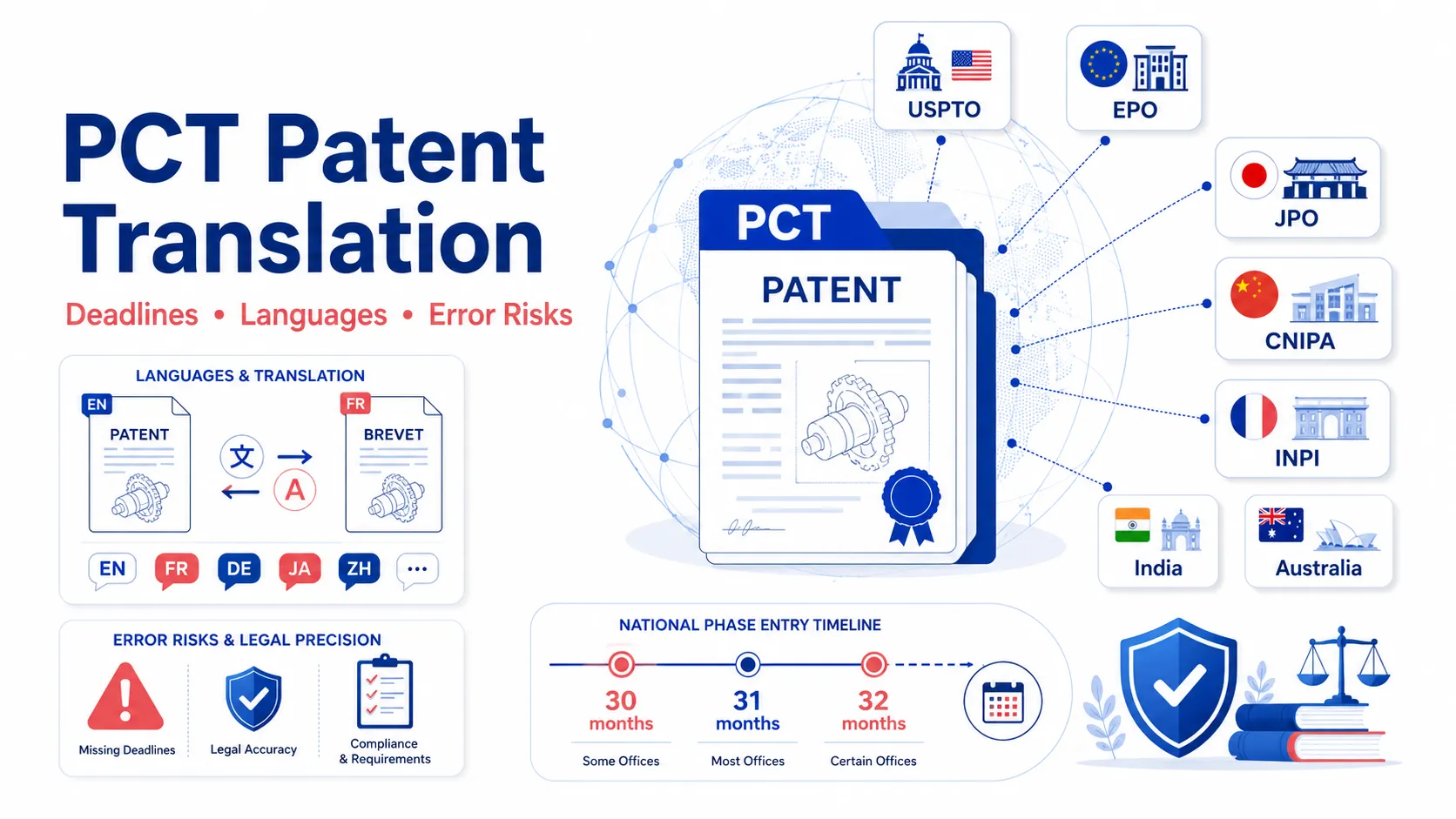
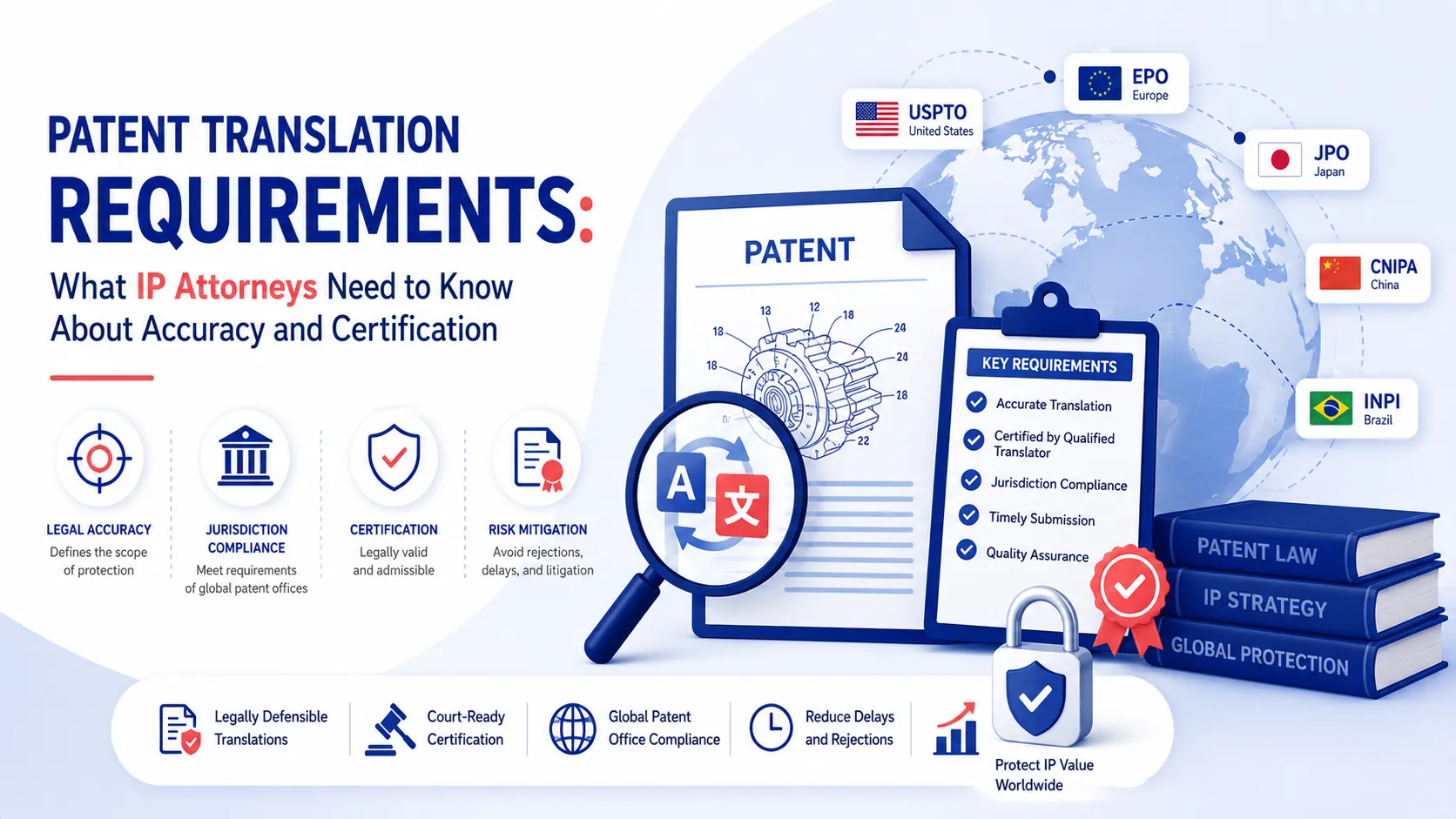
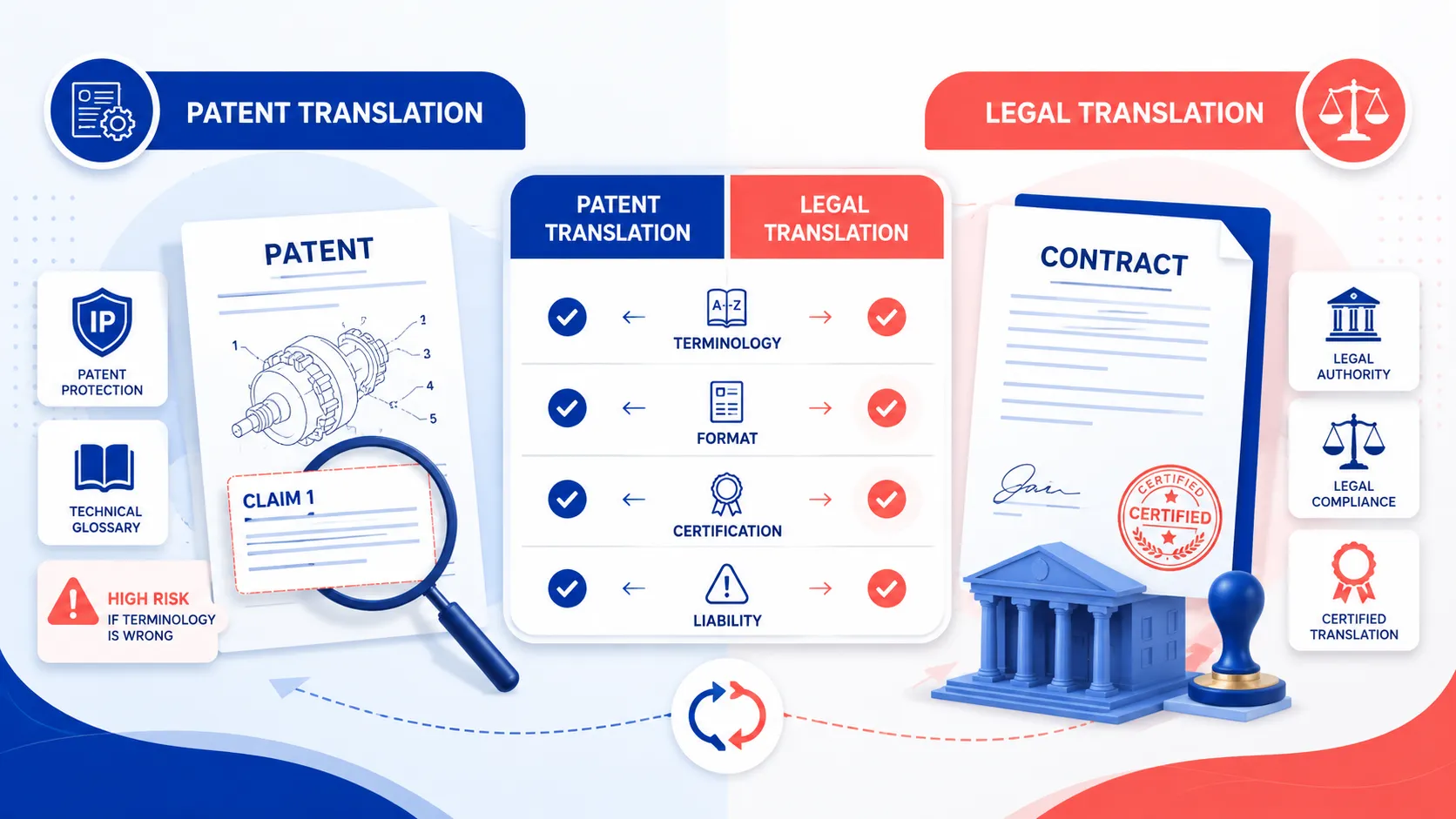
| Patent / IP documents | €0.20–€0.35/word | €50–€87/page | Legal-technical hybrid; specialist required |
| Technical manuals (heavy machinery) | €0.18–€0.28/word | €45–€70/page | CAD/specs integration |
| SaaS / software documentation | €0.15–€0.25/word | €37–€62/page | API docs, help centres, changelogs |
| Automotive technical specs | €0.18–€0.30/word | €45–€75/page | OEM terminology critical |
| Aerospace / defence documentation | €0.25–€0.45/word | €62–€112/page | Highest complexity + regulatory |
| Scientific / R&D reports | €0.20–€0.35/word | €50–€87/page | Mixed technical-academic |
| Medical device IFUs / technical docs | €0.22–€0.38/word | €55–€95/page | MDR/FDA compliance |
*Per-page assumes approximately 250 source words.
Rates shown apply to EN↔DE/FR/ES/IT. Add 20–40% for CJK languages (Chinese, Japanese, Korean) and 30–60% for rare language pairs.
How Technical Translation Is Priced: Models and Structures Explained
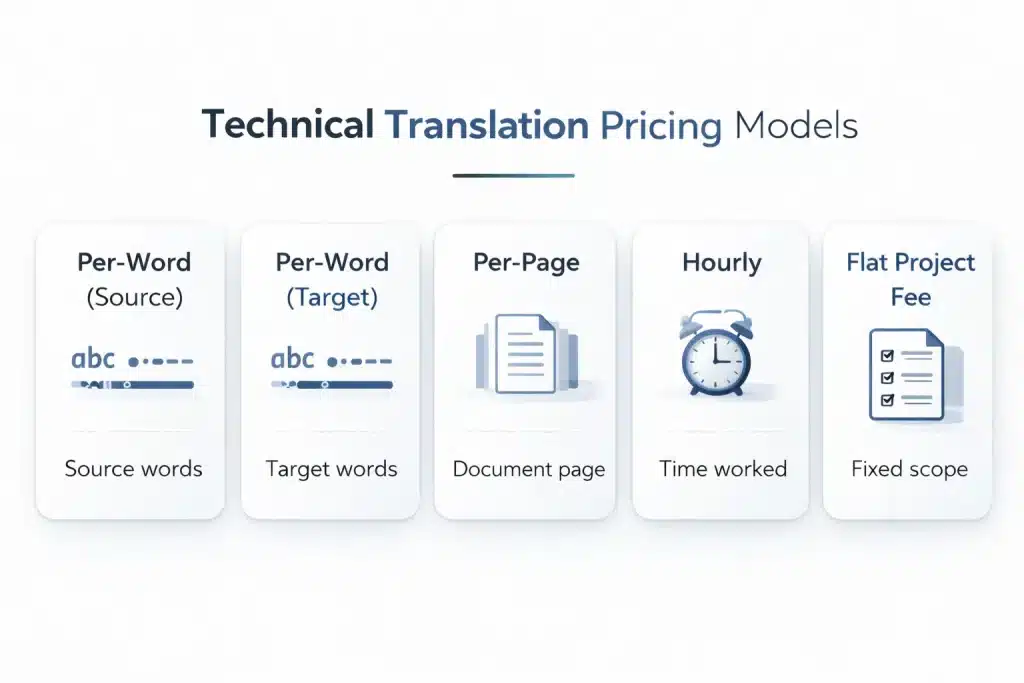
Technical translation can be priced in several ways. The right pricing model depends on document type, formatting complexity, project volume, and whether you are managing a one-off assignment or an ongoing multilingual documentation programme.
| Model | How it works | Best for | Watch-out |
| Per word (source) | Charged per word in source document | Standard volume docs | Most predictable |
| Per word (target) | Charged per translated word | Expansion languages | Harder to forecast |
| Per page | Flat rate per document page | Certified docs, formatted PDFs | Page definition varies (250 vs 300 words) |
| Hourly | Billed per hour | SME review, editing, DTP | Less transparent |
| Project / flat fee | Fixed quote for defined scope | Large, complex projects | Requires detailed specification |
| Volume SLA | Blended per-word rate | Enterprise programmes | Requires minimum volume commitment |
Per-Word vs Per-Page Pricing for Technical Documents: Which to Request
Per-source-word pricing is the standard for technical translation. It is transparent, auditable, and allows procurement teams to compare translation agencies accurately. Always request quotes based on source word count rather than target word count to maintain budget predictability.
Per-page pricing is common when word counting is impractical, such as AutoCAD drawings with embedded text, scanned PDFs, SDS forms, or heavily formatted documents.
Key watch-out: Page definitions vary. Some agencies define one page as 250 words, others use 300. On a 200-page manual, that 50-word difference equals 10,000 words. At technical rates, this can mean a cost variance of €1,500–€3,500.
Procurement tip: Request confirmed source word counts for text-heavy documents and confirm the page definition in writing before approval.
Minimum Fees and Project Setup Costs for Small Technical Translation Orders
Most professional technical translation agencies apply minimum fees, typically €50–€150 per project, regardless of word count. This covers project management, file preparation, terminology setup, QA coordination, and delivery.
For engineering and procurement teams placing small orders such as safety labels, short specifications, or SDS updates, minimum fees can distort the effective per-word rate.
To reduce impact:
- Batch multiple short documents into a single project order
- Establish a volume SLA where minimums are often waived
- Provide editable source files (DOCX/XLSX) to minimise file preparation and DTP costs
Circle Translations applies transparent pricing with no hidden setup fees. Volume clients benefit from structured SLA pricing.
Volume Discounts and TM Leverage: How Repeat Technical Content Reduces Long-Term Cost
For engineering, manufacturing, and SaaS organisations managing recurring multilingual documentation, Translation Memory (TM) is the most powerful cost-reduction mechanism available.
| Match Type | Description | Typical Rate Applied |
| Exact / 100% match | Identical segment in TM | 0–30% of full rate |
| Fuzzy 85–99% match | Minor variation | 30–60% of full rate |
| Fuzzy 50–84% match | Partial overlap | 60–80% of full rate |
| No match (new) | No TM reference | 100% of full rate |
Real-world example: A 200-page technical manual translated in Year 1 at €0.20 per word. In Year 2, with 70% repeated content, the effective blended rate can drop to approximately €0.10–€0.13 per word.
Circle Translations builds and maintains client-owned TM assets, allowing cost efficiency to compound across product updates and documentation cycles.
7 Cost Drivers That Make Technical Translation More Expensive Than General Translation
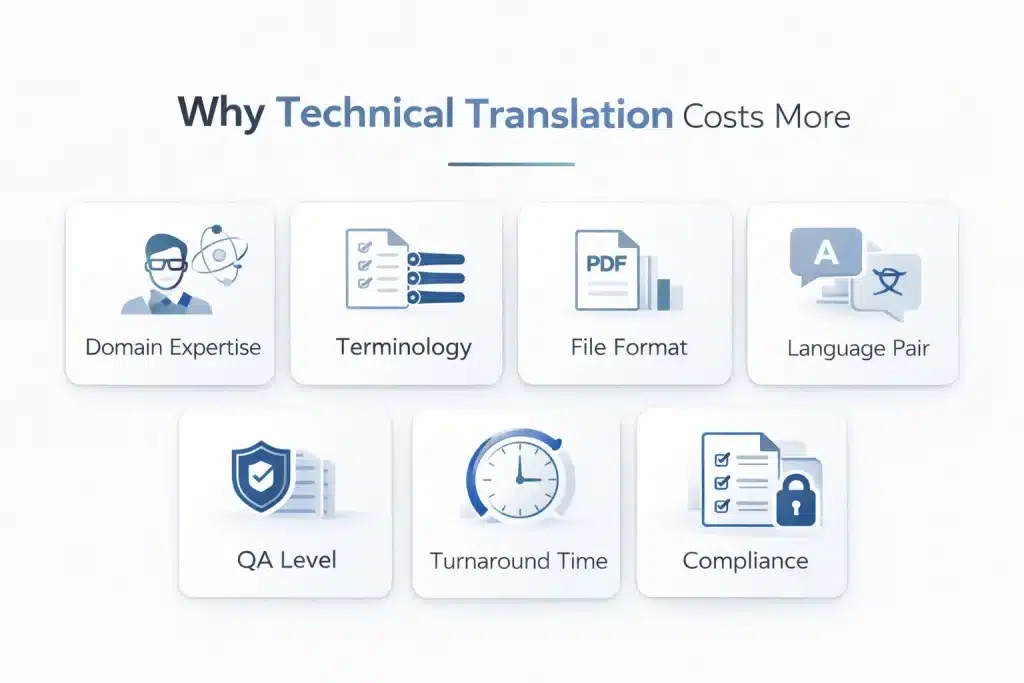
Technical translation commands a premium over general content translation. The premium reflects real cost inputs: subject-matter expertise, terminology management, complex file handling, multi-layer QA, and regulatory accountability.
For B2B buyers in engineering, manufacturing, and SaaS, understanding these seven cost drivers makes budgeting more predictable and negotiations more informed.
Cost Driver 1: Domain Expertise — Why Technical Translators Cost More Per Word
Technical translation requires subject-matter expertise, not just bilingual ability. A translator handling aerospace MRO documentation must understand airworthiness directives and maintenance procedures. An automotive technical translator must know OEM terminology and ECU calibration concepts.
Domain specialists typically charge €0.18–€0.35 per word compared to €0.10–€0.15 for general content. The premium reflects training, industry experience, and the liability tied to safety-critical or regulated documentation. Always verify domain credentials for each project type.
Cost Driver 2: Terminology Management — Building and Maintaining Glossaries
Terminology consistency is critical in technical translation. A single incorrect term in a maintenance manual can create safety risk or invalidate warranties.
Terminology management includes building a client-specific glossary or termbase, enforcing terminology through CAT tools, and conducting SME review for new product lines. Initial termbase creation typically ranges from €200–€800 depending on scope. Without structured terminology control, revision cycles can add €300–€1,200 per major project.
Cost Driver 3: File Format and DTP — When Your Source Files Add Cost
Non-editable source files increase costs. Scanned PDFs, locked InDesign or FrameMaker files, and AutoCAD drawings require desktop publishing before and after translation.
| Source file type | Processing required | Typical extra cost |
| Editable DOCX/XLSX | Minimal | No surcharge |
| PDF (text layer) | Extraction + reformatting | +€10–€25 per page |
| Scanned PDF / image | OCR + extraction + reformatting | +€20–€50 per page |
| InDesign / FrameMaker | DTP reconstruction | +€25–€80 per page |
| AutoCAD DWG (text callouts) | Manual extraction + reinsertion | +€30–€100 per drawing |
Supplying editable source files can reduce total project cost significantly.
Cost Driver 4: Language Pair — How Rare Languages Multiply Technical Rates
Translator availability directly affects cost. Less common language pairs require specialists with both linguistic and technical expertise.
| Tier | Examples | Per-word multiplier |
| Common Western European | EN↔DE/FR/ES/IT/NL | 1× baseline |
| Scandinavian | EN↔SV/DA/NO/FI | +10–20% |
| Central/Eastern European | EN↔PL/CS/HU/RO | +10–25% |
| CJK | EN↔ZH/JA/KO | +20–40% |
| Arabic / Semitic | EN↔AR/HE | +25–45% |
| Rare / Limited supply | EN↔KA/AM/MY | +40–80% |
Manufacturers expanding into Asia or the Middle East should factor these multipliers into localisation budgets early.
Cost Driver 5: QA and Review Loops — The Hidden Cost of Getting Technical Translation Right
Technical QA goes beyond proofreading. Regulated industries often require structured multi-stage review.
| QA tier | Process | Premium |
| Standard | Translation + proofreading | Baseline |
| TEP | Translation + editing + proofreading | +15–25% |
| SME review | Subject-matter expert validation | +€80–€180 per hour |
| Back-translation | Reverse translation for verification | Up to double cost |
| LQA | Structured error scoring | +10–20% of project value |
For safety-critical documentation, reducing QA may lower upfront cost but significantly increase liability exposure.
Cost Driver 6: Turnaround Time — How Urgency Affects Technical Translation Pricing
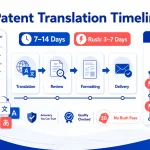
Technical translators average 1,500–2,500 words per day depending on complexity. Patents, aerospace manuals, and regulated documentation often move slower.
| Turnaround tier | Timeline | Premium |
| Standard | 5–10 business days | No surcharge |
| Expedited | 2–4 business days | +15–25% |
| Rush | 1–2 business days | +35–60% |
| Same-day | Under 24 hours | +75–100% |
A 10,000-word technical manual typically requires 4–7 business days at standard pace.
Cost Driver 7: Regulatory and Compliance Requirements —When Certification Adds to the Bill
Certain technical documents require certified translation, particularly patents, CE or FCC submissions, import/export compliance documents, and ISO audit materials.
Certification typically adds €15–€75 per document. Notarisation may add €20–€100. Apostille for international legal recognition can add €30–€150 depending on jurisdiction.
Always confirm the regulator’s specific certification format before ordering, as requirements vary by authority.
Machine Translation Post-Editing (MTPE) for Technical Content: Cost, Quality, and When to Use It
Machine Translation Post-Editing (MTPE) is increasingly used for technical translation at scale, particularly for internal documentation, software help centres, and high-volume repetitive product descriptions.
MTPE combines neural machine translation engines such as DeepL or Google Translate with human post-editing. For technical buyers, understanding when MTPE delivers measurable cost efficiency and when it introduces unacceptable regulatory or safety risk is critical.
| Approach | Rate (2026) | Quality Output | Best For | Risk Level |
| Full human translation | €0.15–€0.35 per word | Highest | Safety-critical, regulated, client-facing | Low |
| MTPE (light) | €0.04–€0.08 per word | Good | Internal use, low-risk content | Medium |
| MTPE (full) | €0.06–€0.12 per word | Very good | High-volume, repetitive technical content | Low–Medium |
| Raw MT (unedited) | €0.00–€0.02 per word | Variable (70–90% accuracy) | Not suitable for B2B technical documents | High |
When MTPE Is Appropriate for Technical Documentation
MTPE typically delivers 40–65 percent cost savings compared to full human translation when content is structured and repetitive. It works best for parts catalogues, product attribute lists, UI strings, and help centre content.
It is suitable for internal-use documentation and language pairs where neural machine translation performs strongly, such as EN↔DE, FR, ES, and NL.
It is not appropriate for safety documentation, medical instructions, patents, legal-technical contracts, or regulatory submissions where terminology precision carries legal liability.
MTPE Rates in 2026: Light Post-Editing vs Full Post-Editing for Technical Content
Light post-editing generally ranges from €0.04–€0.07 per word. The reviewer corrects terminology and factual errors but does not fully refine style. This level is appropriate for internal documentation only.
Full post-editing ranges from €0.06 – €0.12 per word and raises output to near human-translation quality. For CJK language pairs such as EN→JA, ZH, or KO, full MTPE may range from €0.10–€0.18 per word due to higher correction effort.
Example: 50,000-word parts catalogue EN→DE. Full human translation at €0.18 per word equals €9,000. Full MTPE at €0.09 per word equals €4,500, representing approximately 50 percent savings before Translation Memory leverage.
In-House Translation vs Agency for Technical Documents: Real Cost Comparison
The build-versus-buy decision in technical translation often overlooks total cost of ownership. While an in-house translator may appear cost-effective based on salary alone, infrastructure, QA layers, and capacity constraints significantly increase the true cost.
| Cost Element | In-House Team (1 FTE) | Agency (Variable Model) |
| Salary + benefits | €50,000–€80,000 per year | €0 fixed cost |
| CAT tool licences | €600–€1,200 per year | Included |
| TM / termbase management | Internal resource time | Included |
| QA / proofreading | Additional hire or outsource | Included |
| Volume flexibility | Limited to FTE capacity | Scalable |
| Language coverage | Typically 1–2 languages | 100+ languages |
In-house translation is viable for consistent, very high-volume output in one or two languages. For variable volume, multi-language requirements, or specialist technical domains, an experienced technical translation agency typically provides better cost efficiency, structured QA, and scalability.
How to Calculate Your Technical Translation Budget: A 4-Step Framework
Whether you are costing a single product manual or planning a multilingual documentation programme across multiple markets, this four-step framework allows procurement and operations teams to estimate a realistic technical translation budget before engaging a translation agency.
Step 1: Count Your Words and Identify Document Types Accurately
Start with an accurate source word count. Use your CAT tool or MS Word word count for editable DOCX files. For PDFs, run OCR extraction or estimate 250–300 words per page for text-dense technical content.
For mixed-format files such as AutoCAD drawings or product catalogues, isolate text callouts and UI strings separately, as they involve different handling costs.
Categorise documents by type, such as engineering manual, SDS, patent, or SaaS documentation. Each category carries different per-word rates.
Formula: Estimated translation cost = total source word count × per-word rate for that document type.
Step 2: Apply Language Pair and Domain Complexity Multipliers
Identify all target languages and map them against the language tier structure defined earlier. Apply domain complexity multipliers as follows:
General technical content such as SOPs and product specifications uses the baseline rate. Engineering and machinery documentation typically adds 10–15 percent. Legal-technical content such as patents adds 20–35 percent. Aerospace and medical device documentation adds 25–45 percent.
Combine the multipliers:
Base rate × language multiplier × domain multiplier = adjusted per-word rate.
Example: EN→JA aerospace documentation. €0.20 base × 1.30 (CJK) × 1.35 (aerospace) ≈ €0.35 per word.
Step 3: Add File Preparation, QA Tier, and Certification Costs
Review source file formats and add DTP surcharges for non-editable formats such as scanned PDFs, InDesign, or AutoCAD files. Specify the required QA tier:
Internal-use documentation: translation + proofreading (baseline).
Client-facing documentation: TEP process (+15–25%). Regulated or safety-critical documentation: add SME review at approximately €80–€180 per hour.
Confirm whether certified translation is required and add €15–€75 per document where applicable. Include minimum project fees for small jobs under 500 words.
Step 4: Apply TM and MTPE Savings to Reduce Year-2+ Costs
If the project is an update or part of an ongoing documentation programme, request a Translation Memory (TM) analysis from your vendor. Identify exact and fuzzy match percentages and apply TM leverage discounts to calculate the blended rate.
For large, repetitive, lower-risk batches, evaluate MTPE as an alternative to full human translation.
Output: a blended effective rate for the full programme across Year 1 and Year 2+.
Example: Year 1 programme at €0.20 per word. With 60 percent TM leverage in Year 2, the effective rate may drop to approximately €0.11 per word.
Technical Translation Cost by Industry: Engineering, Manufacturing, SaaS, and More
Technical translation cost is not uniform across industries. Engineering, manufacturing, SaaS documentation, automotive, pharmaceutical, and aerospace sectors each carry different terminology density, regulatory exposure, file format complexity, and QA requirements. Below are cost profiles for four of the most common B2B technical translation buyer verticals.
Engineering and Industrial Manufacturing: Translation Cost Profile
Typical documents include operating manuals, maintenance procedures, parts catalogues, assembly instructions, safety data sheets (SDS), and CE declarations of conformity.
Per-word rates typically range from €0.15–€0.28 depending on complexity and regulatory exposure. SDS/MSDS documents follow regulated formats and often run 8–12 pages per substance, making bulk pricing critical for large chemical catalogues.
Parts catalogues usually contain high repetition, enabling strong Translation Memory leverage from Year 2 onward, often delivering 30–50 percent savings on updates. CE and safety documentation may require certified translation in certain markets such as Germany or France.
Typical annual volume for mid-sized manufacturers ranges from 50,000 to 500,000 words. Key cost risk: non-editable legacy PDFs or DWG drawings that trigger DTP surcharges. Always audit file formats before contracting.
SaaS and Software Documentation: Translation and Localisation Cost Profile
Typical SaaS documentation includes API documentation, help centres, release notes, changelogs, onboarding flows, UI strings, and error messages.
Per-word rates generally range from €0.12–€0.22 for standard SaaS documentation, with the lower end applying to UI strings that contain high repetition. For CJK languages, character-based pricing is common, typically equivalent to €0.18–€0.30 per source-word equivalent.
SaaS environments benefit from high TM leverage because documentation updates reuse structured terminology, often reducing effective Year 2 rates by 40–60 percent.
MTPE is suitable for help centre articles, FAQs, and release notes where risk is low. It is not appropriate for legally binding documents such as terms of service, privacy policies, or compliance statements.
Get an Itemised Technical Translation Quote in 24 Hours
Circle Translations provides technical translation for engineering, manufacturing, SaaS, and regulated industries, with domain-qualified translators, client-owned Translation Memory, and transparent per-word pricing.
Every technical translation quote includes:
✓ Per-word rate breakdown by document type
✓ TM and MTPE savings analysis
✓ QA tier options (translation-only through SME review)
✓ File format assessment — no hidden DTP costs
✓ No automatic rush-fee surcharge on standard expedited orders
Upload your document or share your project scope →
Get an Accurate Quote for Your Technical Project
Pricing varies by language pair, volume, and complexity — get a tailored quote from Circle Translations and know exactly what your project will cost.
Frequently Asked Questions – Technical Translation Cost
How much does technical translation cost per 1,000 words in 2026?
Technical translation costs €150–€350 per 1,000 source words in 2026. Western European pairs (EN↔DE/FR/ES/IT) usually range from €150–€220. CJK languages range from €200–€350. Safety-critical or regulated documents sit at the top end. MTPE can reduce suitable lower-risk content to €60–€120 per 1,000 words.
Is technical translation more expensive than legal or medical translation?
Not necessarily. Technical translation typically ranges from €0.15–€0.35 per word. Legal ranges from €0.18–€0.35. Medical often ranges from €0.20–€0.40. Overlap is common. Patent and regulatory documents usually attract the highest rates across all three categories.
How many words can a technical translator translate per day?
Most technical translators deliver 1,500–2,500 words per day. Highly complex documents, such as patents or aerospace manual,s may reduce output to 1,000–1,500 words per day. A 10,000-word manual typically requires 4–7 business days per language.
How much does MTPE cost per word for technical content in 2026?
MTPE costs €0.04–€0.12 per word. Light post-editing ranges from €0.04–€0.07 and suits internal content. Full post-editing ranges from €0.06–€0.12 and suits lower-risk external content. It is not appropriate for safety-critical or regulated documentation.
What is the cost difference between a technical translation agency and a freelancer?
Freelancers often charge €0.12–€0.25 per word. Agencies range from €0.15–€0.35. Agency rates include project management, QA, TM management, terminology control, and data security. For multi-language or regulated projects, agencies usually offer better risk control and scalability.
Does the source language affect technical translation cost?
Yes. English-source projects are usually more competitive due to a larger translator pool. Less common source languages reduce the availability of qualified technical translators and can increase rates by 20–50 percent.
Are there hidden costs in technical translation?
Typical extra costs include DTP for non-editable files, minimum project fees, SME review billed hourly, certification fees, and rush surcharges. Request an itemised quote to avoid surprises.
Can AI replace technical translators for engineering documents?
No. AI works for repetitive, low-risk technical content with MTPE review. It is not reliable for patents, aerospace manuals, regulatory submissions, or safety-critical engineering documents.
How can I reduce technical translation costs without lowering quality?
Use editable source files, implement Translation Memory early, build a termbase, apply MTPE selectively, and negotiate a volume SLA. Structured terminology and TM strategy can reduce update costs by 30–50 percent over time.