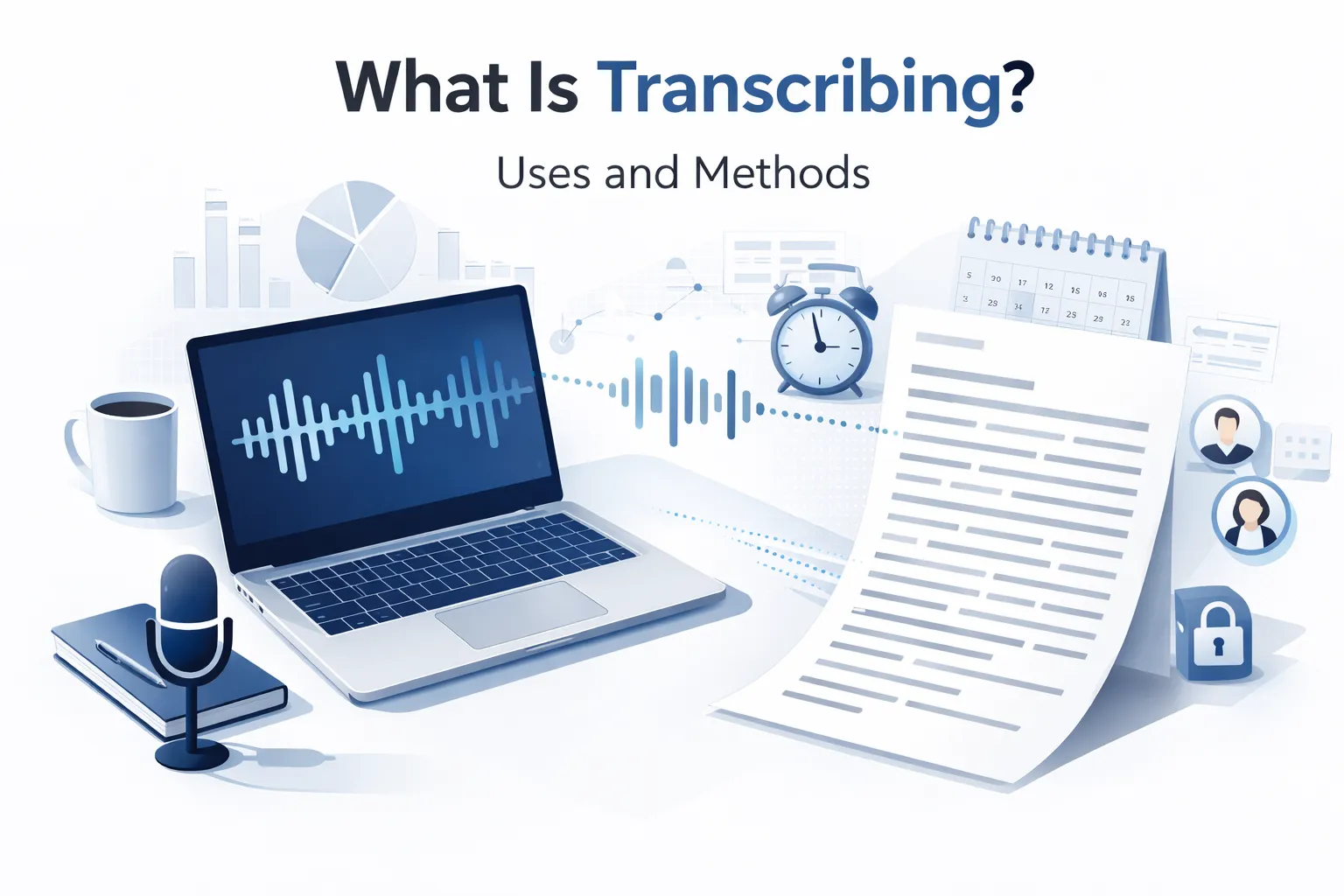
Transcribing is the process of converting spoken audio, from meetings, interviews, calls, hearings, or any recorded speech, into an accurate written document. The result is called a transcript.
Transcription is used across legal, medical, corporate, research, and compliance environments where spoken communication must become searchable, shareable, and documented.
For businesses, transcription turns unstructured spoken content, team meetings, client calls, training sessions, and compliance recordings into permanent written records. These records support governance, audit trails, knowledge management, and operational clarity.
This guide explains the definition of transcribing, the main types, the professional process, business use cases, AI vs human methods, confidentiality standards, and when to use a professional transcription service.
Transcribing Definition: What Does It Mean to Transcribe?
Transcribing is the act of listening to spoken audio and producing an accurate written record of its content. The written output is called a transcript, and the overall process is known as transcription. As Tony McEnery and Andrew Hardie (2012) explain in Corpus Linguistics: Method, Theory and Practice, “Transcription is the process of converting speech into written text,” establishing it as a formal method of representing spoken language in written form.
The term originates from the Latin transcribere, meaning “to write over” or “to copy.” In modern usage, transcription covers audio recordings, video recordings, live speech, dictation, webinars, hearings, and in some contexts, handwritten-to-typed conversion.
In a business context, transcription converts speech-to-text to create permanent, searchable documentation of verbal communication. These transcripts support compliance requirements, audit trails, governance documentation, training records, and structured knowledge management.
Transcription vs Transcribing: Is There a Difference?
Transcription refers to the process or the finished output, meaning the transcript itself. Transcribing refers to the act of performing that process. A transcriptionist or transcriber listens to audio and produces the transcript.
In B2B environments, organisations commission transcription services. The transcriptionists perform the transcribing, and the final deliverable is the transcript.
Entity clarification:
Transcription = process or noun
Transcribing = act or verb
Transcript = output document
Transcriptionist = person performing the task
Transcription vs Translation: How Are They Different?
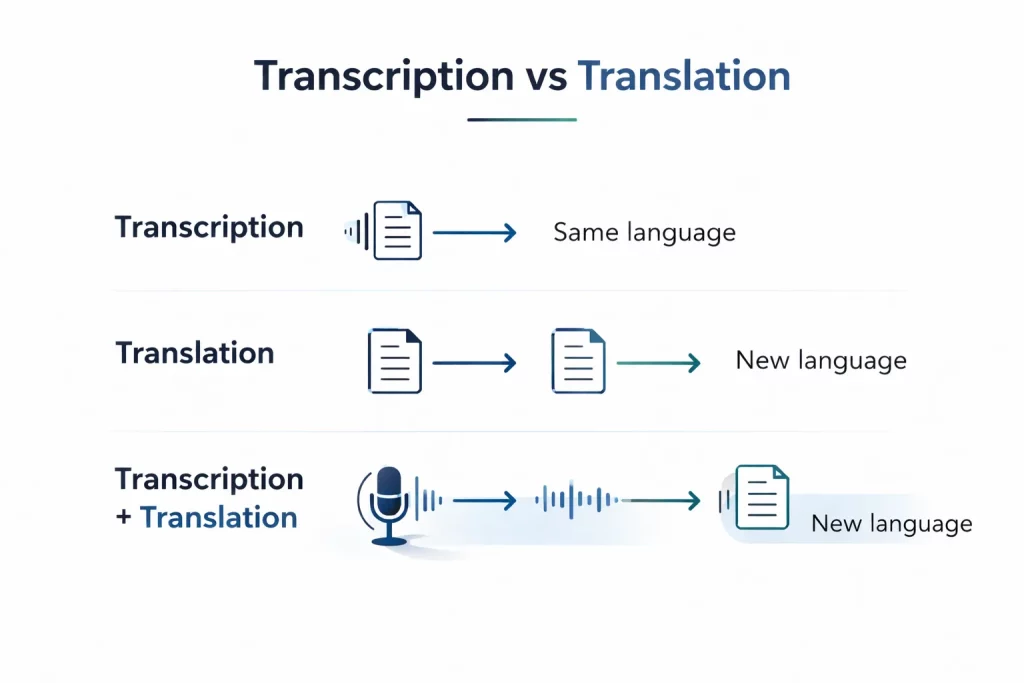
Transcription and translation are separate services. Transcription converts spoken audio into written text in the same language. Translation converts written text from one language into another language.
When combined, transcription + translation converts spoken content in Language A directly into written text in Language B. This workflow is common in multilingual legal proceedings, international compliance calls, cross-border board meetings, and global research interviews.
| Process | Input | Output | Language change? |
| Transcription | Spoken audio | Written text | No |
| Translation | Written text | Written text | Yes |
| Transcription + Translation | Spoken audio | Written text | Yes |
For international businesses, choosing the correct service prevents workflow errors. If your source is audio and your required output is in another language, you need both transcription and translation within a structured audio translation process.
Types of Transcription: The Main Categories Explained
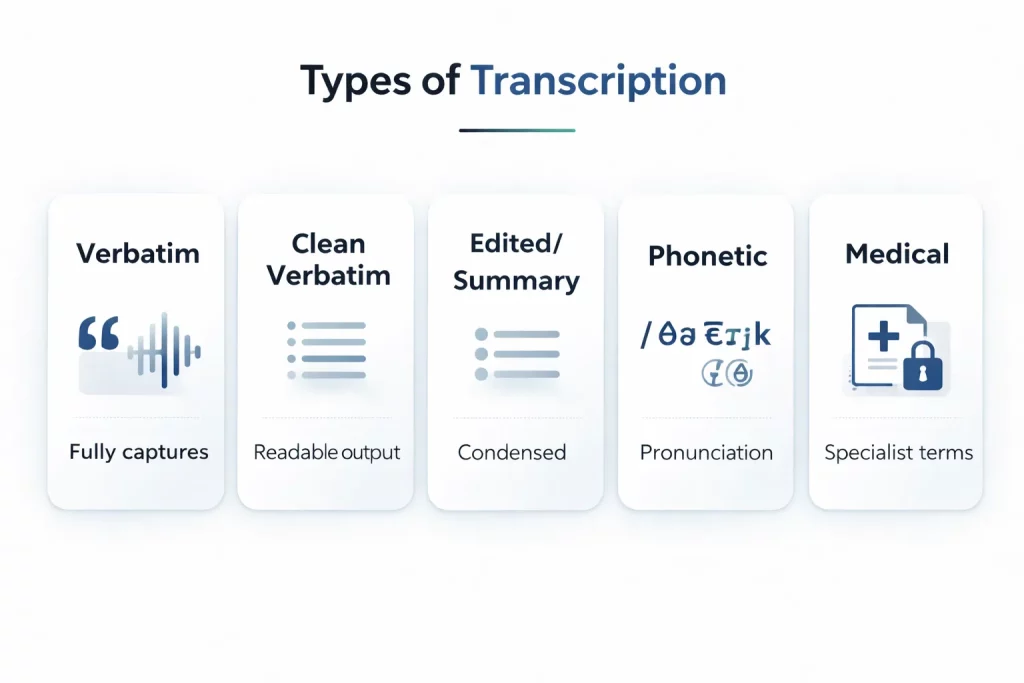
Not all transcription is the same. The required format depends on the purpose, industry, and accuracy standard. Legal proceedings demand exact capture. Corporate meetings require readability.
Medical documentation requires specialised terminology. Understanding these categories helps procurement, legal, HR, and research teams specify requirements correctly when commissioning professional transcription services.
| Type | Definition | Common use case | Format style |
| Verbatim | Every word, filler, pause captured | Legal, court, compliance | Exact capture |
| Clean verbatim (intelligent) | Words preserved, fillers removed | Business, HR, research | Polished, readable |
| Edited / summary | Condensed key points | Board meetings, briefings | Concise notes |
| Phonetic | Pronunciation notation | Linguistics, voice training | Phonetic symbols |
| Medical | Clinical dictation format | Healthcare, pharma | Specialised terminology |
Verbatim vs Clean Verbatim Transcription: Which Does Your Business Need?
Verbatim transcription captures every spoken word exactly as delivered. This includes false starts, filler words such as “um” and “uh,” repetitions, and non-verbal sounds like [laughter] or [pause]. It is required when the precise spoken record carries legal weight.
As Malcolm Coulthard and Alison Johnson (2010) explain in An Introduction to Forensic Linguistics: Language in Evidence, “In legal contexts, transcripts aim to represent as faithfully as possible what was said,” including hesitations and discourse markers, because even small details may become evidentially significant.
Court depositions, police interviews, disciplinary hearings, insurance claims, and regulatory call recordings typically require verbatim transcripts. Any omission may be interpreted as alteration of evidence.
Clean verbatim, also called intelligent transcription, removes filler words and false starts while preserving full meaning and speaker intent. It produces a clearer, more readable document without changing the substance of the conversation.
Businesses prefer clean verbatim for team meetings, client calls, research interviews, HR documentation, and training materials.
Decision guide:
- Use verbatim for legal proceedings, compliance recordings, and formal investigations.
- Use clean verbatim for meetings, interviews, training sessions, and SOP documentation.
- B2B clients should always specify the format at the briefing stage to avoid revision costs and delays.
Legal, Medical, and Corporate Transcription: Industry-Specific Differences
Legal transcription covers court hearings, depositions, police interviews, arbitration sessions, and disciplinary proceedings. It requires verbatim accuracy, precise speaker identification, exact timestamps, and documented chain-of-custody handling.
Transcriptionists must understand legal terminology. Errors can affect admissibility or regulatory compliance. As Malcolm Coulthard, Alison Johnson, and David Wright (2017) explain in An Introduction to Forensic Linguistics: Language in Evidence, “Transcripts used in legal settings may become evidence in their own right,” meaning accuracy and faithful representation are critical because inaccuracies can influence judicial interpretation.
Corporate transcription covers board meetings, earnings calls, strategy sessions, employee interviews, compliance calls, and internal training. Clean verbatim is standard. Procurement priorities include turnaround speed, volume capacity, and NDA-level data security.
Circle Translations provides legal, medical, and corporate transcription through its professional audio translation and transcription services using NDA-protected and GDPR-compliant workflows.
Research Transcription: Why Qualitative Data Requires Specialist Accuracy
Research transcription converts recorded interviews, focus groups, and ethnographic observations into analysable written data. Accuracy is critical because researchers code transcripts for themes, patterns, and direct quotations used in reports and publications.
Key research requirements include clear multi-speaker attribution, consistent timestamps for coding reference, and strict confidentiality handling with participant anonymisation. Dialect and accent familiarity also improve accuracy when working with diverse participant groups.
Market research agencies, academic institutions, UX research teams, HR departments, and consulting firms conducting stakeholder interviews rely on specialist transcription to protect data integrity and analytical reliability.
How Transcribing Works: The 7-Step Transcription Process
Professional transcription follows a structured, repeatable quality process. Whether completed by a human transcriptionist or an AI-assisted workflow, the steps remain consistent.
Understanding them helps business teams plan realistic turnaround times, prepare high-quality audio files, and evaluate transcript accuracy before approval.
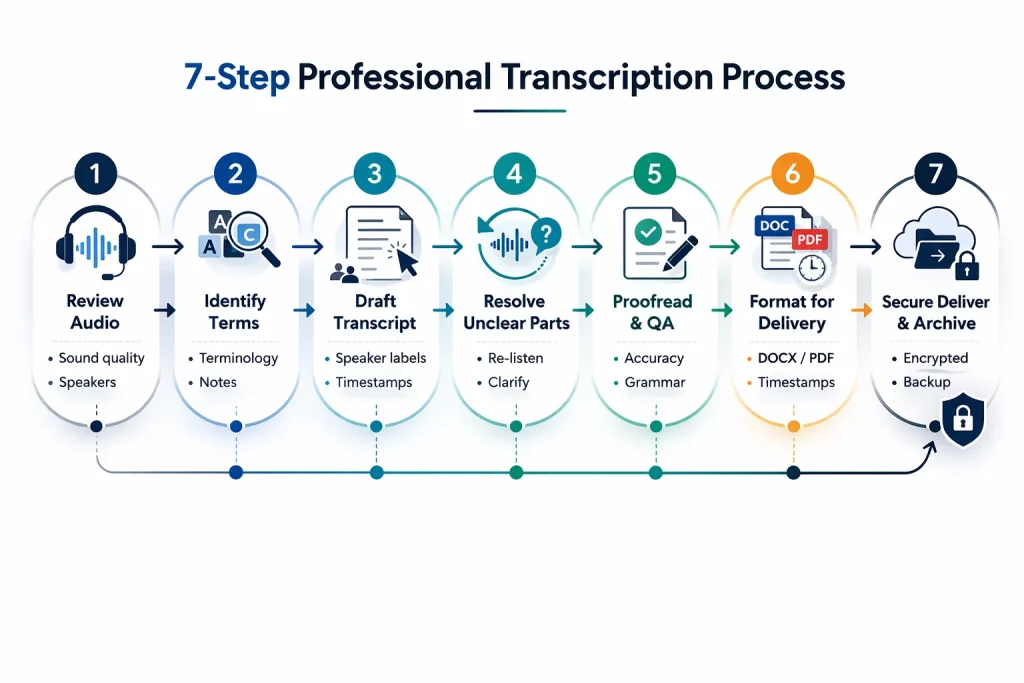
Step 1: Prepare and Review the Source Audio
Before transcription begins, review the audio file carefully. Assess sound quality, background noise, overlapping speakers, accents, and technical terminology. Identify the number of speakers, since accurate speaker attribution depends on it.
Confirm the required format such as verbatim or clean verbatim, and whether timestamps or speaker labels are mandatory. Provide context materials including participant names and specialist vocabulary.
Clarify confidentiality requirements such as NDA, GDPR, or HIPAA handling. A clear project brief reduces revisions and improves turnaround accuracy.
Step 2: Listen Through and Note Technical Terminology
Professional transcriptionists listen to the full recording once before typing. This initial playback maps structure, speaker changes, themes, and approximate length.
It allows identification of industry terminology, brand names, acronyms, and specialist vocabulary that may require verification. Challenging sections such as heavy accents, fast speech, or poor microphone quality are flagged for closer review.
Playback speed is usually set at 50–75% for accuracy. Automated tools skip this contextual review stage, which increases error rates for technical and multi-speaker recordings.
Step 3: Transcribe the First Draft with Speaker Labels and Timestamps
The first draft converts speech to text continuously. Unclear sections are flagged rather than guessed. Speaker labels are inserted at every speaker change, using consistent formatting such as “Speaker 1:” or named identifiers.
Timestamps are added either at fixed intervals, typically every one to five minutes, or at each speaker change when required for legal or research transcripts. In verbatim format, non-verbal cues such as [laughter], [pause 3s], or [inaudible] are included.
The first draft prioritises completeness over formatting polish.
Step 4: Review, Cross-Check, and Resolve Flagged Sections
The draft is reviewed against the audio in a second pass. Every flagged section is resolved using slower playback, high-quality headphones, and contextual inference. Speaker identification is verified through voice patterns and conversational context. Technical terms are cross-checked against reference materials.
Timestamps are validated for accuracy. After this stage, professional human transcription typically reaches 99%+ accuracy.
AI-generated drafts require this human review to correct terminology errors, accent misunderstandings, and speaker misattribution.
Step 5: Proofread the Final Transcript for Grammar and Consistency
A complete proofreading pass ensures the transcript meets quality standards. Typographical errors, punctuation inconsistencies, and formatting irregularities are corrected. Speaker labels are standardised throughout the document.
If a client style guide is provided, formatting conventions are applied consistently. In clean verbatim transcripts, filler words are removed and false starts are lightly adjusted for readability.
In verbatim transcripts, no editing occurs; the focus is accuracy, not stylistic refinement.
Step 6: Format and Structure the Transcript for Delivery
The transcript is formatted according to the agreed specification. A document header may include recording date, participants, duration, and project reference number.
Speaker labels and timestamps are applied consistently. Paragraph breaks follow natural topic changes rather than arbitrary line length. The final file is delivered in the requested format such as DOCX for editing, PDF for submission, TXT for database integration, or SRT for subtitle workflows.
Proper formatting improves usability in legal bundles, training materials, and compliance archives.
Step 7: Deliver, Archive, and Secure the Final Transcript
The completed transcript is delivered through a secure channel such as encrypted transfer or a protected client portal. Client approval confirms acceptance and quality sign-off.
Source audio is either securely deleted or archived according to the agreed data processing policy. For compliance-sensitive transcription involving legal, medical, or financial content, vendors must operate under NDAs, GDPR data processing agreements, and ISO 27001-aligned security protocols.
B2B buyers should verify data handling standards before vendor engagement.
Key Business Use Cases for Transcription
Transcription underpins governance, compliance, legal operations, HR processes, and research across nearly every industry.
It converts spoken communication into structured documentation that can be searched, audited, and archived. For B2B buyers, the value lies in risk reduction, knowledge retention, and operational transparency.
| Use Case | Business function | Typical format | Volume |
| Board / leadership meetings | Corporate governance | Clean verbatim | Monthly |
| Compliance & regulatory calls | Legal / compliance | Verbatim | Ongoing |
| Research interviews | Market research / UX | Clean verbatim | Project-based |
| Legal proceedings / depositions | Legal operations | Verbatim + timestamps | Case-based |
| HR interviews & disciplinary | Human resources | Verbatim | Ad hoc |
| Medical dictation & clinical notes | Healthcare | Medical verbatim | Daily |
| Training session recordings | L&D | Edited / clean | Per-programme |
| Conference & earnings calls | Investor relations | Clean verbatim | Quarterly |
Meeting and Conference Call Transcription: Creating Searchable Records from Spoken Decisions
Every business meeting produces decisions, action items, and strategic context that often remain buried in audio files. Meeting transcription converts these discussions into durable, searchable records with clear speaker attribution.
Business value includes documented action items linked to named speakers and timestamps, governance-ready board minutes, and structured documentation for audit purposes.
For cross-border teams, transcription combined with translation ensures all stakeholders can review content in their own language.
Many organisations use AI auto-transcription tools for informal meetings. However, for board sessions, legal discussions, or compliance calls, professional human transcription delivers the accuracy, accountability, and data security required.
Compliance and Regulatory Call Transcription: Evidence-Grade Accuracy
Financial services, insurance, legal, and healthcare organisations record calls to meet regulatory requirements such as MiFID II, Dodd-Frank, FCA standards, and HIPAA rules.
These recordings must be transcribed verbatim with no removal of filler words, fully timestamped, and precisely speaker-attributed.
Compliance-grade transcripts require strict chain-of-custody handling, controlled access, and secure storage with audit logging. Automated transcription tools frequently misinterpret financial or medical terminology and struggle with overlapping speakers. In regulated environments, even a minor transcription error can compromise the integrity of a regulatory record.
Circle Translations provides compliance-grade transcription with NDA-protected handling, GDPR-compliant processing, and 99%+ accuracy standards through its audio translation services and company credentials.
Research Interview Transcription: From Recorded Data to Analysable Insight
Qualitative research depends on accurate transcription. Academic institutions, market research agencies, UX teams, and consulting firms convert interviews and focus groups into transcripts for coding and thematic analysis.
Research transcripts must include consistent multi-speaker labelling and regular timestamps, typically every two to five minutes or at each speaker change. Confidentiality is critical. Participant names are often anonymised according to ethics protocols.
Accuracy directly affects research validity. Errors in transcripts propagate into findings, reports, and published conclusions.
For ongoing research programmes, working with a professional transcription partner ensures consistency, data protection, and reliable turnaround times.
Transcription Methods: Human, AI, and Hybrid Approaches Compared
Three transcription approaches dominate the market today: human transcription, AI or automated speech-to-text, and hybrid human plus AI workflows. Each differs in accuracy, speed, cost, and data security. The correct choice depends on how critical the content is and what accuracy threshold the business requires.
| Approach | Accuracy | Speed | Cost | Security | Best for |
| Human transcription | 99%+ | 4–6 hrs per audio hour | Highest | Highest (NDA/GDPR aligned) | Legal, compliance, medical, high-stakes |
| AI / automated (ASR) | 85–95% | Real-time or minutes | Lowest | Variable | Informal meetings, internal notes |
| Human + AI hybrid | 97–99% | 1–3 hrs per audio hour | Medium | Medium–High | Research, corporate, volume transcription |
What Is Manual (Human) Transcription and When Is It Essential?
Manual transcription involves a trained human transcriptionist listening to audio and typing the transcript. It remains the gold standard for 99%+ accuracy, especially when audio includes strong accents, overlapping speakers, technical vocabulary, or poor sound quality.
Human transcription is essential for legal proceedings, regulatory compliance, medical documentation, and financial recordings where even minor errors carry risk. Verbatim legal transcripts must reflect speech precisely, without alteration.
Speed benchmark: a professional transcriptionist requires approximately 4–5 hours to transcribe one hour of audio at 99%+ accuracy.
AI-assisted tools such as foot pedals or smart editing interfaces can reduce this to 2–3 hours, but human validation remains mandatory for regulated content.
What Is AI Transcription and What Are Its Limitations for Business Use?
AI transcription uses Automatic Speech Recognition (ASR) to convert speech-to-text algorithmically. Common tools include Otter.ai, Microsoft Teams auto-transcription, Google Meet, AWS Transcribe, and Whisper-based platforms.
AI delivers fast, low-cost transcripts, often in real time. For informal internal meetings where 85–95% accuracy is acceptable, automated transcription is practical.
However, AI struggles with accents, technical terminology, overlapping speakers, and poor audio quality. It cannot reliably anonymise research participants and may process data on third-party cloud servers, raising GDPR or HIPAA concerns.
With average error rates of 5–15%, AI-only transcription is unsuitable for legal, compliance, or regulated business records.
Practical rule: use AI transcription for notes, not for records.
Human + AI Hybrid Transcription: Combining Speed with Accuracy
Hybrid transcription combines AI-generated first drafts with human review and correction. AI converts speech-to-text within minutes, and a professional transcriptionist then validates terminology, speaker attribution, and timestamps.
This model reduces turnaround to approximately 1–3 hours per audio hour while maintaining final accuracy levels near 99%. It is typically 30–40% more cost-effective than fully manual workflows for standard corporate audio.
Security remains controlled because human reviewers operate under NDA and GDPR-compliant handling. Circle Translations uses an AI-assisted plus human-review workflow for corporate transcription through its professional audio translation services.
Transcription Accuracy, Confidentiality, and Quality Standards
For B2B buyers, three non-negotiable criteria separate professional transcription services from generic speech-to-text tools: measurable accuracy rates, documented confidentiality controls, and clearly defined turnaround SLAs.
Errors in any of these areas create legal exposure, compliance failures, and reputational risk.
What Accuracy Rate Should You Expect from a Professional Transcription Service?
Professional transcription services should deliver a minimum of 99% accuracy on clear audio. Accuracy is measured using Word Error Rate (WER), which represents the percentage of words transcribed incorrectly. A 1% WER means 1 word in 100 is wrong.
For legal, medical, and compliance use, 99%+ accuracy is the baseline requirement. AI-only tools rarely meet this threshold consistently, particularly with technical vocabulary or multi-speaker recordings.
| Transcription type | Expected accuracy | WER benchmark | Acceptable for |
| Professional human | 99%+ | <1% | Legal, medical, compliance, research |
| AI-assisted + human review | 97–99% | 1–3% | Corporate, research, training |
| Fully automated (AI only) | 85–95% | 5–15% | Informal meetings, internal notes |
| Poor audio / heavy accent | 90–97% (human) | 3–10% | Case-dependent, specialist required |
For compliance-grade transcription, always request WER guarantees and a documented revision policy in the service agreement.
Data Security in Transcription: What B2B Buyers Must Verify Before Engaging a Vendor
Every audio file submitted for transcription contains confidential business, financial, medical, or personal data. Data security is therefore a procurement-level concern, not a technical afterthought.
Before engaging a transcription vendor, verify the following:
✓ Is an NDA signed before audio is shared?
✓ Are transcriptionists employees or vetted contractors bound by NDA?
✓ Is a GDPR Data Processing Agreement provided?
✓ Are files stored only for the project duration, then securely deleted?
✓ Is the infrastructure aligned with ISO 27001 or equivalent standards?
✓ Is data processed within the required jurisdiction (EU or US)?
✓ Can the vendor provide a documented data flow map upon request?
Circle Translations operates under NDA-protected, GDPR-compliant workflows with secure transfer protocols and formal data processing agreements for all transcription projects.
Need Professional Transcription for Your Business? Get a Quote in 24 Hours
Circle Translations provides professional transcription and audio translation services for legal, corporate, compliance, and research teams with 99%+ accuracy, NDA-protected handling, and no rush fees.
Every transcription order includes:
✓ Human or AI-assisted plus human-review workflow
✓ Speaker labelling and timestamps
✓ Verbatim or clean verbatim format, based on your needs
✓ GDPR-compliant data handling
✓ Delivery in DOCX, PDF, or SRT format
Upload your audio or describe your project today.
Need Your Audio Transcribed & Translated?
Circle Translations delivers accurate, fast transcription paired with expert translation — in 100+ languages, built for businesses that can’t afford errors.
Frequently Asked Questions – What is Transcribing
What are the main methods of transcription used professionally?
The three methods are manual (human), automated (AI/ASR), and hybrid (AI draft plus human review). Human delivers 99%+ accuracy. AI is faster but less accurate. Hybrid balances speed and quality.
What is the difference between a transcript and a transcription?
Transcription is the process. A transcript is the final written document produced from that process.
How long does it take to transcribe one hour of audio?
Human transcription takes 4–6 hours per audio hour. Hybrid takes 1.5–3 hours. AI-only runs in near real time but requires review.
Can AI tools like ChatGPT do transcription accurately enough for business use?
AI can create drafts for informal use. It is not reliable enough for legal, compliance, or regulated business records without human review.
What is a verbatim transcription, and when is it legally required?
Verbatim transcription captures every spoken word exactly. It is required for court proceedings, depositions, compliance calls, and legal evidence.
What skills does a professional transcriptionist need?
Strong listening skills, fast typing, grammar accuracy, terminology research ability, and strict confidentiality compliance. Legal and medical work requires domain expertise.
Is transcription different from captioning and subtitling?
Yes. Transcription produces a document. Captioning and subtitling format text with timing codes for video display.
What file formats are transcripts typically delivered in?
Common formats include DOCX, PDF, TXT, and SRT or VTT for subtitles.