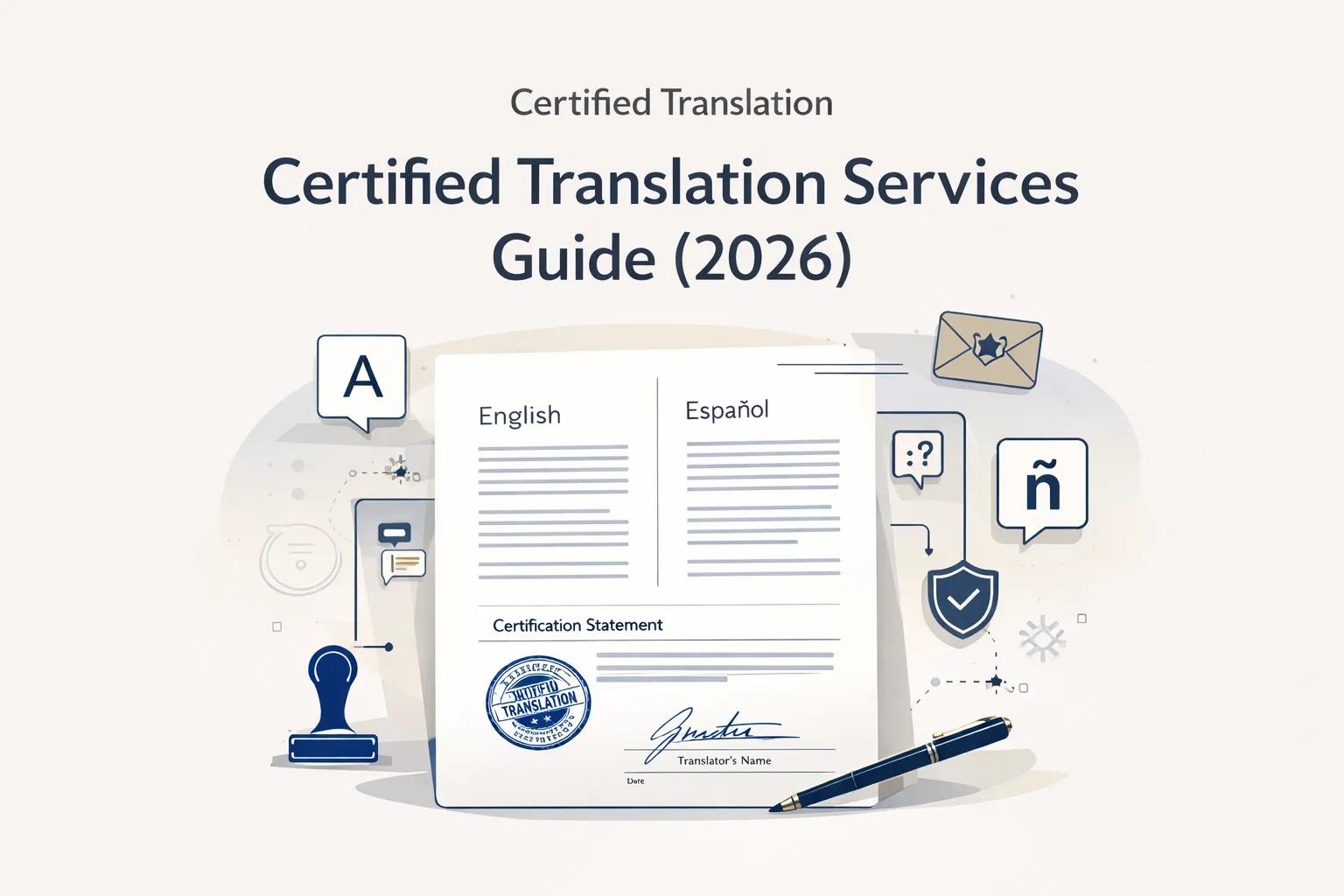
Certified translation does not mean the same thing in every context, and choosing the wrong certification type is one of the fastest ways to have your document rejected. USCIS applications, court filings, diploma equivalency assessments, employment verification, and regulatory submissions all require specific certification formats. A simple translation with a stamp is often not sufficient.
This guide explains what certified translation actually means and what it does not, when it is required, current 2026 cost benchmarks, and a six-step checklist to help you identify legitimate providers. It is written for HR managers, legal teams, procurement officers, universities, and compliance departments sourcing certified translation for high-stakes submissions or recurring volume needs.
If this works for you, we will move to the definition section next.
What Is Certified Translation? The Definition That Actually Matters for B2B Buyers
A certified translation is a translation accompanied by a signed statement from the translator or translation agency attesting that the translation is complete, accurate, and true to the best of their knowledge. This certification statement is typically required by official bodies when accepting foreign language documents.
As the United States Citizenship and Immigration Services (USCIS) (2023) states in its official policy guidance, “Any document containing foreign language submitted to USCIS shall be accompanied by a full English translation which the translator has certified as complete and accurate,” and the translator must certify competence to translate from the foreign language into English.
Before selecting a provider, buyers need to understand exactly what certified translation means in their specific context. The term is used loosely across government agencies, legal authorities, academic institutions, and regulatory bodies. Getting the definition right before ordering prevents rejected submissions, wasted fees, and compliance failures in high-stakes B2B environments.
Certified Translation vs Notarised Translation vs Sworn Translation: Key Differences
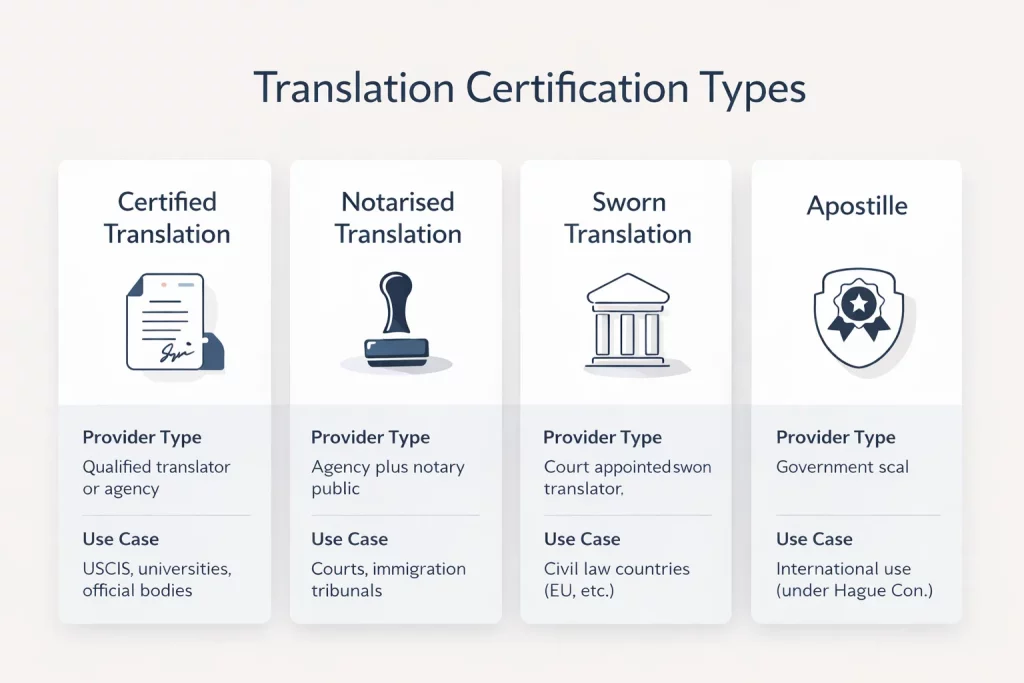
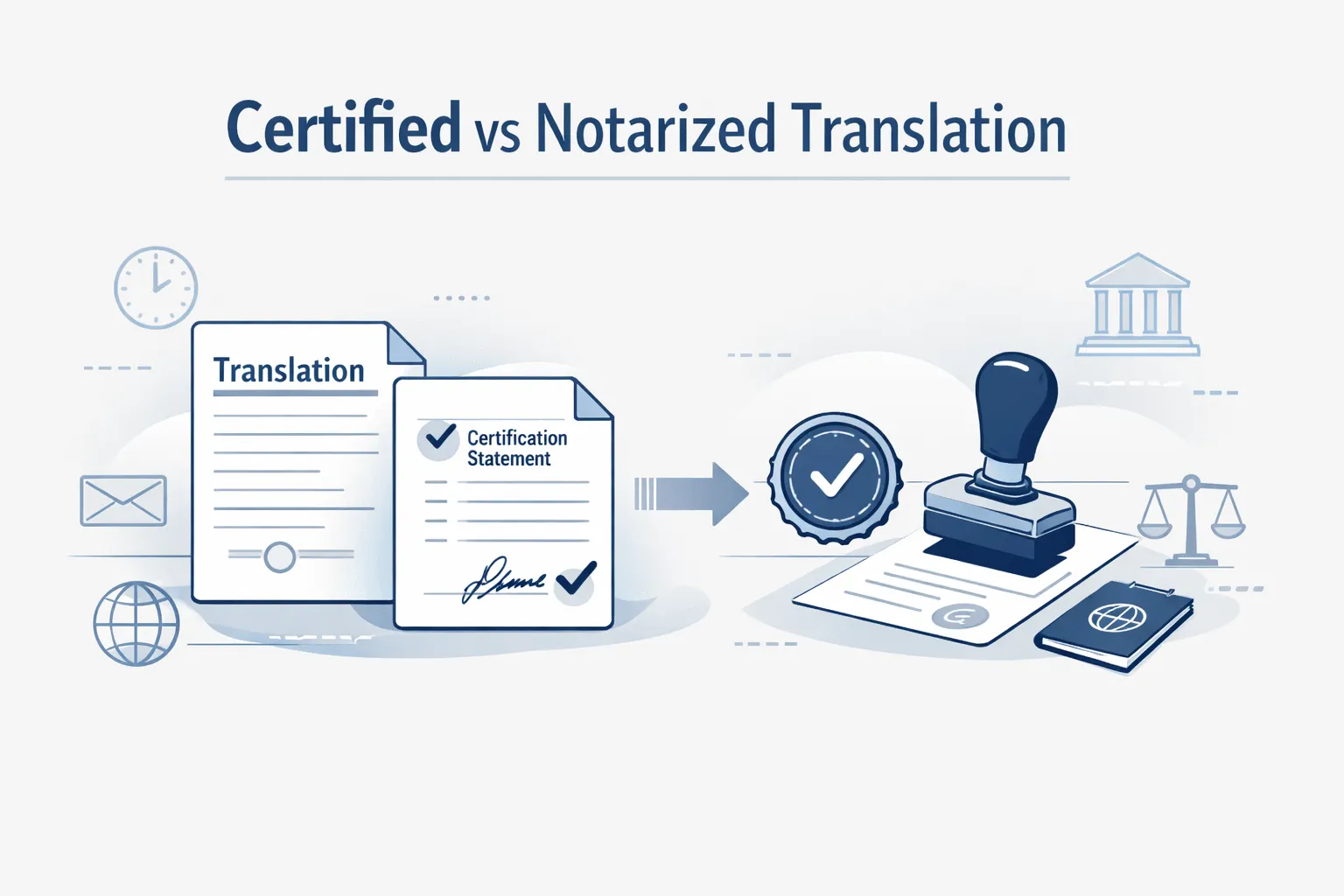
Certified and notarized translations are frequently confused, and accepting the wrong type will result in document rejection by the receiving authority. Certified translation refers to a translation accompanied by a signed accuracy attestation. Notarised translation adds a notary public stamp to verify the identity of the translator who signed the certification statement.
Sworn translation is produced by a court appointed sworn translator with legal status in certain civil law countries. An apostille is not a translation type at all, but a government seal authenticating the origin of a document.
| Type | What it is | Who provides it | When required |
| Certified translation | Translation plus signed accuracy statement | Any qualified translator or agency | USCIS, universities, most official bodies |
| Notarised translation | Certified translation plus notary public stamp on the translator signature | Agency plus notary public | Some courts, immigration tribunals, foreign authorities requiring extra verification |
| Sworn translation | Translation made by a court appointed sworn translator with legal authority | Court appointed sworn translator | EU courts and civil law jurisdictions such as France, Spain, Germany, Italy |
| Apostille | Official government seal authenticating the origin document, not the translation | Government authority | International use under the Hague Convention |
B2B note: Always confirm with the receiving authority exactly which type they require before ordering. Substituting one type for another is the most common and most avoidable cause of submission rejection.
What a Certified Translation Must Contain: The Required Elements
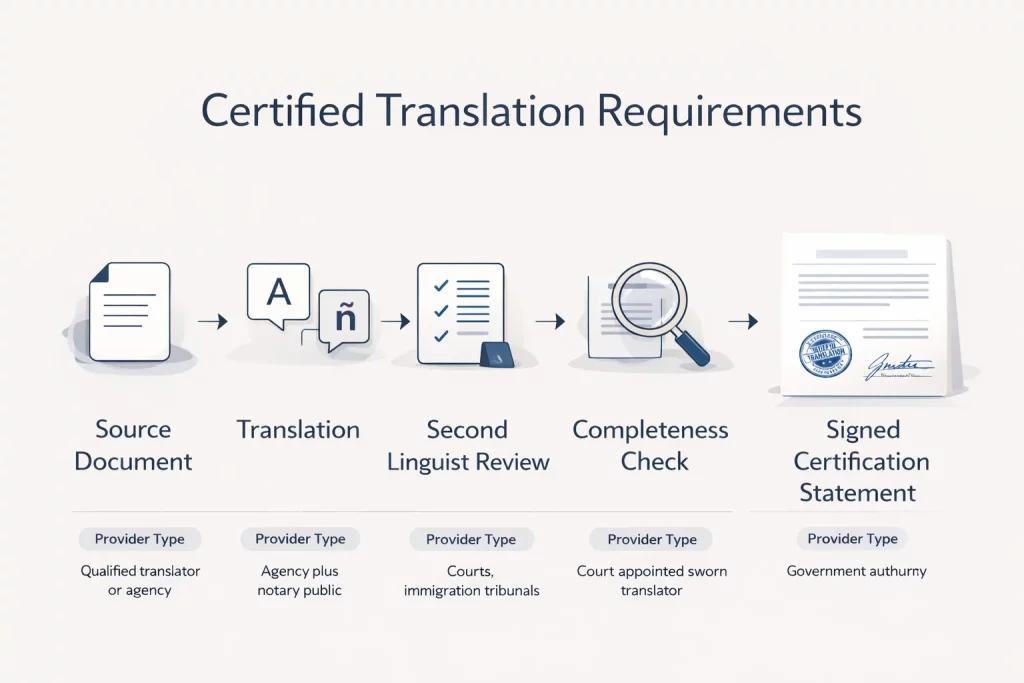
A certified translation without the correct components will be rejected. Most US and UK authorities expect a complete and faithful rendering of the source document, supported by a formal certification statement signed by the translator or agency.
Requirements vary by jurisdiction, so always verify with the receiving body before submission.
Required elements typically include:
✓ Complete translation of all text in the source document, including headers, footers, stamps, seals, form fields, and watermarks
✓ Translator or agency full name and contact details
✓ Signed certification statement with date and declaration of accuracy and completeness
✓ Statement confirming translator competency in both languages
✓ For notarised translations, notary public stamp and signature on the certification statement=
| B2B note: Many rejections occur because stamps, seals, or handwritten text are omitted. The certified translation must mirror the source document in full, including all graphic text elements. |
When Is Certified Translation Required? Official Use Cases by Authority
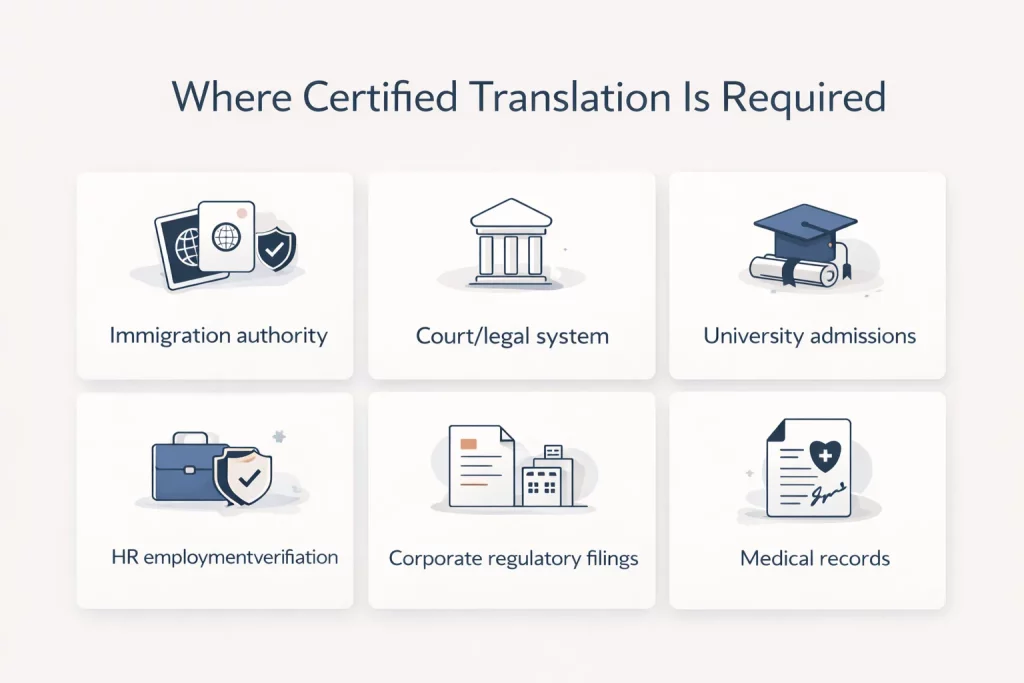
Certified translation is required whenever an official body must rely on the accuracy and completeness of a foreign language document for legal, immigration, academic, regulatory, or employment purposes.
| Authority or Context | Document types | Certification type typically required |
| USCIS United States immigration | Birth certificates, marriage certificates, divorce decrees, criminal records, diplomas | Certified. ATA certified translator preferred but not mandatory |
| UK Home Office or Visa | Personal documents, academic records | Certified by competent translator |
| Courts in US or UK | Contracts, legal correspondence, evidence documents | Certified. Notarised if required by court order |
| Universities and higher education institutions | Diplomas, transcripts, academic certificates | Certified. Some require notarised |
| HR and Employment | Foreign qualifications, employment records, police clearances | Certified |
| EU regulatory bodies | Regulatory submissions, technical standards | Sworn in civil law jurisdictions |
| Companies House or SEC | Corporate documents, annual reports | Certified or sworn depending on jurisdiction |
| Medical authorities and hospitals | Medical records, clinical trial documentation | Certified. Sometimes notarised |
B2B framing: HR departments processing international hires, legal teams managing cross border disputes, and compliance officers filing regulatory submissions are the most frequent institutional users of certified translation at volume.
How to Identify a Legitimate Certified Translation Provider: 6 Non-Negotiable Standards
Not every agency that offers certified translation delivers a product that will be accepted by official authorities. The certification statement is only as credible as the translator and the process behind it.
These six standards separate legitimate certified translation providers from those whose certificates fail at the submission stage.
Standard 1: Translator Qualification. Does the Translator Have Verified Credentials?
The certification statement is only as credible as the translator signing it. For certified translation, credible qualifications include ATA certification, which verifies competency through examination and is particularly relevant for USCIS and US legal submissions.
A degree level qualification in translation or linguistics, or membership of recognised professional bodies such as ITI, CIOL, BDÜ, or SFT, also strengthens credibility.
For specialised documents, domain expertise matters. Legal documents should be handled by translators with legal knowledge. Medical records require medical terminology competence.
Key distinction: an ATA certified translator is an individual who passed the ATA exam. An ATA member agency is simply a member organisation and does not certify individual translator competency. Always verify what is being offered.
Standard 2: QA Process. What Happens Between Translation and Certification?
A certification statement is not a quality assurance process. The statement attests that the translation is complete and accurate, but only a documented QA workflow makes that attestation credible. At minimum, certified translation should include a second linguist review of the full text before certification.
Terminology must be verified for legal, medical, and official form content. Every text element in the source, including stamps and handwriting, must be checked for completeness. Formatting should mirror the original layout.
Red flag: an agency that certifies without independent review cannot credibly attest to accuracy. The certification statement loses weight if challenged.
Standard 3: Provider Track Record. Verifying Acceptance History with Target Authorities
The strongest evidence that a certified translation provider is legitimate is prior acceptance by the authority you are submitting to. Ask whether they have delivered certified translations accepted by USCIS, a specific court, a named university, or a regulatory body relevant to your case. Request references from clients in your sector. Ask about their rejection rate and written policy if a translation is rejected.
A legitimate provider will know their acceptance history and discuss it clearly. Vague answers or avoidance of rejection policy questions suggest limited authority specific experience.
Standard 4: Completeness Guarantee. Does the Provider Translate Every Element of the Source Document?
One of the most common causes of certified translation rejection is incompleteness. Missing stamps, seals, handwritten notes, form field labels, and marginal notations frequently lead to rejection. A professional provider must translate every visible text element in the source document. Partially illegible sections should be marked clearly as illegible.
The layout of the translation should reflect the structure of the original document. Any intentionally untranslated elements, such as photos or signatures, should be noted and explained.
Ask directly how stamps, seals, and handwritten text are handled. If these are routinely omitted, disqualify the provider.
Standard 5: Data Security and Confidentiality. Protecting Sensitive Personal Documents
Certified translation often involves highly sensitive personal documents, including birth certificates, medical records, divorce decrees, criminal records, financial statements, and academic transcripts. Data security standards must be explicit and documented.
Security checklist:
✓ NDA signed before any document is shared as standard practice
✓ GDPR compliant Data Processing Agreement for EU personal data
✓ Encrypted file transmission rather than plain email attachments
✓ Secure storage with defined retention period and deletion policy
✓ Translators and project managers bound by written confidentiality agreements
B2B note: HR and legal teams have statutory data protection obligations. Using a provider without documented data handling procedures creates compliance risk.
Link: /content/about | /blog/security-compliance-in-document-translation
Standard 6: Turnaround, Rejection Policy, and SLA Commitment
Turnaround commitments must reflect document length and complexity. Professional certified translation includes translation, review, completeness verification, and issuance of the certification statement.
| Service tier | Typical turnaround | Notes |
| Standard certified translation 1 to 5 pages | 2 to 5 business days | Allows full review and completeness check |
| Expedited 1 to 5 pages | 24 to 48 hours | Agreed in writing before the project start |
| Rush same day | 4 to 8 hours | Add 75 to 100 percent. Suitable only for short and simple documents |
| Large volume certified projects | Custom SLA | Agreed in writing before project start |
Insist on a written rejection policy. It should include free revision if rejection is attributable to provider error, reissue of the certification statement at no charge if formatting changes are required, and a clear definition of provider error versus authority requirement change.
Circle Translations provides a written SLA for every certified project and free correction where rejection is attributable to provider error.
Link:
Certified Translation by Document Type: What Each Official Body Actually Requires
Official requirements for certified translation vary by authority, country, and document type. Submitting the correct format for your specific document to your specific authority determines acceptance. Below are the requirements for the four most common certified document categories in B2B and institutional contexts.
Certified Translation for Immigration Documents: USCIS and UK Home Office Requirements
USCIS requires a complete certified translation for any foreign language document submitted with an immigration petition. An ATA certified translator is not mandatory, but the translator must certify their competency and confirm the translation is complete and accurate.
Common immigration documents include birth certificates, marriage and divorce certificates, criminal records, police clearances, diplomas, financial statements, and military records.
The UK Home Office requires a certified translation from a competent translator. The translation must include a signed declaration of accuracy.
In B2B contexts, HR departments handling international hires often require certified translation of employment records, academic qualifications, and background checks for USCIS or Home Office submission.
An apostille authenticates the original document, not the translation.
Link: /content/certified-translation | /content/legal-translation
Certified Translation of Academic Documents: Diplomas, Transcripts, and Degree Certificates
Universities, licensing bodies, and credential evaluation services require certified translation of foreign academic documents such as diplomas and academic transcripts. Most US universities require a certified translation with a signed accuracy statement and full completeness, including grades, seals, and institutional stamps.
UK ENIC requires a certified translation with a translator’s declaration. Some equivalency assessments require notarised translation. Professional licensing boards in medical, legal, and engineering fields may require notarised or apostille-backed translations. ECFMG has specific formatting requirements for medical transcripts and diplomas.
In B2B settings, HR teams verifying qualifications for international hires often require multiple certified academic translations across several languages. Volume agreements reduce cost and administrative friction.
Certified Translation for Legal and Court Documents: When Notarisation Is Also Required
Legal documents submitted to courts or regulatory bodies may require certified legal translation and, in some cases, notarisation. Notarisation confirms the identity of the translator who signed the certification statement.
Common legal documents include contracts, affidavits, court judgements, powers of attorney, corporate registration documents, patent filings, and regulatory submissions.
Requirements vary by jurisdiction. Many US courts accept certified translation, though some require notarised versions. English courts require certification by a competent translator. Civil law countries such as France, Spain, Germany, and Italy often require sworn translation by a court-appointed translator. Arbitration rules differ by institution.
In-house legal teams managing cross-border disputes or transactions must confirm jurisdiction-specific requirements before ordering translation.
Certified Translation for HR and Employment Verification: Volume Needs and B2B Workflows
HR departments in multinational organisations regularly require certified translation of employment records, reference letters, academic credentials, professional licences, criminal background checks, passport documents, tax records, and right to work documentation.
For volume buyers, batching multiple employee documents into a single order reduces minimum fees and administrative overhead. A preferred vendor agreement with defined turnaround times and volume pricing improves predictability.
Confidentiality is critical because HR documents contain sensitive personal data. NDA and GDPR compliant DPA should be standard. Terminology consistency for job titles and qualification names across employee records supports audit readiness.
Circle Translations provides GDPR compliant workflows and volume SLA pricing for HR certified translation needs.
How Much Do the Best Certified Translation Services Cost in 2026?
Certified translation pricing varies widely, and the cheapest option often becomes the most expensive when documents are rejected and must be re ordered. Below are current 2026 benchmarks for professional certified translation, plus guidance on what drives cost variation and how B2B buyers can control per unit spend.
| Document type | Pages or Words | Price range | Notes |
| Standard personal document birth certificate marriage certificate | 1 to 2 pages | 35 to 90 per page | Per page pricing standard for certified documents |
| Academic transcript | 2 to 5 pages | 40 to 100 per page | Depends on layout complexity |
| Legal contract | Variable | 50 to 150 per page | Higher due to complexity and possible notarisation |
| Diploma plus academic supplement | 2 to 4 pages | 40 to 95 per page | Varies by country of origin |
| Medical record multi page | 5 to 20 pages | 35 to 80 per page | Bulk pricing often available |
| Notarised translation add on | Per document | 20 to 75 additional | Notary fee billed separately |
| Apostille facilitation add on | Per document | 30 to 150 additional | Government fee plus handling |
| Rush surcharge 24 to 48 hours | Per project | 25 to 60 percent | Avoid where possible |
Per Page vs Per Word Pricing for Certified Translation: Which Is More Common and Why
Certified translation is almost always priced per page of the source document, not per word. Certified documents require fixed formatting, completeness checks, and a signed certification statement regardless of word count.
A one page birth certificate with 150 words requires the same treatment as one with 300 words because stamps, seals, and form labels must be mirrored.
A standard certified page is typically defined as 250 to 300 words or one physical page, whichever is greater.
Procurement note: request confirmation of page count and per-page rate in writing. For dense forms or complex layouts, request itemised pricing that separates formatting and completeness checks.
How to Reduce Certified Translation Costs for B2B Volume Buyers
HR departments, legal teams, and admissions offices commissioning certified translation at volume can reduce per-unit cost through structured procurement. Negotiate a preferred vendor agreement with blended per-page pricing for committed monthly volume.
Batch multiple documents into one project to reduce setup time and minimum fees. Provide clear digital source files to minimise formatting work. Plan ahead and avoid rush ordering whenever possible. Confirm whether previously issued certified translations can be reused for multiple submissions before re-ordering.
Circle Translations offers volume SLA pricing for institutional buyers with no minimum fee for contracted accounts.
7 Red Flags When Choosing a Certified Translation Service
Certified translation is a high-stakes purchase. Rejection costs time and money and in immigration or legal contexts can have serious consequences. Spot these seven warning signs before submitting payment, not after receiving a certificate that gets rejected.
Red Flag 1: The Certification Statement Is Vague, Unsigned, or Missing Required Elements
Request a sample certification statement before ordering. A legitimate statement includes the translator’s full name and contact details, the language pair, a declaration of competency in both languages, an attestation of completeness and accuracy, and a dated signature.
A generic line stating translated by XYZ Agency, certified accurate without an individual name and signed declaration, is insufficient for most official bodies.
Red Flag 2: The Provider Cannot Confirm Experience with Your Specific Authority
USCIS, the UK Home Office, specific courts, ECFMG, and NARIC all apply different formatting expectations. A provider who cannot confirm previous accepted submissions to your authority and cannot explain that authority’s requirements is guessing.
One incorrectly formatted certification statement can result in rejection, reordering, and missed filing deadlines.
Red Flag 3: The Price Is Below 25 Per Page for Any Certified Document
Professional certified translation requires full document translation, completeness checks, a second linguist review, and a signed certification statement. Delivering this below 25 to 30 per page for standard documents is not commercially realistic. Extremely low pricing usually signals machine translation with a certification stamp, single translator delivery without review, or unvetted marketplace assignment. The certificate may not withstand scrutiny.
Red Flag 4: Turnaround Is Quoted as Same Day for All Documents Without Qualification
A one page birth certificate can reasonably be delivered within 24 hours. A multi-page legal contract cannot be translated, reviewed, formatted, and certified to a professional standard in the same timeframe.
Providers who promise same day turnaround for any document of any length are prioritising speed over process and may be applying a rubber stamp rather than a full review workflow.
Red Flag 5: No Clear Policy on What Happens If the Translation Is Rejected
No provider can guarantee acceptance because authorities make final decisions. However, a professional agency should commit in writing to free revision and re-certification if rejection is due to their error, clearly define what counts as provider error, and outline an escalation path. If this is vague or undocumented, risk remains entirely with you.
Red Flag 6: Machine Translation Is Used for the First Draft Without Disclosure
Some low-cost providers generate a draft using neural machine translation and then apply a human certification statement without transparent disclosure. Certified translation is based on a human translator attesting to accuracy and completeness.
Ask directly whether any part of the translation is machine-generated. If the answer is unclear, request a sample before proceeding.
Red Flag 7: No NDA or Data Protection Agreement for Personal Documents
Certified translation frequently involves birth certificates, medical records, criminal records, divorce documents, and financial statements. A provider that does not offer an NDA and GDPR compliant data processing agreement before document sharing is not operating at professional data protection standards.
For HR, legal, and compliance teams, using such a provider can create regulatory exposure for your organisation.
Need a Certified Translation That Will Be Accepted the First Time? Get a Quote in 24 Hours
Circle Translations provides certified translation for immigration, legal, academic, and HR document submissions, with a signed certification statement, full document completeness guarantee, and acceptance-ready formatting for USCIS, courts, universities, and regulatory bodies.
Every certified translation includes:
✓ Complete translation of all text, including stamps, seals, and handwritten content
✓ Signed certification statement with translator credentials
✓ Second linguist QA before certification
✓ NDA and GDPR compliant DPA signed before document sharing
✓ Free revision if rejected due to our error
Frequently Asked Questions – Best Certified Translation Services
Can I use a free or AI translation tool for an officially certified translation?
No. Certified translation requires a named human translator to sign a statement confirming competency, accuracy, and completeness. AI tools cannot legally provide this declaration. USCIS, courts, and universities require a human-certified translation. AI-generated documents will be rejected.
How long does a certified translation take?
For 1 to 3-page documents, standard turnaround is 2 to 5 business days. This includes translation, review, and issuance of the certification statement. Expedited 24 to 48-hour service is usually available for short documents. Larger or complex files require more time.
Does USCIS require an ATA-certified translator?
No. USCIS requires the translator to certify competency and accuracy, but does not mandate ATA certification. However, ATA-certified translators provide independently verified credentials, which can reduce risk.
What is the difference between certified translation and official translation?
Certified translation includes a signed statement of accuracy and completeness. Official translation is a general term that may refer to certified, notarised, or sworn translation, depending on the authority. Always confirm the exact requirement.
Can an in-house bilingual employee certify a translation?
In the US, a competent bilingual individual can certify a translation for USCIS. However, many courts, universities, and licensing bodies expect an independent professional translator. For B2B and legal contexts, independent certification is safer.
Is certified translation the same as notarised translation?
No. Certified translation includes the translator’s signed statement. Notarised translation adds a notary who verifies the identity of the signer. The notary does not verify translation accuracy. Some authorities require both.
What languages are most commonly requested for certified translation?
High volume pairs in US and UK markets include Spanish, Chinese, Portuguese, Arabic, French, German, Italian, Korean, Japanese, and Russian into English. Multinational employers often require multiple language pairs at once.
How do I verify a translation agency is qualified for certified translation?
Request a sample certification statement, confirm translator qualifications, ask about prior acceptance by your authority, check independent reviews, and verify NDA and data protection compliance before sharing documents.
What happens if my certified translation is rejected?
Obtain the written reason for rejection and send it to your provider. If the issue is due to provider error, a professional agency should correct and reissue the certified translation at no charge.