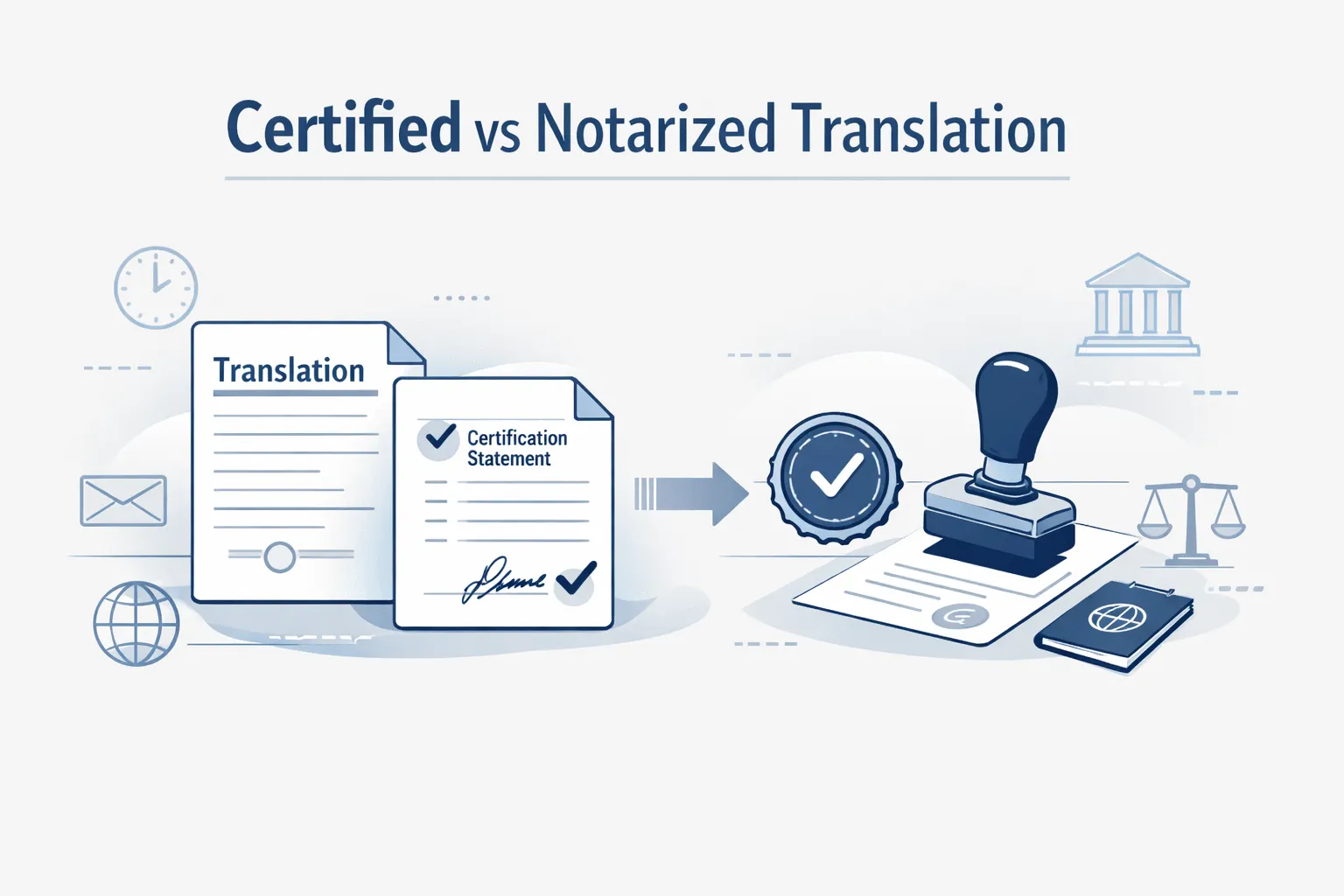
A notarized translation is a certified translation that has been taken one step further: a notary public has witnessed and stamped the translator’s signature. Most official bodies, including USCIS, UK Home Office, and most universities, require only a certified translation, not a notarized one.
Ordering the wrong type of translation leads to rejection, reordering costs, and missed legal or immigration deadlines.
This guide is written for both individuals submitting personal documents and B2B buyers such as legal teams, HR departments, and compliance officers managing document workflows at scale.
We explain certified translation, notarized translation, sworn translation, and apostille, when each is required by an official authority, how certification statements work, cost benchmarks, red flags, and a step by step decision framework so you can order correctly the first time.
Certified Translation vs Notarized Translation: The Core Difference Explained

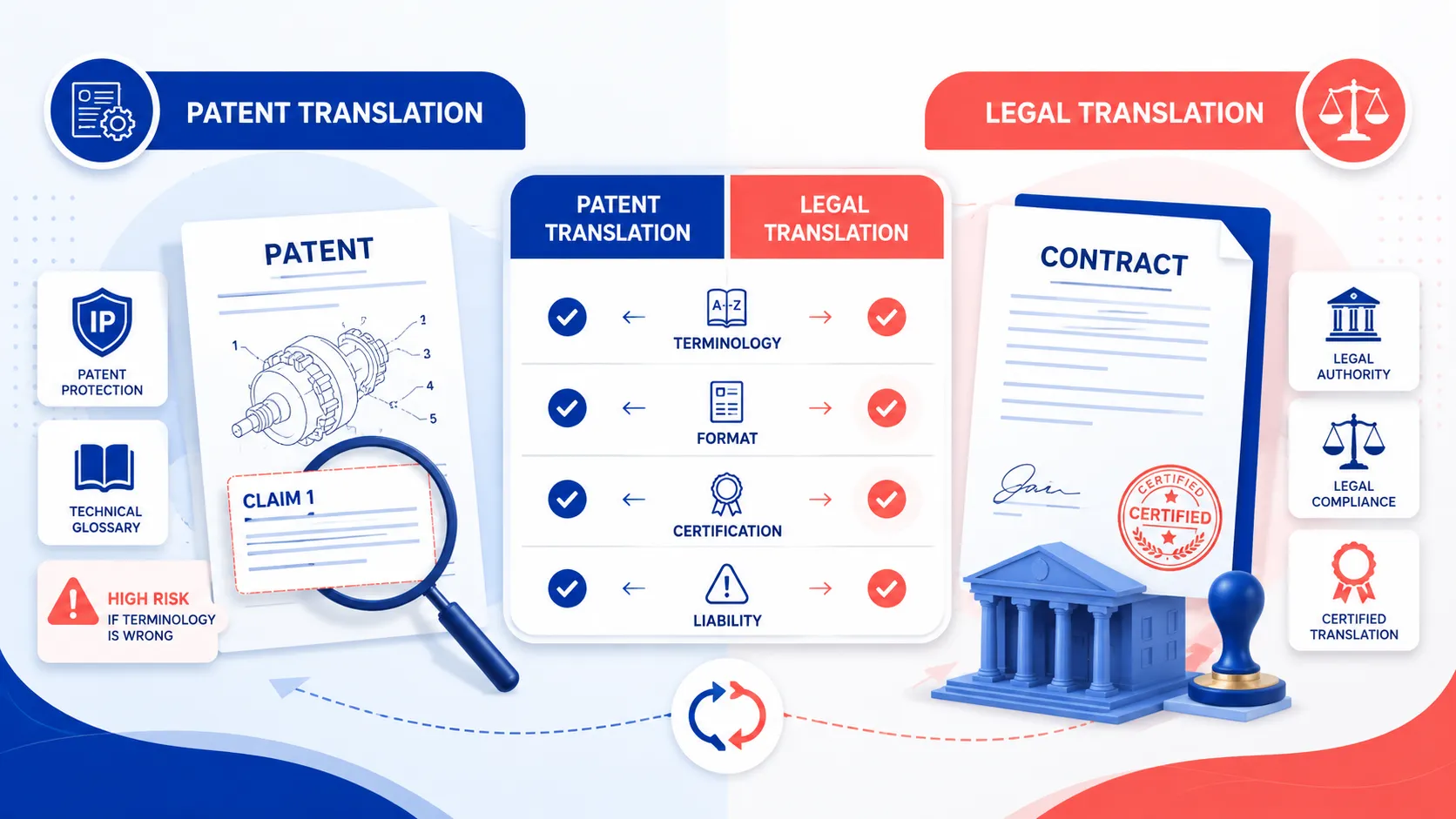
A certified translation is a translation accompanied by a signed statement from the translator or agency confirming that the translation is complete and accurate. A notarized translation is a certified translation where a notary public has witnessed and stamped the translator’s signature. A sworn translation is issued by a court-appointed translator in certain civil law countries, and an apostille is a government certificate that authenticates the original document, not the translation.
As the United Kingdom Government – GOV.UK (2023) explains in its official guidance on certifying documents, “If you need to certify a translation, the translator must confirm in writing that it is an accurate translation of the original document, give the date of the translation, and include their full name and signature,” clarifying that certification concerns accuracy, while notarisation serves to verify the identity of the person signing the statement rather than the content itself.
These are not interchangeable services. Each has a specific legal meaning and use case. Confirming which type your authority requires before ordering prevents rejection, delays, and unnecessary cost.
Master Comparison Table
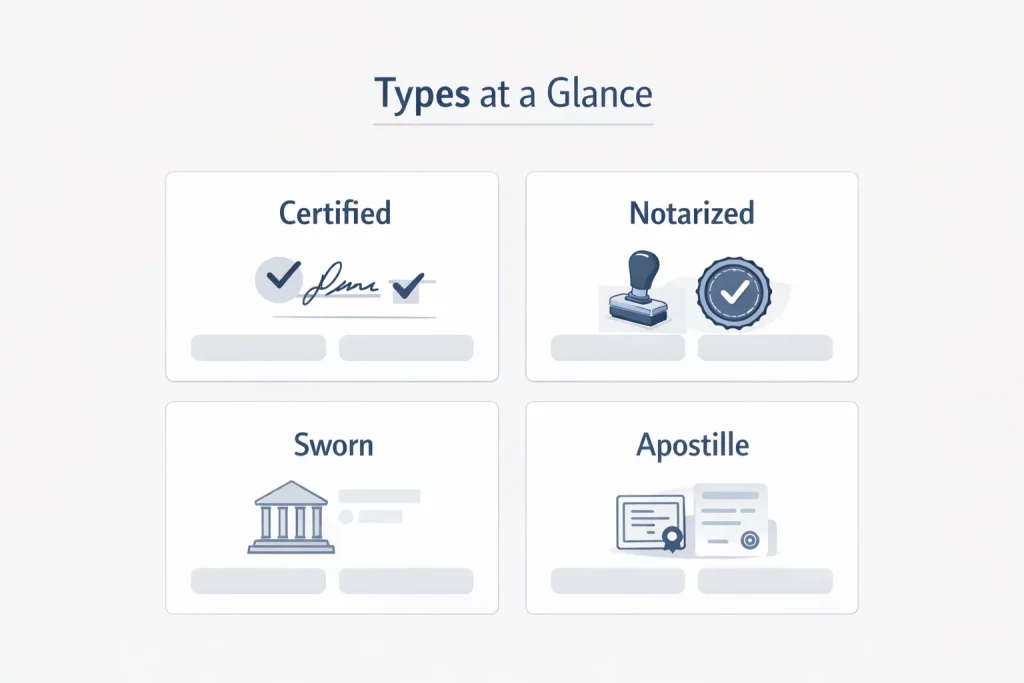
| Type | What it is | Who provides it | What the notary or authority does | When required |
| Certified translation | Translation plus translator’s signed accuracy and completeness statement | Any competent qualified translator or translation agency | No external authority involved | USCIS, most universities, most immigration authorities, most courts |
| Notarized translation | Certified translation plus notary public stamps the translator’s signature | Translation agency for the translation and notary public for the stamp | Notary verifies translator’s identity and signature only, not the translation quality | Some courts, some foreign embassies, certain legal proceedings requiring extra verification |
| Sworn translation | Translation by a court appointed sworn translator with legal status | Court registered sworn translator only | Court authority appoints and regulates the sworn translator | EU civil law courts including France, Spain, Germany, Italy, Portugal, Netherlands, often mandatory |
| Apostille | Authentication of the source document’s origin, not a translation | Government authority such as Secretary of State or Foreign Office | Government certifies the authenticity of the original document signature and seal | International document use under the Hague Convention, certifies the document not the translation |
What Is a Certified Translation? Definition and Required Components
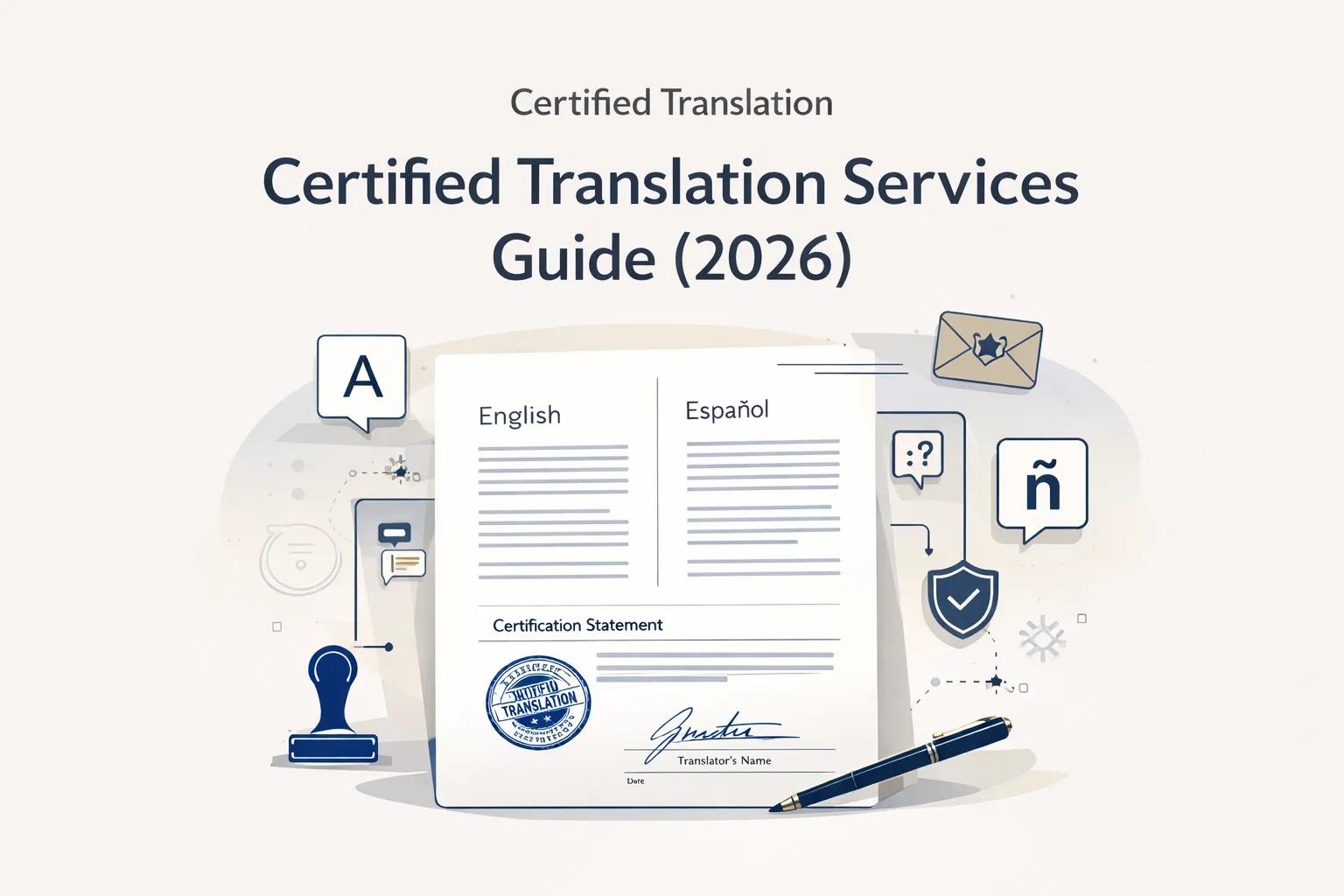
A certified translation is a translation of a document accompanied by a signed statement from the translator or agency attesting that the translation is complete and accurate to the best of their knowledge. No government authority, notary, or external stamp is involved.
A certified translation relies on the translator’s certification statement. For most authorities, it must include specific components:
✓ Complete translation of all source text, including stamps, seals, handwritten text, form field labels, and marginal notes
✓ Translator’s full name and contact information
✓ Statement confirming the translator’s competency in both source and target languages
✓ Signed and dated declaration of accuracy and completeness
✓ For agency-issued certifications, agency letterhead, and the responsible signatory
Certified translation does not mean the work was produced by an ATA-certified translator. An ATA-certified translator is an individual who has passed the ATA examination. Certified translation simply refers to the signed declaration attached to the translation.
What Is a Notarized Translation? What the Notary Public Actually Does
A notarized translation is a certified translation to which an additional step has been added: a notary public witnesses and stamps the translator’s signature on the certification statement, verifying the identity of the signatory, not the accuracy of the translation.
As the National Notary Association (2023) explains, “A Notary’s duty is to screen the signer for identity, willingness and awareness,” and notaries “are not responsible for the content of the document,” clarifying that notarization authenticates the signature rather than validating the substance of the translation.
The notary public does not assess whether the translation is correct, complete, or legally accurate. The notary does not need to understand either language. The notary stamps the certification statement only, not the translation itself. Notarization adds identity verification of the translator. It does not add quality assurance. A poorly translated document with a notary stamp remains a poorly translated document.
In B2B contexts, legal teams sometimes request notarized translation when only certified translation is required. This adds cost and turnaround time without improving acceptance. Always confirm the requirement with the receiving authority first.
What Is a Sworn Translation and When Is It Mandatory?
A sworn translation is a translation produced by a translator who has been officially appointed and registered by a court or government authority in a civil law jurisdiction, giving the translation legal standing equivalent to an official document.
| Country | Who appoints sworn translators | Required for |
| France | Cour d’appel | Documents for French courts, notaries, prefectures |
| Spain | Ministry of Foreign Affairs | Official documents for Spanish authorities |
| Germany | Regional courts | Court documents and official registrations |
| Italy | Courts | Legal proceedings and official submissions |
| Portugal | Ministry of Justice | Court and official submissions |
| Netherlands | Courts | Legal proceedings |
Sworn translation is not available as a general on demand service. It can only be issued by a court appointed translator in the relevant country. For EU civil law jurisdictions, confirm whether sworn translation is mandatory before instructing a standard certified translation provider.
When Do You Need Certified vs Notarized Translation? Authority by Authority Breakdown
The answer to “do I need certified or notarized?” is always the same: confirm directly with the receiving authority. That said, the guidance below reflects standard practice across common US and UK submission contexts and will be correct for the vast majority of immigration, court, academic, and corporate filings.
USCIS and US Immigration: Why Certified Is Required and Notarized Is Often Unnecessary
USCIS requires certified translation for all foreign language documents submitted with immigration petitions. USCIS does not require notarization. Ordering notarized translation for a USCIS submission adds cost, typically 20 to 75 per document, and delays processing without adding value. USCIS adjudicators are not looking for a notary stamp.
The certification statement must include the translator’s full name and address, a statement of competency in both languages, a declaration that the translation is complete and accurate, and the translator’s signature and date.
Common documents include birth certificates, marriage and divorce certificates, police clearances, diplomas, transcripts, military records, and financial documents. All must be complete, including stamps and seals.
Submitting the wrong type or an incomplete certification can trigger a USCIS Request for Evidence, delaying the case and requiring resubmission.
For HR teams and immigration law firms managing high volume I 140, I 485, or naturalisation filings, maintaining a preferred certified translation provider with documented USCIS acceptance reduces RFE risk at scale.
Courts and Legal Proceedings: When Notarization Is Actually Required
Unlike USCIS, some courts do require notarized translation, and requirements vary by jurisdiction and even by individual court.
In US federal courts, certified translation is generally accepted, but local rules may require notarization. US state courts vary. Some require notarized translations, others accept certified. Immigration courts under EOIR typically require certified translation only. Arbitration bodies such as AAA, JAMS, and ICC usually accept certified translations, but rules should be checked.
In UK courts, certified translation by a competent translator is standard. Notarization is rarely specified unless required by a particular proceeding.
| Authority | Certified | Notarized | Sworn |
| USCIS | Required | Not required | Not applicable |
| US federal courts | Generally accepted | Sometimes required | Not applicable |
| US state courts | Varies | Varies | Not applicable |
| EU civil law courts | Sometimes | Sometimes | Often mandatory |
| UK courts | Standard | Occasionally specified | Not applicable |
| UK Home Office | Required | Not required | Not applicable |
In house legal teams managing cross border litigation should always specify the exact court and proceeding type when instructing a translation agency and request confirmation of prior experience with that authority.
Academic Institutions and Professional Licensing Bodies: What Universities and Boards Require
Most universities and professional licensing bodies require certified translation of foreign academic documents, not notarized.
US universities typically require a certified translation with a signed accuracy statement and full completeness, including grades, seals, and institutional stamps. UK universities and UCAS require certification by a competent translator. UK ENIC requires certified translation for equivalency assessments and may require notarization in specific cases.
ECFMG and other medical credential bodies often publish detailed format requirements for transcripts and diplomas. Professional licensing boards in medicine, law, engineering, and finance may require notarized or apostille-backed translations, depending on state or national rules.
For B2B HR teams processing international hires in regulated professions, confirm the specific board’s requirement before commissioning translation. Requirements often differ by state.
Corporate and Regulatory Submissions: Apostille, Legalisation, and Document Authentication
For corporate filings and international regulatory submissions, certified translation is often only one part of a broader authentication chain.
An apostille under the Hague Convention authenticates the origin of a public document. It is issued by a government authority and applies to the original document, not the translation. An apostille does not replace certified translation. In most cross border use cases, both are required.
For countries not party to the Hague Convention, full legalisation is required. This usually involves notarisation, authentication by a Foreign Office or State Department, and consular legalisation. This process can take several weeks.
Common corporate documents requiring apostille and certified translation include company registration certificates, powers of attorney, board resolutions, regulatory filings, and intellectual property registrations.
For corporate legal and compliance teams, apostille and certified translation are usually cumulative requirements, not alternatives. Budget and timeline planning should reflect the full chain from translation through authentication.
How to Order the Right Translation and Notary Service: A 5 Step Decision Workflow
Before you upload a document and place an order, five questions determine exactly what type of translation service you need. Following this workflow prevents the most common and costly mistake: specifying the wrong certification type and receiving a rejection from the authority reviewing your submission.
Step 1: Identify the Exact Authority Receiving Your Document and Confirm Their Format Requirement
Never assume. Always confirm directly with the receiving authority.
Visit the authority’s official website and review its translation requirements page. If anything is unclear, contact the authority and ask clearly whether they require certified translation, notarized translation, or sworn translation. Where possible, request written confirmation, especially for court or regulatory filings.
For USCIS, check the specific form instructions such as I 485, I 130, or N 400. For courts, review the local rules and standing orders of the exact court division handling your matter.
Do not rely on forums or third party summaries. Requirements change and unofficial sources are often outdated.
Step 2: Identify Your Document Type and Check for Completeness Requirements
Different documents require different levels of review and formatting precision.
First, identify the category: personal document such as a birth certificate or diploma, legal document such as a contract or court order, corporate document such as a board resolution, medical record, or financial statement. Confirm the source and target language requirements with the authority.
Check for special elements including stamps, seals, handwritten notes, and official markings. Every visible text element must be translated or clearly marked as illegible or signature.
For B2B procurement teams handling multiple documents, group them by type and complexity before requesting a quote. This allows accurate pricing and proper translator assignment.
Step 3: Confirm Whether Notarization, Apostille, or Legalisation Is Also Required
Once you know the authority’s translation requirement, confirm whether additional authentication steps apply.
| Your situation | What you need |
| Authority requires certified translation only | Certified translation only |
| Authority requires notarized translation | Certified translation plus notarisation |
| International submission under Hague Convention | Certified or notarised translation plus apostille on the source document |
| Submission to non Hague country | Certified translation plus full legalisation chain including notarisation, government authentication, and consular legalisation |
If uncertain, ask two separate questions: Do I need the original document apostilled? Do I need the translation notarised? Confusing these is one of the most common causes of rejection.
Step 4: Select a Translation Provider Qualified for Your Specific Authority and Document Type
Choose a provider based on suitability, not just price.
Confirm they have experience with your specific authority, such as USCIS, a named court, NARIC, or ECFMG. Ensure the translator has appropriate subject matter knowledge for legal, medical, or corporate content. Request a sample certification statement and verify it includes the translator’s name, contact details, competency declaration, and signed attestation.
Confirm data protection procedures, including NDA and GDPR DPA where applicable. If notarisation is required, check whether the agency coordinates it. Finally, request a written rejection and revision policy.
Step 5: Review the Delivered Translation Before Submission and Check Key Elements
Before submission, perform a final review against a simple checklist.
✓ All visible source text appears in the translation, including stamps, seals, headers, and form labels
✓ Illegible or non textual elements are clearly marked as illegible, stamp, signature, or photo
✓ The certification statement is included, signed, and dated
✓ The statement includes translator name, contact information, and competency declaration
✓ For notarised translations, the notary stamp and signature appear on the certification statement
✓ For court matters, formatting complies with any local rule requirements
Do not skip this step. Most rejections are caused by visible omissions that can be identified in a two minute pre submission review.
Translation and Notary Services Cost in 2026: Certified, Notarized, and Full Authentication Chain
Certified translation pricing is relatively standardised across professional agencies. Notarisation and apostille add separate, predictable fees. Understanding the total cost of your full authentication chain before ordering prevents budget surprises, particularly in B2B environments where multiple documents and multiple languages are processed at the same time.
2026 Pricing Benchmarks
| Service | Pricing model | Typical cost | Notes |
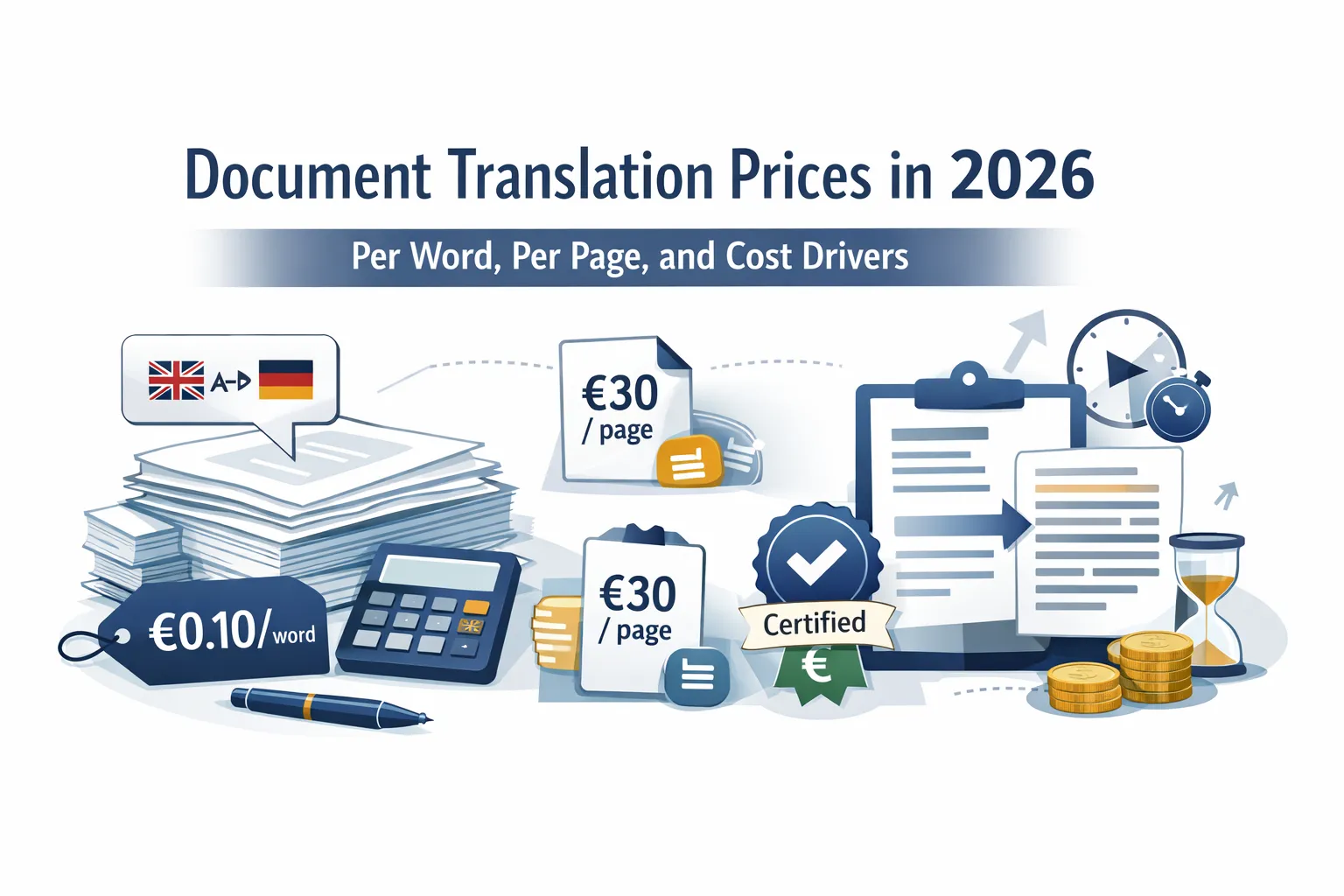
| Certified translation (standard personal document) | Per page | 35 to 95 per page | One to three pages most common for personal documents |
| Certified translation (legal or corporate) | Per page or per word | 50 to 150 per page | Complexity and subject matter expertise drive upper range |
| Notarisation add on | Per document | 20 to 75 per certification statement | Notary fee billed separately, agency may facilitate or client arranges |
| Apostille on source document | Per document | 30 to 150 | Government fee plus facilitation fee, varies by state or country |
| Full legalisation chain | Per document | 150 to 400 or more | Notarisation plus government authentication plus consulate, typically two to six weeks |
| Rush surcharge 24 to 48 hours | Percentage add on | 25 to 60 percent on base rate | Avoid for complex or multi page documents |
| Volume discount under B2B SLA | Negotiated | 10 to 25 percent below list rate | Available for committed monthly volume |
When Does Notarization Add Cost Without Adding Value? Avoiding Unnecessary Notarisation
For many submissions including USCIS, UK Home Office, most universities, and most corporate filings, notarisation is not required. Ordering notarised translation when certified translation is sufficient adds 20 to 75 per document, introduces scheduling delays, and does not improve acceptance.
Common over specification scenarios include HR teams ordering notarised translations for USCIS cases, legal teams requesting notarisation for court filings that accept certified, and procurement teams defaulting to the term official or notarised without checking requirements.
Procurement rule: never specify notarisation without written confirmation from the receiving authority. A competent translation agency should flag unnecessary notarisation and recommend the correct level of certification.
B2B Translation and Notary Workflow: Managing Volume Submissions Efficiently
HR departments, legal teams, and compliance officers managing certified and notarised translation at volume require structured workflows rather than ad hoc orders.
Best practices include negotiating a preferred vendor SLA with committed volume to reduce per page costs by 10 to 25 percent, batching documents by authority and type to streamline quoting and notary scheduling, and documenting authority specific format requirements internally to avoid repeat errors.
Where notarisation is frequently required, coordinate recurring notary access through the agency or an established local relationship. For ongoing HR processing, a standing GDPR data processing agreement avoids repetitive compliance steps.
Circle Translations offers volume SLA pricing, notary coordination where required, and a standing GDPR DPA for all B2B accounts.
5 Common Mistakes When Ordering Certified and Notarized Translation (and How to Avoid Them)
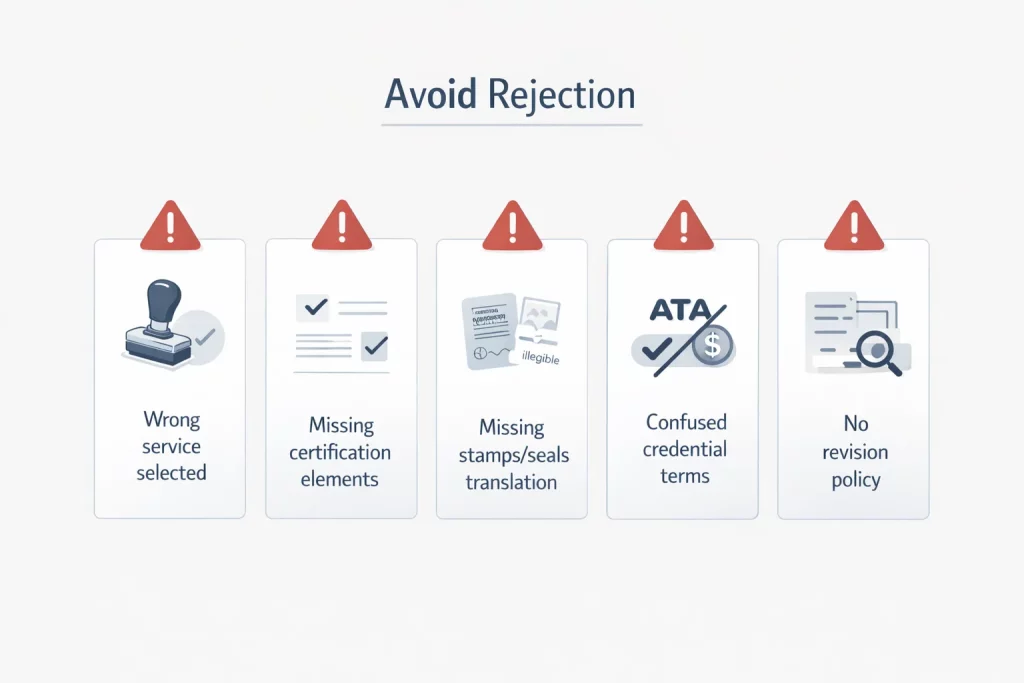
Most certified translation rejections are avoidable. They result from predictable errors in specification, provider selection, and final document review. The five mistakes below account for the majority of resubmissions and USCIS RFEs in immigration, court, academic, and corporate filings.
✗ Mistake 1: Ordering Notarized When Only Certified Is Required
✓ Confirm the exact requirement in writing before ordering
The most frequent and costly error is over specification. Ordering notarised translation when the authority requires only certified adds 20 to 75 per document and often delays delivery by several business days.
USCIS, UK Home Office, most universities, and many corporate authorities do not require notarisation. Always verify the requirement directly with the receiving authority before instructing your agency.
✗ Mistake 2: Accepting a Certification Statement Missing Required Elements
✓ Request and review a sample certification statement in advance
A certification statement that omits the translator’s name, contact details, competency declaration, or dated signature may be rejected. Many authorities actively check these elements.
Before approving payment, request a sample certification statement and confirm it includes the translator’s full identity, language pair, competency declaration, and signed accuracy attestation. An agency unwilling to share this should raise concern.
✗ Mistake 3: Failing to Translate All Text Elements in the Source Document
✓ Compare the translation against the original before submission
Authorities often compare the translated document directly to the source. Missing stamps, seals, handwritten notes, marginal text, or form field labels can trigger rejection.
Every visible text element must appear in the translation or be clearly marked as illegible, stamp, or signature. A two minute side by side review before submission prevents most completeness related rejections.
✗ Mistake 4: Confusing ATA Certified Translator with Certified Translation
✓ Understand the distinction before specifying credentials
An ATA-certified translator is an individual who has passed the American Translators Association examination. A certified translation is any translation accompanied by a signed accuracy statement. These are separate concepts.
USCIS and most authorities do not require an ATA certified translator. Confusing the two often increases cost without changing acceptance criteria.
✗ Mistake 5: Not Asking About the Provider’s Rejection and Revision Policy
✓ Obtain a written revision policy before placing your order
No agency can guarantee acceptance by every authority. However, a professional provider should commit in writing to correct errors attributable to them at no additional charge.
This includes incomplete translation, missing certification elements, or formatting mistakes. If an agency cannot clearly state its rejection and revision policy before you order, reconsider your choice.
Need Certified or Notarized Translation? Tell Us What You Need and We’ll Confirm the Right Service.
Not sure whether you need certified, notarized, or sworn translation? Circle Translations will confirm the correct service for your specific authority and document type before you commit.
Every certified and notarised translation we provide includes:
✓ Complete translation of all text, including stamps, seals, and official markings
✓ Full certification statement with translator credentials and signed competency declaration
✓ NDA and GDPR DPA signed before document sharing
✓ Second linguist QA before certification
✓ Notary coordination on request
✓ Written rejection and revision policy on every order
Submit your document or describe your requirement.
Not Sure Which Type You Need? We’ll Sort It Out.
Whether your document requires certified or notarized translation, Circle Translations delivers legally accepted, accurate translations — accepted by governments, courts, and institutions worldwide.
Frequently Asked Questions – Translation and Notary Services
Can a notary public translate and certify a document themselves?
No. A notary verifies identity and witnesses signatures. They do not certify translation accuracy. The translator must produce and sign the certification statement. The notary then stamps the translator’s signature. In most jurisdictions, the translator and the notary must be different individuals.
Is a foreign notarized document automatically valid in the United States?
No. A foreign notarized document usually requires authentication. If the country is part of the Hague Convention, it needs an apostille. If not, it requires full legalisation through government and consular channels. Any foreign language content must also include a certified English translation.
How long does it take to get a certified translation notarized?
Certified translation of a short document typically takes 1 to 5 business days. Notarisation usually adds 1 business day. The total timeline for standard personal documents is 2 to 6 business days. Rush service is available at an additional cost.
What is the difference between an apostille and a notarized translation?
An apostille authenticates the original document’s signature and seal. It is issued by a government authority and attached to the source document. A notarized translation is a certified translation where a notary stamps the translator’s signature. They serve different purposes and are often both required.
Can I get a birth certificate translated and notarized online?
Yes. You submit a clear scan, the translator prepares and certifies the translation, and the signature is notarized either in person or via remote online notarization where permitted. Confirm the receiving authority accepts remote notarisation before ordering.
Does a certified translation expire?
No fixed expiry date applies to certified translations. They remain valid as long as the original document is valid. Some authorities may require a recently issued translation, so confirm with the receiving body.
What happens if I submit the wrong type of translation?
The authority may reject the document, delay processing, or issue a request for correction such as a USCIS Request for Evidence. You will usually need to reorder the correct type at full cost. Obtain written confirmation of the deficiency before reordering.
Do translation agencies handle notarization, or do I arrange it separately?
It depends on the agency. Some provide translation only. Others coordinate notarisation for an additional fee. Full-service providers deliver a completed, notarized, certified translation. Confirm the model before placing your order.
Is a notarized translation the same in all countries?
No. In common law countries, notarisation confirms identity and signature. In civil law countries, notaries have broader legal authority. Some jurisdictions require sworn translation instead. Always check the destination country’s specific requirements.