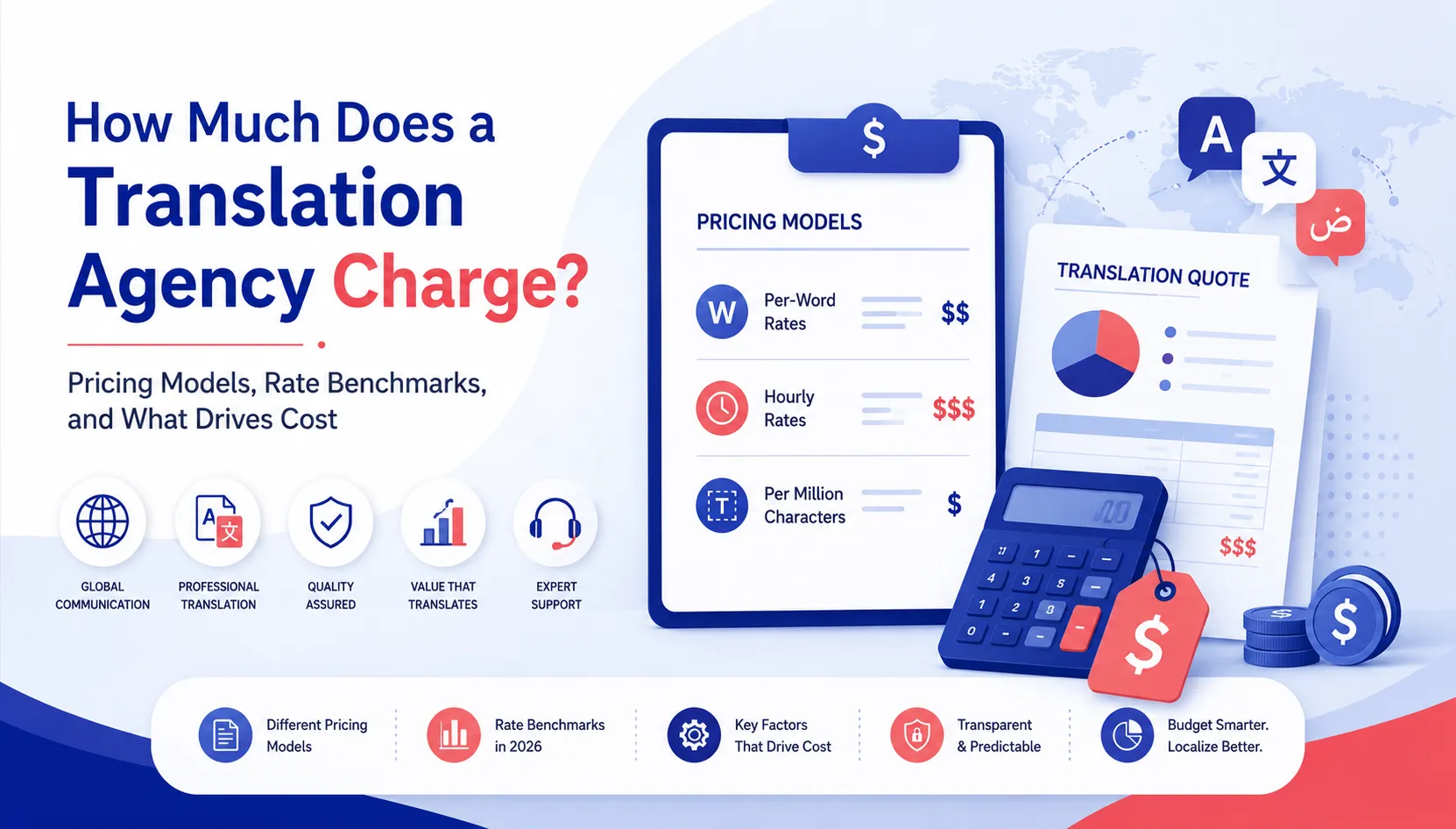
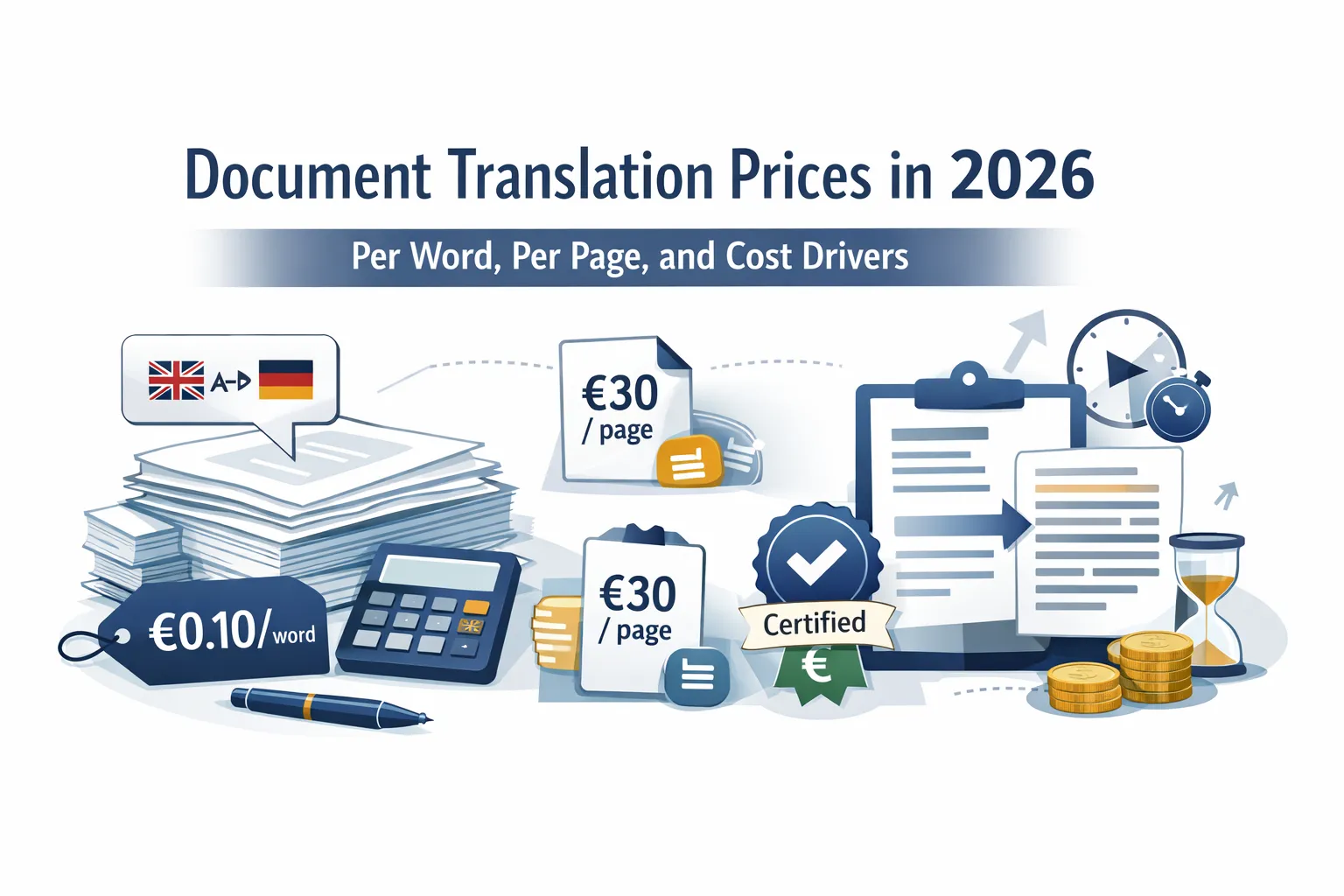
Professional document translation typically costs €0.05–€0.16 per word for standard content, €0.10–€0.25 per word for specialised domains such as legal, medical, or technical material, and €30–€90 per page for certified translations. Final pricing depends on the language pair, subject complexity, quality tier (translation only vs full TEP), turnaround time, and project volume.
Many translation pricing pages list a single rate range, but that number alone provides little practical guidance. Translation costs can vary two to four times depending on factors buyers actually control, including language pair, turnaround schedule, quality process, and document complexity.
This guide explains translation pricing models, document-specific benchmarks, and the real cost drivers that influence translation quotes. If you are comparing providers before issuing an RFQ or negotiating a volume SLA, the context in this guide helps determine whether a translation quote is competitive or overpriced.
Translation Pricing Models Explained: Per Word, Per Page, Per Hour, and Flat Rate

Translation services use four primary pricing models. The model used in your quote determines how predictable and comparable your costs are. Understanding which model applies to your project helps prevent billing surprises and makes it easier to compare quotes from different agencies on a consistent basis.
Translation Pricing Model Comparison
| Model | Best for | Transparency | Budget predictability | Red flag risk |
| Per word (source) | Standard document translation | High | High | Low |
| Per word (target) | Some agencies depending on language | Medium | Medium | Medium. Target word count can be 10 to 30 percent higher than source |
| Per page | Certified translation and short documents | Medium | Medium | High. Page definitions vary widely |
| Per hour | Complex projects, editing, DTP | Medium | Low | Medium. Time estimates are harder to verify |
| Flat project fee | Defined scope projects | High | Very high | Low if scope is clear. Risk arises if scope changes |
Per Word Pricing: The Industry Standard and Why Source vs Target Words Matters

Per word pricing is the dominant model in professional translation because it is directly tied to measurable work volume and is the most transparent model for buyers.
The rate can apply either to the source document word count or the target translation word count.
Source word pricing (preferred by buyers)
• More predictable because the source text already exists
• Enables accurate budgeting before work begins
• Standard practice among most professional agencies
Target word pricing
• Target text may be 10 to 30 percent longer depending on the language pair
• English to German typically expands 20 to 30 percent
• English to Chinese typically contracts 15 to 20 percent
Always confirm whether a quote is calculated using source or target words. On a 50,000 word project this difference can change the final cost by several thousand euros.
Typical per word benchmarks
• General or marketing content: €0.08 to €0.16 per word
• Technical or specialised content: €0.10 to €0.20 per word
• Legal or medical content: €0.12 to €0.25 per word
• Rare language pairs: €0.18 to €0.35 per word
For volume agreements, buyers should specify source word pricing and word count methodology in the contract.
Per Page Pricing: When It Applies, How Pages Are Defined, and the Hidden Cost Risk
Per page pricing is common for certified translation of official documents such as birth certificates, diplomas, passports, and court documents. It is also used for short documents where per-word pricing would produce very small invoices.
The main risk is that the definition of a “page” varies across providers.
Common page definitions
• Physical source document page
• A 250 word block regardless of layout
• A 300 word block
The second and third methods can significantly increase the final cost of dense documents.
Before placing an order, always ask how a provider defines a page for pricing purposes.
Typical certified translation per page pricing
• Standard personal documents: €30 to €70 per page
• Academic transcripts: €40 to €90 per page
• Legal documents: €50 to €130 per page
• Rush service surcharge: typically 25 to 60 percent
Circle Translations uses physical source document pages as the basis for per page pricing, with pricing confirmed before work begins.
Per Hour and Flat Rate Pricing: When They Apply and What to Watch For
Hourly pricing is used when the workload cannot be easily measured by word count or page count. Typical examples include editing existing translations, terminology research, complex formatting, and desktop publishing work.
Typical hourly ranges
• Translation work: €30 to €60 per hour
• Editing or proofreading: €25 to €50 per hour
• Desktop publishing and formatting: €25 to €55 per hour
• Specialist review such as legal or medical: €50 to €110 per hour
Because hourly work is difficult to estimate precisely, buyers should always request an expected hour range before approving the work.
Most agencies also apply a minimum project fee, usually between €40 and €90. On small projects under 200 words this minimum fee determines the total price rather than the per word rate.
Flat project fees are used for clearly defined deliverables such as website translation packages or long term localisation programmes.
What Drives Document Translation Costs: 7 Factors That Explain Every Quote
Two quotes for the same document can differ by 200 to 400 percent. The per-word rate alone does not explain this variation. What actually drives translation cost, and what procurement teams can control or negotiate, are several underlying factors.
Understanding these variables turns quote evaluation from guesswork into a structured comparison.
Language Pair: Why Some Combinations Cost 2 to 3 Times More Than Others
Language pair is often the largest factor affecting translation rates. Pricing reflects translator availability, market demand, training requirements, and the size of the professional translator pool for that language combination.
| Tier | Example pairs | Typical per word range | Availability |
| Tier 1 Major European | EN↔ES, EN↔FR, EN↔DE, EN↔IT, EN↔PT | €0.08–€0.14 | Very high |
| Tier 2 Major Asian | EN↔ZH, EN↔JA, EN↔KO, EN↔AR | €0.10–€0.18 | High |
| Tier 3 Mid availability | EN↔PL, EN↔TR, EN↔NL, EN↔SV, EN↔RU | €0.09–€0.16 | Medium |
| Tier 4 Low availability | EN↔Amharic, EN↔Burmese, EN↔Khmer | €0.15–€0.28 | Low |
| Tier 5 Rare pairs | DE↔ZH, FR↔AR | €0.18–€0.35+ | Very low |
When translation occurs between two non English languages, agencies may use English as a pivot language. For example French to English to Japanese. This effectively doubles translation effort and increases cost.
For multilingual programmes, procurement teams typically anchor their SLA pricing around Tier 1 language pairs and treat Tier 4 or Tier 5 pairs as specialist exceptions.
Subject Matter Complexity and Domain Specialisation: Why Legal Costs More Than Marketing
Different content types require different levels of subject expertise. A marketing email requires strong writing ability in two languages. A clinical trial protocol requires a translator with medical knowledge and regulatory terminology expertise.
| Domain | Per word range | Why it costs more |
| General marketing or PR | €0.08–€0.14 | High translator availability and lower risk |
| Technical engineering software | €0.10–€0.18 | Terminology precision and subject knowledge required |
| Legal contracts or court documents | €0.12–€0.22 | Legal terminology and jurisdiction specific knowledge |
| Medical clinical pharmaceutical | €0.14–€0.25 | Medical expertise and regulatory accuracy required |
| Financial compliance regulatory | €0.12–€0.20 | Domain knowledge and compliance accuracy |
| Certified or official documents | €30–€90 per page | Certification statement and completeness requirements |
Domain complexity multiplies the base rate regardless of language pair. A rare language legal document translation combines both cost drivers and therefore sits at the highest price range.
Quality Tier: Translation Only vs TEP and How QA Affects Price
Not all translation services include the same quality assurance process. Translation only and full TEP represent very different products with different costs and risk levels.
| Tier | What is included | Cost multiplier | When to use |
| Translation only | Single translator, no independent review | 1.0x | Internal content or quick understanding |
| Translation and editing | Translator plus editor review | 1.3 to 1.5x | Marketing material, website content |
| Full TEP | Translator, editor, and proofreader | 1.5 to 2.0x | Legal, technical, regulatory, client facing content |
| MTPE | Machine translation plus human post editing | 0.5 to 0.8x | High volume, lower risk content |
Procurement teams often underestimate the importance of QA level. Ordering translation only for content that requires full TEP frequently leads to revision costs later.
Translation Memory and CAT Tools: How Repeated Content Reduces Costs
Translation memory stores previously translated segments and reuses them when similar content appears again. CAT tools automatically detect these matches and reduce the effort required for translation.
| Match type | Description | Typical discount |
| 100 percent match | Exact segment already in translation memory | 75 to 100 percent discount |
| Repetition | Same segment repeated within the document | 50 to 75 percent discount |
| Fuzzy match 75 to 99 percent | Similar segment requiring small edits | 25 to 50 percent discount |
| Fuzzy match 50 to 74 percent | Moderate similarity | 10 to 25 percent discount |
| New content | No previous match | Full rate |
Translation memory delivers long term savings only when the client owns the TM. If the agency retains ownership, the cost benefits remain with the provider rather than the client.
Example: A 10,000 word technical manual updated quarterly can see translation costs drop by 40 to 60 percent once a translation memory has been built.
Turnaround Time: How Rush Requests Affect Pricing
Rush surcharges are one of the most controllable cost drivers in translation projects. A professional translator can typically translate 1,500 to 2,500 words per day depending on subject complexity.
| Turnaround | Definition | Typical surcharge |
| Standard 5 to 10 business days | Normal workflow | 0 percent |
| Expedited 3 to 4 days | Priority scheduling | 15 to 30 percent |
| Rush 1 to 2 days | Top priority allocation | 35 to 60 percent |
| Same day or overnight | Near capacity scheduling | 60 to 100 percent |
Projects that include translation in the initial project schedule avoid these surcharges entirely. Waiting until the final stage of a project almost always increases cost.
File Format and DTP: When Formatting Increases the Cost
Desktop publishing and formatting work can add unexpected costs to translation projects, especially when source files are not editable.
Common triggers include scanned PDFs requiring OCR extraction, complex InDesign layouts that must be recreated in the translated version, and right to left languages that require specialist formatting support.
Typical DTP work is billed at €25 to €55 per hour.
Buyers can reduce these costs by providing editable source files, requesting a separate DTP estimate when layouts are complex, and maintaining translated templates for recurring documents.
Volume and Preferred Vendor Agreements: How B2B Buyers Lower Translation Costs
Volume is the strongest lever for reducing translation cost in B2B environments. Agencies typically offer tiered discounts for committed monthly volumes.
| Monthly volume | Typical discount | Additional benefits |
| Under 5,000 words | 0 percent | Minimum project fees apply |
| 5,000 to 20,000 words | 5 to 12 percent | Minimum fees often waived |
| 20,000 to 50,000 words | 12 to 18 percent | Dedicated project manager |
| 50,000 to 100,000 words | 18 to 25 percent | Custom pricing and SLA |
| 100,000 plus words | 25 percent plus | Enterprise service agreements |
To negotiate a preferred vendor agreement, organisations should first aggregate translation demand across departments, identify the highest volume language pairs, and request an SLA that includes client owned translation memory and clearly defined QA standards.
Document Translation Price Ranges by Document Type: 2026 Benchmarks

These 2026 benchmarks reflect typical market rates for professional human translation at TEP quality level with standard turnaround and major language pairs. Specialised domains, rare language pairs, rush delivery, and additional services such as DTP, certification, or notarisation may increase the final price.
| Document type | Pricing model | Price range | Notes |
| General business documents | Per word | €0.08–€0.16/word | Standard TEP, major language pairs |
| Technical or engineering | Per word | €0.10–€0.20/word | Domain expertise and terminology research |
| Legal contracts | Per word | €0.12–€0.25/word | Jurisdiction specific terminology |
| Medical or clinical | Per word | €0.14–€0.28/word | Requires medical subject expertise |
| Financial or compliance | Per word | €0.12–€0.22/word | Regulatory accuracy required |
| Website localisation | Per word or project | €0.10–€0.20/word | CMS integration and DTP may apply |
| Marketing or transcreation | Per word or hour | €0.12–€0.30/word | Cultural adaptation required |
| Certified personal document | Per page | €30–€70/page | Certification statement included |
| Academic transcript or diploma | Per page | €40–€90/page | Complex layout and completeness requirement |
| Legal certified document | Per page | €50–€130/page | Notarisation may add extra cost |
| Book or long form editorial | Per word | €0.10–€0.18/word | Volume pricing often applied |
| Software or UI strings | Per word | €0.08–€0.18/word | High translation memory leverage |
Legal Document Translation Rates: Contracts, Court Documents, and Compliance Filings
Legal translation typically carries the highest per word premium in standard professional translation. Legal documents require translators with legal knowledge, familiarity with jurisdiction specific terminology, and a full quality assurance workflow.
Errors in legal translations can affect contracts, court submissions, and regulatory filings, which increases the required level of review.
Typical legal translation benchmarks include
• Standard contracts and agreements: €0.12–€0.20 per word
• Court submissions for civil or commercial cases: €0.15–€0.25 per word
• Regulatory filings such as FDA, EMA, SEC, or FCA documents: €0.18–€0.28 per word
• Patent documents: €0.15–€0.25 per word plus patent-specific terminology research
• Certified legal documents: €50–€130 per page
• Notarised legal documents: typically an additional €20–€60 per certification
In house legal teams and external counsel managing cross border matters should include translation costs in project budgets early. For ongoing legal programmes, preferred vendor agreements often secure lower rates.
Medical and Technical Translation Costs: Domain Expertise Premiums Explained
Medical and technical translation requires subject matter expertise. The pool of translators with both language skills and technical qualifications is smaller than for general content, which raises the market rate.
Typical medical translation benchmarks
• Clinical trial documentation: €0.18–€0.30 per word
• Medical device instructions and IFUs: €0.15–€0.24 per word
• Patient facing healthcare content: €0.12–€0.20 per word
• Pharmaceutical regulatory dossiers: €0.20–€0.32 per word
• Hospital medical records: €0.14–€0.24 per word
Typical technical translation benchmarks
• Engineering manuals or technical specifications: €0.10–€0.18 per word
• Software documentation or IT guides: €0.10–€0.16 per word
• Safety data sheets (SDS or MSDS): €0.15–€0.24 per word
• CAD drawings or technical diagrams: translation per word plus formatting work billed hourly
Using general translators for specialised technical or medical documents often results in errors that require correction later. The cost of revision usually exceeds the initial savings from using lower rates.
Website Translation and Localisation Pricing: What the Base Rate Does Not Include
Website translation costs are often underestimated because the quoted per word rate covers only the translation itself. Several additional components may affect the final project cost.
Typical cost elements include
• Translation: €0.10–€0.20 per word for most website content
• CMS integration or file handling: €50–€200 setup per language
• SEO localisation including keyword research and metadata translation: typically charged per page or per language
• Image text replacement when text is embedded in graphics: DTP work billed around €25–€55 per hour
• QA testing of translated pages inside the CMS: €30–€60 per hour
• Ongoing content updates translated using the same translation memory
Example project cost for a 10 page website translated into Spanish and French
| Item | Estimated cost |
| Translation (5,000 words × 2 languages × €0.14) | €1,400 |
| CMS setup and file handling | €200 |
| SEO localisation | €350–€550 |
| Functional QA review | €150–€250 |
| Total estimated project cost | €2,100–€2,400 |
Hidden Translation Costs and Pricing Red Flags: What to Check Before You Pay
The quoted per word rate is only the starting point. Several additional costs are common in translation projects, but the difference between transparent providers and problematic ones lies in how clearly these costs are disclosed.
Before approving any translation engagement, review the following potential pricing pitfalls.
Minimum Project Fee: The Cost That Surprises Small Orders
Most professional translation agencies apply a minimum project fee, typically between €40 and €90, regardless of word count. On small projects the minimum fee determines the total price rather than the per word rate.
For example, a €0.12 per word rate on a 200 word document suggests €24, but if the minimum project fee is €50 the final cost becomes €50.
Always confirm the minimum fee before requesting a quote or placing a small order. For organisations with frequent small translation requests, negotiated service agreements often remove minimum fees entirely.
Per Page Definition Inflation: The €35 Page That Becomes €70
Per page pricing is not always defined the same way. Some platforms define a page as 250 words or 300 words rather than the physical page of the source document.
This can inflate billing significantly. For example, a two page document containing 600 words may be billed as three pages under a 250 word definition.
The most transparent definition is the physical source document page. Always request written confirmation of how a page is defined before ordering certified or per page translation.
Target Word Count vs Source Word Count: The 20 Percent Billing Difference
Per word pricing should always specify whether the count is based on source text or the translated output. When billing is based on target word count, the final invoice can exceed the original estimate because some languages expand during translation.
English to German often expands by 20 to 30 percent, while English to Russian expands around 15 to 25 percent. A 20,000 word project quoted at €0.14 per word could increase significantly if billed on target word count. Confirm that pricing is calculated using source words before approving a project.
Rush Fees Applied Retroactively and Same Day Premium Structures
Rush surcharges should always be disclosed before work begins. Some agencies apply expedited delivery fees after the project is delivered rather than during the quotation stage.
This creates invoices that exceed the original quote. A transparent provider clearly defines rush pricing in advance. Always confirm that all surcharges appear in the written quote and that the turnaround time triggering a rush fee is defined before the project begins.
Agency Margin on Freelancers: What It Means for B2B Buyers
Translation agencies apply a margin on top of translator rates to cover project management, quality assurance, technology infrastructure, and operational overhead. This margin is reasonable when it adds measurable value. B2B buyers should evaluate whether the agency provides a structured workflow and operational support.
Key indicators of value include
• A dedicated project manager responsible for coordination
• Independent quality review rather than translator self-checking
• Client-owned translation memory assets
• Technology platforms for terminology and file management
• Documented service level agreements and revision policies
• Data protection compliance, including NDA and GDPR agreements
If these elements are absent, the agency margin is not delivering operational value to the buyer. Read about the best translation agencies on our blog.
Get a Transparent Quote for Your Document Translation
Circle Translations provides itemised and transparent quotes for document translation at every quality tier, whether priced per word, per page, or under a volume service agreement. Pricing is clearly defined from the start, with no hidden minimum fees for contracted accounts and no unexpected rush surcharges for committed clients. Source word pricing is used as standard so estimates remain predictable.
Every quote includes
✓ Per word or per page rate clearly stated based on source content
✓ QA tier specified clearly, whether translation only, translation and editing, or full TEP
✓ All surcharges such as rush delivery, DTP, or certification disclosed at quote stage
✓ Client owned translation memory from the first project
✓ Volume service agreements available from 10,000 words per month
Submit your document for a free quote.
Frequently Asked Questions – Document Translation Prices
How much does it cost to translate 1,000 words professionally?
Translating 1,000 words typically costs €80–€160 for general business content at standard professional rates (€0.08–€0.16 per word). Specialised content costs more. Legal translation usually ranges from €120–€220 per 1,000 words, while medical or pharmaceutical translation ranges from €140–€260. Rush delivery, rare language pairs, or complex formatting increase the final price.
How is a translation fee calculated when submitting a document for a quote?
Translation fees are calculated in three steps. First, the source document is analysed using CAT tools to determine word count and identify translation memory matches. Second, the applicable per word rate for the language pair and subject area is applied. Third, additional services such as DTP, certification, notarisation, or rush delivery are added to the quote.
What is a fair price per word for translation services in 2026?
A fair market rate for professional human translation in 2026 is about €0.08–€0.16 per word for general content and €0.12–€0.28 for specialised content such as legal, medical, or technical material. Rates below €0.06 per word usually indicate machine translation with minimal human review.
Does machine translation with human post-editing cost significantly less than full human translation?
Yes. Machine translation with human post-editing usually costs 40–60 percent less than full human translation. Typical MTPE rates range from €0.04–€0.10 per word. It is suitable for high-volume internal content but not recommended for legal, medical, regulatory, or certified documents.
How much does it cost to translate a legal document?
Legal translation typically costs €0.12–€0.25 per word depending on complexity and language pair. Highly specialised legal work such as regulatory filings or patents may reach €0.18–€0.30 per word. Certified legal documents are often priced per page, usually €50–€130 per page, with notarisation adding €20–€60.
How much does website translation cost for a 20 page B2B website?
A 20 page B2B website with about 10,000 words usually costs €1,000–€2,000 to translate into one language. Additional costs may include CMS integration (€100–€300), SEO localisation (€300–€600), and functional QA testing (€150–€250). Each additional language repeats the translation cost.
What is the typical cost to translate a book or long form document?
Book translation usually costs €0.09–€0.18 per word for general or literary content. An 80,000 word book therefore costs about €7,200–€14,400. Technical or academic books may reach €0.18–€0.26 per word. Volume discounts often apply to book-length projects.
Are translation prices negotiable, and what gives a buyer leverage?
Yes. Translation pricing is often negotiable for buyers with consistent volume. The strongest leverage factors are monthly word volume, long-term service agreements, faster payment terms, and consolidating translation work with a single provider.
Why do two agencies quote very different prices for the same document?
Price differences usually come from different service levels. Some agencies provide translation only, while others include editing, proofreading, project management, and terminology management. Translator expertise, language pair difficulty, and formatting requirements also affect the final price.