Certified translation typically costs €0.09–€0.18 per word or €22–€60 per page, depending on language pair, document type, certification level, and turnaround time. Legal, HR, and regulated-industry documents typically sit at the higher end of that range due to subject-matter expertise and enhanced QA requirements.
This guide breaks down certified translation pricing models, key cost drivers, document-specific benchmarks, hidden fees, and a practical budgeting framework for procurement and HR teams. Circle Translations delivers ISO 17100-certified translations for enterprises across legal, HR, and compliance functions, ensuring accuracy, regulatory acceptance, and transparent quoting.
If you’re managing translation budgets for contracts, HR documentation, or compliance filings, this guide gives you the numbers and framework you need.
What Is a Certified Translation and Why Does It Cost More?
A certified translation is a translated document accompanied by a signed attestation confirming accuracy and completeness. Courts, government agencies, USCIS, academic institutions, and regulated industries require this statement for official use.
As the United States Citizenship and Immigration Services (USCIS) (2023) states in its official policy guidance, “Any document containing foreign language submitted to USCIS shall be accompanied by a full English translation which the translator has certified as complete and accurate,” and the translator must certify that they are competent to translate from the foreign language into English.
Unlike standard translation, certified translation carries legal weight. The translator or agency accepts formal responsibility for accuracy. That liability directly affects pricing.
Certified work also requires:
- Subject-matter expertise (legal, medical, regulatory)
- Layout replication to mirror the original document
- Inclusion of seals, stamps, and signatures
- QA review, often by a second linguist under ISO 17100 processes
These additional controls increase production time and compliance risk. As a result, certified translation costs 15–30% more than standard translation.
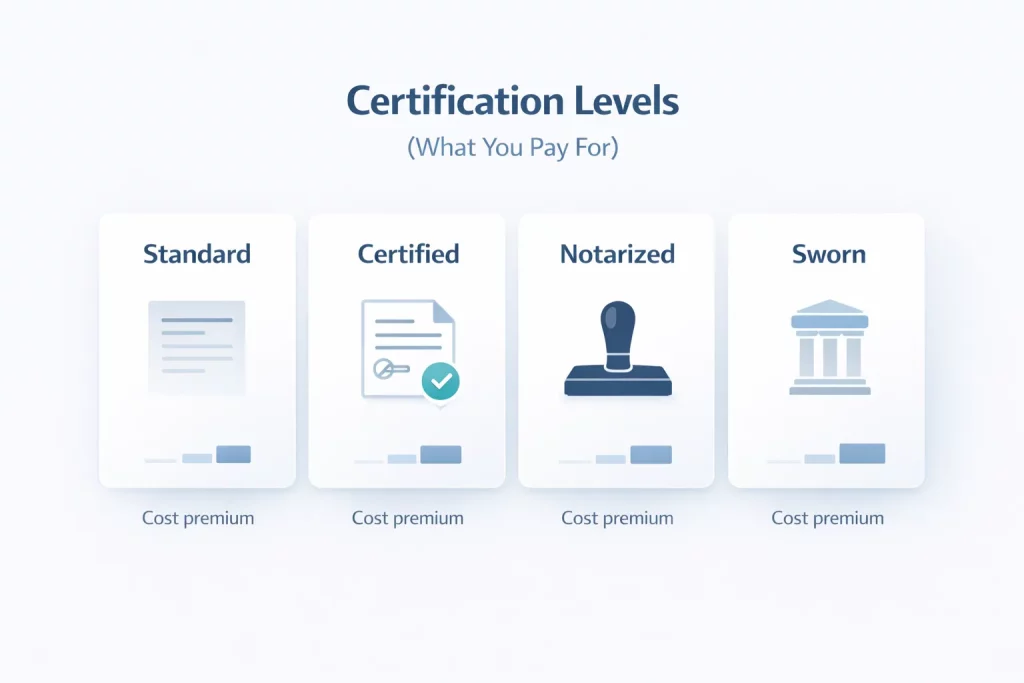
Certification level further impacts price.
| Type | What it includes | Typical cost premium | When required |
| Standard translation | Linguistic accuracy only | Baseline | Internal use, marketing |
| Certified translation | Accuracy + signed attestation | +15–30% | USCIS, courts, academic institutions |
| Notarized translation | Certified + notary seal | +30–60% | Legal filings, some immigration cases |
| Sworn translation | Certified by court-sworn translator | Varies by country | European legal proceedings |
Certification Levels Explained
Self-certified translation
The translator signs the attestation. This is common for USCIS submissions and carries the lowest certification-related cost.
Agency-certified translation
The agency adds its official seal or stamp alongside the translator’s signature. Corporate legal teams often prefer this format for added accountability.
Notarized certified translation
A notary public verifies the signer’s identity. Notary fees and administrative handling increase total cost.
Understanding the difference between certified, notarized, and sworn translation prevents overpaying for unnecessary certification tiers.
Certified Translation Cost: 2026 Pricing Benchmarks by Document Type
Document type is one of the strongest predictors of certified translation cost. A one-page birth certificate and a 30-page clinical study report both require certification, but terminology density, formatting complexity, and regulatory exposure create very different pricing structures.
Short personal documents are typically priced per page. Multi-page legal, HR, clinical, and compliance documents are usually priced per word with QA tiers applied.
Certified Translation Pricing Benchmarks (EUR)
| Document Type | Typical per-page cost (€) | Typical per-word range (€) | Avg pages | Budget range (€) |
| Birth certificate | €22–€40 | €0.10–€0.16 | 1–2 | €22–€80 |
| Marriage certificate | €22–€40 | €0.10–€0.16 | 1–2 | €22–€80 |
| Diploma / academic transcript | €30–€60 | €0.11–€0.17 | 1–4 | €30–€240 |
| Legal contract | €40–€85 | €0.12–€0.18 | 5–30 | €200–€2,550 |
| HR policy / employee handbook | €35–€65 | €0.10–€0.16 | 10–50 | €350–€3,250 |
| Clinical study report (30 pages) | €50–€90 | €0.14–€0.20 | 30 | €1,500–€2,700 |
| Driver’s licence | €22–€35 | €0.10–€0.15 | 1 | €22–€35 |
| Immigration document (general) | €28–€55 | €0.10–€0.18 | 2–5 | €55–€275 |
| Patent document | €50–€100 | €0.15–€0.22 | 10–50 | €500–€5,000 |
| Financial/compliance report | €45–€80 | €0.13–€0.20 | 10–40 | €450–€3,200 |
Circle Translations positions its pricing within these industry benchmarks. Exact rates depend on language pair, QA tier, and turnaround time. For enterprise-specific pricing tiers, see /content/pricing or request a tailored quote.
How Much Does a Certified Translation Cost for Legal Contracts and HR Documents?
Legal contract and HR document translation typically ranges from €0.12–€0.20 per word, depending on complexity, regulatory exposure, and QA level.
Legal contracts require domain-expert translators familiar with jurisdiction-specific terminology, clause structure, and enforceability standards. This increases rates compared to general content.
HR document translation, including employee handbooks, employment contracts, offer letters, and compliance policies, varies by terminology density and formatting complexity. High-volume policy translations benefit from TM leverage, which reduces repeat costs over time.
Legal and HR-specific cost drivers include clause-level review, dual-linguist QA under ISO 17100 workflows, structured formatting that mirrors the source layout, and GDPR-compliant handling of employment records.
Budget example: A 15-page NDA translation into German and French with dual-linguist review typically ranges from €1,100–€1,950, depending on urgency, language pair, and formatting requirements.
Enterprise HR teams managing recurring document updates often reduce Year 2 costs by 25–40% through TM leverage and SLA pricing models.
What Does a Certified Translation Cost for Immigration and USCIS Documents?
USCIS-certified translation typically costs €22–€60 per page for standard personal documents.
USCIS requires that all foreign-language documents be accompanied by a certified English translation signed by a competent translator. No specific certification body is mandated, but the translator must attest to accuracy and competence.
Common USCIS document pricing benchmarks include:
- Birth certificate: €22–€40
- Marriage certificate: €22–€40
- Divorce decree: €30–€55
- Police record: €30–€60
- Academic transcript: €30–€60
Corporate HR teams managing employee visa and work permit applications regularly require USCIS-compliant translations. Volume agreements with a certified LSP significantly reduce per-document administrative cost.
Using an unqualified translator or incorrect attestation wording increases rejection risk. A rejected filing requires full retranslation and resubmission fees. Quality control outweighs the lowest-price option.
Cost to Translate and Certify Clinical and Medical Documents
Clinical and medical certified translation typically ranges from €0.14–€0.20 per word and represents one of the highest pricing tiers due to regulatory and QA requirements.
Clinical study reports, patient records, pharmaceutical documentation, and medical device manuals require specialist linguists trained in regulatory terminology.
Cost drivers include FDA and EMA terminology standards, ICH E6 GCP guidelines for clinical trials, mandatory dual-review for patient safety, and large document volumes often exceeding 30–100 pages.
Budget benchmarks:
- 30-page clinical study report: €1,500–€2,700
- 300+ page clinical dossier: €15,000–€27,000
ISO 17100-compliant workflows and alignment with GAMP/ICH regulatory standards increase QA rigor and reduce compliance risk.
Pharmaceutical and medical device companies benefit from negotiated SLAs rather than per-project pricing. Volume programmes typically reduce recurring clinical documentation costs by 20–35%.
How Certified Translation Pricing Models Work: Per Word, Per Page, and Flat Fee
Certified translation pricing follows five primary models: per word, per page, flat fee, hourly, and per character. Understanding which model applies to your project prevents billing surprises and inaccurate budget forecasts.
Per-word pricing is most common for large or technical documents. Per-page pricing is standard for certified personal and legal documents. Flat project fees apply to clearly defined scopes or urgent assignments. Some providers also apply minimum fees, which disproportionately affect small orders.
Circle Translations provides itemised quotes before project start, outlining rate basis, QA tier, certification level, and any additional services. There are no post-delivery billing adjustments outside approved scope.
| Model | How calculated | Best for | Transparency | Watch out for |
| Per-word | Word count × rate | Large documents, technical content | High | Source vs. target word count gap (+10–20%) |
| Per-page | Fixed rate per page | Certified docs, personal documents | High | Define “page” (250 or 300 words?) |
| Flat project fee | Fixed quote based on scope | Defined projects, rush orders | High upfront | Scope creep risk |
| Hourly | Hours × rate | Complex editing, research-heavy | Variable | Hard to predict total cost |
| Per-character | Characters × rate | Japanese, Chinese, Korean | Fair for CJK | Less familiar to Western buyers |
Per-Word vs. Per-Page Pricing: Which Model Works Best for Your Project?
Per-word pricing is more accurate for documents over 500 words. It protects the buyer when content is dense or technical. Always confirm whether the rate applies to source or target word count. Language expansion matters. English to German can expand by up to 30%, increasing billable target words if not clarified.
Per-page pricing works best for standardised certified documents. Birth certificates, marriage certificates, diplomas, and immigration documents follow consistent layouts. A “page” typically assumes 250–300 words.
Decision guide:
Use per-word when:
- Contracts over 10 pages
- Technical manuals
- Financial reports
- Policy documents
Use per-page when:
- Birth or marriage certificates
- Academic transcripts
- Immigration documents
- Driver’s licences
Most agencies apply a €25–€70 minimum fee. Enterprise buyers with recurring volume should negotiate blended per-word rates with TM leverage built into the SLA.
What Are Minimum Translation Fees and When Do They Apply?
Most certified translation agencies apply a minimum project fee of €25–€90, regardless of word count.
The minimum covers translator allocation, project management, QA setup, and certification document preparation.
Example:
A 100-word certified birth certificate at €0.14 per word equals €14. The minimum fee increases the invoice to approximately €25–€40.
HR teams submitting single employee documents should factor minimum charges into per-document budgeting.
To reduce impact, batch multiple short documents into one order. Most agencies apply one minimum fee per project, not per individual document.
7 Cost Drivers That Affect the Price of Certified Translation
The base per-word or per-page rate is only the starting point. Seven operational and compliance factors determine your final invoice. Procurement and legal teams that understand these drivers write clearer RFPs, forecast budgets more accurately, and avoid unexpected surcharges.
Visual recommendation: Infographic or icon list titled “7 factors that determine certified translation cost”
Language Pair: Why Rare Languages Cost More
Language pair availability directly affects certified translation cost.
High-resource pairs such as EN↔ES, EN↔FR, and EN↔DE typically range from €0.09–€0.13 per word due to large translator supply. Low-resource pairs such as EN↔Icelandic, EN↔Swahili, and EN↔Lithuanian typically range from €0.16–€0.30 per word due to limited availability of qualified professionals and specialist demand.
CJK languages (Chinese, Japanese, Korean) command medium-high rates because of character density and specialist demand.
| Language pair | Relative cost | Availability |
| EN↔ES / FR / DE | Low–medium | High |
| EN↔JA / ZH / KO | Medium–high | Moderate |
| EN↔AR / RU / PL | Medium | Moderate |
| EN↔IS / SW / LT | High | Limited |
Document Complexity and Specialisation: Technical, Legal, Medical
Specialised content increases certified translation cost by 20–50%.
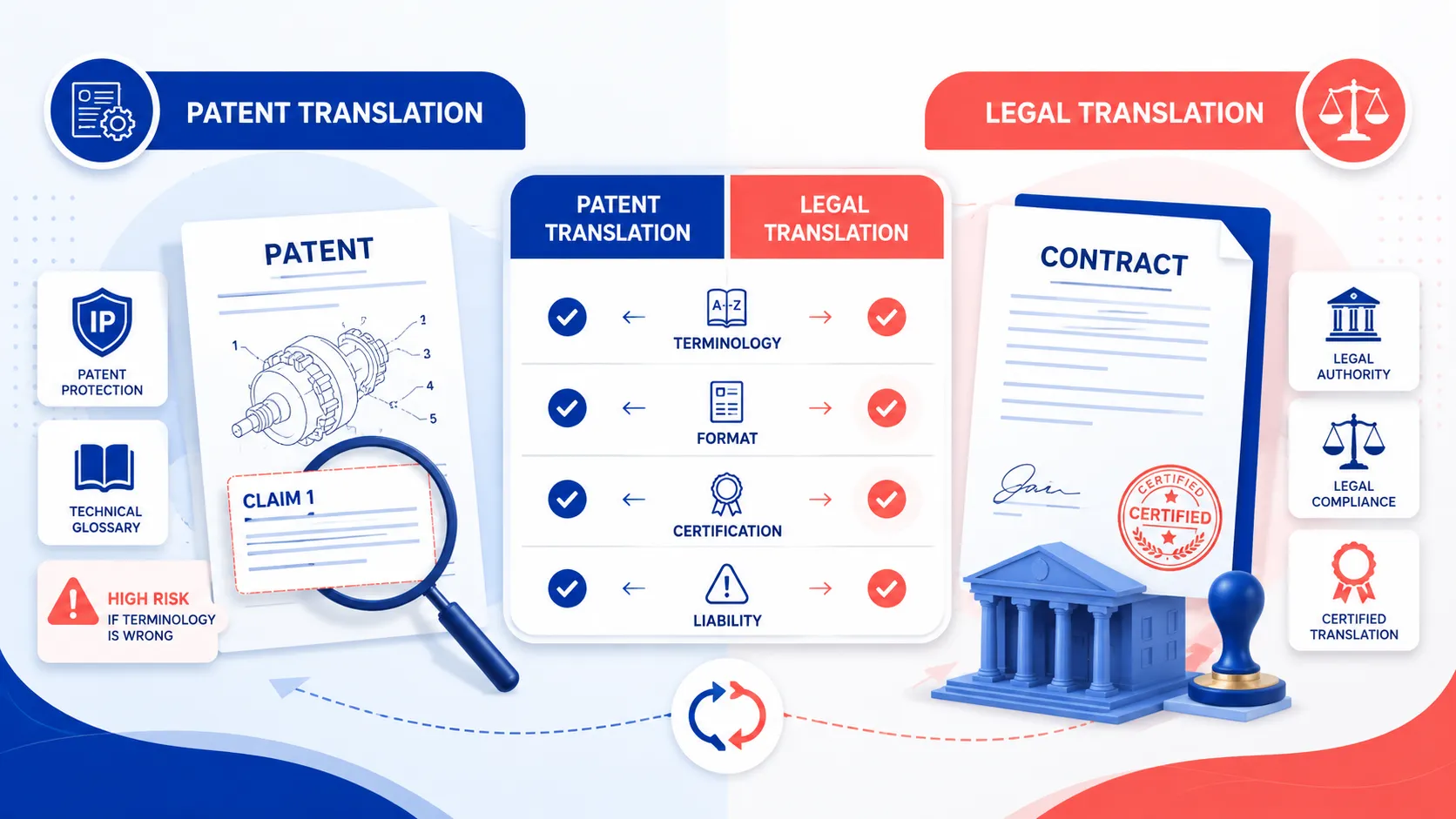
Legal translation, medical translation, patent translation, and technical translation require subject-matter expertise. Qualified specialists are less available and assume higher liability per error.
A standard birth certificate may cost €0.10–€0.14 per word. A certified patent translation for the same language pair may cost €0.16–€0.22 per word, reflecting technical complexity and specialist expertise.
Domain expertise premium is one of the most consistent pricing multipliers in regulated industries.
Turnaround Time: How Rush Fees Are Calculated
Standard output averages 1,500–2,000 words per translator per day. When clients require delivery faster than the standard SLA, rush surcharges apply.
| Turnaround | Surcharge | Typical use case |
| Standard (5–7 business days) | 0% | Routine procurement |
| Expedited (2–3 business days) | +20–30% | Filing deadlines |
| Rush (24 hours) | +50–75% | Urgent court submissions |
| Same-day | +100%+ | Emergency filings |
Circle Translations does not charge rush fees as standard, as confirmed on /content/pricing. This policy reduces unpredictability for enterprise buyers managing strict timelines.
Certification Level: Standard, Notarised, and Apostilled Translations
Certification level directly increases total project cost.
- Standard certified translation includes translator or agency attestation and is typically included in the base rate.
- Notarised translation adds a notary public fee of €15–€45 per document.
- An apostille adds government authentication of the notarised document, costing €20–€90+ depending on jurisdiction and adding 1–5 business days to the timeline.
Procurement teams should confirm the required certification level with the receiving authority before ordering. Incorrect certification results in full retranslation and duplicate cost.
Word Count and Page Volume: How Bulk Orders Reduce Per-Word Rates
Higher volume lowers effective per-word rates through scale and TM leverage.
| Volume | Typical per-word rate (€) | Discount mechanism |
| <500 words | €0.12–€0.18 | Minimum fee applies |
| 500–5,000 words | €0.10–€0.15 | Standard rate |
| 5,000–20,000 words | €0.08–€0.13 | Volume discount tier |
| 20,000+ words | €0.06–€0.11 | Enterprise rate + TM leverage |
| Repeat content (TM match) | €0.02–€0.06 | Fuzzy/exact match discount |
For volume-specific pricing tiers, see /content/pricing or request a tailored quote.
Formatting and DTP: When Layout Replication Adds to the Invoice
Certified translations often require layout replication of the original document.
Desktop Publishing (DTP) charges apply when:
- Files contain tables, seals, stamps, or multi-column layouts
- Output must mirror the source exactly (IDs, diplomas, medical forms)
- Source files are non-editable PDFs or scans
DTP typically adds €18–€75 per page depending on complexity. Always confirm whether formatting is included in the quoted rate.
QA and Review Tiers: Single Linguist vs. Dual-Review vs. LQA
Quality assurance level significantly affects certified translation cost.
| Tier | Process | Cost premium | When required |
| Single linguist | Translation only | Baseline | Internal communications |
| Single + proofreading | Translation + proof | +10–15% | Standard certified documents |
| Dual linguist (TEP) | Translate + Edit + Proof | +20–35% | Legal, medical, regulated |
| LQA (MQM scoring) | Structured error analysis | +30–50% | Enterprise SLAs |
| Sworn / notarised | Legal attestation process | +30–60% | Court, immigration |
Hidden Costs in Certified Translation: What Your Quote May Not Include
The most common source of buyer frustration is a final invoice that exceeds the initial per-word quote. Base rates rarely reflect the full scope of certification, formatting, compliance, and logistics requirements. These five hidden cost categories are frequently overlooked in procurement and HR budgets.
Circle Translations itemises all charges before the project starts. No undocumented add-ons. No post-delivery billing surprises.
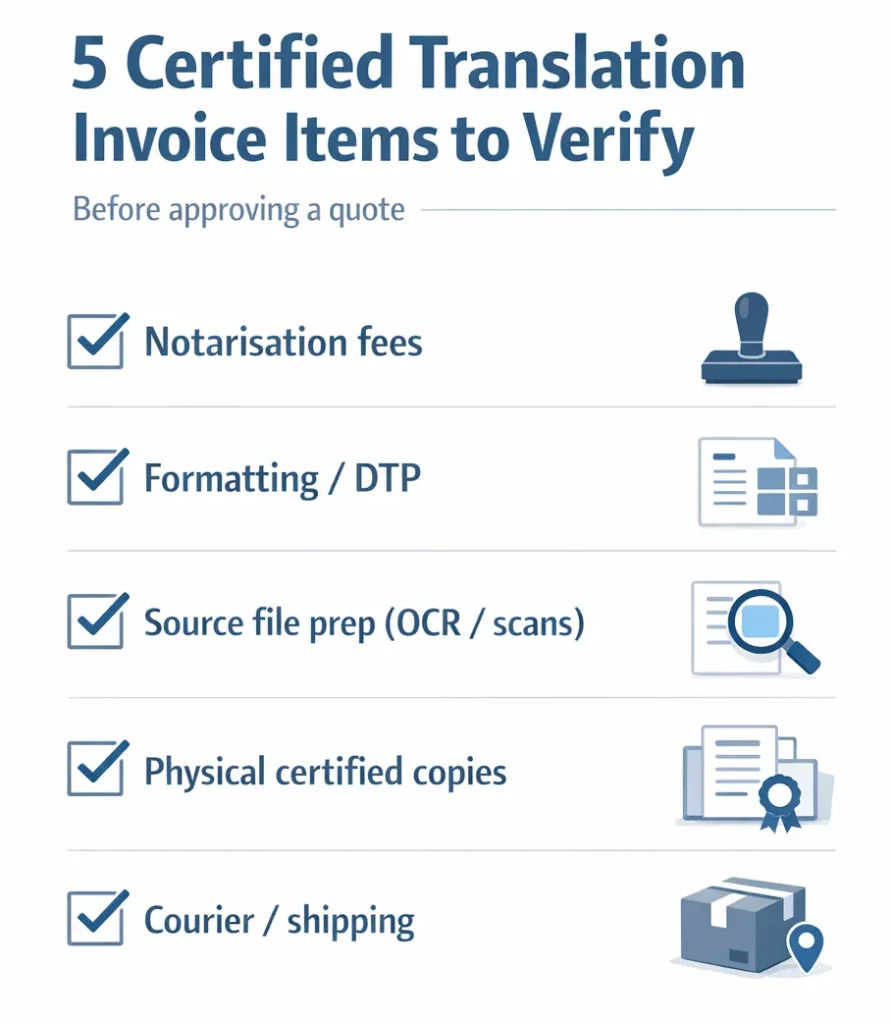
Notarisation and Courier Fees for Physical Certified Copies
Some courts, embassies, and government agencies require physical certified translations with wet ink signatures.
Additional costs may include:
- Notary fee: €15–€45 per notarised signature
- Printing and binding: €5–€18 per copy
- Courier shipping: €15–€75 domestic; €40–€140 international
- Multiple originals: 2–3 copies often required
For HR teams managing multi-country visa applications, physical copy and courier costs can add €90–€350 per employee file. Budget accordingly.
Source File Preparation: Scanned, Handwritten, and Non-Editable Documents
Poor-quality source files increase preprocessing time and cost.
Common add-ons include:
- OCR (image-to-text conversion): €10–€28 per page
- Handwritten document interpretation: +25–50% per-word rate
- Complex table or multi-column extraction: €15–€38 per page
Procurement tip: Submit editable Word, DOCX, or clean PDFs whenever possible. Clean source files alone can reduce total project cost by 15–25%.
Retranslation Risk: The Real Cost of Getting Certification Wrong
Rejection is the most expensive certified translation outcome.
Incorrect attestation wording, wrong certification level, or unqualified translators can result in full rejection by USCIS, courts, or academic institutions.
Consequences include:
- Full retranslation at original cost
- Resubmission fees (USCIS: €45–€650+ depending on form)
- Missed deadlines and permit delays
- Rush retranslation premium of +50–100%
Risk reduction requires ISO 17100-compliant processes and correct certification formatting. Circle Translations provides revision and recertification as standard if a regulatory authority requests changes.
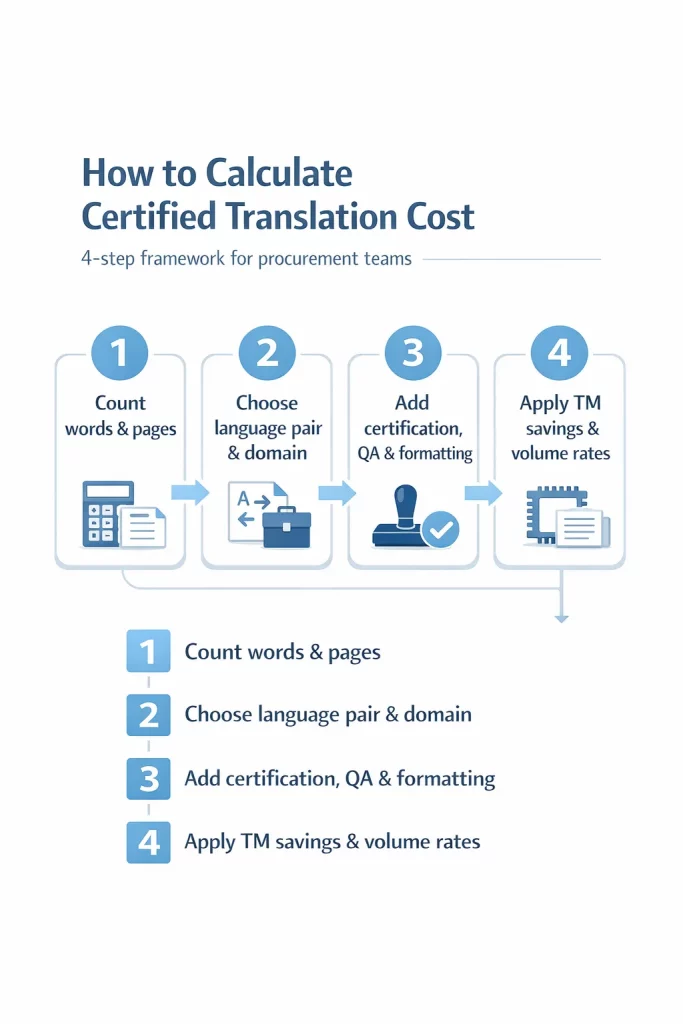
How to Calculate Your Certified Translation Budget: A 4-Step Framework
For HR and legal procurement teams, inaccurate budgeting leads to overspend, rejected documents, or emergency rush fees. This 4-step framework provides a repeatable method aligned with how professional language service providers calculate certified translation cost.
Step 1: Count Your Words and Pages Accurately
Base your estimate on source word count, not target. Most translation pricing models use source word count as the billing unit.
For multi-document orders:
- Use MS Word word count for editable files
- For scanned PDFs, estimate 250–300 words per page
- For legal contracts, assume 250–350 words per page
- For medical or technical files, count only text-bearing elements
Formula:
Estimated base cost = Word count × per-word rate range
Example:
2,500-word contract × €0.12–€0.18 = €300–€450 (before QA or rush fee
Step 2: Identify Language Pair and Domain Complexity
Adjust your baseline rate according to language pair and subject matter.
Language multipliers:
- Common pair (EN↔ES/FR/DE): baseline
- Medium pair (EN↔AR/RU/PL): +15–20%
- Rare pair (EN↔LT/IS/SW): +30–60%
- CJK (EN↔JA/ZH/KO): +20–40%
Domain multipliers:
- General/personal: baseline
- Legal/compliance: +15–25%
- Medical/pharmaceutical: +25–40%
- Patent/technical: +20–35%
Output: Your adjusted per-word rate based on language pair and complexity.
Step 3: Add Certification, Formatting, and QA Tier Costs
Layer compliance and production requirements onto your base translation cost.
Add where applicable:
- Certification/attestation: typically included — confirm
- Notarisation: +€15–€45 per document
- DTP/formatting: +€18–€75 per page
- QA upgrade (TEP dual review): +20–35%
- Physical copies and courier: +€45–€180 per set
Summary formula:
Total estimated cost = (Word count × adjusted per-word rate) + DTP + Notarisation + Courier + QA premium
Use our quote form to receive an itemised estimate within 24 hours: /content/contact-us
Step 4: Apply TM Leverage Savings for Repeat or Similar Content
Translation Memory (TM) reduces billable word count for recurring content.
Typical TM rate structure:
- Exact match: 0–30% of standard rate
- Fuzzy match (75–99% similarity): 30–60%
- New content: 100%
Example:
An HR team translating the same employment contract template quarterly into five languages can reduce Year 2 certified translation costs by 30–45% through structured TM programmes.
Certified Translation Cost by Region: US, UK, EU, and Australia
Certified translation cost varies by region due to regulatory frameworks, accreditation systems, and cost-of-living factors. The United States allows self-certification by a competent translator, while many EU countries require court-sworn translators.
Australia mandates NAATI accreditation for immigration and government submissions. These structural differences directly affect per-page pricing and vendor selection.
For procurement and HR teams managing cross-border filings, understanding regional certification rules prevents rejection and duplicate spend.
| Region | Certification framework | Typical per-page rate (€) | Key notes |
| United States | USCIS guidelines (self-certification by competent translator) | €22–€60 | No official body; agency seal accepted |
| United Kingdom | CIOL / ITI membership preferred | €30–€95 | Professional association standards |
| European Union | Sworn translator system in most member states | €40–€120 | Court-appointed sworn translators required for legal documents |
| Australia | NAATI accreditation required | €35–€110 | NAATI certification mandatory for immigration/government use |
| Canada | CTTIC-affiliated translators preferred for IRCC | €20–€65 | IRCC-specific requirements apply |
For global enterprises managing certified translation across multiple jurisdictions, consolidating with a single language service provider ensures consistent QA standards, unified terminology management, and predictable pricing.
Circle Translations delivers certified translations accepted by authorities in 40+ countries. Use one vetted partner instead of managing separate vendors per market.
Get an Itemised Certified Translation Quote in 24 Hours
Ready to budget your certified translation project? Circle Translations provides itemised quotes with no hidden fees, within 24 hours of receiving your documents.
What you receive with every quote:
✓ Per-word rate broken down by language pair and domain
✓ QA/review tier options with side-by-side cost comparison
✓ TM leverage discounts applied where applicable
✓ Turnaround options with no rush-fee surcharge
✓ Certification level and notarisation costs clearly stated
Upload your document or describe your project and receive a transparent, procurement-ready estimate.
Get a Free Quote →
View our pricing tiers →
Frequently Asked Questions About Certified Translation Cost
How much does a certified translation cost per page?
Certified translation typically costs €22–€60 per page for standard personal documents. Legal, technical, and patent documents range from €40–€100 per page due to complexity and QA requirements. A “page” usually assumes 250–300 words. Final pricing depends on language pair, certification level, and turnaround time.
What is the average cost of certified translation services overall?
The average certified translation cost is €0.09–€0.18 per word or €25–€60 per page. A single birth certificate often costs €30–€85. A 10-page legal contract typically ranges from €550–€1,300. Enterprise volume agreements can reduce blended rates to €0.07–€0.13 per word.
Is certified translation more expensive than standard translation?
Yes. Certified translation costs 15–30% more than standard translation. The premium covers a signed attestation, legal liability, formatting replication, and QA review. Notarisation adds €15–€45 per document.
How much does a certified translation cost for USCIS immigration documents?
USCIS-certified translations usually cost €22–€60 per page. Birth and marriage certificates average €30–€55. Academic transcripts and divorce decrees range from €30–€65. The translator must attest to accuracy and competence.
Can I do my own certified translation to reduce costs?
No, in most cases. USCIS prohibits self-translation. Courts and universities require an independent third party. Using an unqualified translator increases rejection risk and may require full retranslation.
How long does certified translation take, and does speed affect cost?
Standard turnaround is 2–5 business days for short documents. Multi-page contracts may take 5–10 business days. Many providers charge 50–75% for 24-hour delivery. Circle Translations does not apply rush fees as standard, subject to capacity.
What is the difference between certified and notarised translation, and how does it affect cost?
Certified translation includes a signed accuracy statement. Notarised translation adds a notary seal verifying the signer’s identity. Notarisation increases cost by €15–€45 per document, plus potential courier fees.
Do certified translation costs vary between translation agencies and freelancers?
Yes. Freelancers often charge €0.09–€0.14 per word with limited QA. Agencies charge €0.10–€0.20 per word and include proofreading, project management, and liability coverage. Agencies typically provide stronger compliance protection for B2B use.
How can enterprises reduce certified translation costs without lowering quality?
Enterprises reduce costs through TM leverage, batch ordering, volume SLAs, and clean source files. TM programmes alone can reduce repeat costs by 25–45% over time. Structured vendor agreements deliver predictable pricing without sacrificing quality.
Subtitles

Professional and Accurate Subtitle Services for your Videos.
- Video subtitles specifically tailor-made for improving accessibility.
- Using highly experienced subtitlers with years of industry experience.
- Professionally written and expertly timed.
Translation

We help the world’s top companies translate their content in over 73 languages!
- We localize content for internet websites, games, travel, cryptocurrencies, and more
- Expand your global audience by adding different languages.
- We work only with qualified translators and experienced content creators
Audio translation

Ensuring full accessibility for Blind and visual impaired audiences.
- Visual descriptive events as they occur in the video.
- Working with top audio describers to perfectly describe what is happening on-screen
- Professional sound recording.