Every country’s medical documents, policies, etc., are very important for the people. Many countries have multilingual people. And for those people, medical document translation is very crucial. Now you might ask what this translation or what actually it translates?
Medical document translation services convert healthcare content from one language to another while maintaining clinical accuracy, regulatory compliance, and patient safety standards. These services help healthcare providers, insurers, pharmaceutical companies, and clinical research organizations communicate critical medical information across language barriers using qualified medical translators and secure handling protocols.
Here we try to cover accuracy standards, security requirements, common document types, and how to choose a qualified medical translation provider. So let’s be with us to learn the details.
What Counts as a “Medical Document” for Translation?
You might think every medical document needs translations. But in reality actually not. You need to identify which documents actually need translations. Medical documents include any healthcare-related content that requires translation for patient care, research, regulatory compliance, or administrative purposes. Understanding these categories helps you identify what needs professional medical translation versus general translation.
Patient care documents:
- Medical records and health histories (used by clinics and hospitals)
- Discharge summaries and care instructions (hospitals, specialists)
- Prescriptions and medication lists (pharmacies, providers)
- Vaccination records and immunization certificates (schools, immigration)
- Doctor’s notes and diagnostic reports (referring physicians)
- Referral letters and treatment plans (care coordinators)
Research and clinical trial documents:
- Study protocols and amendments (CROs, sponsors)
- Informed consent forms (clinical sites, ethics committees)
- Case report forms and patient diaries (data management teams)
- Safety reporting and adverse events (regulators, sponsors)
- Clinical trial labels and instructions (trial sites)
Regulatory and compliance documents:
- FDA/EMA submissions and approval packages (regulatory affairs)
- Medical device registrations (medtech companies)
- Product labeling and package inserts (pharma, device manufacturers)
- Post-market surveillance materials (quality assurance)
- Clinical evaluation reports (notified bodies, regulators)
Device and pharmaceutical materials:
- Instructions for Use (IFU) for medical devices (manufacturers)
- Patient information leaflets (pharma)
- Technical specifications (engineering, quality)
- Safety data sheets (regulatory compliance)
Administrative and insurance documents:
- Insurance claims and pre-authorization forms (insurers, billing)
- Credentialing documents (hospital admin, licensing boards)
- Disability evaluation reports (insurers, legal)
- Medical-legal reports (attorneys, courts)
Almost every medical sector has the above documents. Each category has different accuracy requirements and stakeholders. Patient care documents prioritize clarity for understanding, while regulatory documents require exact terminology and formatting compliance.
Patient-Facing Documents (Records, Discharge Summaries, Prescriptions)
Any document that is directly connected to a patient is very important and needs to be accurate. Patient-facing medical documents communicate health information directly to patients or their caregivers. Translation quality affects patient understanding, medication adherence, and health outcomes.
Common patient-facing documents include:
Let’s learn about some patient-facing document details here:
Medical records — comprehensive health histories containing diagnoses, treatments, lab results, and imaging reports. Translation must preserve clinical accuracy while remaining understandable to patients and their families.
Doctor’s notes — clinical observations, examination findings, and treatment recommendations. Translating doctor’s notes requires medical terminology knowledge to accurately convey diagnostic reasoning and care plans.
Discharge summaries — post-hospitalization instructions covering medications, follow-up appointments, activity restrictions, and warning signs. These documents are critical for continuity of care when patients seek treatment across language barriers.
Prescriptions — medication orders specifying drug names, dosages, frequency, and administration routes. Prescription translation requires exact dosing accuracy and clear instructions to prevent medication errors.
Vaccination records — immunization histories needed for school enrollment, immigration, employment, or international travel. These translations often require certification for official acceptance.
Patient instructions — post-procedure care, medication guides, dietary restrictions, and self-care protocols. Clear translation ensures patients can follow medical advice correctly.
Referral letters — physician-to-physician communications explaining why a patient needs specialist care. Doctor report translation must convey clinical reasoning and relevant history accurately.
For patient safety, these documents need medical translators who understand clinical context, not just literal word-for-word conversion. A mistranslated medication instruction or missed contraindication can have serious health consequences.
Research & Clinical Trial Documents (Protocols, CRFs, ICFs)
Clinical trial translations support global medical research by enabling multinational studies while maintaining scientific accuracy and regulatory compliance. These documents face strict oversight from ethics committees and regulatory authorities.
Key clinical trial documents requiring translation:
Study protocols — detailed research plans describing study design, objectives, methodology, safety monitoring, and statistical analysis. Protocol translation must preserve scientific precision and regulatory terminology across languages.
Informed consent forms — documents explaining study risks, benefits, procedures, and patient rights. These require both medical accuracy and patient-friendly language so participants can make informed decisions about enrollment.
Case report forms (CRFs) — data collection instruments used to record patient information during trials. CRF translation needs exact field labels and response options to ensure data consistency across international sites.
Patient diaries and questionnaires — tools for participants to self-report symptoms, quality of life, or medication adherence. Healthcare document translation of these materials must be culturally appropriate and easily understood by diverse patient populations.
Clinical trial labels — investigational product labels providing dosing instructions, storage requirements, and safety warnings. These translations must comply with local regulatory requirements while maintaining clarity.
Safety reporting materials — adverse event forms and safety communications. Accurate translation ensures patient safety signals are correctly identified and reported across all trial sites.
Regulatory and Compliance Documents (FDA/EMA Submissions, Labeling)
Regulatory documents support product approvals, market authorization, and post-market surveillance for drugs and medical devices. These translations must meet strict compliance standards set by authorities like the FDA (United States) and EMA (European Medicines Agency).
Common regulatory translation needs:
Regulatory submissions — comprehensive dossiers containing clinical data, manufacturing information, and safety profiles submitted for product approval. These multi-thousand-page documents require consistent medical terminology and exact data representation.
Device registrations — technical files supporting medical device market clearance, including design specifications, clinical evaluations, and risk analyses. Medical regulatory documents translation for devices must align with ISO standards and regional requirements.
Product labeling — official labels, package inserts, and patient information leaflets that accompany medicines and devices. Labeling translation is heavily regulated, requiring approval before use and adherence to specific formatting and content rules.
Post-market materials — periodic safety update reports, field safety notices, and recall communications. These time-sensitive documents need fast, accurate translation to meet regulatory reporting deadlines.
Clinical evaluation reports — analyses of clinical evidence supporting device safety and performance. These technical documents require translators with both medical and regulatory expertise.
Regulatory translations can’t be approximate. A single terminology inconsistency across a 500-page submission can trigger regulatory questions or delays. That’s why pharmaceutical and medical device companies use specialized medical document translation services with regulatory experience and quality management systems aligned to industry standards.
What Accuracy Standards Matter in Medical Document Translation?
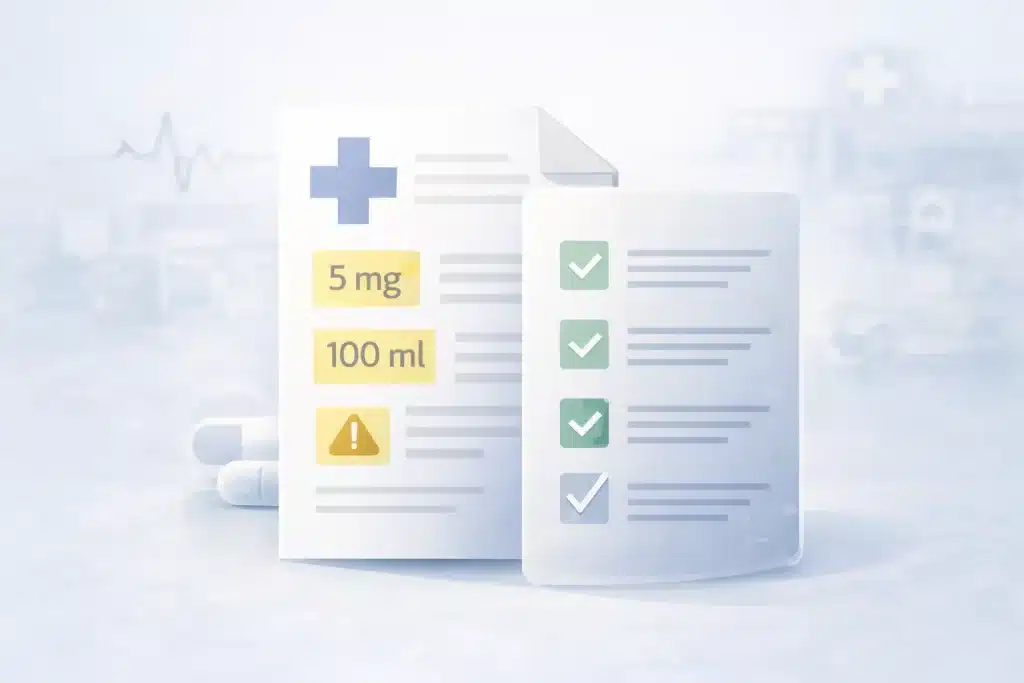
Accuracy in medical document translation means terminology precision, consistency throughout the document, correct numerical expressions for dosages and measurements, and no loss of clinical meaning. Unlike other content where minor variations are acceptable, medical translation errors can compromise patient safety or regulatory compliance.
Medical translation accuracy checklist:
| Checklist Item | What to Verify | Why It Matters |
| Terminology Precision | Medical terms, diagnoses, procedures, and anatomical references follow standardized clinical language in the target language. | Prevents clinical misunderstanding and protects patient safety. |
| Abbreviations & Acronyms | Clinical abbreviations (e.g., CABG, MI, COPD) are correctly interpreted and adapted to local medical conventions. | Avoids misinterpretation in treatment or documentation. |
| Numbers & Units | Dosages, lab values, measurements, and vital signs are accurately converted and clearly presented. | Incorrect numbers can lead to dosage errors and serious harm. |
| Drug & Device Names | Pharmaceutical names follow local rules (generic vs brand names, INN vs local nomenclature). | Ensures regulatory acceptance and correct medication usage. |
| Contraindications & Warnings | Safety information is complete, clearly highlighted, and preserves all risk details. | Reduces liability and protects patient outcomes. |
| Dates & Timeframes | Treatment dates, medication schedules, and follow-up timelines use correct local formatting. | Prevents confusion in treatment continuity and compliance. |
| Clinical Context Preservation | Diagnostic reasoning, treatment rationale, and patient history connections remain intact. | Maintains medical accuracy and supports proper clinical decisions. |
Professional medical translation services use qualified linguists with healthcare backgrounds, implement review processes, and maintain terminology databases to achieve these accuracy standards consistently.
Terminology Control: Abbreviations, Acronyms, and Drug/Device Terms
Medical terminology are not like some other content’s terms. It challenges translation because healthcare uses thousands of specialized terms, abbreviations, and conventions that vary between languages and regions.
Common terminology challenges:
Clinical abbreviations — terms like CABG (coronary artery bypass graft), MI (myocardial infarction), or BP (blood pressure) are standard in English but may have different abbreviations or require full spelling in other languages. Medical translators need domain expertise to correctly interpret these abbreviations before translating.
Drug names — medications have multiple naming conventions (brand names, generic names, International Nonproprietary Names). A prescription listing “Tylenol” in English might need translation to “paracetamol” or local brand equivalents depending on the target market. Don’t directly translate drug names—verify local conventions and approved nomenclature.
Device terminology — medical devices often have technical names that must align with regulatory classifications. An “infusion pump” has specific regulatory definitions that affect how it’s described in different markets.
Lab values and reference ranges — laboratory results include measurements (mg/dL vs mmol/L), normal ranges, and diagnostic codes. Translators shouldn’t convert units or interpret ranges without clinical context—preserve the source values and add clarifying notes if needed for the target audience.
Anatomical terms — body parts, organs, and systems have standardized medical Latin terminology that forms the basis for many languages, but usage varies. Professional translators use medical dictionaries and anatomical references specific to the target language.
Practical terminology guidance:
It’s not always easy to maintain or remember all medical terms for a translator. But there is a guide. By using or following this guide a professional translator can ease this issue. Let’s learn about this guide.
Maintain termbases — create glossaries of your organization’s preferred terms, approved translations, and prohibited variations. This ensures “informed consent” always translates consistently across all your clinical trial documents.
Verify drug databases — check local pharmaceutical references for correct drug names and formulations before finalizing translations of prescriptions or medication lists.
Preserve coding systems — don’t translate ICD codes, CPT codes, LOINC identifiers, or other standardized medical coding. These remain unchanged across languages to maintain data integrity.
Medical translators with healthcare backgrounds recognize these terminology patterns and apply appropriate conventions based on document type and intended use.
Standard medical translation workflow
Professional medical document translation uses a multi-step review process to catch errors and ensure clinical accuracy before delivery. This workflow mirrors quality standards like ISO 17100 that establish minimum requirements for translation services.
Step 1: Initial translation — a medical translator with healthcare background and language expertise translates the source document, applying approved terminology and maintaining clinical meaning.
Step 2: Revision — a second medical linguist reviews the translation against the source, checking for accuracy, completeness, terminology consistency, and appropriate register (formal clinical language vs patient-friendly wording).
Step 3: Medical QA checks — quality reviewers verify specific elements that impact patient safety and regulatory compliance:
- Numbers and units (dosages, lab values, measurements)
- Medication names and administration instructions
- Contraindications and warnings
- Clinical terminology consistency
- Formatting and document structure
- Cross-references and appendices
Step 4: Final delivery — reviewed translations undergo formatting checks, version control documentation, and secure delivery to the client.
For regulated documents like clinical trial materials or regulatory submissions, this process includes additional audit trail documentation: translator qualifications, review records, terminology sources used, and quality checkpoints completed. This version control supports regulatory inspections and demonstrates translation quality management.
The review model adds time compared to single-translator workflows, but it’s essential for medical content where accuracy directly affects patient safety, clinical decisions, and regulatory compliance.
Certified vs Non-Certified Medical Translations: What Changes?
Certified translation means the translation includes a signed certification letter from the translator or translation company attesting to the accuracy and completeness of the work. This certification makes the translation acceptable for official purposes like regulatory submissions, insurance claims, legal proceedings, or credentialing.
What certification adds:
Signed statement — the translator or agency signs a declaration confirming the translation is complete and accurate to the best of their knowledge and ability.
Translator credentials — the certification typically includes the translator’s name, qualifications, and contact information, providing accountability.
Official acceptance — courts, government agencies, insurers, and licensing boards often require certified translations as proof of authenticity.
Document integrity — certified translations usually include page-by-page formatting that mirrors the original, sometimes with stamps or seals on each page.
When you need certified medical document translation services:
In the below scenario you need a professional medical document translator.
Medical records for insurance — insurers reviewing claims for care received abroad often require certified medical record translation to verify diagnoses and treatments.
Credentialing and licensing — healthcare professionals seeking licensure in a new country must submit certified translations of their medical education, training certificates, and work history.
Immigration medical examinations — visa and immigration processes require certified translations of vaccination records, health examinations, and medical histories.
Legal proceedings — medical-legal cases need certified translations of medical records, expert reports, and treatment documentation for court admissibility.
Disability claims — government disability programs often require certified translation of medical evidence supporting disability determinations.
Workers’ compensation — cross-border employment injuries may require certified translation of medical reports, treatment plans, and return-to-work assessments.
Standard (non-certified) medical translations work for:
Internal clinical use — when healthcare providers need to understand a patient’s foreign medical records for treatment decisions but won’t submit them to external authorities.
Research and analysis — clinical researchers reviewing international literature or aggregating global health data.
Patient education — translating aftercare instructions or health information for patient understanding doesn’t require certification.
Preliminary review — getting a standard translation first to determine if formal certification is worth the additional cost.
The main difference is official acceptance, not necessarily translation quality. Both certified and standard medical translations should use qualified medical translators and review processes. Certification adds documentation and attestation for official purposes.
How Medical Translation Handles PHI
Medical documents often contain Protected Health Information (PHI), such as patient names, medical record numbers, diagnoses, treatments, and other sensitive data. Translation providers handling medical documents must implement security controls to protect patient privacy and meet healthcare confidentiality expectations.
Key security concerns in medical translation:
Data breaches — unauthorized access to patient information can lead to identity theft, discrimination, or privacy violations.
Unauthorized disclosure — sharing patient data with translators, reviewers, or systems without proper safeguards violates privacy regulations and patient trust.
Data retention — keeping patient information longer than needed increases exposure risk.
Cross-border transfers — sending PHI to translators in other countries may conflict with data protection laws unless proper safeguards exist.
Professional medical document translation services address these risks through secure workflows, access controls, confidentiality agreements, and privacy-aligned handling procedures.
HIPAA and Healthcare Privacy Expectations (US-Focused)
The Health Insurance Portability and Accountability Act (HIPAA) sets privacy and security standards for handling patient health information in the United States. While HIPAA technically applies to covered entities (healthcare providers, insurers, clearinghouses) and their business associates, healthcare organizations expect translation providers to support HIPAA-aligned workflows.
What HIPAA-aligned medical translation means:
Business Associate Agreements (BAA) — translation providers working with HIPAA-covered entities often sign BAAs committing to safeguard PHI according to HIPAA standards.
Minimum necessary access — translators and reviewers see only the patient information required to complete the translation, not broader medical record access.
Secure transmission — PHI moves between client and translator using encrypted channels, not standard email.
Access controls — translation systems limit who can view patient data, with role-based permissions and audit logging.
Breach notification — if patient data is accessed without authorization, the provider has procedures to investigate and notify affected parties.
Retention limits — translated documents containing PHI are stored only as long as needed for quality assurance, then securely deleted according to retention policies.
Staff training — translators and project managers receive privacy training covering patient confidentiality, proper PHI handling, and security incident reporting.
Many medical translation providers reference HIPAA compliance in their marketing, but the actual controls vary. When evaluating providers, ask specifically about their BAA availability, encryption methods, access controls, and audit capabilities to ensure they can support your HIPAA obligations.
Secure Translation Workflow (Access Control, Audit Trail, Retention)
A secure medical translation workflow protects patient information through the entire translation lifecycle, from initial file upload to final delivery and eventual deletion.
Step 1: Secure intake — clients upload medical documents through encrypted portals, not email attachments. The portal uses TLS encryption (HTTPS) and may require multi-factor authentication (MFA) for access.
Step 2: Role-based access — only assigned translators, reviewers, and project managers can access specific documents. Technical staff can’t view file contents; translators can’t access unassigned projects.
Step 3: Translator assignment — translators and reviewers sign confidentiality agreements (NDAs) before accessing any client files. Many providers maintain pools of security-cleared translators specifically for medical work.
Step 4: Encrypted storage — documents are stored with encryption both at rest (on servers) and in transit (during transfer). Access requires authentication and is logged in audit trails.
Step 5: Translation and review — translators work in secure environments, often using cloud-based translation platforms with built-in access controls rather than downloading files to personal computers.
Step 6: Secure delivery — completed translations return to clients via the same encrypted portal used for upload, or through secure file transfer protocols. Sensitive translations aren’t sent via standard email.
Step 7: Retention and deletion — files are retained for a defined period (often 30-90 days for quality assurance), then permanently deleted according to the provider’s retention policy. Clients can request immediate deletion after delivery.
These controls work together to protect patient privacy while enabling professional medical translation. When choosing a provider, confirm they can document their security practices and provide evidence of proper safeguards.
Common Language Pairs and Use Cases (Spanish, Arabic, Hindi, Urdu)
Medical translation demands vary by region, patient demographics, and healthcare setting. Certain language pairs see high volume due to immigration patterns, medical tourism, international clinical trials, and cross-border care.
Medical translation demand varies by region, immigration patterns, clinical research activity, and cross-border healthcare. High-volume language pairs such as Spanish–English, Arabic, Hindi, and Urdu are common in cross-border care, immigration and insurance documentation, international clinical trials, telehealth, occupational health, and medical tourism.
Spanish to English translation is especially frequent in North America and requires careful handling of abbreviation differences (e.g., “TA” vs “BP”), medication name variations (e.g., Novalgina/metamizole differences), diagnostic phrasing structure, lab units, and date formatting (DD/MM/YYYY vs MM/DD/YYYY).
Arabic, Hindi, and Urdu medical report translation presents additional complexities such as right-to-left formatting (Arabic/Urdu), Devanagari script handling (Hindi), transliteration of technical terms, English medical loanwords, and regional terminology variation.
In all cases, translators must adapt formatting, preserve clinical context, maintain unit accuracy, and adjust language style depending on whether the material is patient-facing or clinician-facing, ensuring clarity, safety, and regulatory alignment across healthcare systems.
Which Medical Documents Need Translation for Regulators, Insurers, or Legal Use?
Certain medical documents require translation for official purposes where accuracy, completeness, and certification affect legal acceptance, payment approval, or regulatory compliance.
Who requests medical document translations:
Insurers — health insurance companies reviewing claims for care received in another country or provided in a foreign language.
Hospital administrators — credentialing committees verifying foreign medical degrees, training certificates, and work experience for provider licensing.
Regulators — FDA, EMA, and other health authorities requiring translated documentation for product approvals, safety reporting, or compliance investigations.
Attorneys — legal counsel preparing medical evidence for personal injury cases, malpractice claims, or workers’ compensation disputes.
Immigration authorities — government agencies processing visa applications, refugee status determinations, or citizenship petitions that include health-related requirements.
Licensing boards — professional boards evaluating foreign-trained healthcare workers for practice authorization.
Employers — HR and occupational health departments reviewing fitness-for-duty evaluations or return-to-work clearances for international employees.
Medical Regulatory Documents Translation (Device/Pharma)
Pharmaceutical companies and medical device manufacturers need medical regulatory documents translation to obtain market authorization, maintain compliance, and communicate safety information across global markets.
Common regulatory translation requirements:
Medical device labeling — Instructions for Use (IFUs), quick reference guides, and on-device labels must be translated according to local regulatory requirements. Many markets require regulatory approval of translations before commercial use.
Pharmaceutical labeling — package inserts, patient information leaflets, and outer packaging text need translation that meets local pharmaceutical regulations for content, format, and readability.
Safety information — adverse event reports, field safety notices, and recall communications require fast, accurate translation to meet regulatory reporting deadlines and protect patient safety.
Submission modules — regulatory dossiers for drug and device approvals contain clinical data, manufacturing information, and safety profiles. These multi-thousand-page submissions need consistent terminology across all translated sections.
Clinical evidence summaries — clinical evaluation reports, literature reviews, and post-market surveillance analyses support regulatory decision-making and require precise translation of medical and scientific content.
Medical regulatory documents translation demands specialized expertise because regulatory agencies scrutinize translations during product reviews. Terminology inconsistencies, formatting errors, or scientific inaccuracies can trigger regulatory questions, delay approvals, or even cause rejection of submissions.
Pharmaceutical and medical device companies typically work with translation providers who have regulatory experience, maintain quality management systems, and can demonstrate compliance with industry standards like ISO 17100. This quality infrastructure provides confidence that translations meet regulatory expectations.
How to Choose a Medical Document Translation Provider
Selecting a medical translation provider affects translation quality, security, turnaround time, and cost. Use these criteria to evaluate providers and find the right match for your needs.
Provider evaluation scorecard:
| Criteria | Why It Matters | What to Verify |
| Medical linguist qualifications | Medical terminology knowledge and healthcare context understanding | Ask about translator backgrounds, medical training, and subject-matter expertise |
| QA model | Multi-step review catches errors before delivery | Confirm use of translator + reviser + medical QA checks |
| Secure handling | PHI protection and privacy compliance | Verify encryption, access controls, NDAs, and BAA availability |
| Capacity and turnaround | Meeting your volume and timeline needs | Ask about translator pools, rush capabilities, and batch processing |
| Certification options | Official acceptance for regulatory/legal use | Confirm certification format and whether it meets your requirements |
| Terminology management | Consistency across projects | Check for termbase creation, glossary usage, and term approval processes |
| Industry experience | Understanding regulatory context and document types | Ask about pharma/medtech experience, clinical trial work, and regulatory translation |
| Technology platform | Efficiency and security of translation tools | Understand whether they use CAT tools, secure portals, and audit trail capabilities |
Different providers excel in different areas. A provider perfect for clinical trial translation might not be the best choice for patient-facing materials. Match provider strengths to your specific requirements.
Get a Quote for Medical Document Translation (Secure Upload)
Ready to translate medical documents with accuracy, security, and compliance? Circle Translations provides medical document translation services for healthcare providers, pharmaceutical companies, medical device manufacturers, clinical research organizations, and insurers worldwide.
Next steps for your medical translation project:
Upload your files securely — use our encrypted portal to submit medical documents for review. Your files are protected with end-to-end encryption and accessed only by assigned translators.
Specify your requirements:
- Source and target language pairs
- Document type and medical specialty
- Certification needed (yes/no)
- Intended use (clinical, regulatory, legal, patient care)
- Deadline and urgency
- Any terminology preferences or glossaries
Choose your service level:
- Standard translation (translator + reviser + QA)
- Certified translation (includes certification letter for official use)
- Rush service (expedited assignment and delivery)
Receive your translation:
- Professional medical linguists translate your documents
- Multi-step review ensures accuracy
- Secure delivery via encrypted portal
- Certification included if requested
What to Send for an Accurate Estimate
Help us provide precise quotes and realistic timelines by including this information with your request:
Document details:
□ Source file format (PDF, DOCX, scanned image, handwritten)
□ Page count or word count estimate
□ Target language(s) for translation
□ Document type (medical record, prescription, consent form, clinical trial protocol, regulatory submission, device IFU, etc.)
□ Medical specialty (cardiology, oncology, surgery, general practice, etc.)
Project requirements:
□ Certification needed (yes/no)
□ Deadline or preferred delivery date
□ Intended use (insurance claim, court filing, provider review, regulatory submission, patient understanding)
□ Any existing glossaries or terminology preferences
□ Volume of ongoing work (one-time vs recurring needs)
Providing complete information upfront helps us match your project to appropriate medical translators, estimate accurate turnaround times, and offer transparent pricing.
Two ways to start:
Upload files — Submit documents through our secure portal for review and quote Talk to a project manager — Discuss your medical translation needs, volume requirements, and quality expectations
Professional medical translation protects patient safety, ensures regulatory compliance, and enables effective healthcare communication across language barriers. Let Circle Translations handle your medical document translation with the accuracy, security, and expertise your organization requires.
Frequently Asked Question
What is the Difference Between Medical Translation and Healthcare Interpreting?
Medical translation focuses on written content like records, reports, consent forms, and regulatory documents. Healthcare interpreting handles spoken communication during medical appointments, either in-person, by phone, or via video. Both are part of comprehensive healthcare language services, but they require different skills. Translators work with text and have time for research and review, while interpreters provide real-time spoken language conversion.
Can I Use Google Translate to Translate Medical Records?
Yes, but for low-risk personal understanding, Google Translate might help you get the general idea of a medical document. But for clinical use, insurance claims, legal proceedings, or regulatory submissions, professional medical translators are essential.
When Do I Need Certified Medical Document Translation Services?
You need certified translations when medical documents are used for official purposes: insurance claims for care received abroad, medical licensing and credentialing, immigration medical examinations, legal proceedings, disability claims, or workers’ compensation. Certification includes a signed letter from the translator or agency attesting to translation accuracy and completeness, which authorities require for document acceptance.
Are Medical Translation Services HIPAA Compliant?
Many professional medical translation providers support HIPAA-aligned handling of Protected Health Information using secure workflows, business associate agreements, encryption, access controls, and audit trails. When evaluating providers, ask specifically about their BAA availability, security measures, and privacy procedures to ensure they can meet your HIPAA obligations.
What Medical Documents Are Most Often Translated?
The most common medical documents for translation include patient medical records and health histories, prescriptions and doctor’s notes, informed consent forms for procedures and clinical trials, clinical trial protocols and case report forms, regulatory submissions for drug and device approvals, and medical device instructions and labeling.
How Do You Translate Doctor’s Notes and Handwritten Records?
Sometimes yes. Professional medical translators preserve the original layout, mark unclear or illegible handwriting, maintain clinical abbreviation consistency based on context, and route documents through medical reviewers when terminology impacts care decisions. For official use requiring certification, the translator notes any ambiguous sections and provides best-effort interpretations based on clinical context. Handwritten medical records are among the most challenging documents to translate due to legibility issues.
Do You Translate Clinical Trial Protocols and Informed Consent Forms?
Yes. Clinical trial translation is a core category of medical document translation services. This includes study protocols, informed consent forms, case report forms, patient-facing materials, investigational product labels, and safety reporting documents.