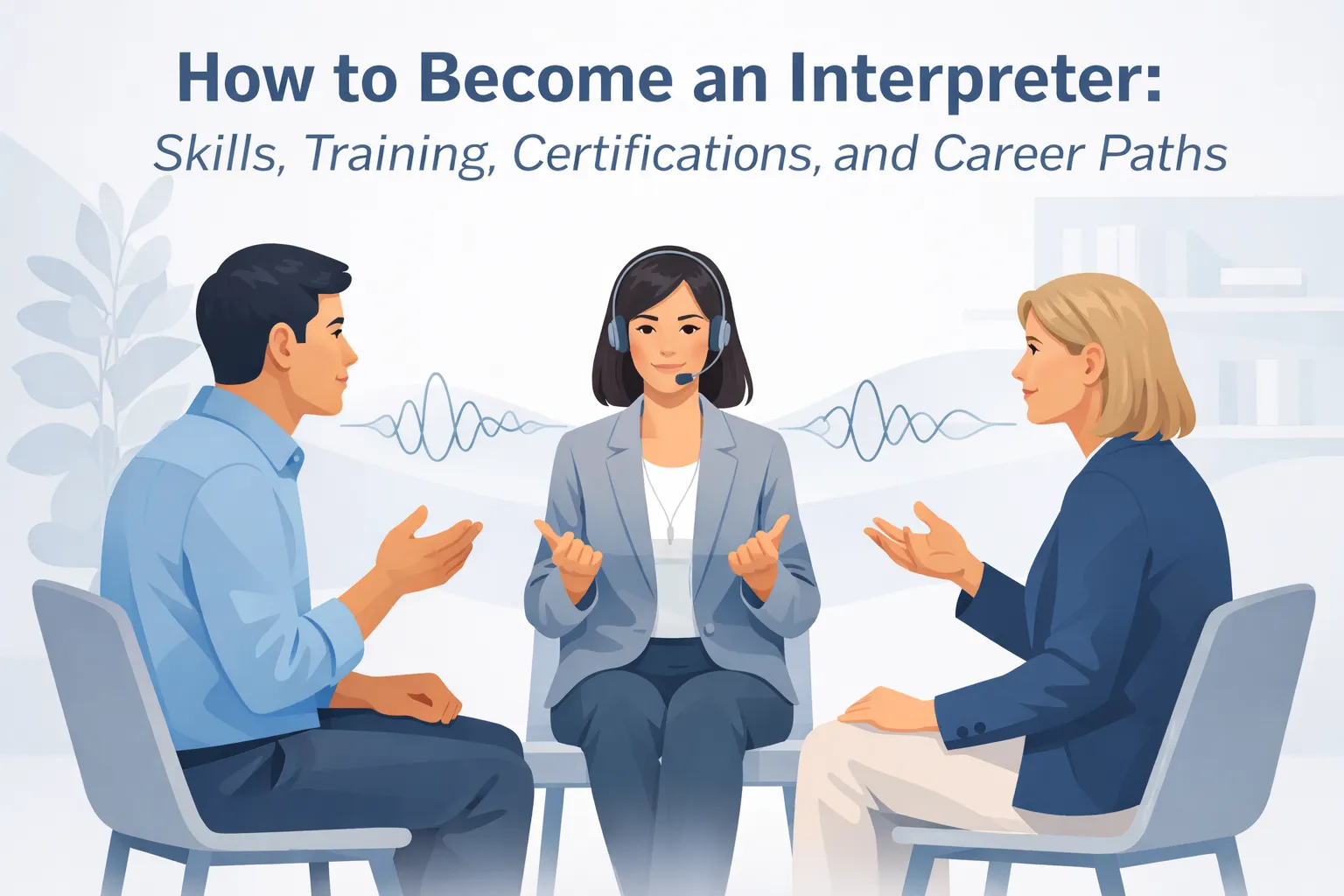
Most of us think an interpreter and a translator are the same person. But that is not true. An interpreter converts spoken communication from one language to another in real time, enabling people who speak different languages to understand each other during conversations, meetings, medical appointments, court proceedings, and conferences. If anyone wants to be an interpreter, it requires bilingual fluency, specialized training, professional certification, and strong ethical judgment to accurately convey meaning without adding, omitting, or altering information.
This career path offers opportunities across healthcare, legal systems, government agencies, international conferences, and community services. The US Bureau of Labor Statistics projects steady demand for interpreters, particularly in medical and legal settings where language access is both a practical necessity and a legal requirement.
Here, we try to cover the skills, education, certifications, and career paths you need to become a professional interpreter.
What Does an Interpreter Do? (Roles vs Translators)
Interpreters do real-time spoken communication between people who speak different languages. They listen to speech in one language (the source language) and immediately convey the meaning in another language (the target language), enabling conversations to flow naturally despite language barriers.
Key interpreting methods:
Consecutive interpreting — the speaker pauses after each thought or sentence, allowing the interpreter to render the message in the target language. This is very common in medical appointments, business meetings, and small group settings.
Simultaneous interpreting — the interpreter speaks at nearly the same time as the source speaker, with only a few seconds’ delay. This method is mainly used in conferences, courtrooms, and large events, often with specialized equipment like headsets and soundproof booths.
Sight translation — the interpreter reads a written document in one language and immediately speaks the content aloud in another language. Frequently used in legal and medical settings when documents need quick oral translation.
How interpreters differ from translators:
People always misunderstand the difference between interpreters and translators. Interpreters work with spoken language in real time. This requires immediate processing and delivery without time for research or revision. Translators work with written text and have time to research terminology, refine phrasing, and review their work before delivery.
The skills overlap—both need excellent language proficiency and cultural knowledge. But interpreting demands quick thinking, strong memory, and composure under pressure, while translation emphasizes precision, research ability, and writing quality.
Common interpreter work environments:
There are some specific areas and environments where an interpreter mostly works.
Courts and legal proceedings — interpreting for defendants, witnesses, and attorneys during trials, depositions, and legal consultations.
Hospitals and medical facilities — enabling communication between healthcare providers and patients who speak different languages.
Government agencies — supporting immigration interviews, consular services, law enforcement interactions, and public benefit programs.
Conferences and international meetings — providing simultaneous interpretation for business conventions, diplomatic summits, and academic conferences.
Community organizations — helping schools, social services, and non-profit agencies serve diverse populations.
Types of Interpreting
Not every interpretation is good for every industry. There are some distinct differences based on their expertise. Different interpreting specializations require distinct training, certifications, and skill sets. Understanding these categories helps you choose the right career path based on your interests and language pairs.
Medical and healthcare interpreting — facilitating communication between healthcare providers and patients in hospitals, clinics, and telehealth settings. Medical interpreters must understand anatomy, diagnoses, treatments, and medical ethics while maintaining patient confidentiality.
Court and legal interpreting — providing interpretation during legal proceedings, including trials, hearings, depositions, and attorney-client meetings. Court interpreters need extensive legal vocabulary and must maintain absolute accuracy since errors can affect case outcomes.
Sign language interpreting (ASL) — converting between spoken English and American Sign Language for Deaf and hard-of-hearing individuals. ASL interpreters work in education, healthcare, legal settings, performances, and community events.
Conference interpreting — simultaneous interpretation for large events, international summits, business meetings, and diplomatic gatherings. This advanced specialization typically requires years of training and experience.
Community interpreting — general interpretation for government agencies, schools, social services, immigration offices, and community organizations. Entry-level interpreters often start in community settings before specializing.
Each type has different certification bodies and training requirements. Medical interpreters might pursue CCHI or NBCMI certification, court interpreters take state or federal exams, ASL interpreters work toward RID credentials, and conference interpreters often need graduate-level training.
What Skills Do You Need to Become an Interpreter?
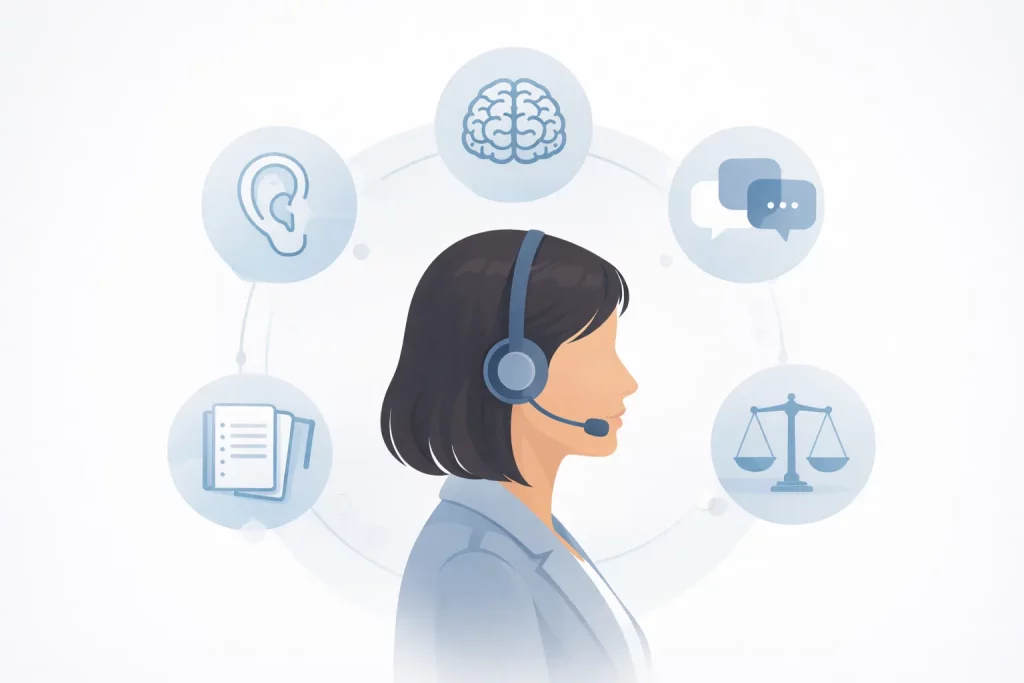
Every profession needs special education and certification. An interpreter also needs to educate himself and study to achieve professional certificates. Professional interpreting needs a combination of linguistic ability, cognitive skills, and ethical judgment. These competencies separate qualified interpreters from simply bilingual individuals.
Bilingual fluency — near-native proficiency in at least two languages, including advanced vocabulary, idiomatic expressions, regional variations, and cultural references.
Active listening — ability to focus intensely on speakers, catch nuances, understand accents, and process meaning while filtering out background noise.
Memory retention — holding complete thoughts, numbers, names, and complex information in short-term memory while interpreting, especially for consecutive interpreting.
Note-taking — using symbols, abbreviations, and structured notation to capture key information during longer consecutive interpreting segments.
Cultural competence — understanding how culture affects communication, recognizing culturally-specific references, and adapting interpretation to cultural context.
Ethical judgment — maintaining confidentiality, impartiality, accuracy, and professional boundaries in sensitive situations.
Composure under pressure — staying calm and accurate during emotionally charged situations, fast-paced exchanges, or when handling difficult subject matter.
Professional presence — presenting yourself appropriately, managing interpreter positioning, and understanding your role in different settings.
All these skills are developed through training and practice. Natural bilingualism provides the foundation, but professional interpreting requires deliberate skill development through formal education. So if you want to be a professional interpreter, learn these skills and practice them.
Language Proficiency and Fluency Requirements
Conversational bilingualism isn’t sufficient for professional interpreting. The work demands what’s called “professional-level fluency” in both working languages. The ability to understand and express complex ideas, specialized vocabulary, formal and informal registers, and cultural nuances.
What professional fluency means:
Comprehensive vocabulary across multiple domains (medical, legal, technical, social). Understanding of idioms, colloquialisms, and cultural references in both languages. Ability to switch registers from formal to casual depending on context. Strong command of grammar, syntax, and pronunciation in both languages. Familiarity with regional variations and accents
How to become a bilingual interpreter:
If you learned both languages growing up (heritage bilingual), you have an advantage, but still need formal training to develop interpreting techniques and specialized vocabulary.
If you learned your second language later, aim for near-native proficiency through immersion, advanced study, and extensive practice before pursuing interpreter training.
Most certification exams test language proficiency separately from interpreting skills. You’ll need to demonstrate a strong command of both languages before you’re evaluated on interpretation ability.
Don’t assume bilingualism automatically qualifies you to interpret. Professional interpreters study their languages continuously, expanding vocabulary and staying current with evolving usage in both cultures.
Cognitive, Ethical, and Professional Skills
Beyond language proficiency, interpreting demands specific cognitive abilities and ethical commitments that protect the people you serve.
Critical cognitive skills:
Simultaneous processing — listening to one language while speaking in another, managing dual cognitive streams without losing accuracy.
Quick decision-making — choosing the best equivalent when exact translations don’t exist, making split-second terminology decisions under pressure.
Concentration stamina — maintaining focus for extended periods without mental fatigue affecting accuracy.
Information management — prioritizing key content, recognizing when to ask for clarification, and knowing what details matter most.
Essential ethical principles:
Accuracy — conveying the complete message without adding, omitting, or changing meaning. You’re the communication conduit, not an editor or advisor.
Confidentiality — protecting sensitive information heard during interpreting assignments. This is especially critical in medical and legal settings.
Impartiality — remaining neutral and not letting personal opinions influence interpretation. You interpret for all parties equally, regardless of your sympathies.
Professional boundaries — understanding your role limits. Interpreters don’t give advice, make decisions for clients, or act as advocates.
Continuing competence — pursuing ongoing education, practicing languages regularly, and staying current with terminology in your specialization.
These ethical standards appear in professional codes of conduct for medical interpreters (NCIHC National Standards), court interpreters (NAJIT Code), and sign language interpreters (RID Code). Violating these principles can result in lost credentials, legal liability, or harm to the people you serve.
What Education or Training is Required to Become an Interpreter?
Most professional interpreters complete formal training programs rather than relying solely on native bilingualism. While degree requirements vary by specialization, structured interpreter training is nearly universal across the field.
Here you can find some typical pathways:
Certificate programs (3–12 months) — focused interpreter training covering techniques, ethics, note-taking, and specialty vocabulary. Offered by community colleges, professional institutes, and continuing education programs.
Associate degrees (2 years) — combine interpreter training with general education, often including practicum hours and preparation for certification exams.
Bachelor’s degrees (4 years) — not always required, but helpful for conference interpreting, government positions, or career advancement. Common majors include languages, linguistics, or international studies.
Graduate degrees (2+ years) — master’s programs in interpretation and translation, primarily for conference interpreters or those seeking university-level positions.
Training matters more than degrees for most interpreting paths. A certificate holder with strong skills and certification often has better job prospects than a bachelor’s degree holder without specialized interpreter training.
Interpreter Training Programs and Certificates
Accredited training programs teach the specific techniques, ethics, and skills that separate professional interpreters from bilingual amateurs.
What quality interpreter training covers:
- Interpreting modes and techniques (consecutive, simultaneous, sight translation)
- Memory development and note-taking systems
- Ethical standards and professional conduct
- Role boundaries and positioning
- Accuracy self-monitoring and error correction
- Specialized vocabulary (medical, legal, or other fields)
- Cultural mediation and context management
- Practice hours with feedback and evaluation
Program types and providers:
Not every program will give you the same type of curriculum. Different program has their different specialities:
Community colleges offer affordable certificate programs, often including medical or court interpreter specializations with evening and weekend options for working students.
Universities provide degree programs with comprehensive training, particularly for conference interpreting or ASL interpretation.
Professional institutes deliver intensive training for specific specializations, sometimes taught by working interpreters with real-world experience.
Online programs (hybrid models) — many interpreter training programs now offer online coursework combined with in-person practicum hours and evaluation.
How to become an interpreter online:
Today’s era of online work culture is very common in every industry. If you want to be an online interpreter then look for accredited programs offering remote instruction, but understand that interpreting practice requires real-time evaluation. Quality online programs include live virtual practice sessions, recorded performance reviews, and in-person or supervised practicum requirements.
Fully online self-study courses can supplement training but rarely provide sufficient preparation for certification exams or professional work. Interpreting is a performance skill that requires supervised practice and expert feedback.
Degree vs Non-Degree Career Path
| Career Path | Education Required | Why It Matters | Time Investment | Best For |
| Conference Interpreting | Master’s degree in interpretation (required/preferred) | International organizations and diplomatic settings expect advanced academic training in simultaneous interpretation | 5-7 years (bachelor’s + master’s) | Advanced specialization, international organizations, high-level diplomatic work |
| Government Positions | Bachelor’s degree (sometimes required) | Competitive federal roles use degrees as screening criteria | 4+ years | Federal interpreting positions, career stability, government benefits |
| Academic/Teaching Roles | Graduate degree (typically required) | Teaching interpreter training or university programs requires advanced credentials | 6+ years (bachelor’s + master’s/PhD) | Teaching, curriculum development, academic research |
| Medical Interpreting | Certification (CCHI or NBCMI) – degree NOT required | Hospitals prioritize verified competence; certified interpreter with high school diploma beats uncertified bachelor’s holder | 6-18 months (training + certification) | Healthcare settings, patient communication, HIPAA-compliant work |
| Court Interpreting | State/federal certification exam – degree NOT required | Courts require exam passage regardless of education; demonstrates legal interpreting competence | 2-3 years (training + exam prep) | Legal proceedings, courtroom work, high accuracy requirements |
| Community Interpreting | Certification + language proficiency – degree NOT required | Agencies value practical skills and credentials over formal degrees | 6-12 months (training + proficiency testing) | Entry-level positions, diverse settings, building experience |
| Freelance Interpreting | Professional credentials and references – degree NOT required | Clients hire based on verified skills and recommendations, not educational background | Varies (depends on specialization) | Flexible schedule, independent work, client diversity |
| Career Flexibility | Degree in linguistics, languages, or cultural studies (recommended) | Provides backup career options and professional credibility beyond interpreting | 4 years (bachelor’s) | Multiple career options, academic credibility, and career pivoting |
The most practical path for many aspiring interpreters: complete focused interpreter training, pursue relevant certification, and consider degree programs if your specialization or career advancement requires them.
How Do You Get Interpreter Certification?
Interpreter certification resembles one’s verified competence through standardized testing of language proficiency, interpreting skills, and ethical knowledge. Certification improves employability, commands higher pay rates, meets compliance requirements, and signals professional credibility to clients.
Why certification matters:
Employment requirements — many healthcare systems, courts, and government agencies require or strongly prefer certified interpreters.
Legal compliance — some jurisdictions mandate certification for interpreters in medical or legal settings.
Quality assurance — certification provides objective verification of skills beyond self-reported fluency.
Professional recognition — credentials from respected certifying bodies establish you as a qualified professional.
Competitive advantage — certification differentiates you from uncertified bilingual individuals in the job market.
Higher compensation — certified interpreters typically earn 15-30% more than their non-certified counterparts.
General certification process:
Complete approved interpreter training (varies by certifying body). Document language proficiency through testing or evaluation. Pass written exam on ethics, standards, and professional practice. Pass oral performance exam,m demonstrating interpreting skills. Maintain certification through continuing education requirements
Different specializations have different certifying organizations and processes. Let’s look at the major certification paths.
Medical Interpreter Certification (CCHI, NBCMI)
Medical interpreters are a very special type. They help patients and healthcare providers communicate during appointments, procedures, hospitalizations, and treatment decisions. Certification demonstrates competence in medical terminology, healthcare ethics, and accurate interpretation in clinical settings.
How to become a medical interpreter
Step 1: Build language proficiency — achieve professional-level fluency in English and your target language, including medical vocabulary and healthcare contexts.
Step 2: Complete medical interpreter training — most certification bodies require 40-60 hours of approved medical interpreter training covering healthcare terminology, ethics, HIPAA, cultural competence, and interpreting techniques.
Step 3: Gain practical experience — many programs require supervised practice hours in healthcare settings before certification eligibility.
Step 4: Pass certification exam — demonstrate skills through written and oral testing.
Major medical interpreter certifications:
If you want to become a medical interpreter, below certification help you to achieve your dream.
CCHI (Certification Commission for Healthcare Interpreters) — offers the CHI™ (Certified Healthcare Interpreter) credential for multiple languages. Requirements include 40 hours of training, language proficiency testing, written exam on healthcare interpreting knowledge, and oral exam demonstrating interpreting performance.
NBCMI (National Board of Certification for Medical Interpreters) — provides the CMI (Certified Medical Interpreter) credential for Spanish and Arabic. Similar requirements with emphasis on consecutive interpreting skills and medical terminology mastery.
How to get medical interpreter certification:
Apply to your chosen certifying body (CCHI or NBCMI) Submit proof of training completion Pass language proficiency screening Schedule and pass written ethics/knowledge exam Schedule and pass oral performance exam Maintain certification through continuing education (typically 30 hours every 3-5 years)
Spanish medical interpreters often have the most certification options since Spanish is the most common non-English language in US healthcare. Other languages may have limited certification availability, but training and skills standards remain consistent.
Court and Legal Interpreter Certification
Court interpreters work in legal proceedings where accuracy is critical to justice and due process. Certification requirements are often mandated by law and vary significantly by jurisdiction.
How to become a court interpreter:
Federal court certification — the Administrative Office of the US Courts offers certification for federal court interpreters in Spanish only. The exam tests consecutive, simultaneous, and sight translation in legal contexts. Requirements include passing written English proficiency test, oral proficiency interview, and three-part interpreting performance exam.
State court certification — most states administer their own court interpreter certification programs with varying requirements and available languages. Some states accept federal certification; others require separate state-specific exams.
Legal interpreter training — before attempting certification, most successful candidates complete legal interpreter training covering courtroom procedures, legal terminology, ethics, and role boundaries. Community colleges and professional organizations offer these programs.
Typical state court interpreter requirements:
Written exam on legal terminology and procedures Oral proficiency interview in both languages Consecutive interpreting test Simultaneous interpreting test Sight translation test (reading legal documents aloud in target language) Ethics and professional responsibility assessment
Challenges in court interpreter certification:
Many states offer certification only for Spanish, with limited options for other languages. Non-certified interpreters in other languages may still work under conditional authorization or as provisionally approved interpreters, but career advancement and pay are limited.
Exams are notoriously difficult, with pass rates sometimes below 10%. Rigorous preparation through training programs and practice is essential.
How to become a certified court interpreter:
Research your state’s certification program requirements Complete legal interpreter training program Practice all three interpreting modes extensively Take and pass your state or federal certification exam Maintain certification through continuing legal education
Some states require licensing in addition to certification. Check your jurisdiction’s requirements before beginning this career path.
Sign Language / ASL Interpreter Certification
ASL interpreters facilitate communication between Deaf or hard-of-hearing individuals and hearing people, working in education, healthcare, legal settings, performing arts, and community events.
How to become an ASL interpreter:
Step 1: Learn American Sign Language — achieve fluency in ASL, which is a complete language with its own grammar, syntax, and cultural conventions distinct from English. This typically requires years of study and immersion in Deaf community contexts.
Step 2: Complete ASL interpreter training program — attend an accredited interpreter preparation program, usually 2-4 years. These programs include extensive supervised practice, Deaf culture education, ethics training, and interpreting theory.
Step 3: Gain supervised experience — build practice hours working alongside experienced interpreters before pursuing certification.
Step 4: Pursue RID certification — the Registry of Interpreters for the Deaf offers the NIC (National Interpreter Certification), which includes written and performance components.
How to get ASL certified:
RID NIC certification:
- Complete approved interpreter education program or demonstrate equivalent training
- Pass NIC Knowledge Exam (written test on interpreting theory, ethics, and standards)
- Pass NIC Performance Exam (video-recorded interpreting performance)
- Maintain certification through professional development and ethics compliance
State licensure — many states require separate licensure for sign language interpreters, particularly those working in educational or legal settings. Requirements vary but often include RID certification plus state-specific exams or approvals.
Important consideration:
The Deaf community has strong cultural standards and expectations for interpreters. Developing cultural competence, respecting Deaf community norms, and building relationships within Deaf communities are essential for ethical ASL interpreting practice.
Government and Community Interpreter Credentials
Government agencies at federal, state, and local levels employ interpreters for immigration services, law enforcement, courts, social services, emergency response, and public benefits programs.
How to become an interpreter for the government:
Federal positions — search USAJobs.gov for interpreter positions. Requirements typically include language proficiency testing through the Interagency Language Roundtable (ILR) scale, background checks, and sometimes security clearances. Degrees may be preferred or required depending on the agency.
State and local government — positions vary widely. Some require certification in specific specializations (court, medical), while others prioritize language proficiency and cultural competence.
Language testing for government roles:
Many government positions use standardized language proficiency tests like the Defense Language Proficiency Test (DLPT) or ILR Oral Proficiency Interview (OPI) to verify fluency levels.
Community interpreter roles often serve as entry points to the field. These positions typically require basic training and demonstrated language proficiency but may not demand certification, making them accessible for new interpreters building experience.
Bilingual interpreter certifications:
While “bilingual interpreter” is sometimes used as a job title for general interpreting roles, professional certification requires specialization. Focus on medical, legal, or conference credentials rather than generic “bilingual interpreter” certificates, which may not be recognized by employers or professional associations.
Do You Need a License to Work as an Interpreter?
Licensing and certification are different requirements. Certification verifies competence through professional testing, while licensing is a legal authorization to practice in regulated settings.
Certification vs licensing:
Certification — voluntary credential from professional associations (CCHI, NBCMI, RID) demonstrating verified skills. Improves employability but isn’t always legally required.
Licensing — state or jurisdiction-specific legal requirement to practice in certain settings. Mandatory in regulated sectors and enforced by law.
When licensing is required:
Court interpreters — many states license court interpreters, requiring certification plus additional state-specific testing or registration.
Sign language interpreters — numerous states mandate licensure for ASL interpreters, particularly in educational and legal settings.
Healthcare interpreters — some states require interpreter certification or credentialing for medical settings, though this is less common than court interpreter licensing.
When certification alone is sufficient:
Freelance interpreting in non-regulated settings Agency-employed interpreters in states without licensing laws Conference interpreting and private sector roles Community interpreting for non-governmental organizations
Interpreter Licensing by Sector and Region
Licensing requirements vary dramatically by location and specialization. This jurisdictional variation means you must research your specific state or country’s regulations.
Examples of licensing variations:
Some states require court interpreter licensure only for Spanish, leaving other languages unregulated.
ASL interpreter licensing exists in states like Texas, Virginia, and Utah, but not in all 50 states.
Healthcare interpreter licensing is rare in the US but exists in some jurisdictions like Washington state for limited modalities.
The lack of universal licensing standards across the US means aspiring interpreters should verify their state’s requirements before pursuing training. What’s mandatory in one state might be voluntary in another.
Job Opportunities for Interpreters
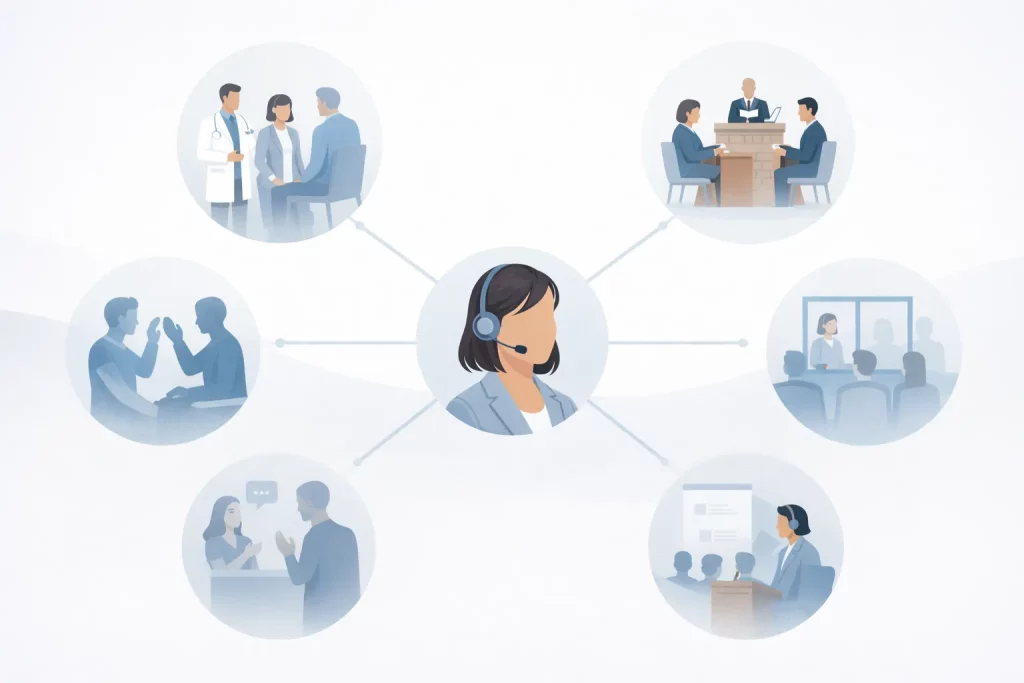
Professional interpreters work in diverse settings with varying employment models, specializations, and career trajectories. Understanding these options helps you plan your career path based on your interests, skills, and lifestyle preferences.
Some of the common employers are Hospitals and healthcare systems (staff or contracted) Courts and legal services School districts and universities Government agencies Translation and interpreting agencies Conference and event services Remote/video interpreting platforms Freelance independent practice.
The Bureau of Labor Statistics projects continued demand for interpreters, particularly in healthcare and legal sectors where language access is both practically necessary and legally mandated. Population diversity, globalization, and language access laws drive steady job growth.
Hospital and Healthcare Interpreter Careers
Healthcare interpreting offers stable employment opportunities as hospitals, clinics, and healthcare systems expand language access services to meet patient needs and regulatory requirements.
How to become a hospital interpreter:
Obtain certification (CCHI or NBCMI preferred) Apply to hospital language services departments Complete healthcare system orientation and credentialing Demonstrate knowledge of medical terminology and HIPAA requirements
On-site vs remote healthcare interpreting:
On-site interpreters work in hospitals and clinics, providing face-to-face interpretation for appointments, procedures, and patient education. These positions offer stable employment, benefits, and regular schedules.
Remote interpreters work via video or phone platforms, providing on-demand interpretation from call centers or home offices. Remote positions offer flexibility but may have variable hours and less employment stability.
Medical Spanish interpreters see particularly high demand due to large Spanish-speaking patient populations across the US. Other high-need languages include Mandarin, Cantonese, Vietnamese, Arabic, and Russian, though availability varies by region.
Healthcare interpreters typically work for hospital language services departments, interpreting agencies that contract with healthcare facilities, or remote interpreting platforms like LanguageLine or AMN Healthcare.
Freelance vs Agency vs In-House Roles
| Aspect | Freelance Interpreters | Agency Interpreters | In-House Interpreters |
| Employment Structure | Work independently, finding own clients and managing business operations | Contract with interpreting agencies that match them with client assignments | Direct employees of hospitals, courts, corporations, or government agencies |
| Income Model | Set own rates and schedules | Earn lower rates than freelancers (agencies take percentage) | Receive stable salaries and benefits |
| Income Stability | Variable income but potentially higher hourly rates | Steady work flow through agency assignments | Predictable salaries and regular paychecks |
| Client Diversity | Work with multiple clients across various settings | Multiple clients arranged through agency | Work primarily for single employer |
| Marketing & Business Responsibilities | Bear full responsibility for marketing, client acquisition, and business development | No marketing responsibilities; agency provides clients | No marketing needed; employed by organization |
| Administrative Burden | Manage own taxes, insurance, billing, scheduling, and continuing education | Benefit from agency infrastructure for billing, scheduling, and insurance | Employer handles payroll, benefits, and administrative tasks |
| Benefits & Perks | No benefits; must secure own health insurance and retirement | Limited or no benefits; some agencies offer minimal coverage | Full benefits package including health insurance, paid time off, retirement |
| Schedule Flexibility | Complete control over schedule and availability | Flexible but dependent on agency assignments | Predictable schedules with set hours |
| Skills Required | Strong business skills beyond interpreting competence | Primarily interpreting skills; minimal business knowledge needed | Interpreting competence plus organizational fit |
| Career Advancement | Income growth through rate increases and client base expansion | Limited advancement; may transition to freelance or in-house | Advancement opportunities within the organization (senior interpreter, supervisor, manager) |
| Qualifications Needed | Certification preferred; strong portfolio and references | Certification often required by agencies | Certification and proven experience typically required |
| Best For | Experienced interpreters seeking autonomy, higher income potential, and variety | New interpreters building experience and portfolio without business burden | Interpreters seeking stability, benefits, and predictable work environment |
| Risk Level | High (income variability, business management risk) | Low to Medium (steady work but lower rates) | Low (stable employment with benefits) |
Many interpreters combine models, maintaining part-time agency work while building freelance client bases or working in-house positions supplemented with freelance assignments.
Conference and Simultaneous Interpreting
Conference interpreting represents the most advanced and specialized interpreting path, requiring extensive training, experience, and often graduate-level education.
How to become a simultaneous interpreter:
Advanced language proficiency — conference interpreters typically work with 2-3 languages at native or near-native levels, often including a third “passive” language they understand but don’t interpret into.
Graduate training — most successful conference interpreters complete master’s programs specifically in conference interpretation, offered by universities in the US and abroad.
Specialized equipment skills — simultaneous interpreting requires working in soundproof booths, using headsets and microphones, and managing simultaneous rendition while listening to source speech.
Topic preparation — conference interpreters receive advanced materials (speeches, presentations, technical documents) to prepare vocabulary and context before assignments.
Team interpretation — simultaneous interpreters work in pairs, alternating every 20-30 minutes to maintain accuracy and avoid mental fatigue.
Conference interpreters work at international summits, United Nations meetings, European Parliament sessions, multinational corporate events, and academic conferences. This career path demands significant investment in education and experience but offers high compensation and intellectually engaging work.
Breaking into conference interpreting requires building specialized subject-matter expertise (international relations, finance, technology), developing extensive networks, and often starting with smaller events before advancing to major international assignments.
How Long Does It Take to Become an Interpreter?
This is a very common question we get . How much time do I need to become an interpreter? Timeline varies significantly based on your starting point, target specialization, and available time for training.
Community interpreters: 6-12 months if you already have strong bilingual proficiency. Complete basic interpreter training, pass proficiency testing, and begin working in entry-level roles.
Medical interpreters: 12-18 months including training program (3-6 months), practical experience building, and certification exam preparation and completion.
Court interpreters: 2-3 years for most candidates. Legal interpreter training takes 6-12 months, but passing extremely difficult certification exams often requires additional study and multiple attempts.
ASL interpreters: 3-5 years including ASL language acquisition, interpreter preparation program (2-4 years), supervised practice, and RID certification completion.
Conference interpreters: 5-7 years or more. Includes advanced language study, bachelor’s degree, master’s program in interpretation (2 years), and several years building experience and specialization.
These timelines assume you begin with strong bilingual skills. If you’re still developing second language proficiency, add years for language learning before interpreter training.
How to Get Your First Job as an Interpreter
Landing your first professional interpreting position requires strategic planning, credential building, and practical experience development.
Steps to employment:
Complete training and certification — finish recognized interpreter training and pursue relevant certification for your specialization. Entry-level employers still prefer or require these credentials.
Build supervised experience — seek internships, volunteer opportunities, or supervised practice hours through your training program. Real-world experience makes you more employable.
Register with agencies — apply to interpreting agencies in your area or nationally. Agency work provides steady assignments and helps new interpreters build portfolios.
Join professional associations — membership in organizations like CHIA (California Healthcare Interpreters Association), NAJIT (National Association of Judiciary Interpreters and Translators), or RID provides networking opportunities and job boards.
Check certification registries — some certifying bodies maintain public directories of certified interpreters that clients use for hiring. Ensure your profile is complete and current.
Network actively — connect with experienced interpreters, attend professional conferences, and engage with the interpreting community in your languages and specialization.
Start broad, then specialize — many successful interpreters begin with community interpreting or general agency work before focusing on specialized areas like medical or legal interpretation.
Pursue continuing education — demonstrate commitment to professional development through workshops, advanced training, and skill enhancement courses.
Building Experience and Credibility
Early career development focuses on skill refinement, reputation building, and professional network expansion.
Mentorship — seek experienced interpreters willing to observe your work, provide feedback, and guide your professional development. Many professional associations offer formal mentorship programs.
Practice hours documentation — track your interpreting hours by setting, mode, and language pair. This documentation supports future advanced certification applications and demonstrates experience to potential clients.
Ethics training — pursue continuing education in professional ethics, conflict resolution, and boundary management. Ethical reputation is essential for long-term career success.
Performance evaluation — request feedback from trainers, supervisors, and experienced colleagues. Use evaluations to identify skill gaps and target improvement areas.
Specialty development — build deep knowledge in specific domains (medical, legal, technical) through subject-matter study and focused practice.
Professional presence — develop your reputation through reliable service, ethical practice, accurate interpretation, and professional conduct. Word-of-mouth recommendations drive much of the interpreting business.
Credibility takes time. Focus on quality work, ethical practice, and continuous improvement rather than rushing to the highest-paying assignments before you’re ready.
Why Professional Interpreting Matters for Organizations
Organizations using qualified interpreters rather than ad-hoc bilingual staff protect themselves legally, improve service quality, and reduce risk.
Critical organizational benefits:
Legal compliance — Title VI of the Civil Rights Act, the Affordable Care Act, and state-level language access laws require meaningful language access in healthcare, courts, and government services. Using certified interpreters demonstrates compliance.
Accuracy and risk reduction — untrained bilingual staff make errors that can lead to misdiagnoses, wrongful convictions, contract disputes, or safety incidents. Professional interpreters minimize these risks.
Patient and client safety — medical interpreting errors have caused serious patient harm. Certified interpreters reduce medical errors and improve health outcomes for limited-English patients.
Legal validity — court proceedings require certified interpreters to ensure due process. Using unqualified interpreters can result in case dismissals or appeals.
Professional liability protection — certified interpreters carry professional standards and often liability insurance. They understand confidentiality, conflicts of interest, and ethical boundaries.
Quality of service — professional interpreters facilitate better communication, leading to higher patient satisfaction, improved legal outcomes, and more effective service delivery.
Organizations that use family members, untrained bilingual staff, or uncertified interpreters expose themselves to legal liability, quality problems, and ethical violations. The cost of professional interpreting services is minimal compared to the risks of inadequate language access.
Explore Professional Interpretation Services or Training Partnerships
Whether you’re an organization seeking qualified interpreters or an individual pursuing interpreter training, professional partnerships ensure quality language access and career development.
For organizations:
Circle Translations connects you with certified professional interpreters across medical, legal, technical, and business settings. Our interpreters meet credentialing requirements, maintain ethical standards, and deliver accurate communication for your diverse stakeholders.
Services include on-site interpretation, remote interpreting via video or phone, and specialized support for healthcare, legal, conference, and government needs. All interpreters undergo verification of credentials and language proficiency before assignment.
For aspiring interpreters:
Invest in accredited training programs that prepare you for certification in your chosen specialization. Verify program recognition by relevant certifying bodies before enrollment.
Consider partnerships with established interpreting agencies for mentorship, supervised hours, and entry-level opportunities that build your professional portfolio.
Professional interpreting requires commitment to ongoing learning, ethical practice, and skill development. Organizations benefit from working with trained, certified interpreters who bring professionalism and accountability to every assignment.
Frequently Asked Questions:
How Do I Become an Interpreter with No Experience?
Enroll in an accredited interpreter training program for your target specialization (medical, legal, or community). Complete the program, pass language proficiency assessments, and build supervised hours through internships or entry-level community interpreting roles.
How Do I Become a Certified Medical Interpreter?
You need to complete medical interpreter training (40-60 hours from an approved program), demonstrate professional-level language proficiency in English and your target language, and pass a national certification exam from CCHI (Certified Healthcare Interpreter) or NBCMI (Certified Medical Interpreter).
How Do I Become a Court Interpreter?
Court interpreters must pass state or federal certification exams, complete legal terminology and courtroom procedure training, and meet licensing requirements that vary by jurisdiction.
How Do I Become a Sign Language (ASL) Interpreter?
ASL interpreters typically complete accredited interpreter preparation programs (usually 2-4 years) and pursue professional certification through the Registry of Interpreters for the Deaf (RID). Begin by achieving fluency in American Sign Language through coursework and immersion in Deaf community contexts.
Do Interpreters Need a License?
Yes, Licensing requirements vary by specialization and location. Court interpreters often need state licensing in addition to certification. Sign language interpreters require licensure in many states, particularly for educational and legal work.
How Long Does It Take to Become a Professional Interpreter?
Timelines vary by specialization and starting proficiency. Basically, for general certification, you need 6-8 months. But for specialization such as medical, legal etc it might take 2-7 years.
Can I Become an Interpreter Online?
Yes, you can. Many training programs offer online or hybrid coursework for theory, ethics, and terminology study. However, certification exams require in-person or formally proctored testing, and supervised practice hours typically involve real-time evaluation with instructors or mentors.