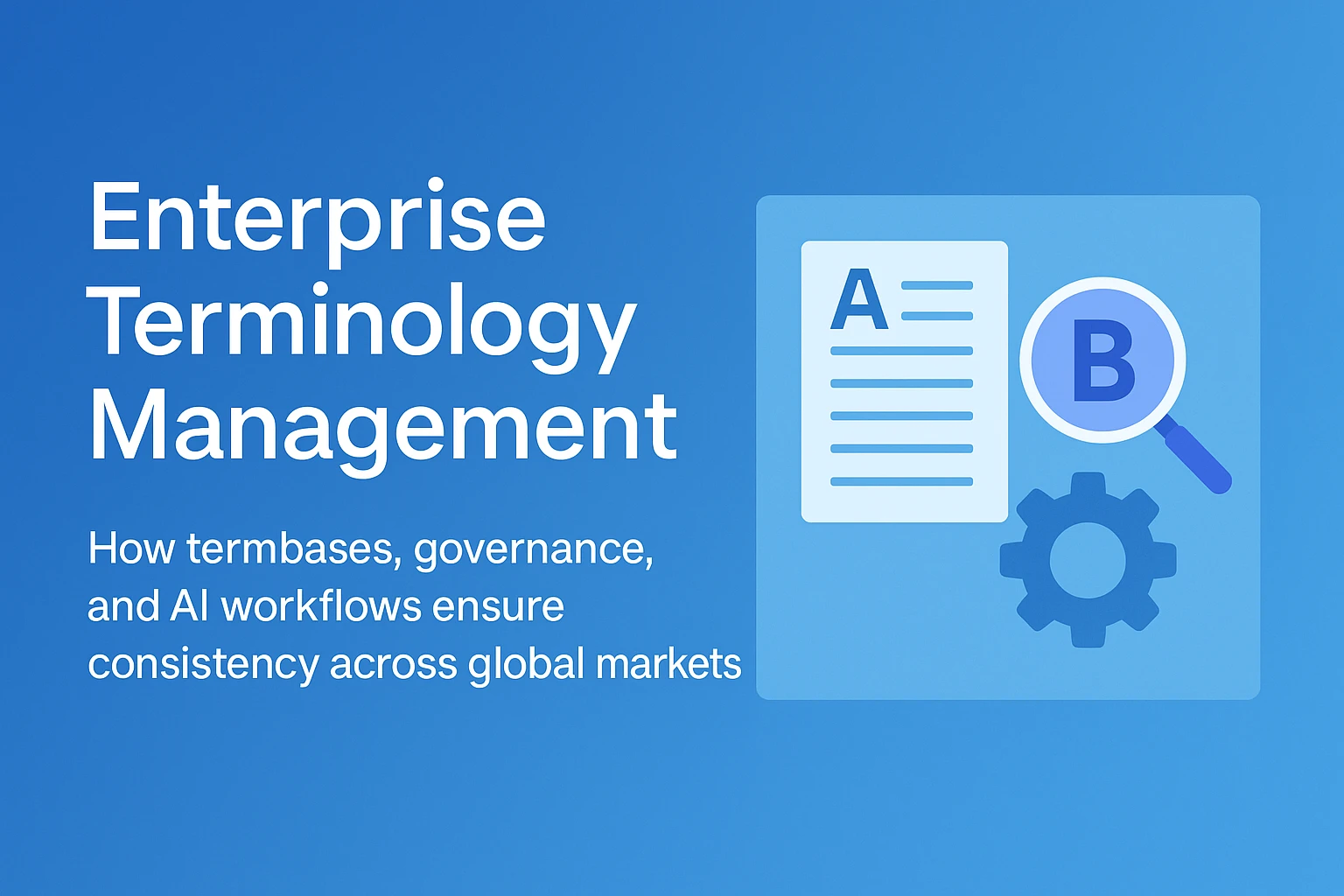
In globalized organizations, language is a regulated, monetized, and compliance-critical corporate asset. As enterprises scale into multilingual markets, consistent terminology becomes critical for coordinating products and services across all markets. This consistency must span product names and legal definitions, UI strings, medical terminology, and fintech compliance language.
Enterprise terminology management solves this problem with structured governance, centralized termbases, and organization-wide alignment. For localization managers, content governance leads, and translation buyers, terminology management is one of the highest-ROI investments in global operations.
Modern systems, enhanced by AI, deliver scalability, multilingual accuracy, and compliance protection that are impossible to achieve with manual glossaries.
This guide provides a complete enterprise overview on how it works, governance models, AI capabilities, ROI calculations, KPIs, and why companies worldwide rely on Circle Translations for multilingual terminology governance.
What Is Enterprise Terminology Management?
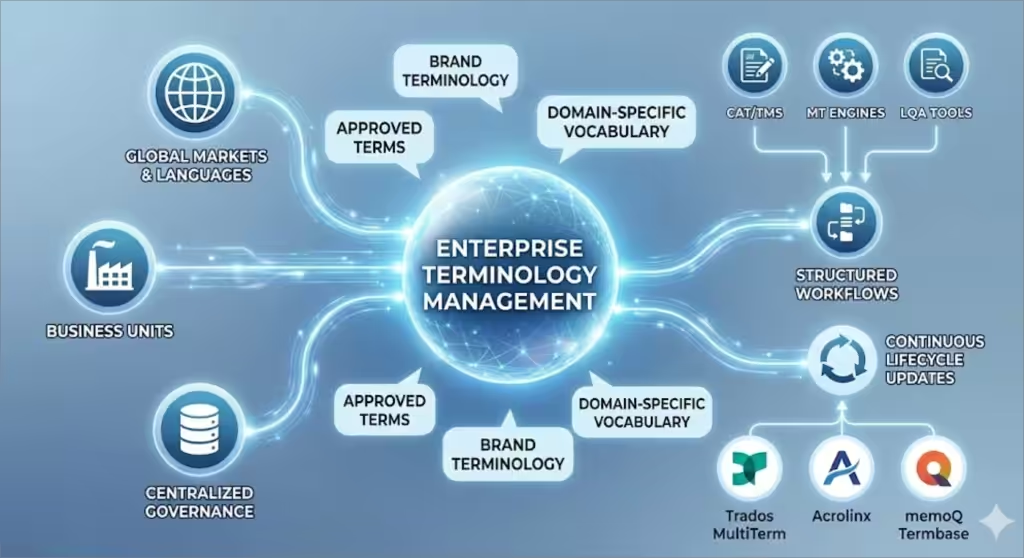
Enterprise terminology management is the centralized governance of approved terms, brand terminology, and domain-specific vocabulary across business units, markets, and languages. It ensures consistency across all of the levels within the organization, minimizing confusion and, in turn, errors.
Enterprise Terminology Management is a dynamic system, fully integrated into CAT/TMS environments, translation memory, MT engines, and LQA tools. It operates through structured approval workflows, continuous lifecycle updates, and metadata-rich entries that define context, grammar, forbidden terms, variants, and usage notes.
Enterprise-grade tools such as Trados MultiTerm, Acrolinx, and memoQ Termbase are implemented, ensuring linguistic consistency across multicultural markets and driving ROI.
Why Consistent Terminology Matters for Global Enterprises
Terminology management is crucial for organizations to deliver accurate and consistent information in foreign markets. This offers operational benefits such as reducing errors during the translation process, reducing turnaround times and compliance risks. This boosts brand alignment and global scalability.
Terminology Management vs. Glossary Creation
Terminology management is a living system, not a document. It evolves alongside products, legal requirements, and brand strategy. The glossary is a core part of the system and not inherently different from it.
Here are the basic differences between a glossary and an enterprise-grade terminology management system:
| Glossary | Enterprise Terminology Management |
| Static word list | Dynamic, metadata-rich termbase |
| No governance or approval workflow | Governed with approval roles and workflows |
| Limited context | Includes context, forbidden terms, abbreviations, and variants |
| Not connected to CAT/TMS systems | Integrated into CAT/TMS, MT, and QA systems |
| Quickly outdated | Continuously updated and lifecycle-managed |
| High risk of inconsistency | Automatically surfaced in translation workflows |
| Lacks organization-wide visibility | Searchable across the entire organization |
| Not aligned with strategic goals | Aligned with corporate content strategy |
| Not suitable for MT workflows | Essential for MTPE and AI-driven translation |
How Terminology Management Works in Enterprise Workflows
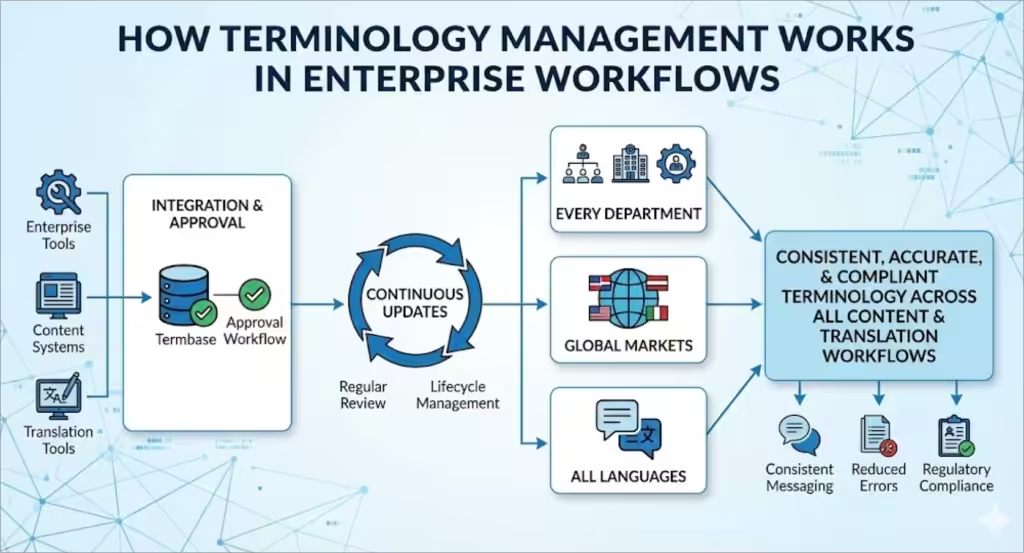
Terminology management is a multistep workflow that accounts for integration, approval, and continuous updates. It ensures that every department, market, and language uses consistent, accurate, and compliant terminology across all content and translation workflows.
Here’s what the typical workflow looks like:
- Term Extraction
Term extraction uses AI and NLP technologies to identify candidate terms across all key content sources, including product documentation, UI strings, legal contracts, support materials, marketing assets, engineering specifications, and existing translations.
This automated process ensures comprehensive coverage and captures terminology that reflects real-world usage across departments.
- SME & Linguistic Approval
Once terms are extracted, subject-matter experts validate technical accuracy, legal teams ensure regulatory compliance, and linguists confirm linguistic consistency and appropriateness across target locales. This multi-layered review process guarantees that only authoritative, risk-free terminology enters the enterprise termbase.
- Termbase Creation
Approved terms are added to a structured, metadata-rich termbase that includes preferred terms, synonyms, forbidden terms, parts of speech, definitions, contextual examples, locale-specific variants, and status indicators such as draft, approved, or deprecated. This ensures every term is fully documented and usable across all teams and systems.
- Integration with CAT/TMS and MT Systems
The enterprise termbase is then integrated with core translation technologies, including Trados, Phrase, memoQ, XTM, DeepL API, and custom TMS platforms, so translators and MT engines receive real-time terminology guidance.
This integration minimizes errors, enforces consistency, and automates adherence across all translation workflows.
- Monitoring & Lifecycle Updates
Terminology management continues through ongoing lifecycle updates, where outdated terms are deprecated, new terms are introduced, and regulatory or product-driven changes are incorporated. Regular audits keep the termbase current as markets, documentation, and product lines evolve.
Circle Translations supports enterprises with complete end-to-end maintenance, including governance, tooling, AI-driven extraction, and multilingual termbase updates.
Key Components: Termbase, Governance, Integration
Terminology management relies on three crucial steps.
- Termbase Structure
A mature enterprise termbase stores each term with rich metadata, including definitions, usage rules, part of speech, contextual examples, forbidden synonyms, regional variants, and approval history. This structure ensures every stakeholder and system relies on the same authoritative linguistic data, reducing ambiguity and improving translation quality.
- Governance Model
Effective terminology governance assigns clear roles to linguists, SMEs, approvers, reviewers, compliance teams, and localization leads. This cross-functional model ensures accountability, regulatory alignment, and consistent decision-making across global markets.
- System Integration
Termbases must integrate seamlessly with CAT tools, MT engines, and corporate documentation systems to ensure real-time terminology enforcement. Circle Translations specializes in building scalable, enterprise-ready governance and integration frameworks for organizations with 10 to 500 internal stakeholders.
Integration with CAT Tools & AI Translation Systems
Effective terminology management requires deep integration across the entire translation technology+ stack. Modern workflows connect termbases directly to platforms such as Trados Studio and MultiTerm, memoQ with its built-in Termbase, Phrase TMS, Smartling, XTM, the DeepL API, custom neural MT models, and LQA systems like DQF/MQM.
Through these seamless integrations, enterprises ensure consistency in step with production across their multicultural markets.
Terminology Governance: Roles, Rules & Responsibility
Enterprise terminology governance defines ownership and accountability so that terms are created, reviewed, approved, and deployed with consistent quality across all markets. These governance council models are often inspired by Acrolinx-style governance. It coordinates all levels of translation processes and maintains alignment.
This council oversees naming policies, approval workflows, technical term definitions, forbidden language rules, and locale-specific variations to standardize usage across the organization. It also manages escalation paths and review cycles, ensuring that terminology stays accurate, compliant, and continuously updated.
Who Manages Terminology in a Global Enterprise?
Much like the management system, the governance council itself is a multilayered workflow.
Here are the key owners of the governance council:
- Localization Lead
They control the term base strategy, approvals, and cross-departmental alignment. They also define the governance rules that dictate how terminology scales across products and markets.
- Linguistic QA Manager
They ensure compliance with terminology rules across all translations. Their audits maintain brand consistency and prevent translation drift in multilingual content.
- Legal Reviewer
They validate terminology critical to compliance, regulatory texts, and contractual terms. They protect the company from legal risk caused by ambiguous or incorrect wording.
- Subject-Matter Experts (SMEs)
They are an integral part of the governance workflow. They provide technical accuracy for industry-specific terminology. Their input keeps terminology factually precise in high-complexity domains like medical, finance, and engineering.
- Regional Reviewers
They ensure linguistic and cultural relevance in local markets. They adapt terminology for cultural nuances, preventing misinterpretation or brand damage in target regions.
Building a Terminology Policy: Naming, Versioning, Access
A comprehensive terminology policy governs how language is created, approved, and used across global content. It typically defines capitalization rules, product naming conventions, abbreviation and acronym standards, synonym control protocols, and a forbidden terms list to prevent ambiguity or brand misuse.
Strong policies also specify a versioning structure for major and minor updates, along with department-based access controls that regulate who can edit or approve terms.
To help organizations establish these foundations, Circle Translations provides a “Terminology Policy Essentials” checklist as part of its enterprise onboarding package.
Technology in Modern Terminology Management
As content ecosystems scale, manual terminology management becomes impossible. Manual workflows offer better security, a better understanding of nuances and contexts, but it’s simply incapable of keeping up with the scale of growth. Whereas, AI systems lag behind the nuance and context, they offer scalability, accuracy that fit the workflow better.
AI-Powered Term Extraction & Validation
AI/NLP systems automatically detect candidate terms, rank them by frequency and relevance, cluster related concepts, analyze multilingual equivalents, and flag incorrect usage in real time. They also identify obsolete or duplicate terms that dilute terminology consistency. When validated, these terms can connect directly to MQM/DQF quality frameworks, enabling measurable, standards-based improvements in translation quality.
Centralized vs. Decentralized Termbase Models
Here’s a snapshot comparing the two termbase models:
| Key Characteristic | Centralized Termbase (Global Standard) | Decentralized Termbase (Market-Flexible) |
| Description | Single authoritative source managed globally | Allows regional or product-line terminology variations |
| Governance | Core terminology governed centrally | Local teams manage variations aligned to global rules |
| Consistency | High consistency via one source of truth | Moderate consistency with localized variants |
| Flexibility | Limited — strict control | High — supports market adaptation |
| Risk | Lower risk of misinterpretation, audit failures | Higher risk if local rules are poorly aligned |
ROI of Enterprise Terminology Management
ROI formula:
ROI= (QA savings + productivity gains + compliance cost avoidance) ÷ tool investment
Effective terminology management offers one of the highest efficiency and compliance returns in localization. When an enterprise deploys a strong termbase and workflow, translation cycles accelerate, QA errors drop, translation-memory leverage rises, rework costs shrink, legal or compliance escalations decrease, and time-to-market for global launches shortens.
Case Example: Brand Voice Consistency Across 20+ Languages
A global SaaS provider struggled with inconsistent UI strings, product feature names, and legal terminology. Circle Translations implemented:
- AI-driven term extraction
- SME + linguist governance
- 20-language termbase
- CAT/TMS integration
- Quarterly audits
Results:
- 27% reduction in QA defects
- 35% faster MTPE throughput
- 60% fewer terminology disputes among translators
- Consistent brand voice across 20+ markets
KPIs for Terminology Success
Enterprises measure success using KPIs(Key Performance Indicators) such as term-adherence rates, reuse of approved terms, QA error reduction, MTPE efficiency gains, shorter review-cycle turnaround, and decreasing translator query volume. These metrics reveal how consistently linguists apply approved terminology and how effectively governance reduces rework and ambiguity.
Circle Translations supports this by offering dashboards that provide real-time KPI visibility across languages and vendors, ensuring transparent and measurable terminology performance.
Why Circle Translations for Enterprise Terminology Management
Circle Translations delivers a fully integrated, enterprise-ready terminology management ecosystem built for global brands that require uncompromising accuracy, consistency, and linguistic governance at scale. Our model combines expert linguists with advanced AI tooling, enabling organizations to enforce terminology across every touchpoint, such as product content, UX strings, legal materials, support documentation, and high-volume continuous localization pipelines. With 120+ languages, domain-trained professionals, and enterprise-grade data security, we ensure every approved term flows consistently from creation to publication.
We support brands with multilingual governance frameworks adopted by high-growth companies such as Paysera and Kilo.Health, delivering standardized terminology, reduced QA loops, and strong cross-market brand alignment. Clients benefit from 24/7 project management availability, secure integrations, and predictable delivery workflows designed for velocity and operational efficiency.
Here’s what sets us apart:
- Expert linguists paired with advanced AI terminology tooling
- Coverage in 120+ languages with domain specialization
- Enterprise-grade data security and compliant infrastructure
- 24/7 PM availability for global teams and continuous deployment cycles
- Proven multilingual governance models used by Paysera, Kilo.Health, and other scale-ups
- Easy navigation to About Us, Translation Rates, and Get a Quote
Compliance, Confidentiality & Security
Circle Translations operates with a security-first mindset tailored for enterprises handling sensitive, regulated, or high-stakes content. Our processes follow ISO 17100 for structured workflows, linguist qualification, and consistent QA methodologies. Every operation is fully GDPR compliant, giving global organizations confidence in cross-border data handling and personal information protection.
We reinforce trust with NDA-backed workflows, strict access control, and enterprise-grade data-handling procedures that safeguard termbases, translation memories, and all associated metadata. Secure TMS integrations ensure encrypted data transfer, stable access governance, and protected collaboration across distributed teams.
Compliance & Security Highlights:
- ISO 17100-certified processes for terminology and translation governance
- Full GDPR compliance for EU, UK, and global markets
- NDA-bound workflows with role-based access control
- Enterprise-grade data-handling procedures for sensitive or regulated material
- Secure TMS integrations with encrypted connectors and audit trails
- Available upon request: full data-handling policy
Continuous Improvement & AI Feedback Loops
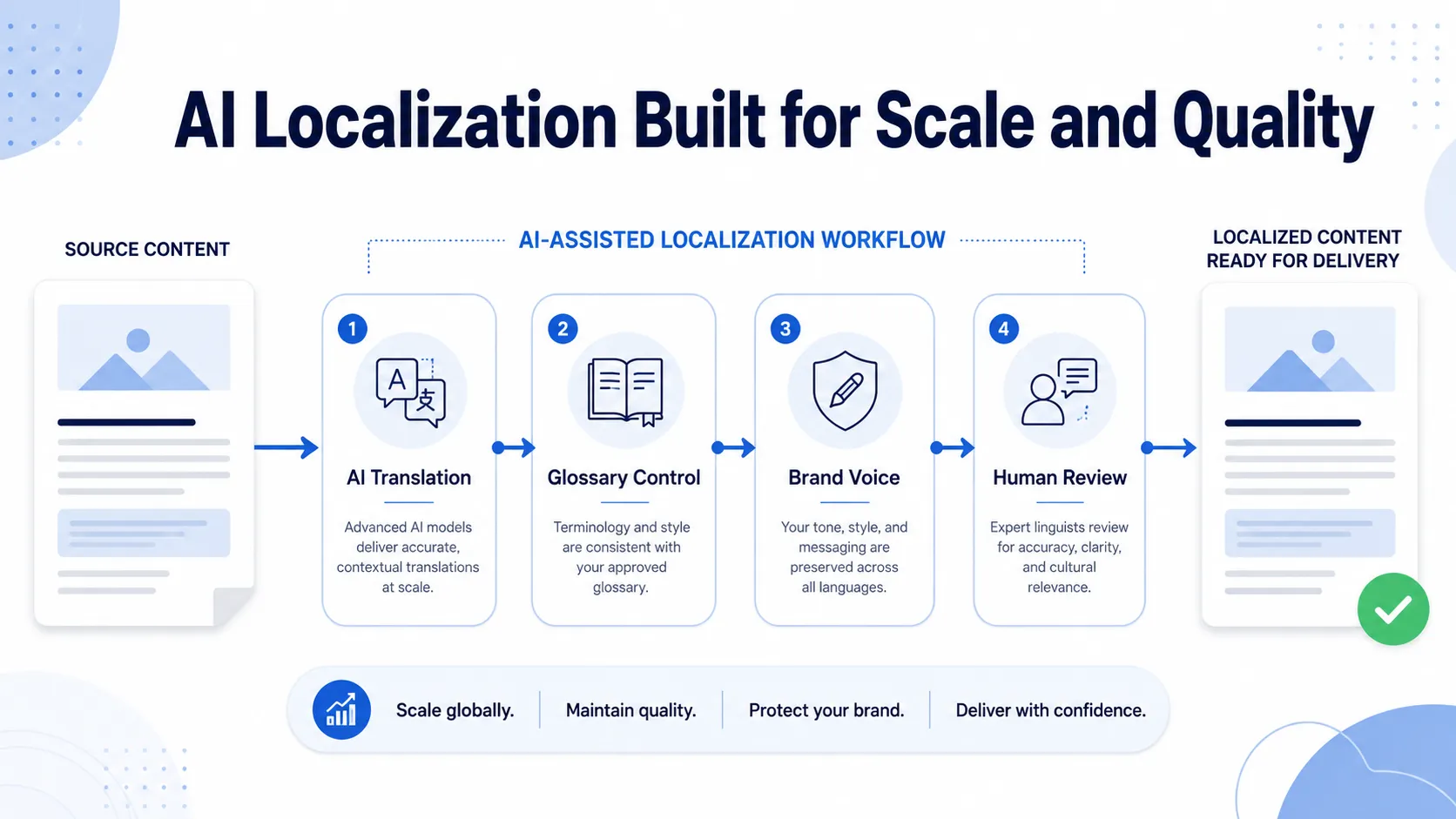
Circle Translations uses continuous improvement mechanisms backed by AI-powered feedback loops to ensure that terminology evolves intelligently with your product ecosystem. Each content cycle feeds new insights into the termbase, improving precision, updating variants, and strengthening cross-market alignment. This constant refinement accelerates MTPE speed, reduces revision cycles, and prevents terminology drift across large content repositories.
Our AI systems deliver real-time error detection, flagging inconsistent terms, context mismatches, outdated entries, or brand deviations before content reaches production. Auto-suggestions and automated quality gates enrich the termbase and prevent repetitive errors, ensuring that the terminology system becomes more accurate with every project.
Our AI-Driven Optimization Capabilities:
- Continuous feedback loops that enhance termbase accuracy
Significant MTPE speed gains thanks to reduced terminology ambiguity - Real-time error detection across large multilingual content ecosystems
AI-generated auto-suggestions for faster corrections and updates - Alignment with Circle’s Technology-Driven brand pillar
- A constantly evolving terminology governance engine that scales with product growth
FAQs
What is enterprise terminology management?
Enterprise terminology management is the structured governance of a company’s language assets to maintain accuracy, consistency, and compliance across global markets. It ensures that brand-specific vocabulary, product names, technical concepts, and regulated terms are used uniformly across all departments and content channels. This discipline becomes essential as organizations scale internationally and must safeguard linguistic precision across marketing, legal, product, and customer-facing communication.
How does terminology management improve translation quality?
It standardizes terms, eliminates ambiguity, accelerates translation cycles, and reduces QA rework by ensuring every translator, reviewer, and MT engine uses the same approved terminology. When terminology is controlled from the beginning, translators make fewer interpretation errors, which increases clarity and dramatically strengthens cross-market consistency. This results in cleaner outputs, more reliable MT performance, and a more trustworthy customer experience.
What’s the ROI of implementing terminology management?
A guide by Lokalize states that companies that invest in localization show “20-30% revenue growth” among other ROI benchmarks. Beyond direct cost savings, companies benefit from faster time-to-market, fewer legal risks, and more efficient localization workflows. Strong terminology governance also boosts translator productivity and reduces friction between product, marketing, and localization teams.
How is AI used in terminology management?
AI extracts new terms, analyzes context, and performs real-time consistency checks across large content ecosystems, including product documentation, UX strings, and regulated materials. Modern AI and NLP also identify emerging terminology trends, suggest updates to termbases, and detect misuse before content enters production. This creates a more intelligent, proactive, and scalable terminology pipeline.
Who owns terminology in a large organization?
Typically, the localization or linguistic QA team owns terminology, supported closely by SMEs, product teams, and legal/compliance reviewers. These cross-functional contributors ensure terminology is technically accurate, legally approved, and aligned with brand strategy. Large enterprises often formalize this structure into a terminology committee or governance framework.
What tools are best for enterprise terminology management?
Tools such as Trados MultiTerm, Acrolinx, memoQ Termbase, TermWeb, and advanced TMS integrations provide the backbone for enterprise terminology workflows. These platforms centralize term validation, offer real-time guidance during translation, and enforce consistency across global content pipelines. Enterprise ecosystems often pair these systems with MT engines and LQA tools for full-stack integration.
Can Circle Translations manage multilingual termbases?
Yes. Circle Translations builds, maintains, validates, and audits multilingual termbases under ISO/GDPR standards to support enterprise-grade content operations. The team ensures terminology is culturally accurate, technically compliant, and continuously updated across all target languages. Their workflow safeguards linguistic integrity for high-volume, high-stakes global content.