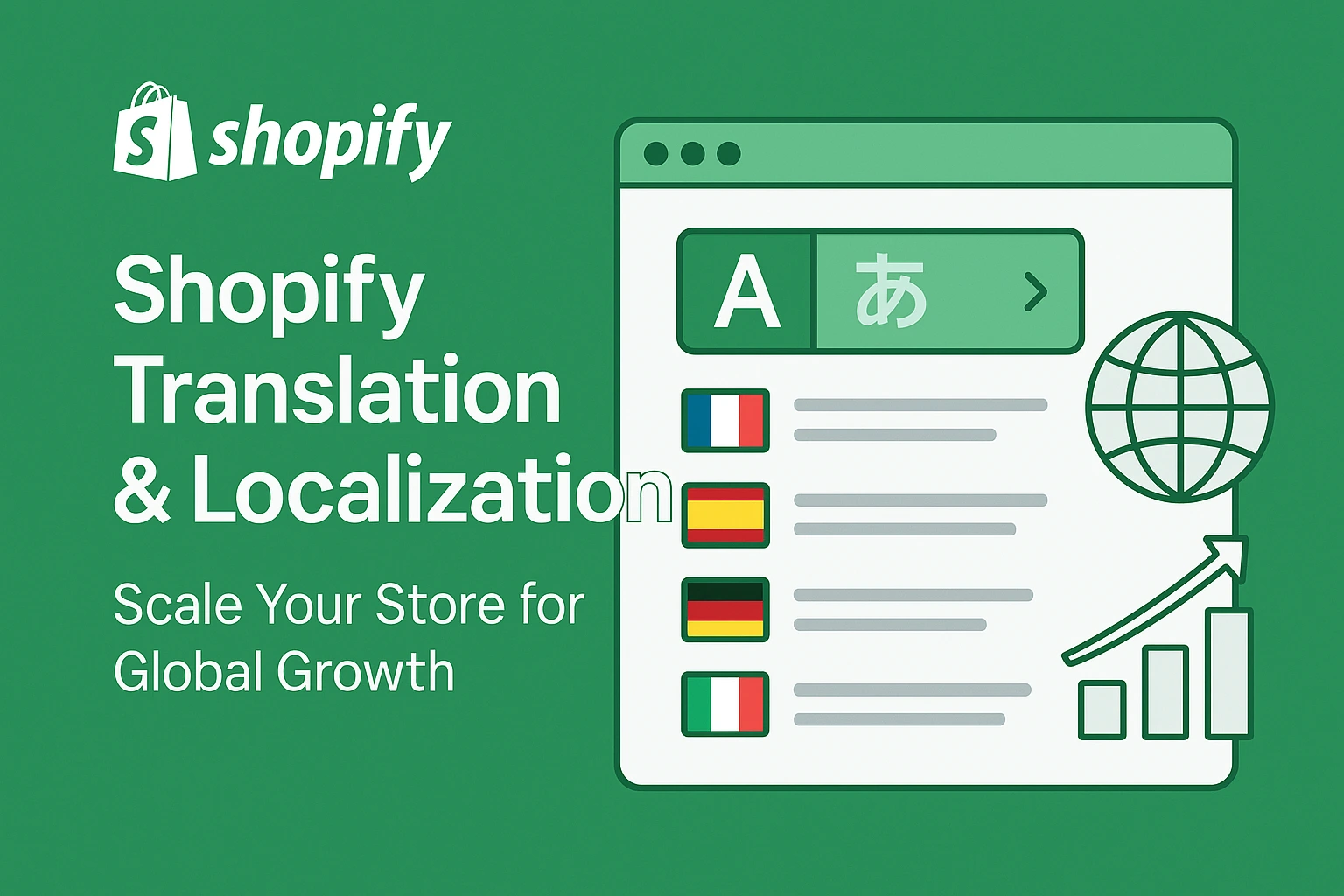
Expanding your Shopify store into foreign markets requires proper localization. It involves adapting your content, UX, checkout flows, currency, and compliance to your target market’s criteria.
Translation handles the linguistic aspect, whereas localization prepares your messaging, visuals, and experience to feel native and trustworthy.
To get your Shopify storefront to rank in foreign markets, Shopify translation and localization is a non-negotiable. This integrates your business into the local ecosystems and drives your e-commerce growth.
This article provides a comprehensive step-by-step guide to Shopify translation and localization workflows, helping you make informed choices for your brand.
What Is Shopify Translation and Localization?
Shopify translation includes the translation of converting all store content, such as product descriptions, theme text, alt text, and checkout strings, into the target language.
Localization takes this a step further by adapting currency, tone, UX elements, cultural references, and legal content to match the expectations of each target market.
For global merchants using Shopify Markets, localized subfolders, hreflang, and language-specific metadata are essential for SEO visibility. Shopify’s ecosystem supports this through tools like Weglot, Langify, and the Shopify Translation API, which enables structured automation and custom workflows, and Circle Translations for professional localization.
Translation vs. Localization: What’s the Difference?
Translation is the fundamental part of localization workflows. Understanding the difference between them is crucial for procurement teams to make accurate judgement for their brands’ future.
Here’s a snapshot that highlights the core differences between Shopify translation and localization:
| Dimension | Translation | Localization |
| Primary Goal | Make content readable in the target language | Make content feel native, familiar, and conversion-ready |
| Focus Areas | Words, sentences, grammar, accuracy | Currency, UX text, images, tone, measurements, CTAs, checkout flow |
| Shopify Examples | English → German product descriptions | USD → EUR, “Add to Cart” → “Add to Basket,” localized imagery |
| Impact on SEO | Ensures keywords exist in translated form | Aligns with real local search intent and SERP behavior |
| Impact on UX | Understandable content | Native-feeling shopping experience; higher trust |
| Impact on Conversion | Basic readability improves usability | Drives conversion uplift, lower bounce rates, and higher AOV |
| Buyer Journey Influence | Product detail clarity | Discovery, pricing clarity, checkout completion, and post-purchase expectations |
How Shopify Handles Multi-Language Support
Shopify now includes native multi-language capabilities through Shopify Markets, which manages language subfolders such as /fr, /de, or /es-mx, and automatically generates locale files.
These subfolders work with hreflang tags to help search engines understand which language version is meant for which audience.
Apps like Weglot, Langify, Translate & Adapt, Crowdin, and LangShop extend this functionality by enabling deep translation control over theme files, dynamic content, and metafields. However, merchants must ensure that multilingual SEO elements are properly implemented.
Technical success depends on:
- Shopify Markets configuration
- Locale file accuracy
- Proper sitemap handling
- Correct hreflang placement
- Full metadata translation
- URL hygiene and localized slugs
How to Translate a Shopify Store: Step-by-Step Workflow
A professional Shopify translation workflow ensures accuracy, scalability, and SEO performance.
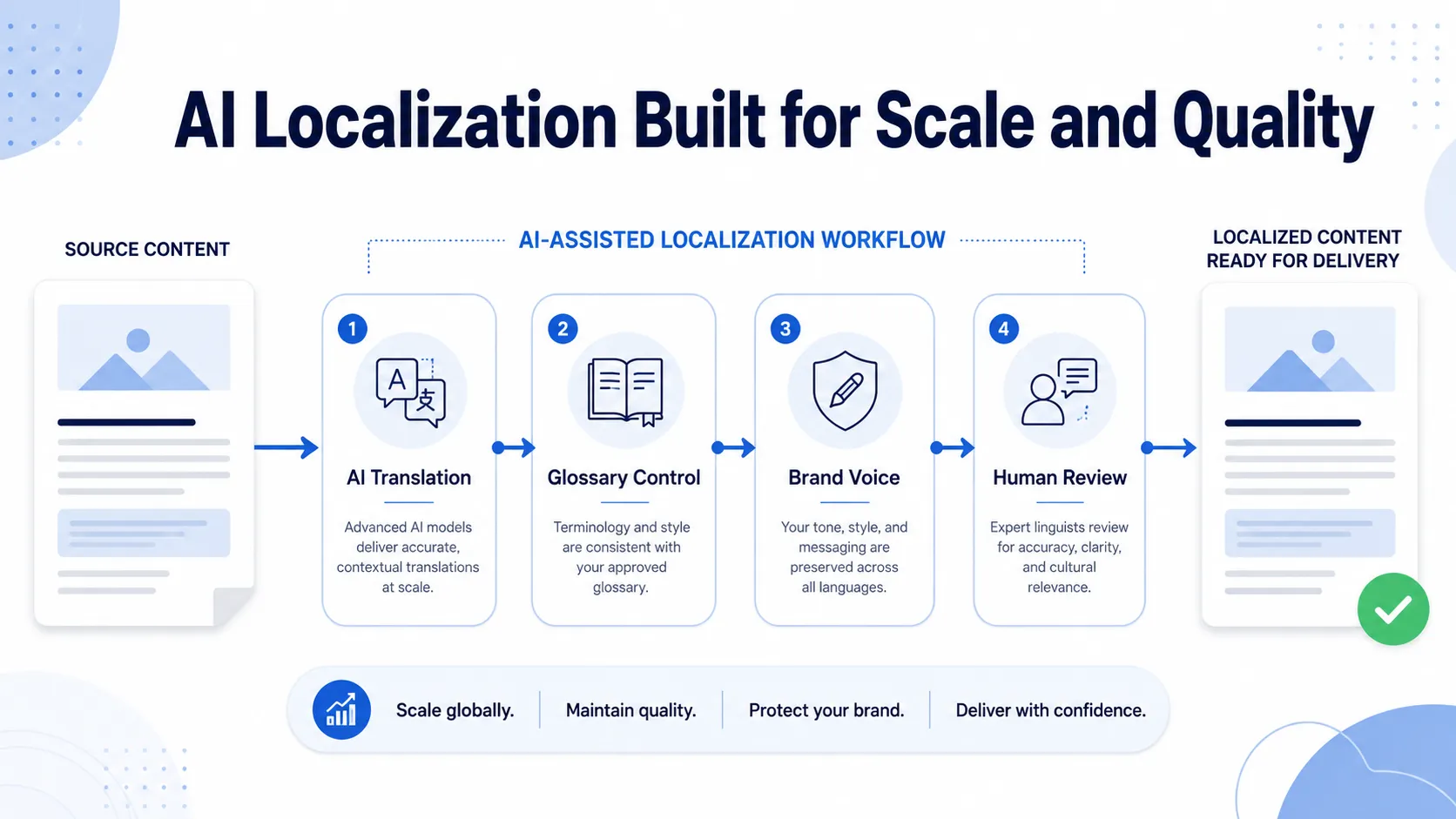
Below is the Step-by-Step workflow enterprise providers use for Shopify localization, supported by AI and human linguists:
1. Identify Translatable Elements
A Shopify store includes multiple content types that require translation, including product titles, product descriptions, collection pages, homepage content, policy pages, marketing pages, checkout text, email templates, and theme strings.
This type of e-commerce translation often involves JSON or CSV exports, theme sections, and metafields that store product specifications, ingredients, or regulatory information.
2. Choose the Right Translation Method (AI, Manual, or Hybrid)
Shopify merchants must choose between AI translation, manual human translation, or hybrid MTPE workflows.
Each of the workflows has its advantages and best fits, such as:
- AI translation is fast but best suited for low-impact content.
- MTPE (Machine Translation + Post Editing) combines AI output with human refinement for accuracy, tone, and SEO optimization.
- Human-only translation is ideal for high-value markets, heavily branded products, or legally sensitive content.
3. Implement Translations via Shopify Apps or API
Translations can be deployed using platforms, such as Weglot for a fast, hosted layer, Langify for theme-focused control, or even Shopify’s native option, Translate & Adapt, based on your requirements and budget.
Each option has trade-offs in terms of control, SEO, or dependency on external infrastructure.
Circle Translations supports all methods, including API-powered pipelines, JSON/theme file localization, and full app-based setups.
4. QA & Launch Multilingual Store
Before launching a multilingual Shopify store, a few rounds of QA are done to ensure a flawless launch. Tools such as MQM/DQF frameworks to evaluate linguistic accuracy, brand tone, compliance, and SEO quality before deployment.
Businesses need to verify:
- UX integrity across languages
- Currency and unit accuracy
- Region-specific pricing
- Form and checkout behavior
- Proper indexing via Search Console
- Correct hreflang signals
- Metadata translations for each language
Shopify Localization Strategies for B2B and Enterprise Merchants
Enterprise Shopify merchants face more complex localization challenges due to large catalogs, multi-region stores, wholesale portals, and layered B2B workflows. Localization strategies must account for thousands of SKUs, large-scale metafield data, and multi-region fulfillment rules.
Adapting Design, Currency, and Legal Pages for Target Markets
Localization involves adapting currencies, measurement units, policies, shipping, warranties, and legal disclaimers to the native preferences.
For instance, Shopify merchants targeting Europe must consider EU cookie compliance, GDPR requirements, CCPA for California, and market-specific legal content.
SEO Localization for Shopify: Ranking in Each Language
SEO localization for Shopify ensures each language version can rank independently by aligning translated content with real search behavior in every market.
Effective Shopify localization requires localized keyword mapping, translated title tags and meta descriptions, region-specific URLs and slugs, correct hreflang implementation, translated image ALT text, localized schema, and regional backlinks that signal geographic relevance.
As highlighted in frameworks from platforms like Lokalise, multilingual Shopify SEO succeeds only when translations follow local SERP intent.
Human + AI Translation for Shopify: Best of Both Worlds
A hybrid process of AI pre-translation with human editing ensures accuracy, cultural nuance, and SEO alignment at scale. This workflow delivers speed and cost efficiency without sacrificing brand tone or quality.
How AI Tools Integrate With Shopify Localization Workflows
AI tools are integrated into Shopify localization workflows by using DeepL, GPT-based MT engines, and similar models to generate fast initial drafts for product data, policy content, theme strings, technical specifications, and bulk metafields.
Human linguists then refine the AI output to correct nuances, adapt tone, fix cultural inconsistencies, and align content with brand and market expectations.
Maintaining Accuracy, Brand Tone, and SEO Across Markets
Shopify localization requires protecting brand language and ensuring consistency across all locales.
Circle Translations uses terminology databases, glossaries, translation memory, and SEO keyword lists to maintain accuracy across markets. While AI accelerates translation, humans contextualize and refine tone, UX writing, and semantically important SEO phrases.
ROI of Professional Shopify Translation & Localization
Companies using Shopify Markets report significant improvements after localization: higher conversion rates, lower cart abandonment, and more substantial organic traffic from localized regions.
Professional translation and localization efforts typically result in 20–30% higher conversions in localized markets, especially when currency, regional UX, and localized SEO are implemented together.
Key Metrics to Measure Localization ROI
Shopify localization ROI becomes clear when you track how translated markets perform across engagement and revenue. With proper multilingual SEO and localized UX, key metrics show whether global expansion is paying off.
The most critica KPIs include:
- Conversion rate uplift per locale
- Bounce rate on translated product pages
- Average session time for non-English visitors
- Sales by region and country
- LTV for international customers
How Localization Boosts Customer Retention
Localized Shopify stores reduce friction, build trust, and align product clarity with customer expectations in each region. When customers shop in their native language, see prices in local currency, and encounter familiar UX terminology, their likelihood of returning or subscribing increases.
Conclusion
Expanding your Shopify store into foreign markets requires a structured translation and localization workflow. This ensures accuracy, brand consistency, SEO visibility, and legal compliance across all regions.
By understanding how Shopify Markets, translation apps, AI-assisted workflows, and professional localization combine, you can build multilingual stores that scale profitably and deliver native-quality experiences to every international visitor.
With Circle Translations, global expansion becomes faster, more predictable, and far more successful.
FAQs
What is the best way to translate a Shopify store?
The best method is a hybrid workflow combining AI pre-translation with professional human editing to ensure accuracy, maintain brand tone, and optimize SEO across each target market.
Do I need an app to translate Shopify?
You can use Shopify’s native Translate & Adapt app, but many merchants prefer third-party tools like Weglot or Langify for deeper multilingual control and automation.
How many languages does Shopify support?
Shopify supports more than 20 languages natively, while third-party translation apps expand that number to more than 100.
Does translation affect SEO on Shopify?
Yes, translation impacts SEO because localized metadata, hreflang signals, and language-specific URLs directly affect organic visibility and rankings.
How much does Shopify translation cost?
Professional translation typically ranges from €0.08 to €0.16 per word depending on language, complexity, and whether MTPE or human-only workflows are used.
Can AI translate Shopify stores automatically?
AI can translate content quickly, but human post-editing is needed to ensure cultural accuracy, tone, and SEO alignment for real-world customer trust.
How long does it take to localize a Shopify site?
Most Shopify stores can be translated and fully QA’d within three to five business days, depending on store size and number of languages.