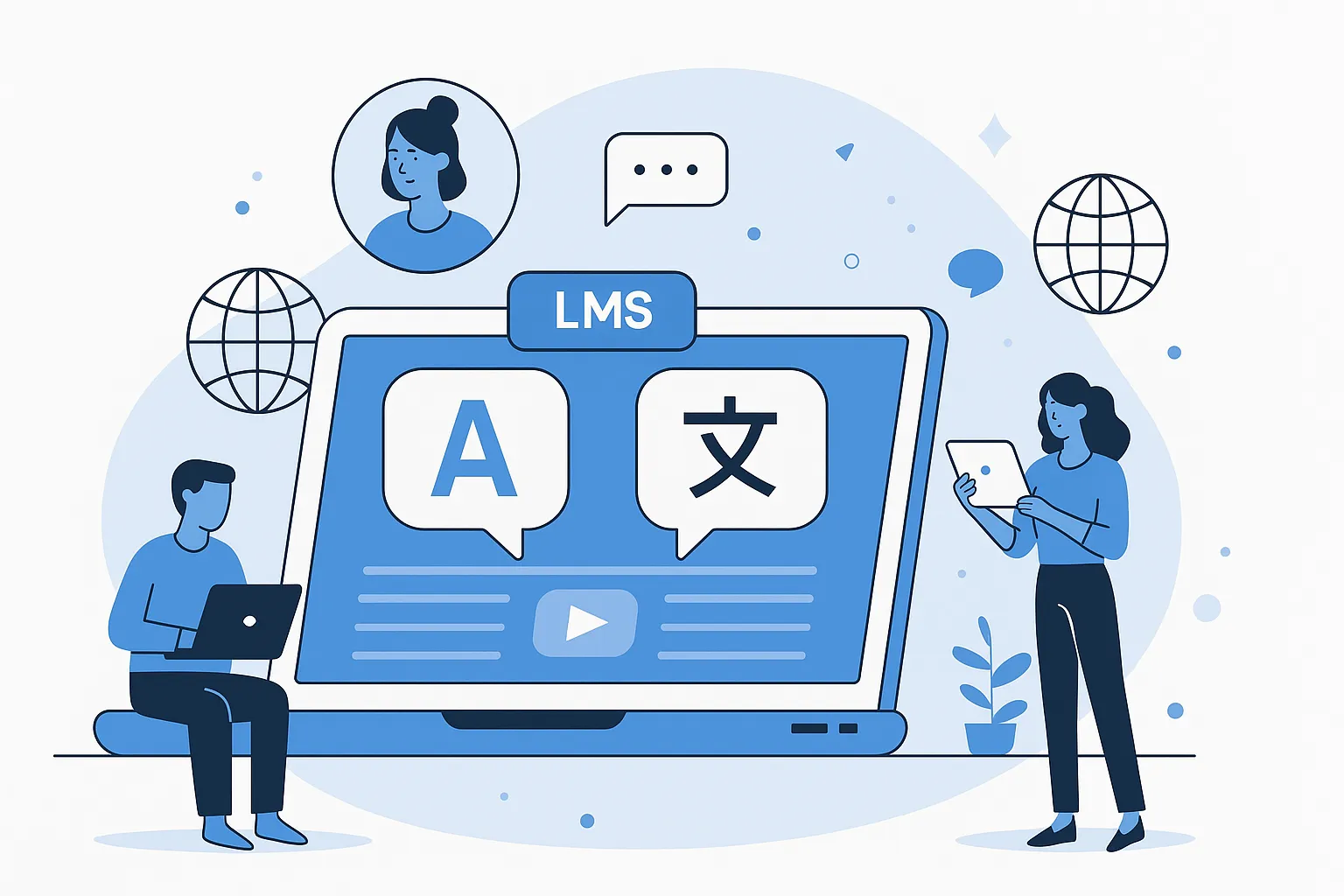
E-learning has taken the world by storm. Global enterprises, L&D departments, HR teams, and EdTech companies increasingly rely on eLearning to train a distributed workforce.
As organizations scale across multiple countries, the need for enterprise-grade e-Learning content translation becomes a fundamental requirement, not simply for language accuracy, but for engagement, compliance, and learning outcomes.
E-Learning translation today is a multi-layer process that combines linguistic accuracy, cultural adaptation, multimedia localization, LMS engineering, and regulatory consistency across all regions.
When implemented correctly, eLearning translation and localization increase learner engagement, reduce training friction, support regional compliance mandates, and maintain brand consistency for global L&D programs.
This guide explains how e-learning content translation works at an enterprise level, the workflows involved, the assets that require localization, and how companies can scale training across different languages while maintaining quality and ROI.
What is E-Learning Content Translation?
E-Learning content translation involves converting instructional materials, such as text and other interactive elements, into another language so international learners receive accurate and consistent training.
Enterprise environments require full e-learning localization to adapt cultural context, regulatory requirements, tone, compliance phrasing, and regional learning styles.
The complete workflow typically follows a structured path: raw content extraction → multimedia processing → engineering workflows → translation → LQA → SCORM packaging → LMS testing.
Which E-Learning Assets Require Translation?
E-learning consists of multiple modes of instructional elements. Text-based content includes scripts, learning objectives, quizzes, scenario prompts, glossary definitions, compliance rules, and knowledge checks. Multimedia assets include voiceovers, system audio prompts, animations, subtitles, and embedded video content.
Also, SCORM or xAPI packages often store interactive elements such as drag-and-drop activities, branching scenarios, and slide-based animations, all of which need precise localization. Certificates, LMS user interface labels, onboarding modules, and content imported from tools like Storyline or Rise also require careful extraction and translation.
Localization of API-connected content, JSON resource bundles, and templated UI strings that feed into interactive modules is also a part of the workflow. These asset types are often overlooked by non-specialist vendors but are critical for enterprise-grade training experiences.
How Localization Differs From Simple Translation
Translation ensures the content is linguistically accurate. This is the fundamental aspect of the localization workflow.
Localization is the complete package that adapts the content to fit cultural context, regulatory norms, and learner expectations.
Corporate training often includes examples, feedback scenarios, leadership communication styles, and compliance phrasing that differ dramatically across regions.
Measurement units, currencies, date formats, legal phrasing, and workplace examples would require adaptation and not just translation, to avoid confusing learners across the pond. Localization ensures the content feels natural, culturally appropriate, and aligned with regional training norms.
What Does the E-Learning Translation Workflow Look Like?
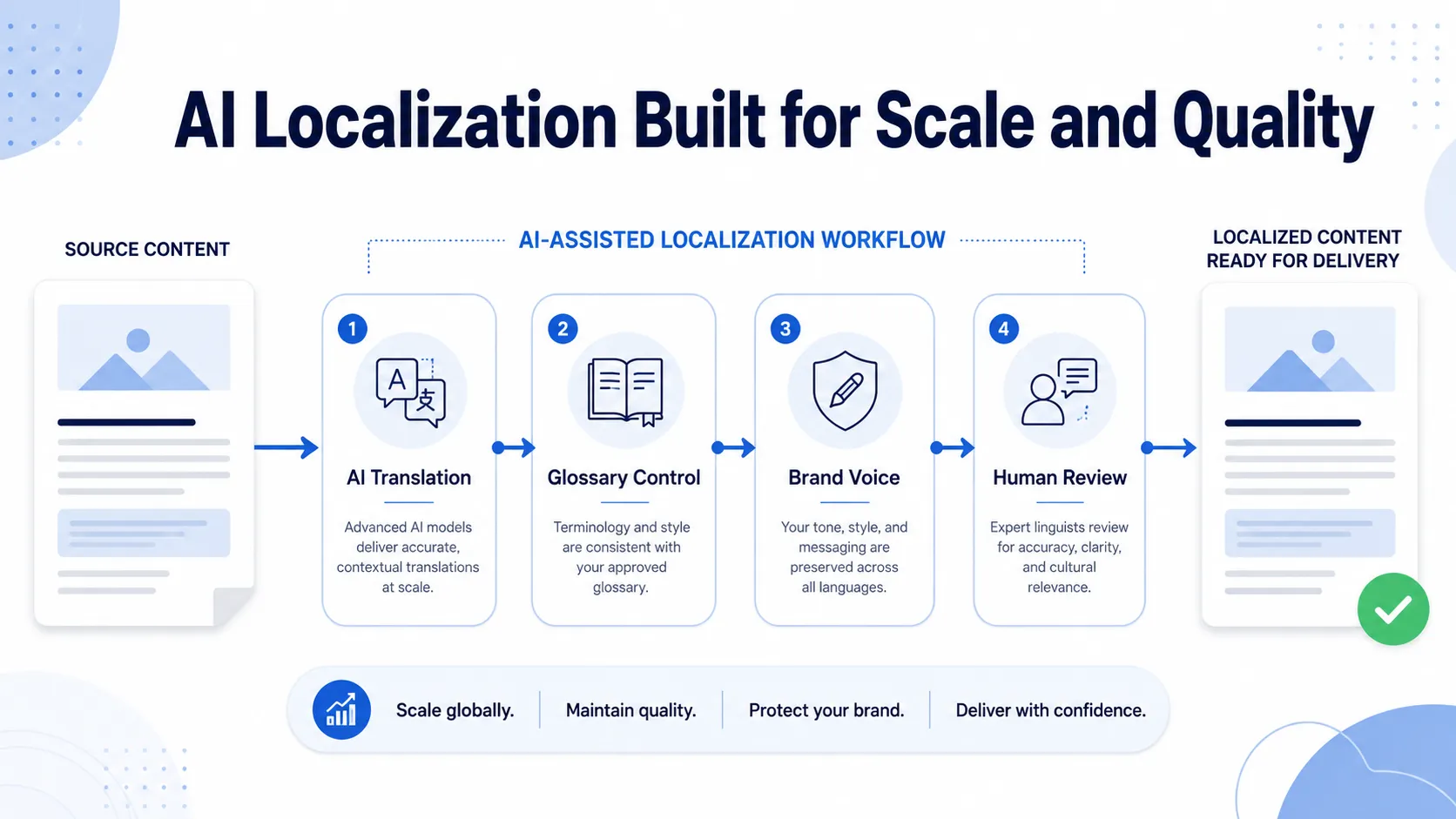
A professional eLearning translation workflow for enterprise programs involves many specialized steps. It begins with scoping and content extraction, followed by terminology setup, linguistic translation, multimedia localization, integration into SCORM/xAPI packages, functional QA, and LMS-level verification.
SCORM/xAPI Packaging & LMS Integration
- Scope assessment and asset inventory:
All course materials: Storyline/Rise projects, SCORM packages, scripts, voiceovers, quizzes, and UI labels, are mapped to determine the volume, complexity, and engineering requirements for localization.
- Content extraction from Storyline, Rise, Captivate, SCORM:
Engineers extract translatable elements, such as XML, JSON, XLIFF, scripts, UI text, triggers, from authoring tools while ensuring that interactions, scoring logic, and navigation paths remain intact.
- SCORM packaging and LMS integration:
After translation, modules are rebuilt into SCORM 1.2/2004 or xAPI formats. Engineers verify that triggers, branching, timelines, and tracking functions operate correctly after reintegration.
- Final QA inside LMS (Moodle, Docebo, TalentLMS, SAP SuccessFactors):
The rebuilt package is uploaded into enterprise LMS platforms to confirm tracking, scoring, bookmarking, completion rules, and user navigation behave exactly as in the source version.
- Deployment and learner testing:
Once compatibility is confirmed, the localized module is deployed to a test learner group to validate usability, readability, device responsiveness, and overall learning experience before global rollout.
Multimedia Translation: Voiceovers, Subtitles, On-Screen Text
- Multimedia localization: voiceovers, subtitles, UI text:
All audio and video assets are localized, including re-timed voiceovers, translated subtitles, and updated UI text within animations or screen recordings.
- Translation and MTPE (if hybrid workflow chosen):
AI-based MT engines, such as DeepL, GPT-based models generate first drafts for text or subtitles, which linguists refine through post-editing to maintain learning clarity, tone, and cultural precision.
- OCR + on-screen text extraction:
For embedded text within diagrams, illustrations, or videos, OCR tools extract the content, allowing designers to replace English text with localized equivalents without disrupting visual layouts.
- Audio/video sync validation:
Localization teams ensure voiceovers match slide timing, animations, and transitions, subtitles are synced with spoken audio, and the pacing remains natural for each language.
Quality Assurance for eLearning Modules
- Glossary and terminology list creation:
Before translation begins, teams build glossaries to maintain consistent terminology for compliance concepts, technical terms, product vocabulary, and corporate language across all modules.
- LQA (linguistic, functional, visual):
Linguistic QA checks accuracy, tone, glossaries, and phrasing. Functional QA validates quizzes, scoring, and interactivity. Visual QA checks layout, text expansion, UI alignment, and timing.
- SCORM validation across LMS platforms:
Specialists confirm that the translated SCORM/xAPI packages load correctly, record scores, track progress, and comply with LMS standards across systems such as Moodle and Docebo.
- Button placements, branching logic, and interaction checks:
Engineers validate that all clickable elements, navigation paths, branching scenarios, triggers, and knowledge-check scoring behave identically to the source version.
Which Languages Should Global Training Programs Prioritize?
When expanding globally, enterprises must prioritize languages that reach the widest possible audience. This increases efficiency by covering the most learners with the fewest conversions. Most multinational L&D programs prioritize Spanish, French, German, Chinese, Arabic, Portuguese, and Japanese, reflecting global workforce distribution and compliance requirements.
Spanish typically addresses the LATAM and U.S. Hispanic markets. French, German, and Portuguese cover most of Europe, Africa, and Canada. Arabic supports MENA workforce compliance. Japanese and Chinese align with major APAC operations.
Cultural & Regulatory Considerations by Region
When localizing for multiple markets, it’s important to adhere to the local expectations. Europe requires GDPR-aligned phrasing and specific compliance terminology. APAC markets often prefer more context and less direct communication. Right-to-left languages like Arabic create layout and UI challenges within SCORM modules.
Following the cultural norm when localizing will yield a better chance of success. Safe to say, regulatory training, such as financial compliance, workplace safety, diversity and inclusion, and cybersecurity, must reflect local laws.
Cost & Turnaround: What to Expect for eLearning Translation
The cost of e-learning localization depends on several factors, including the volume of materials, the number of languages, the language pair, and the project’s technical aspects.
The workflow mode also plays a crucial role in pricing fluctuations. The enterprise standard is the AI+Human (MTPE) approach. However, for sensitive tasks, human-only workflows are also implemented.
Enterprise providers, such as Circle Translations, will always offer cookie-cutter tiered pricing. This might not fit what you’re looking for, but there are always custom quotes. A reputable provider will have clear policies and will be upfront about any cost drivers.
What Affects Cost? (Top Factors)
Module length, engineering requirements, review cycles, number of target languages, and multimedia volume drive cost. However, one of the most significant cost factors is the unique requirements of each asset type, since text, video, audio, SCORM files, and interactive elements each require different workflows and levels of effort.
A snapshot summarizing the typical cost drivers of different assets during an e-learning content translation:
| Asset Type | Cost Drivers |
| e-learning text | Word count, terminology complexity |
| Voiceovers | Script length, talent type, studio requirements |
| Subtitles | Video length, QC depth |
| SCORM/xAPI engineering | Module complexity, tool used (Storyline/Rise) |
| LMS testing | Number of platforms and rounds of QA |
Turnaround Times for Large Training Programs
Turnaround time depends on the scale of the project, and the technical aspect of it. Through parallel team scaling, reduced turnaround rate is achievable. Weekend and after-hours production enables faster delivery for urgent compliance deadlines.
Circle Translations supports 24/7 PM oversight, enabling rapid responses and continuous delivery even during global rollouts.
AI in eLearning Translation: Where It Helps & Where It Fails
Introduction of AI technologies has boosted efficiency in translation and localization workflows. AI’s biggest strengths are captioning, draft text translation, and terminology suggestion.
AI accelerates the early stages of translation, dramatically lowering turnaround time for large modules. However, AI often fails at cultural nuance, legal/regulatory phrasing, assessment logic, and scenario-based content where precision and contextual accuracy are critical.
When to Use AI + Human Post-Editing vs Human-Only
AI+MTPE works for general awareness training, large text volumes, and non-critical content. However, this module is risky for compliance training, HR/legal modules, safety protocols, and any training that affects employee rights or regulatory obligations.
Why Choose Circle Translations for eLearning Localization
At Circle Translations, we provide the precision, structure, and reliability needed to scale global training programs without disruption. Our approach strengthens learning quality, protects technical integrity, and ensures every localized module performs as effectively as the original.
Here’s what sets us apart:
- End-to-end eLearning localization for enterprises:
We deliver full-scope translation and localization for global L&D teams, covering modules, assessments, policies, multimedia assets, and LMS-integrated content across 120+ languages.
- Expertise in Storyline, Rise, Captivate, Camtasia & SCORM/xAPI:
Our engineers localize SCORM 1.2/2004 and xAPI packages without breaking triggers, scoring logic, UI layouts, animations, or LMS tracking.
- Native linguists + multimedia specialists:
Every module combines linguistic accuracy with localized voiceovers, subtitles, on-screen text, and culturally aligned learning examples.
- High-security workflows for enterprise training:
We use NDA-backed file handling, encrypted storage, controlled access, and LMS-safe export/import processes to protect confidential training assets.
- ISO-aligned QA for accuracy and consistency:
Our MQM/DQF-based LQA ensures consistent terminology, correct compliance phrasing, and precise instructional meaning across all languages.
- Scalable production for large global rollouts:
Parallel linguist teams, 24/7 PM oversight, and AI-assisted MTPE workflows enable faster delivery for complex multinational training programs.
Our Technical & Security Capabilities
- NDA-backed file handling:
All eLearning files, SCORM packages, and source assets are processed under strict NDAs to protect confidential training content and corporate IP.
- Encrypted storage and controlled access:
We use encrypted storage environments and role-based access controls to ensure sensitive training materials, LMS data, and multimedia assets remain fully secure.
- SCORM/xAPI engineering support:
Our localization engineers handle all SCORM 1.2/2004 and xAPI packaging tasks, preserving triggers, interactions, scoring logic, and LMS tracking functionality.
- LMS-safe export/import workflows:
Every translated module undergoes structured export and import cycles to confirm compatibility with LMS platforms like Moodle, Docebo, SAP SuccessFactors, TalentLMS, and Cornerstone.
- Full compatibility testing before release:
We run end-to-end functionality tests on navigation, scoring, audio sync, UI labels, and reporting to guarantee stable performance across all languages and LMS environments.
Proof of Quality: Our QA + Revision Model
- Two-linguist translation workflow:
Every module is translated by a native linguist and reviewed by a second specialist to ensure accuracy, clarity, and consistency across all eLearning content.
- Translation memory (TM) management:
We maintain centralized TMs to eliminate inconsistencies, reduce repetitive costs, and ensure uniform terminology across SCORM packages, slides, assessments, and UI labels.
- Glossary and terminology governance
Our teams build and enforce glossary rules so compliance terms, technical vocabulary, and brand-specific phrasing remain consistent across all languages and training modules. - LQA scoring via MQM/DQF frameworks:
We apply MQM/DQF industry standards to score linguistic quality, tone, and functional accuracy, ensuring modules align with enterprise training requirements and regulatory expectations.
- Compliance-ready revision cycles:
All content undergoes structured revision rounds to maintain tone accuracy, legal precision, and instructional clarity for global L&D, HR, and compliance teams.
Conclusion
As enterprises expand globally, eLearning content translation becomes a critical component of scaling workforce learning, ensuring compliance, and delivering consistent training quality across markets.
By understanding the differences between translation and localization, applying structured workflows, and leveraging hybrid MTPE processes, you can deliver impactful, culturally aligned learning experiences in every region.
Understanding the main cost drivers and what fits your workflow best allows you to invest in the correct module and better prepares you for future scalability.
Partnering with a specialized provider like Circle Translations ensures your e-learning modules remain accurate, technically compatible, and ready to drive global training success across 120+ languages.
FAQs
What types of eLearning content can be translated?
All major instructional formats, including courses, slide decks, SCORM/xAPI modules, assessments, UI labels, videos, transcripts, audio files, PDFs, and image-based content, can be translated for global learners while keeping interaction and scoring intact.
How long does it take to translate an eLearning module?
Standard timelines average 10–20k words per language per week, with multimedia-heavy modules requiring additional time for voiceovers, subtitle syncing, and engineering adjustments.
How do you ensure translated modules still work inside an LMS?
Compatibility is maintained through SCORM/xAPI packaging, functional QA, link and trigger testing, audio synchronization checks, and full validation within LMS platforms such as Moodle, Docebo, or SAP SuccessFactors.
Should I use AI translation for eLearning content?
AI can speed up captions and basic text translation, but assessments, compliance training, and culturally sensitive modules require human review to protect accuracy and learner trust.
What are the most requested languages for eLearning translation?
Spanish, French, Chinese, German, Arabic, Portuguese, Japanese, and Korean are typically prioritized for multinational training programs due to workforce distribution and compliance requirements.
How do costs vary for eLearning translation?
Costs depend on module complexity, SCORM engineering, multimedia volume, voice-over duration, the number of target languages, and the subject-matter expertise required.
What file formats do you support?
We support PowerPoint, SCORM 1.2/2004, xAPI, Articulate Storyline, Rise, Adobe Captivate, Camtasia, Moodle XML, MP4, SRT, VTT, JSON, and XLIFF for full end-to-end localization.