Expanding into new markets, enterprises must push well-translated web content that aligns with local demands. This is where SEO-friendly website translation becomes a key growth strategy.
SEO translation combines translation, localization, technical SEO, and multilingual optimization to help brands gain organic visibility and capture markets where buyers search differently, use different terminology, and respond to different value cues. SEO translation adapts for different industries, employing market-specific strategies and driving organic growth.
Unlike basic translation, SEO-friendly website translation ensures your content is discovered, indexed, and understood by search engines and audiences in their native language. Appropriate use of metadata, keywords, hrefalgs, they ensure maximum visibility.
This article explores the technical aspects of SEO-friendly translation, providing a deeper understanding that enables you to make informed decisions for your brand.
What Is SEO-Friendly Website Translation?
SEO-friendly website translation is the process of turning a website into a competitive, search-optimized asset in another language. Instead of producing a literal translation of existing text, the content is optimized to match how local users search, what search engines favor in that region, and what keywords carry commercial intent.
It integrates keyword mapping, localized metadata, URL translation, internal link adaptation, schema markup, and UX localization to support ranking and conversion simultaneously.
In practice, this looks a little something like: a German searching for a service might use different phrasing than the direct translation of it, and SEO teams localise with that in mind to match local SERP behavior and intent.
How SEO Translation Differs From Standard Translation
SEO-translation strays quite far from standard translations in approach, goals, and workflows. Here’s a snapshot that summarizes the core differences between the two:
| Aspect | Standard Website Translation | SEO-Friendly Website Translation |
| Primary Focus | Linguistic accuracy + literal wording | Meaning rewritten for ranking value, SERP intent, and cultural commercial impact |
| Approach | Word-for-word transfer of phrases like “Open a business account online.” | Rewritten to match local search trends and buyer terminology, such as “business account,” “corporate account,” and “online banking for companies”. |
| Keyword Behavior | Uses translated terms that may have no real search volume or commercial relevance. | Uses localized keyword research to target terms people actually search and convert on in that market. |
| Conversion Impact | Content sounds correct, but may not rank or convert. | Content earns visibility, improves CTR, and drives qualified leads from local organic search. |
| Goal | Mirror the original text. | Match search demand, SERP competition, and click behavior unique to each audience. |
What Elements Need SEO Optimization in Translation?
SEO-translation goes beyond just translating what’s on the webpage. Titles and meta descriptions must be rewritten, not translated, to match local SERP tone and length rules.
And even within the web content, headers must include localized keywords, URLs often need translation to rank, image alt text must reflect local terminology, and internal links should use culturally relevant anchor text.
Schema markup and multilingual sitemaps must follow the correct language codes, while hreflang tags guide Google to index the right version in each market.
Without these elements, even perfectly translated content fails to rank properly.
How Does SEO-Friendly Website Translation Work? (End-to-End Workflow)
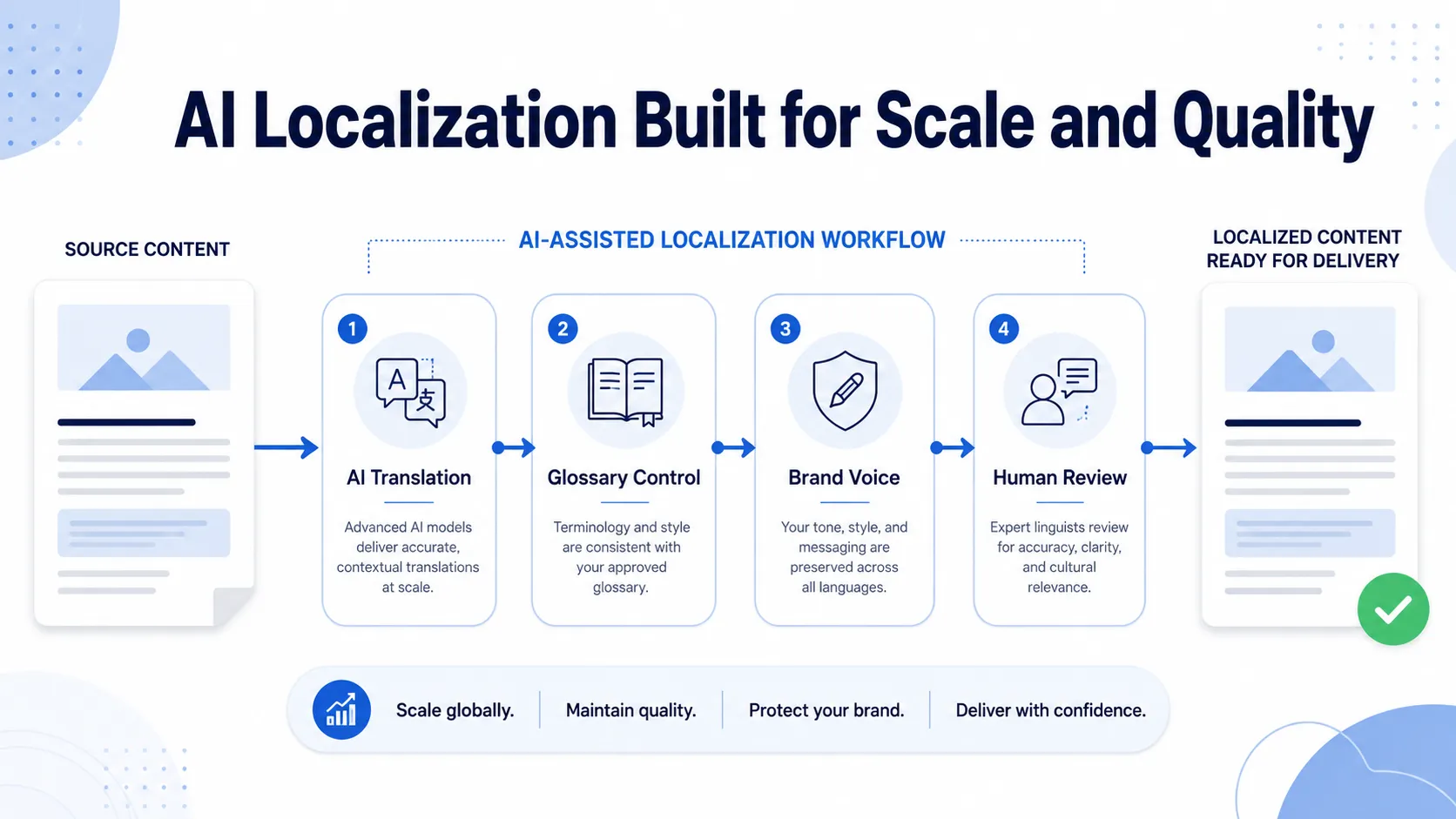
SEO-ready translation is a multilayered process that ensures every language version of a website performs both technically and linguistically. It involves keyword adoption, localization in every step of the process, CMS configuration, and multiple QAs. Each stage is designed to protect ranking equity and align your translated website with real search behavior in each market.
At a high level, the workflow looks like this:
- Research local keywords and SERP intent in each target language.
- Map keywords to pages and rewrite content for local search demand.
- Localize metadata, headings, URL slugs, and internal links.
- Implement hreflang, canonicals, sitemaps, and language-specific URL structures.
- Configure multilingual plugins or CMS modules for SEO indexation.
- Run linguistic and technical QA across all language versions.
- Monitor rankings, CTR, and conversions, and refine content continuously.
Let’s further break it down:
Keyword Research & SERP Intent Matching in Each Language
- Step 1: Identify target markets and languages:
First, the countries and language variants you are targeting are decided on. This avoids using a single generic keyword list for markets with different legal, cultural, and search behaviors.
- Step 2: Run native keyword research for each market:
Local SEO tools and native linguists to discover how real buyers search in that region are then employed. Keyword research must be redone in each language because direct translations almost never match the actual search terms used by buyers.
- Step 3: Map keywords to URLs and user intent:
Next, the localized keywords by intent (informational, commercial, transactional) are clustered and assigned to existing or new URLs. Each page is aligned with a primary keyword and supporting synonyms that reflect how prospects search in that market.
- Step 4: Brief translators with SEO context:
In this step, research into SEO translation briefs that include keyword priorities, SERP examples, competitor positioning, and tonality requirements is converted.
Translators and SEO specialists use these briefs to produce content that is not simply correct but optimized to rank and convert.
Technical SEO Localization (Hreflang, URLs, Canonicals)
- Step 5: Plan localized URL structures:
Whether to use subfolders (/de/, /es-mx/), subdomains, or ccTLDs based on your international SEO strategy is decided in this step.
Localized URLs help search engines index content correctly and improve click-through rates because buyers recognize familiar terms in the URL.
- Step 6: Implement hreflang attributes correctly:
hreflang attributes are added to indicate which language and region each page targets, such as hreflang=”es-ES”, hreflang=”es-MX”, or hreflang=”ar-AE”.
Hreflang attributes tell Google which language version to serve to which audience, eliminating duplicate content issues and preventing different language versions from competing with each other.
- Step 7: Configure canonical tags and multilingual sitemaps:
Each translated page is double-checked so that it has the correct canonical tag to avoid self-competition across languages and country variants. Language-specific XML sitemaps are built and submitted to Google Search Console, so search engines can crawl and understand the full multilingual structure.
Without these technical measures, multilingual sites struggle with indexing, cannibalization, and loss of ranking equity.
- Step 8: Localize schema markup and structured data:
Existing schema types and adapt key fields such as name, description, and inLanguage are reviewed to each localized version.
This supports rich results and ensures structured data is aligned with the language and region of the page.
CMS Integrations (WPML, Yoast, Polylang, Weglot)
- Step 9: Choose and configure the right multilingual stack:
At the platform level, multilingual plugins and CMS frameworks must support SEO indexation. On WordPress, WPML integrates natively with Yoast to localize metadata, sitemaps, and slugs.
Polylang requires a structured configuration to ensure translated pages are indexable and connected to the right language switcher.
TranslatePress offers dedicated SEO packs that manage schema and hreflang.
Weglot provides auto-indexing and metadata translation but still requires manual SEO fine-tuning for accuracy and keyword alignment.
- Step 10: Sync content, metadata, and taxonomies:
Titles, meta descriptions, Open Graph tags, image alt text, and taxonomy names (categories, tags) are correctly translated and mapped in the CMS. This ensures every language version has a complete SEO layer, not just translated body copy.
For enterprise CMS solutions such as Drupal or Adobe Experience Manager, this often means building custom workflows to manage localized fields and URL patterns.
- Step 11: Run full QA and SERP monitoring:
After publishing, both linguistic QA on terminology, tone of voice, UX copy, and technical QA on hreflang validation, sitemap coverage, canonical checks, and internal links are done.
Then move to ongoing monitoring: track rankings, click-through rates, and conversions by language and region.
This data is used to refine content, adjust metadata, and expand keyword coverage over time, turning SEO translation into a continuous optimization process rather than a one-time project.
What Makes Translation SEO-Friendly? (Quality Standards)
An SEO translation is only successful if it contributes to measurable business value. That requires semantic precision, accurate search intent alignment, cultural adaptation, metadata engagement, and internal linking defined by local behavior.
Quality metrics are evaluated against search intent accuracy, keyword efficiency, UX consistency, and technical compliance, using standards such as MQM and DQF.
The translation must satisfy both search engines and users by earning ranking positions, generating organic traffic, and improving conversion behavior.
Semantic Accuracy & Intent Alignment
Semantic accuracy means understanding what a phrase represents within a market’s search psychology and rewriting the content to match local buyer logic. This ensures every keyword and CTA aligns with the user journey in that region.
However, simple translations fail here due to mistranslations or different grammatical structures. Direct translation misses the nuances and, in turn, fails to reach potential customers
Localized Metadata & Search-Specific Content
Metadata must be rewritten to match the cultural persuasion style of the target market. Meeting the length preference of the target language is crucial for rankings. CTAs and tone also differ from language to language. Metadata is often the deciding factor for CTR, and localized metadata must improve click behavior, which simple translations will fail to achieve.
Localized Internal Linking & Multilingual Topic Clusters
Internal linking is crucial for reaching a wider audience. Adding multilingual content is necessary to reach the audience from target markets.
This strengthens topical authority in each language, ensuring that Google connects themes within the translated site based on regional semantic logic. Without localized topic clusters, multilingual sites gain visibility slowly and struggle to dominate high-value keywords.
SEO ROI for Website Translation (Why It Matters for B2B Buyers)
The business value behind SEO translation goes beyond traffic. Brands entering new markets gain long-term visibility without relying heavily on paid advertising. Organic leads convert better because they trust brands that speak their language and understand their cultural expectations. The return compounds over time because ranking equity grows as content earns impressions, backlinks, and repeat visibility. For B2B firms, the outcome is a long-term acquisition channel that continually lowers customer acquisition cost while improving inbound lead quality.
Organic Visibility Gains in New Markets
Multilingual market integration happens by optimizing for search engines within the target market. This enables your brand to rank among the local businesses by responding to the local SERP behaviours.
For example, A SaaS company targeting Germany can outrank incumbents simply by aligning keywords and metadata with the search habits unique to German buyers.
Once your brand secures visibility within the target market, your SEO translated content becomes your greatest asset, which will drive more traffic and convert to customers, building your permanent market presence rather than temporary traffic spikes.
Lower CAC and Higher Quality Leads via Local Search
Organic acquisition costs less than paid advertising, especially in competitive B2B markets. When localized SEO drives consistent inbound leads, companies no longer depend heavily on expensive international campaigns.
Leads generated from localized organic search are more qualified because they search using specific commercial terms that reflect readiness to purchase. Multilingual SEO becomes a cost-efficient system that raises conversion quality and drives ROI.
Why Choose Circle Translations?
Circle Translations offers more than translation. We deliver search-optimized market entry. Each project is led by native specialists trained in SEO, metadata rewriting, technical website localization, UX adaptation, and quality frameworks for multilingual content.
Hybrid SEO + Localization Expertise
Our teams don’t just translate keywords, but research them. Our linguists rewrite content based on local CTR behavior, SERP competitors, and commercial terminology used by regional buyers. This ensures every language version communicates value the way local decision makers expect, while ranking for how they search.
We embed SEO into every deliverable:
- Local keyword research
- Metadata rewriting
- URL + slug localization
- Hreflang implementation support
- Schema adjustments
- Internal link mapping by mark
Secure, Scalable, Tech-Driven Workflows
Circle Translations works with financial, healthcare, SaaS, cybersecurity, and government clients requiring strict security compliance. Content is handled through encrypted systems, backed by audited quality workflows. Large-scale multilingual websites receive dedicated project management, technical SEO supervision, and market-level review cycles. MTPE is used only where appropriate — and always refined by native specialists to ensure ranking value.
Flexible Pricing (Basic/Business/Pro)
Instead of fixed rates that ignore complexity, Circle offers tiered B2B pricing designed around scale, industry terminology, and SEO depth.
Options include Basic (light SEO), Business (full metadata + URLs), and Pro (full technical SEO + SERP analysis). Companies receive a custom quote and multilingual SEO audit before work begins, ensuring the investment matches market opportunity, not guesswork.
Conclusion
SEO-friendly website translation is a strategic investment brands make when expanding internationally. Each market is unique with its unique tonal requirement, phrasing, and grammar, making simple translation helpless in rankings.
Your brand needs visibility when looking to grow into a foreign market. This makes SEO translation an indispensable tool for your growth.
Many brands try to enter new markets with no localization and fail miserably. Invest in proper SEO-friendly translation to grow your brand into a foreign market.
Visit Circle Translations for more information and take your brand to international heights.
FAQs
What makes a translation SEO-friendly?
A translation becomes SEO-friendly when it targets how local users search rather than producing a word-for-word equivalent. The content must be optimized with localized keywords, metadata, URLs, internal links, and search-driven rewrites that reflect cultural behavior. When these elements align, the translated page ranks organically and improves conversion rates.
Do I need separate keyword research for each language?
Yes, because translated keywords rarely reflect how real users search in that market. Local SERP behavior, terminology, and commercial intent vary between countries, industries, and even regions within the same language. Without localized research, you risk ranking for irrelevant terms or missing the primary search opportunities in that language.
How does hreflang impact multilingual SEO?
Hreflang tells search engines which version of a page to serve to users based on language and location, preventing duplicated indexing issues across languages. Without hreflang, Google may display the wrong version, causing ranking conflicts between localized pages. Proper hreflang implementation protects visibility and improves international search accuracy.
Which CMS or plugins work best for multilingual SEO?
Solutions such as WPML, Yoast Multilingual, Polylang with Yoast support, TranslatePress SEO Pack, and Weglot enable metadata, indexation, and hreflang control. These integrations must be configured to ensure translated content is properly indexed and linked to localized URLs. When configured correctly, they provide a strong foundation for multilingual optimization.
Is AI translation good enough for SEO content?
AI can be used to generate draft translations, but it cannot replace human rewriting for search intent, industry vocabulary, and cultural adaptation. SEO content requires native linguistic decision-making and understanding of user psychology, which AI cannot replicate accurately. Human refinement ensures ranking, trustworthiness, and correct keyword alignment.
Does multilingual SEO improve conversions?
Multilingual SEO not only increases traffic, but also attracts buyers who are more likely to convert because they searched using native commercial terms. Users trust brands that speak their language and reflect local communication styles. This trust leads to higher lead quality, reduced acquisition costs, and improved long-term revenue performance.
Can URLs and sitemaps be translated?
Yes, URLs should be localized to reflect local terminology, and sitemaps must be structured to help search engines crawl and index each language version correctly. Localizing them strengthens topical authority and improves CTR because users recognize terms in the URL. When combined with optimized sitemaps, it supports precise multilingual indexing.