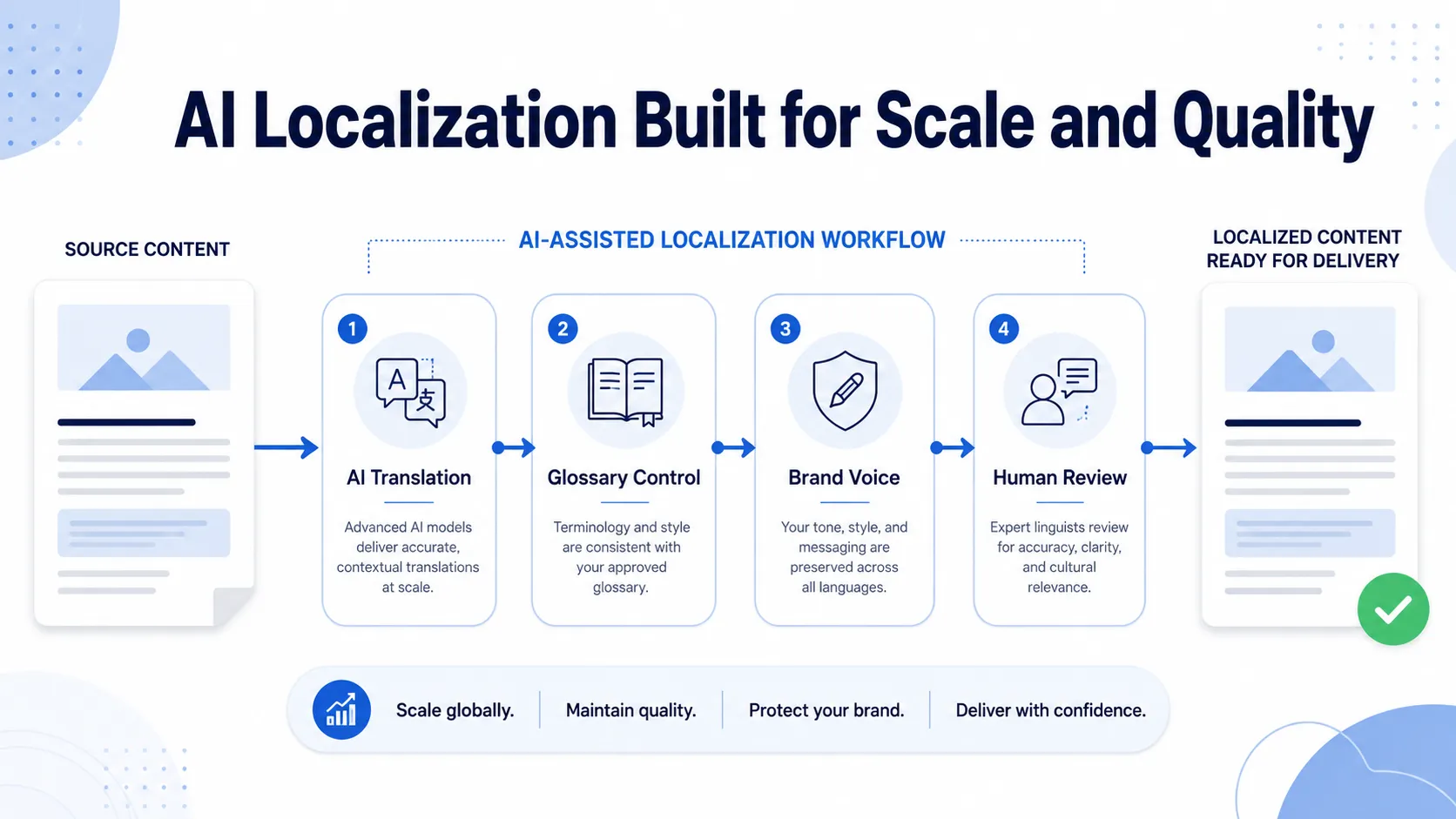

For global organizations operating across multiple markets with diverse languages and regulatory environments, localization has become a standard operational process that enables scaling without compromising release cycles, quality, or driving up costs.
A localization management tool (LMT) replaces spreadsheets, manual email handoffs, and vendor routing with automated, controlled workflows. Making it critical for project managers to gain predictable releases, for developers to regain time, and for procurement to see a more transparent, more structured workflow.
Localization offers consistency, auditability, and measurable ROI. By automating manual handling, LMTs significantly reduce turnaround time, making the workflow more efficient.
This guide explores the functions of an LMT, how it affects scaling, and drives ROI. If you’re evaluating localization technology or preparing an RFP, this article also gives insights into features to look for and how to evaluate suppliers.
What is a localization management tool, and how does it support global content ops?
A Localization Management Tool is a platform that manages the flow of multilingual content through the workflow from source to delivery. It centralizes the core aspects within the whole localization process, such as assets, integrations, and Q&As into a single system.
In traditional approaches, files are emailed, tracked through spreadsheets, and routed manually. This is inefficient, difficult to scale, and prone to errors such as lost content, especially at higher volumes.
LMTs solve that problem by creating repeatable, automated pipelines for the steps. And cutting manual exchanges reduces the risk of losing files.
At a high level, an LMT typically brings together:
- Workflow automation and routing rules
- File ingestion and parsing for multiple formats
- Translation memory (TM) and terminology bases (TB)
- Machine translation (MT) integration
- Linguist work environments or CAT tool access
- Quality assurance and LQA enforcement
- Version control and rollback
- Analytics, reporting, and audit logs
- Connectors to CMS, repositories, design tools, and support platforms
The value lies in centralization. Instead of fragmented processes across departments, vendors, and tools, teams operate from a single source.
Why teams upgrade: where traditional workflows break down
Traditional localization workflows introduce numerous bottlenecks, resulting in delays and errors. These workflows often tend to fail in the same places, such as:
- Handoffs: Email-based routing introduces delays and errors
- Versioning: Teams lose track of which file is current
- Terminology drift: Glossaries aren’t enforced consistently
- Developer dependency: Engineers are pulled into manual fixes
- PM overload: Project managers become bottlenecks
- Inconsistent QA: Quality checks vary by vendor or market
These issues compound as content volume and release frequency increase.
Localization management tools automate much of the workflow and, by reusing content assets, significantly reduce turnaround time and cost.
Core components of modern localization management tools
Modern localization management tools are built from a set of core components that work together to control and audit the localization workflows. These capabilities enable teams to automate workflows, reuse linguistic assets, enforce quality standards, and integrate localization directly into existing content and development systems.
Here are the key functional components of a modern enterprise-grade LMT:
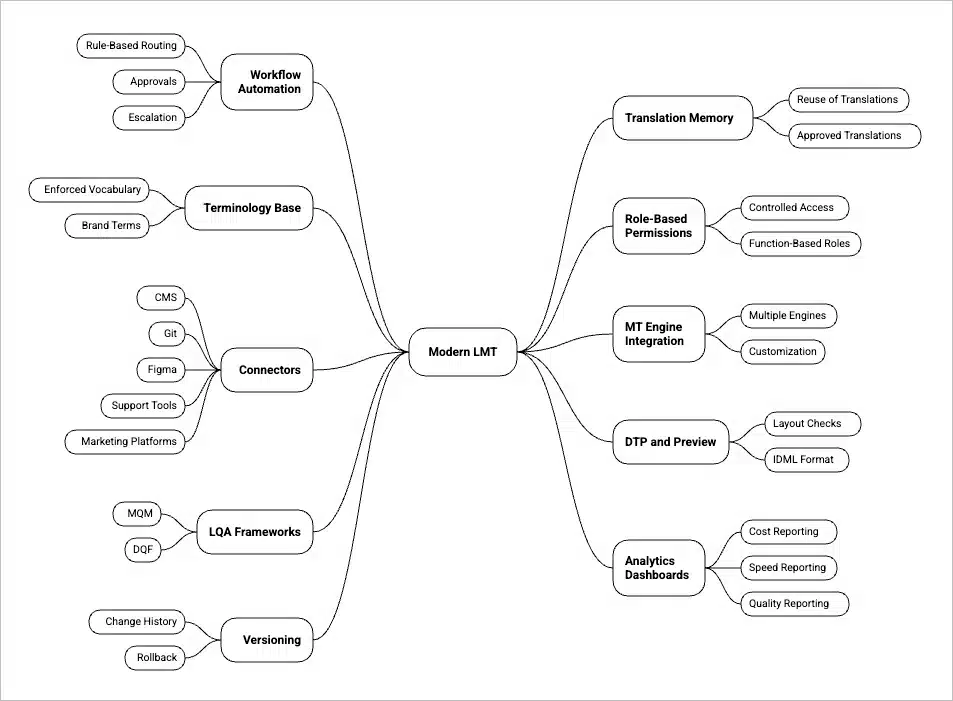
- Workflow automation: Rule-based routing, approvals, and escalation
- Translation memory (TM): Reuse of approved translations
- Terminology base (TB): Enforced vocabulary and brand terms
- Role-based permissions: Controlled access by function
- Connectors: CMS, Git, Figma, support tools, marketing platforms
- MT engine integration: Support for multiple engines and customization
- LQA frameworks: MQM or DQF-based quality models
- DTP and preview: Layout checks for formats like IDML
- Versioning: Full change history and rollback
- Analytics dashboards: Cost, speed, and quality reporting
LMT vs CAT Tool vs TMS
These are often used interchangeably. However, as an enterprise buyer, you must know the distinctions among them to find the right fit for your organization’s workflow.
Here’s a snapshot that highlights the differences between CAT tools, LMTs, and TMS:
| Category | Localization Management Tool (LMT) | CAT Tool | Translation Management System (TMS) |
| Primary purpose | Orchestrates end-to-end localization workflows and governance | Provides a workspace for translators to create translations | Manages translation assets and automates translation processes |
| Main users | Localization managers, PMs, developers, procurement teams | Translators, reviewers, linguists | Localization managers, PMs |
| Workflow orchestration | controls routing, approvals, and automation | No | Partial |
| Integration with systems | Deep integrations with CMS, Git, design, and support tools | Limited or none | Moderate |
| Governance & controls | Strong. Affects role permissions, audit logs, and approvals | Minimal | Moderate |
| Translation environment | Often included or integrated | Core function | Sometimes included |
| Asset management (TM/TB) | Centralized and governed | Uses TM/TB during translation | Stores and manages TM/TB |
| Quality management (LQA) | Enforces QA models and review workflows | Provides linguistic QA checks | Supports QA processes |
| Scalability | Designed for enterprise-scale operations | Scales at the linguistic level | Scales at the project level |
Many enterprise platforms combine all three. Based on the requirements, finding the best combination drives efficiency and ROI.
What features matter most for enterprise-level localization?
Features aren’t the sole criterion for an enterprise-grade LMT. However, they do dominate the deciding factor along with risk assessment.
Audit logs, single sign-on, MFA, approval gates, and SLA enforcement are crucial features LMTs must provide. Together, these controls ensure security and compliance assurance through auditability, TM governance, and clear cost control.
Requirements vary widely by industry. For instance, Manufacturing databases would not match healthcare term bases, and would require much different governance over the content being localized.
How do automation workflows reduce cost and increase speed?
File ingestion, TM pre-processing, and linguistic QA are automated, which helps delegate human labour to more critical parts of localizations, quality checks, and editorial tasks.
This automation leverages high TM leverage for repeated content, MTPE, and reduced human intervention. This keeps costs at bay and reduces turnaround times.
Not all content is automated, however. Legal and regulatory materials, safety documentation, along with other compliance materials are done manually.
This model assigns the bulk of the task to automated systems and delegates human resources only when necessary, reducing costs and time while driving efficiency.
Service partners like Circle Translations align 24/7 project management with automated workflows, ensuring speed without sacrificing accountability.
TM, TB & style guides: how governance improves consistency
Governance over the TM, TB, and style guides reduces the dependence on individual focus on projects. This results in consistent output every time.
An effective governance structure typically includes client-owned translation memories, approved and enforced terminology, centralized style guides, and designated linguist leads for each language, supported by project management oversight and structured client review loops.
This system-based approach reduces linguistic variation across markets, strengthens brand consistency, lowers rework rates, and turns linguistic assets into long-term value rather than one-off deliverables.
To protect that value, as an enterprise buyer, you should apply clear data ownership best practices. These include:
- Explicit TM ownership clauses
- Export rights in standard formats
- Vendor-agnostic data structures
Integrations & connectors: which systems should your LMT work with?
Localization management tools must integrate with the stack of technologies utilized within the workflow.
For content teams, this typically includes CMS platforms such as WordPress and Shopify. Engineering teams rely on integrations with code repositories like GitHub and GitLab, while design teams require compatibility with tools such as Figma.
Customer support teams often need connections to platforms like Zendesk and Intercom, and marketing teams depend on integrations with systems such as HubSpot and Marketo to manage multilingual campaigns efficiently.
LMTs are also expected to support a wide range of file formats, designs, and media. This offers more flexibility for developers and gives more options for clients onboarding.
Security, compliance, and data governance: what should buyers verify?
Localization workflows often involve sensitive business, customer, and regulatory information. Security is hence a non-negotiable consideration for enterprise buyers. Any localization management tool that cannot meet strict security and compliance standards should be eliminated early in the evaluation process.
During procurement, you should verify that localization management tools support GDPR alignment, appropriate handling of personally identifiable information (PII) and protected health information (PHI), encryption of data both at rest and in transit, and secure content portals for file access and collaboration. Clear NDAs and confidentiality controls should also be in place.
Providers will present formal documentation and validation for these safeguards during the evaluation process upon request. This increases their credibility, and the transparency helps avoid any future mishaps.
What security features differentiate enterprise-ready LMTs?
Many platforms claim to be secure, but only a small subset provides the controls procurement teams actually need to manage access, audit activity, and enforce compliance at scale. Concrete, verifiable security features define enterprise-ready LMTs. Here are the core capabilities to look for:
- Granular role permissions to control who can access, edit, and approve content
- Multi-factor authentication (MFA) and single sign-on (SSO) to align with corporate identity systems
- Audit trails that record every action for compliance and investigation
- IP restrictions to limit access by network or region
- Session controls to manage inactivity and forced logouts
- Version histories to track changes and support rollback
Procurement teams should assess these features through formal governance. Professional providers should be able to demonstrate how these controls work in practice clearly. And this not only shows their integrity but also, transparency required for B2B subscriptions.
How to calculate ROI for localization tools (cost, velocity & quality)
ROI is the primary focus for any and all investments. Localization is a long-term investment for organizations operating in multilingual markets.
Here’s a simple formula to calculate ROI:
ROI(%)=Total returns from Localization- Total cost of LocalizationTotal cost of Localization100%
In practice, localization ROI comes from three main areas. First, cost avoidance, achieved by reducing manual workflows and lowering ongoing project management overhead. Second, velocity gains, where faster localization enables quicker releases and earlier revenue recognition. Third, quality improvements, which reduce rework and minimize costly post-release fixes.
This approach helps translate operational improvements into financial terms that resonate with procurement and finance stakeholders.
For customer-facing content, ROI extends beyond cost savings. Faster localization can lower customer acquisition cost (CAC), increase lifetime value (LTV), and improve conversion rates in local markets by delivering relevant content frequently and more consistently.
ROI inputs: which metrics matter?
To quantify gains, enterprise teams should track a defined set of metrics, including translation memory leverage, MTPE productivity rates, linguistic QA error scores, cycle time per release, and overall release frequency. These indicators allow localization leaders to report impact in business terms and justify continued investment in tooling and process improvements.
Here’s what you should look for:
- TM leverage percentage
- MTPE productivity rates
- LQA error scores
- Cycle time per release
- Release frequency
How to evaluate suppliers: agency vs in-house vs hybrid models
For a successful localization, the execution is just as important as the technology itself. How teams staff, govern, and scale localization work directly affects cost, quality, and delivery speed.
In-House Localization
In-house localization teams offer the highest level of control, which can be valuable for regulated or highly specialized content. However, that control comes with high fixed costs and limited scalability.
As content volume fluctuates, in-house teams often struggle to absorb peaks in demand without creating delays or burnout.
Agency Localization
These provide immediate access to scalable expertise across languages, content types, and markets. Costs are more variable, which appeals to procurement teams, but success depends heavily on strong vendor management and clear governance. Without structured workflows and oversight, quality and consistency can vary across vendors and regions.
Hybrid Localization
Hybrid models combine the strengths of both approaches. Internal teams retain governance, standards, and strategic control, while external partners provide scale, specialization, and operational flexibility.
This model is increasingly favored by enterprise organizations that need to move fast without losing visibility or accountability.
RFP Checklist: What to include when selecting a localization management tool
A strong RFP reduces risk, clarifies expectations, and prevents costly surprises after onboarding. For enterprise teams, the goal is not just to compare features, but to assess whether a localization management tool can support scale, governance, and long-term operations.
Procurement-ready criteria to include:
- Content scope and types:
Define content volumes, formats (software strings, marketing content, technical documentation, multimedia), update frequency, and language coverage.
- Required integrations:
Specify mandatory connectors for CMS, code repositories, design tools, support platforms, and marketing systems, along with API requirements.
- SLAs and turnaround expectations:
Include delivery timelines by content type, escalation paths, uptime expectations, and support availability.
- Quality models and review workflows:
Require defined LQA frameworks, such as MQM/DQF, reviewer roles, approval gates, and issue resolution processes.
- Security and compliance requirements:
Document expectations for GDPR alignment, PII/PHI handling, encryption, audit logs, access controls, and data retention policies.
- TM and terminology ownership policies:
Clarify who owns translation memories and glossaries, export rights, update governance, and reuse across vendors or tools.
- Pricing structure and cost transparency:
Request full pricing breakdowns, including per-word rates, MT usage, connector fees, user seats, API limits, and support tiers.
- Onboarding and change management:
Ask for implementation timelines, training plans, documentation, and ongoing enablement support.
- User roles and permissions:
Define required role-based access for linguists, reviewers, PMs, developers, and procurement stakeholders.
- Reporting and analytics:
Require visibility into cost, turnaround time, TM leverage, quality metrics, and historical performance data.
What questions should vendors answer in an LMT RFP?
An effective LMT RFP is designed to surface how a vendor actually operates as opposed to how their platform is marketed. Enterprise buyers should use this stage to test transparency, operational maturity, and long-term fit.
Here are the questions you want clear answers to:
- Who owns the translation memory?
- Which MT engines are supported?
- How is file versioning managed?
- What are uptime and SLA commitments?
- How is quality measured and enforced?
- What onboarding support is provided?
- What are API limits and usage policies?
Vague or evasive answers are often early warning signs of hidden limitations or future cost and governance issues.
Hidden costs to surface in the RFP
Many localization platforms appear cost-effective at first glance, but pricing gaps often emerge after implementation. These overlooked charges can quietly inflate budgets and complicate renewals unless procurement teams address them upfront.
Procurement teams often miss:
- Per-seat licensing fees
- Connector add-ons
- MT usage overages
- API request limits
- SSO surcharges
- Premium support tiers
- Custom engineering costs
Conclusion
Multinational organizations operate across varying cultures and regulatory spaces. Localization becomes a core operational requirement.
A localization management tool provides the structure needed to scale content without sacrificing speed, quality, or governance. By replacing fragmented workflows with centralized automation, enterprises gain predictability in releases, stronger brand consistency, and clearer cost control.
Subscribing to LMTs requires not just marketing buzzwords, but also in-depth knowledge of the localization processes. An understanding of the subtle differences between different localization tools is also required to cut through the noise.
When shopping for an LMT implementation, you should prioritize automation depth, security and compliance controls, TM and terminology governance, integration flexibility, and transparent pricing.
Technology alone, however, is rarely sufficient. Successful localization programs pair the right platform with experienced human oversight. Hybrid models, where automation is combined with subject-matter linguists, QA frameworks, and dedicated project management, deliver the strongest results at scale.
This is where partners like Circle Translations add value by operating directly within client localization tools or providing managed workflows when needed.
FAQs
What does a localization management tool actually do?
It centralizes workflows, automates file routing, manages translation memories and glossaries, applies MT engines, enforces QA, and integrates with CMS and development tools. The result is reduced manual overhead and improved consistency.
Is an LMT the same as a CAT tool or TMS?
No. An LMT orchestrates workflows and integrations. A CAT tool is the translator’s workspace. A TMS manages assets and automation. Many platforms combine all three, but enterprises must assess feature depth.
How do LMTs improve translation quality?
Through TM reuse, terminology enforcement, MT customization, structured LQA frameworks, and controlled review and approval workflows.
Can an LMT reduce translation costs?
Yes. Automation, MTPE, reusable assets, and reduced manual coordination lower costs, especially as content volume and release frequency grow.
Which integrations matter most for global teams?
CMS platforms, Git repositories, design tools like Figma, CRM and marketing tools, support platforms, and support for structured file formats.
How do I compare localization tools in an RFP?
Focus on automation depth, API limits, security, TM ownership, LQA models, connector fees, onboarding, SLAs, uptime, and reporting.
Does Circle Translations work within client localization tools?
Yes. Teams integrate directly into client localization platforms or provide managed workflows, supplying linguists, QA, engineering review, and PM oversight.