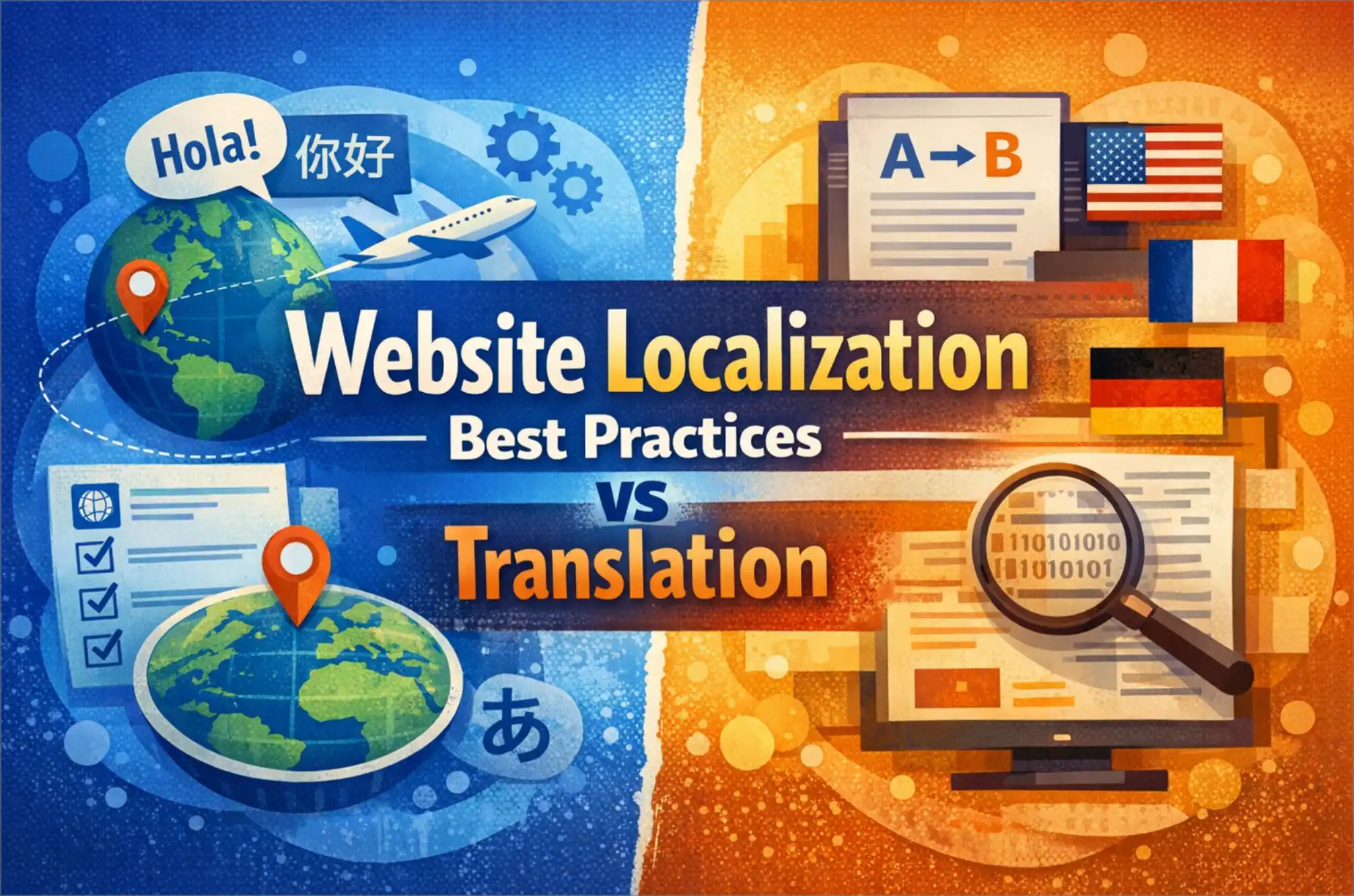
Website Translation and Website Localization define how your customers experience your website. Both achieve the same goal: getting your message across in the local language. But that doesn’t make them interchangeable.
Translation moves words between languages, whereas localization adapts an entire digital experience to a market. Both have their best-fit cases, depending on your project.
This article explains the difference between website translation and localization, outlines best practices for website localization, and shows where AI and machine translation realistically fit into modern workflows.
What Is the Difference Between Website Translation, Localization, and Internationalization?
Website translation focuses on converting text from one language to another. It covers on-page copy, navigation labels, buttons, forms, and basic UI strings. Translation covers just the linguistic aspect.
Website localization goes further. It adapts the entire website experience to the specific market, covering language, tone, visuals, formats, UX patterns, and SEO.
Internationalization is the technical foundation. It prepares your website’s code, structure, and architecture to support multiple languages and locales without breaking. Internationalization happens before localization and enables it.
Translation without localization feels foreign. Localization without internationalization breaks at scale. A complete website localization requires all three.
Comparison chart:
| Dimension | Translation | Localization | Internationalization (i18n) |
| Primary goal | Convert text into another language | Adapt the entire website experience to a local market | Prepare the website’s code and structure to support multiple locales |
| Scope | Words and sentences | Language, UX, visuals, formats, SEO, tone | Code, architecture, templates, and data handling |
| Focus | Linguistic accuracy | User experience and market fit | Technical readiness and scalability |
| Typical content | Page copy, menus, buttons, forms | Pages, CTAs, images, examples, currencies, layouts | Resource files, templates, URLs, and encoding |
| Cultural adaptation | Minimal or none | Core requirement | Not applicable |
| UX impact | Low | High | Indirect (enables UX adaptation) |
| SEO impact | Limited | Significant (localized keywords, metadata) | Foundational (URL structure, hreflang support) |
| Technical involvement | Low | Medium | High |
| When it’s sufficient | Internal or low-visibility content | Customer-facing websites and growth markets | Before any localization at scale |
| Risk if skipped | Poor clarity | Low trust, weak conversions | Broken layouts, rework, scaling issues |
| Business outcome | Comprehension | Engagement, trust, conversions | Long-term efficiency and scalability |
What Is Website Translation and Localization in a B2B Context?
Translation covers the fundamentals of localization. However, it doesn’t account for nuances and cultural contexts. It usually includes:
- Navigation and menus
- Product descriptions
- Forms and CTAs
- Support and help content
Website localization adapts how the site converts in each market. Without localization, a website will feel foreign to the users. Localization typically covers:
- Local imagery and examples
- Testimonials relevant to the region
- Date, number, and currency formats
- Payment expectations
- Regulatory language
- Local keyword targeting for SEO
A core website localization best practice is to treat your site as a product for each market, rather than a static document. For B2B teams, this directly affects demo requests, lead quality, and pipeline velocity.
What Is a Localization Strategy in Translation Projects?
Website localization is a layered, carefully engineered workflow that requires a clear strategy. It requires extrinsic research of the target locale. Leads, trials, and revenues are then put to use. UX is then modified to fit the target language without breaking. Finally, SEO and multiple rounds of quality checks are done.
For B2B organizations, localization strategies sit inside the broader global growth plan, not inside content ops alone.
Website Localization Best Practices
High-performance websites only succeed by making deliberate, market-driven decisions about localization, design, and operations.
Professional teams with a structured approach move faster, make fewer errors, and convert more effectively in new markets.
How Should You Prioritize Markets, Languages, and Pages?
Most of the decisions taken during localizations are mainly based on the market you’re entering and the services you’re selling. For instance, languages are picked based on the market. Say, if your market is Belgium, you’ll need your site to be localized to French and Dutch.
One of the most common mistakes brands make is trying to localize everything at once. Best practice is to prioritize based on business value, not content volume. Start with core conversion paths:
- Homepage
- Product pages
- Pricing
- Demo or contact flows
- Key support content
Then, you can build and expand on the framework as you go.
How Do You Prepare Source Content for Localization?
Poor source content creates expensive localization problems. Make sure that your content has a clear tone and intent that carries your brand’s voice. Try to deal with ambiguity and culture-specific references early on. And build a standardized terminology base.
This improves translation quality, reduces cost, and supports international SEO. It also makes AI and machine translation more reliable.
What UX and Design Choices Support Effective Website Localization?
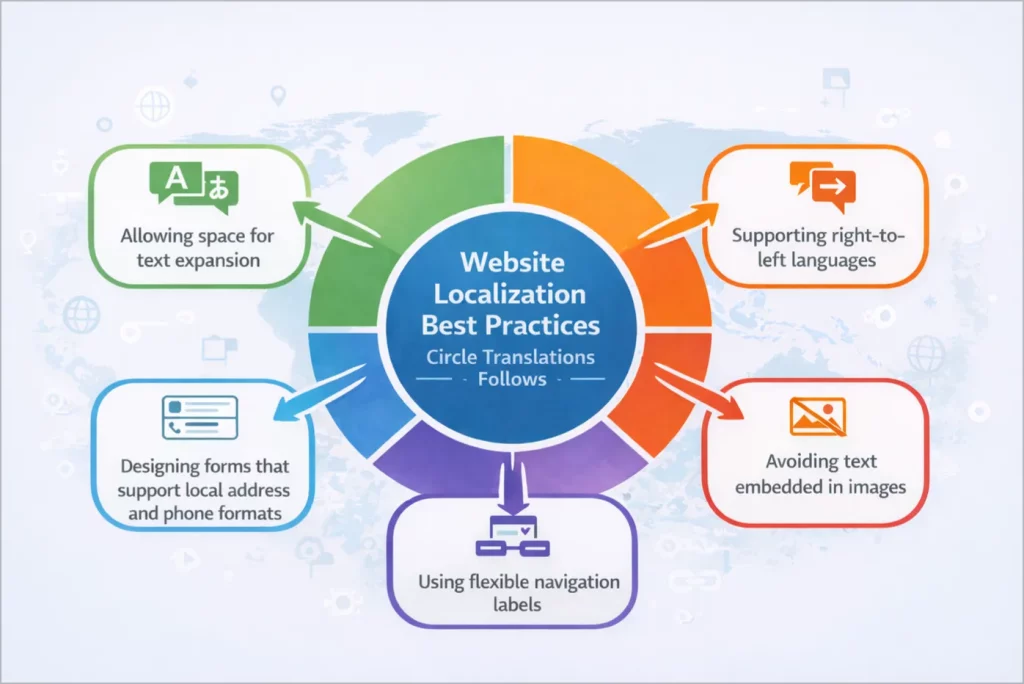
Localization depends on the UX and design of your website. If your design is too rigid or constricting, translated text might not fit the spaces properly.
This causes issues, especially if your target language is a right-to-left language.
Imagery should reflect local norms, not just be globally neutral. UX decisions have a direct impact on trust and conversion.
Here are a few website localization best practices we follow at Circle Translations:
How Do You Handle SEO for Localized Websites?
SEO is not optional after you’ve localized your website. Localization teams would optimize your site based on the market you’re targeting.
Website localization steps for SEO include:
- Local keyword research per market
- Dedicated URLs for each language or locale
- Correct hreflang implementation
- Localized meta titles and descriptions
- Consistent internal linking
A strong international SEO setup ensures search engines understand which version of your site to show.
How Should Localization Workflows and Governance Work?
Manual localization workflows do not scale. As content volume and release frequency increase, spreadsheets and email-based routing quickly become bottlenecks.
Best-in-class teams replace these processes with integrated CMS and localization platforms that automate content synchronization, enforce shared glossaries and style guides, and apply defined review and quality assurance stages.
Continuous localization tied to release cycles allows teams to update multilingual sites without disruption.
At scale, governance matters just as much as speed. Effective website localization requires clear ownership, defined roles, and accountability across teams.
Website Internationalization Best Practices for Dev Teams
Internationalization is the technical foundation that enables localization to be sustainable. Key i18n principles ensure that websites can scale across markets without costly rework
How Do You Architect a Localization-Ready Website?
A localization-ready website starts with the right technical foundation. Internationalization decisions made during architecture and development determine whether localization scales smoothly or becomes a source of ongoing rework and risk.
Key i18n principles include:
- Unicode (UTF-8) support
- Externalized resource files
- No hard-coded strings
- No concatenated phrases
- Locale-aware formatting
- Templates that support RTL and CJK languages
How Do You Handle URLs, hreflang, and Redirects Across Markets?
URLs, tags, and redirectors are a significant pitfall that is often overlooked. They are crucial for integration into a market.
Use hreflang to define language and region relationships clearly. Avoid aggressive geo-redirects that block search engines or users.
Where Does “Best Translation” Stop and Full Localization Begin?
High-quality translation can work for internal portals, knowledge bases, and low-visibility support content where clarity matters more than persuasion.
For customer-facing pages, however, translation alone does not drive results. These pages require full localization, adapting language, UX, visuals, and context to build trust, support conversion, and perform effectively in local markets.
What Content Types Can Stay Closer to Direct Translation?
Lower-risk content doesn’t usually require a full localization. Internal FAQs, support articles, and system notifications are well-suited for AI-assisted translations with human QA.
Which Parts of the Website Always Need Full Localization?
Customer-facing areas that are an essential part of your website, need a full localization. Homepages, landing pages, product pages, and solution pages are the best candidates for localization. Case studies, CTAs, and testimonials are also high-impact parts of your website that would certainly benefit from complete localization.
Localized UX and messaging consistently outperform translated-only pages in engagement and conversion.
Best Practices for AI, ChatGPT, and MT in Website Localization
AI has revolutionized localization with its automation features. With that said, AI and MT are productivity tools, not full replacements for human judgment.
Can ChatGPT and AI Tools Be Used for Website Translation?
AI tools can produce solid drafts for straightforward content and often outperform traditional MT on context-heavy text. However, they still miss brand nuances, cultural contexts, and domain-specific terminologies. Not to mention AI tools still lag far behind in legal and compliance requirements.
For B2B websites, AI should be used within MTPE workflows, mainly for marketing, legal, and product content.
How Accurate Are Google Translate and Other MT Engines for Websites?
Accuracy varies widely by language pair and content type. Often ranging from moderate to high for simple text, and much lower for specialized or creative content.
Google Translate is fine for short strings that need immediate attention. But it lacks the technical nuance required for integration into localization workflows.
Is AI Replacing Translators, or Changing Their Work?
AI has automated the bulk of the workflow that takes up the majority of the time. Freeing up that means human expertise can be assigned to content that actually needs attention.
AI minimizes human intervention and shifts the focus to domain expertise, QA, and subject matter expertise.
For complex B2B websites, humans remain responsible for accuracy, tone, and liability.
How Can Teams Improve the Accuracy of AI and MT Outputs?
As great as AI and MT outputs are, they still make mistakes that could result in costly reworks. Teams can significantly improve AI output by:
- Writing clear source copy
- Keeping sentences short
- Using consistent terminology
- Avoiding wordplay and idioms
- Testing translations before launch
- Applying professional review
These practices improve both machine output and final quality.
Can Turnitin Detect AI-Translated Content?
AI-detection tools exist and continue to evolve. However, their accuracy is still not reliable enough to be implemented into enterprise workflows.
For businesses, the real concern is quality, transparency, and compliance, rather than detection. Organizations should align AI use with internal policies and regulatory requirements.
When to Partner With a Website Localization Agency
When you’re expanding into multiple markets with complex regulatory environments, and the workflow gets too complex for your in-house teams to manage, you need to start shopping for a localization agency.
Professional teams, such as Circle Translations, are well-equipped for synced multi-market launches, manage multiple high-value regional pipelines, and complex CMS or tech stacks. They cover continuous optimization as the content library expands.
This is where partners support B2B teams by combining localization strategy, technical integration, human expertise, and scalable workflows.
What Should You Look for in a Website Localization Partner?
Here’s what to look for when you’re looking for a website localization partner:
- B2B domain expertise:
Proven experience working with complex products, long sales cycles, regulated industries, and buyer-driven content rather than consumer marketing alone.
- Multilingual SEO experience:
The ability to conduct localized keyword research, optimize metadata, implement hreflang correctly, and align localization efforts with international SEO strategy.
- UX and design localization support:
Expertise in adapting layouts, imagery, navigation, forms, and interaction patterns to local user expectations while maintaining brand consistency.
- Internationalization-aware engineering support:
Teams that understand i18n fundamentals and can collaborate with developers to prevent technical issues before localization begins.
- CMS and localization platform integration:
Experience integrating with modern CMSs and localization tools to automate content flow, reduce manual handling, and support continuous localization.
- Clear AI and MT policies:
Transparent guidance on where AI and machine translation are appropriate, how quality is maintained, and where human oversight is required.
- Security, compliance, and reporting:
Strong controls for data protection, role-based access, auditability, and performance reporting that meet enterprise and regulatory requirements.
Summary
For procurement, understanding the difference between translation and localization directly results in how your brand performs in new markets. The choices made at this level influence everything from search visibility and user trust to conversion rates and operational efficiency.
As B2B organizations scale globally, website localization shifts from language coverage to execution. Teams that approach localization as a structured, ongoing capability rather than a one-time translation task are better positioned to support revenue goals while controlling risk and cost.
Partners like Circle Translations are ideal for big projects that expand to multiple markets. With support for 120+ languages, 24/7 project management, and mature MTPE capabilities, Circle Translations offers the operational scale, governance, and flexibility required to manage complex, multi-market website localization programs without sacrificing quality or control.
Whether you are planning an initial expansion or optimizing an existing multilingual site, applying these website localization best practices helps ensure your website works as intended for each audience it serves.
Frequently Asked Questions
What is the difference between translation and localization?
Translation converts text from one language into another. Localization adapts the entire website experience to a specific market, including tone, visuals, formats, UX, and SEO. Translation focuses on words; localization focuses on how users experience and act on your site.
What is website translation and localization in practice?
Website translation covers menus, page copy, forms, CTAs, and system messages. Website localization goes further by adapting currencies, date and number formats, examples, testimonials, imagery, keywords, and UX patterns so the site feels native to local buyers, not merely translated.
What is the difference between literal translation and localization?
Literal translation preserves the original wording as closely as possible, which often leads to awkward phrasing or missed intent. Localization reshapes the message so it sounds natural in context, matches brand tone, and fits cultural and UX expectations in the target market.
Can ChatGPT or other AI tools handle website translation on their own?
AI tools can generate fast, usable drafts for straightforward content, but they should not operate alone on customer-facing B2B websites. Brand messaging, legal content, and conversion pages still require human review to ensure accuracy, tone, and compliance.
Is Google Translate accurate enough for my business website?
Google Translate can be acceptable for short, simple text, but accuracy varies widely by language pair and content type. It struggles with nuance, technical terminology, and brand voice. For business-critical websites, professional review and localization are still necessary.
Is AI replacing human translators?
No. AI is changing how translators work, not replacing them. Machines handle repetitive or draft-level content, while human linguists focus on domain expertise, cultural adaptation, quality assurance, and risk management—especially for B2B and regulated industries.
How can I improve the quality of AI or MT translations on my site?
Write clear source content, keep sentences short, use consistent terminology, avoid idioms and wordplay, and limit ambiguity. Always follow AI or MT output with human review, especially for marketing, legal, and product pages.
Is ChatGPT or Google Translate better?
Neither tool is universally “better.” ChatGPT often performs well with context and natural phrasing, while Google Translate can be strong for common language pairs and simple text. For B2B websites, the key is how these tools fit into a human-led localization workflow—not which tool is used alone.