When it comes to globalization, language is the primary vessel for integration into foreign markets. Appropriate measures must be taken to ensure a clear representation of your brand voice, without any confusion in the messaging.
There are two primary paths you can take: Localization and Translation. This defines not only how your message is conveyed, but how your brand is perceived, trusted, and adopted in each target market.
Translation is but a part of a much bigger system, which is localization. However, that doesn’t necessarily mean there’s one that is better. It boils down to what you need for your brand’s growth.
This guide will help you outline the boundary between these services, understand ROI differences, map workflows, and develop a clear decision framework for your organisation.
What’s the Difference Between Localization and Translation?
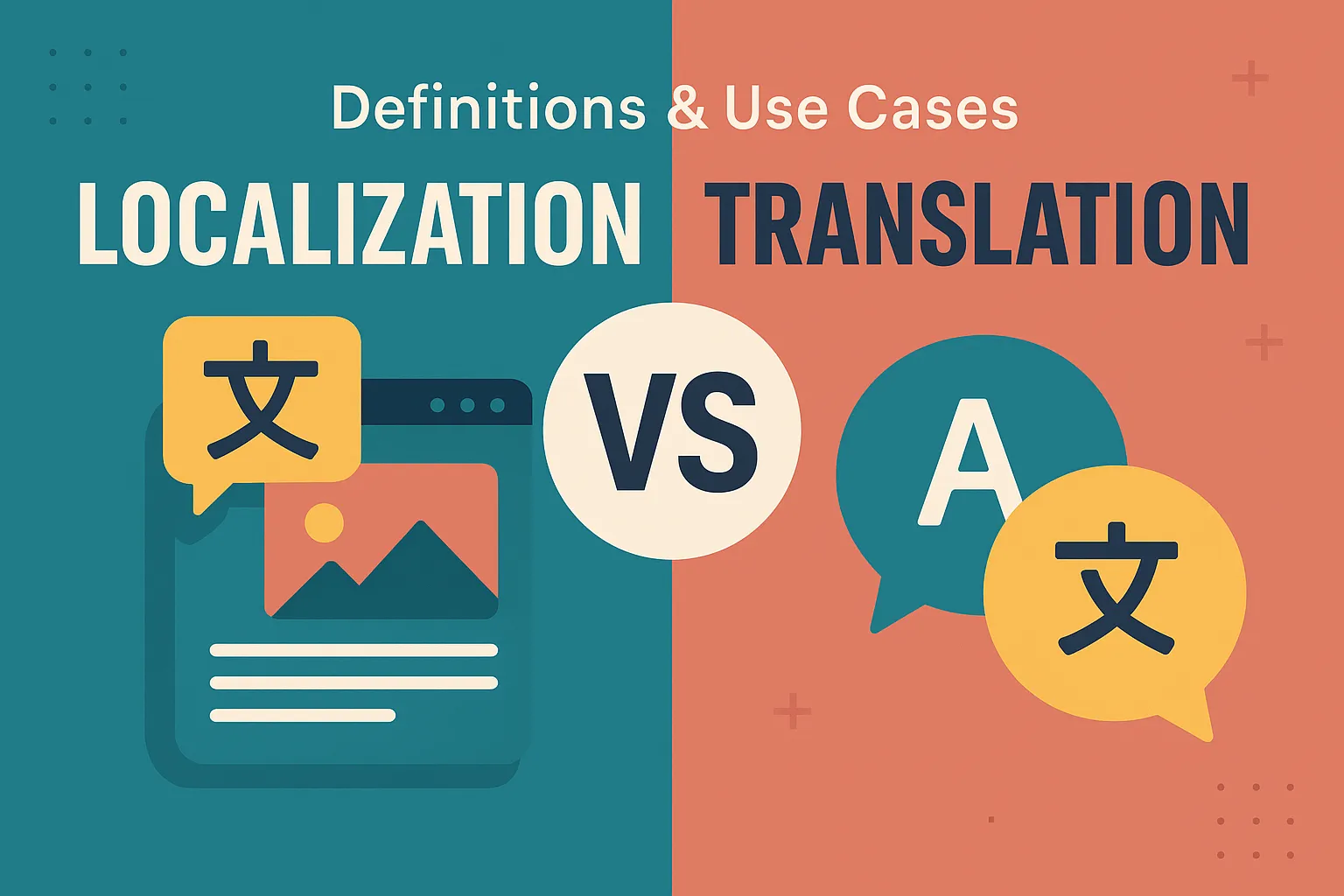
Translation is the process of converting text from one language to another while prioritizing linguistic equivalence, grammar, terminology accuracy, and syntactic clarity.
Localization goes beyond direct language conversion and adapts content for cultural norms, legal requirements, UX expectations, formatting, visuals, and regulatory standards in each target market.
In practical terms, translation aims for accuracy, localization focuses on market relevance and regulatory fit, while transcreation emphasizes audience persuasion and brand tone. Here’s a table that summarizes the key components:
| Feature | Translation | Localization |
| Primary goal | Linguistic accuracy, fidelity to source | Market-relevance, cultural fit, UX alignment |
| Typical assets | Manuals, contracts, legal text | Websites, UI/apps, marketing pages |
| Toolset | CAT tools, translation memory | TMS + DTP + localization engineering |
| ROI focus | Compliance, accuracy, internal consistency | Conversion uplift, market adoption |
How Translation Focuses on Linguistic Accuracy
Translation is suited when the principal requirement is correctness. For documents and manuals, where misinterpretation carries risk. In this context, translation projects emphasise word-for-word translation, consistency across versions, Terminology, and user experience.
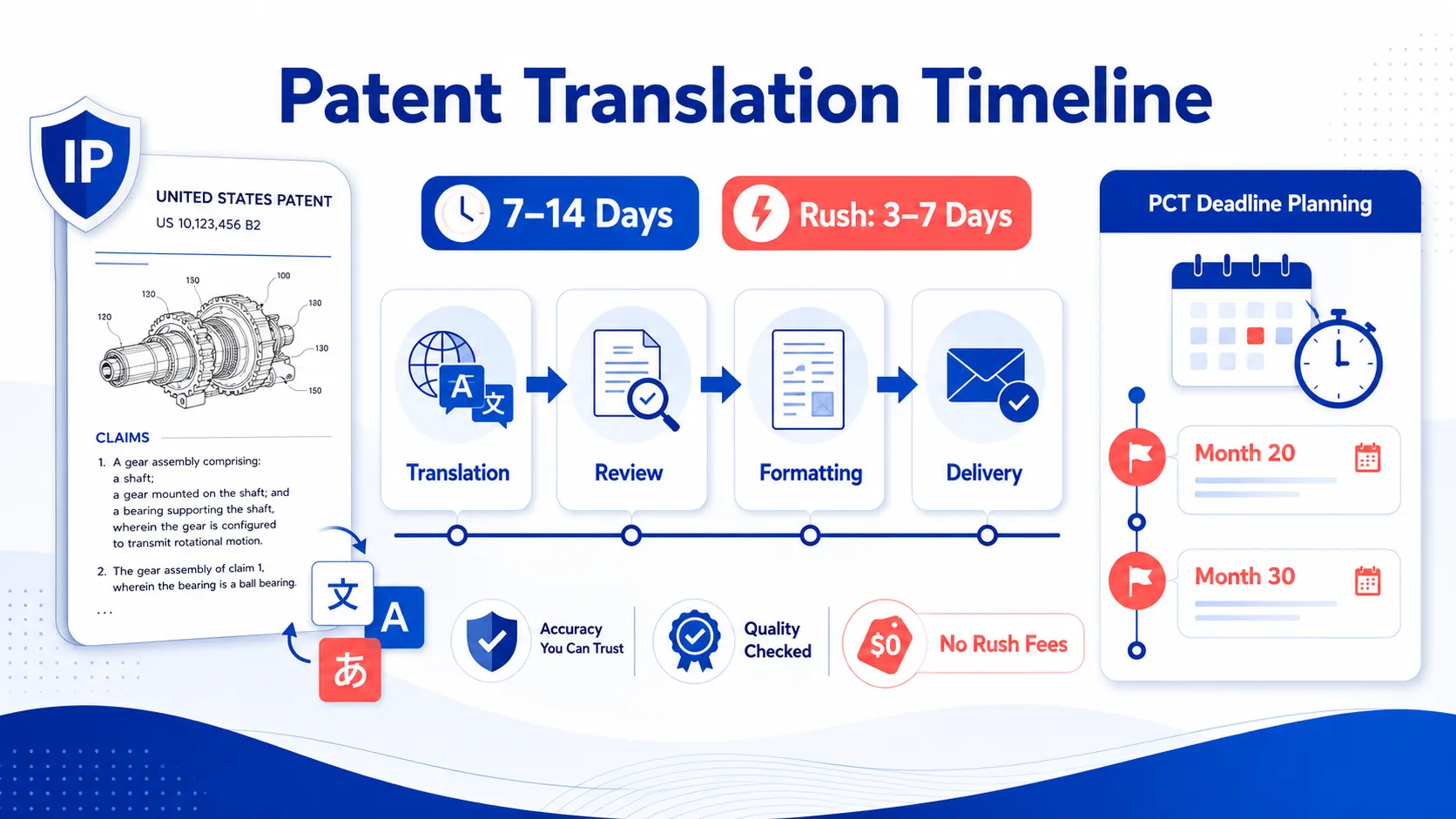
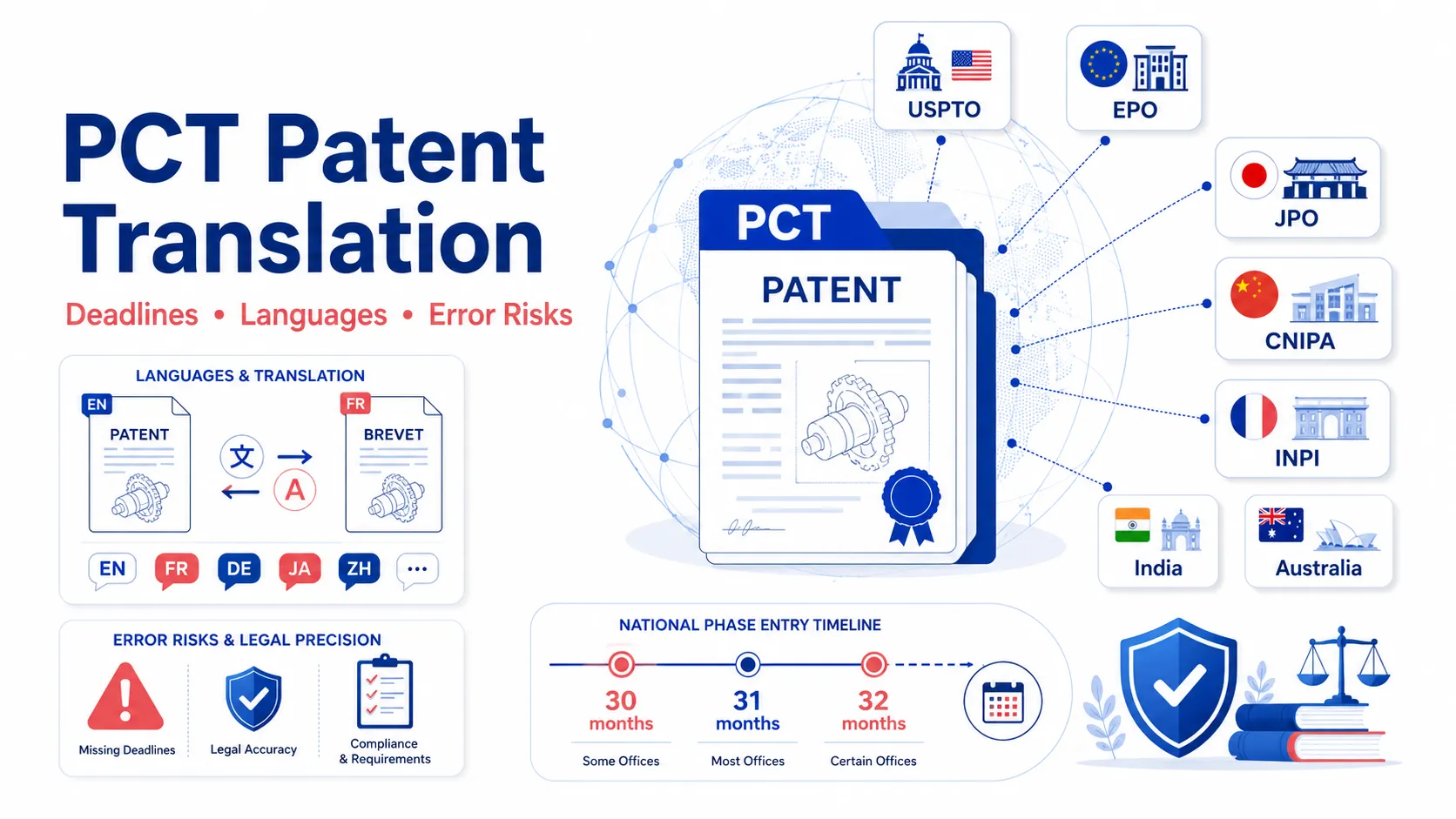
Projects such as Technical service manuals shipped in multiple languages, Patent disclosures, and contracts are a perfect fit for translation workflows.
How Localization Adds Market Relevance & UX Adaptation
Localization makes your content relevant to the target market. It means more than language. It adapts everything from date and time formats to imagery, tone, UI strings, units, and currencies so your product feels native to users in every region.
Cultural phrasing and idiom adaptation for natural communication, visual and color adjustments to avoid cultural misinterpretation, localized units, currencies, and RTL(right-to-left) layouts for seamless readability, user-interface alignment across menus, buttons, and error messages, and built-in compliance with regional laws and regulations are some of the key features that Localization focuses on.
This attention to nuances improves engagement, trust, and drives up ROI.
Why Localization Matters More Than Translation in Global Markets
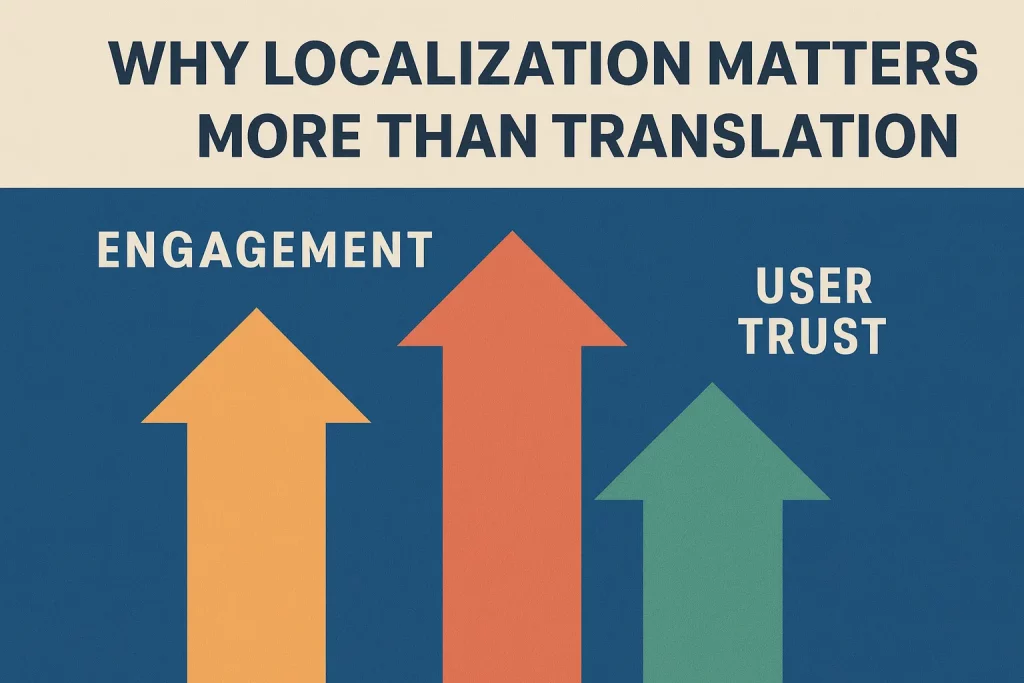
Localized products outperform simple translation because they deliver higher engagement, lower churn, and stronger user trust.
Brands such a GetBlend report bounce rates, time-on-site, and page depth measurements, with well-executed localization typically reducing bounce rates by 30-40%.
For SaaS, finance, healthcare, and eCommerce, localization ensures market fit and compliance (GDPR, ISO, local laws), protecting trust while boosting acquisition and retention far beyond simple translation.
Translation is fundamental; however, localization is a system strategically designed for integration into foreign marketplaces.
Localization in Software, Apps & UX Design
Effective software localization and mobile app localization go beyond text translation. They shape UI/UX and usability. Localized interfaces must account for UI string limitations, character expansion (German, Arabic), RTL(Right-to-Left) layouts, and backend dependencies that break when strings overflow or concatenate incorrectly.
Localization requires UI/UX localization engineering and QA that tests clickable buttons, menu hierarchies, error messages, onboarding flows, and in-app widgets to ensure functional clarity in every locale. Even microcopy affects adoption; a simple change from “Download” to “Get App” in certain markets can shift call-to-action behavior and improve conversion.
Localization for Marketing & Branding
In marketing localization, the message must persuade the listener or reader. Just translating linguistically will not achieve this. This is where transcreation, a key component of marketing localization, and creative adaptation rewrite product names, taglines, and campaign slogans so they emotionally land with local audiences rather than sounding literal or awkward.
Brands that skip this step often fail with direct translations that miss tone or cause misinterpretations, weakening brand perception.
Circle translations ensures success by crafting a culturally native voice and impact, and marketing localization that builds resonance and elevates global campaigns beyond word-for-word accuracy.
Localization for Compliance & Finance
In regulated industries, compliance is a non-negotiable. Localization ensures documents, interfaces, and disclosures meet legal and financial requirements in each jurisdiction. This includes financial document localization and regulatory translation aligned with frameworks such as GDPR, ISO standards, EU medical directives, and fintech KYC obligations, where even minor language variations can trigger liabilities.
Localization protects enterprises by adapting terminology, formats, stamps, numerical conventions, signatures, disclaimers, and mandatory legal phrasing, ensuring documents and digital workflows are legally valid and enforceable in every target market.
Translation vs Localization Workflow: Step-by-Step Comparison
Global teams don’t struggle with choosing the right one for each asset.
A contract and a product page may both need multilingual output, but their risk, UX impact, and market expectations are entirely different, which is why the wrong choice often leads to churn, compliance issues, or low conversion.
Let’s dive deeper into each workflow so you can find the best one for the projects at hand.
Translation Workflow (Accuracy-Oriented)
Translation is the foundation of localization workflows. But this in itself is a multilayered process that spans extraction to delivery and review.
Here’s what a typical translation workflow looks like:
- Project Intake & Scoping:
Source files are collected (editable formats preferred), target languages are confirmed, and requirements are defined: glossary use, style guide, regulatory constraints, and delivery deadlines.
- Content Preparation & Text Extraction:
Text is extracted from documents, CMS, or design files, cleaned, and segmented into translatable units. At this stage, CAT tools and translation memories are set up so existing translations and terminology can be reused.
- Machine Pre-Translation (Optional MTPE Stage):
For straightforward, low-risk content, an MTPE workflow is applied: an MT engine produces a first draft. Which is then fed into the CAT tool environment. This step speeds up delivery while keeping everything trackable.
- Human Translation (Linguistic Fidelity):
A professional translator (subject-matter aware) works segment by segment, ensuring linguistic fidelity, correct terminology, and consistency with the glossary and style guide. For MTPE, this means carefully revising MT output instead of translating from scratch.
- Bilingual Editing & Proofreading:
A second linguist performs proofreading and editing, checking accuracy against the source, fixing terminology, grammar, punctuation, and tone. This is where quality is tightened so that “accuracy > persuasion” is fully respected.
- Quality Assurance (QA) & CAT-Based Checks:
Automated QA checks (within the CAT tool) flag inconsistencies, missing numbers, tag errors, terminology violations, or layout issues. The linguist/QA specialist resolves all issues before sign-off.
- Final Formatting & File Reconstruction:
Translated content is reintegrated into the original file format (DOCX, PPTX, InDesign, CMS templates), preserving layout and structure. Minor layout adjustments are made if needed to accommodate text expansion.
- Client Review, Feedback & Memory Update:
The client reviews the output, requests adjustments if necessary, and once approved, the translation memory and termbase are updated. This closes the loop and makes future proofreading translation and MTPE cycles faster and more consistent.
Localization Workflow (Market-Oriented)
A market-oriented localization workflow focuses on adoption, cultural perception, UX behavior, and legal fit. It goes beyond text conversion to adapt the experience, interface, and messaging for each market. This makes it the right choice when revenue and customer activation matter more than pure accuracy.
Here’s what the workflow looks like:
- Market & Cultural Discovery:
Research is conducted on target-locale preferences, cultural tone, industry norms, compliance expectations, and UX behavior. This may include competitor benchmarking, terminology validation, and cultural risk assessment with in-market reviewers.
- Content Segmentation & UX Context Mapping:
Text is pulled from CMS, UI strings, product interfaces, marketing modules, and multimedia. Unlike translation, segments are mapped to user flows, not just sentences, ensuring copy fits buttons, screens, onboarding, support, checkout, etc.
- Localization Engineering Setup:
Developers and localization engineers configure string files, placeholders, resource bundles, RTL layouts, concatenation fixes, and locale logic (currency, date formats, measurements). CAT/TMS systems are configured with locale-specific UX rules.
- Cultural Adaptation & UX Localization:
Local linguists adapt wording, tone, CTAs, and visual cues for the specific region. Content is rewritten for conversion, readability, and trust triggers (not literal equivalence). UI labels and microcopy are optimized to fit character constraints and UX expectations.
- Design & DTP Adjustments:
Visual assets, typography, image direction, color symbolism, iconography, and layout spacing are adapted per locale. DTP (Desktop Publishing) adjustments ensure text expansion, RTL orientation, and visual compliance do not distort design.
- Multilingual Functional QA & In-Context Testing:
Engineers and reviewers test how localized content behaves inside the product: button breaks, truncated labels, misaligned icons, broken currency logic, mistranslated legal fields, unreadable error messages, or accessibility failures.
- Legal, Regulatory & In-Market Review:
Marketing, product, and legal teams verify compliance with GDPR, ISO, medical directives, fintech KYC, advertising rules, and sector-specific mandates. Local reviewers confirm tone and integrity match cultural expectations.
- Launch, Optimization & Conversion Monitoring:
Post-launch analytics track retention, bounce, funnel progression, activation rates, CTR on localized CTAs, and qualitative feedback. Localization teams iterate to improve conversion and UX performance continuously.
Localization vs Translation: When to Use Each
Picking the right approach depends on your content needs. whether it’s a legal translation, UX-focused localization, or brand-driven transcreation. A privacy policy and a landing page don’t play the same role in user trust or conversion, putting the difference into perspective.
Here’s a table that helps you to cut through the noise and decide on your approach based on what fits your brand:
| Project Type | Best Choice | Reasoning |
| Contracts, legal documents | Translation | Legal accuracy must remain identical |
| Internal communications | Translation | Clarity needed, not cultural persuasion |
| Websites, landing pages | Localization | UX and market relevance drive conversion |
| Mobile apps & UI strings | Localization | UI behavior + culture impact user adoption |
| Brand campaigns & launches | Localization + Transcreation | Messaging must fit the culture and brand tone |
| Slogans, product names | Transcreation | Literal wording hurts persuasion & reputation |
When Translation Alone Is Enough
For high-stakes content where marketing isn’t the primary goal, translation provides the required value without the additional investment of localization.
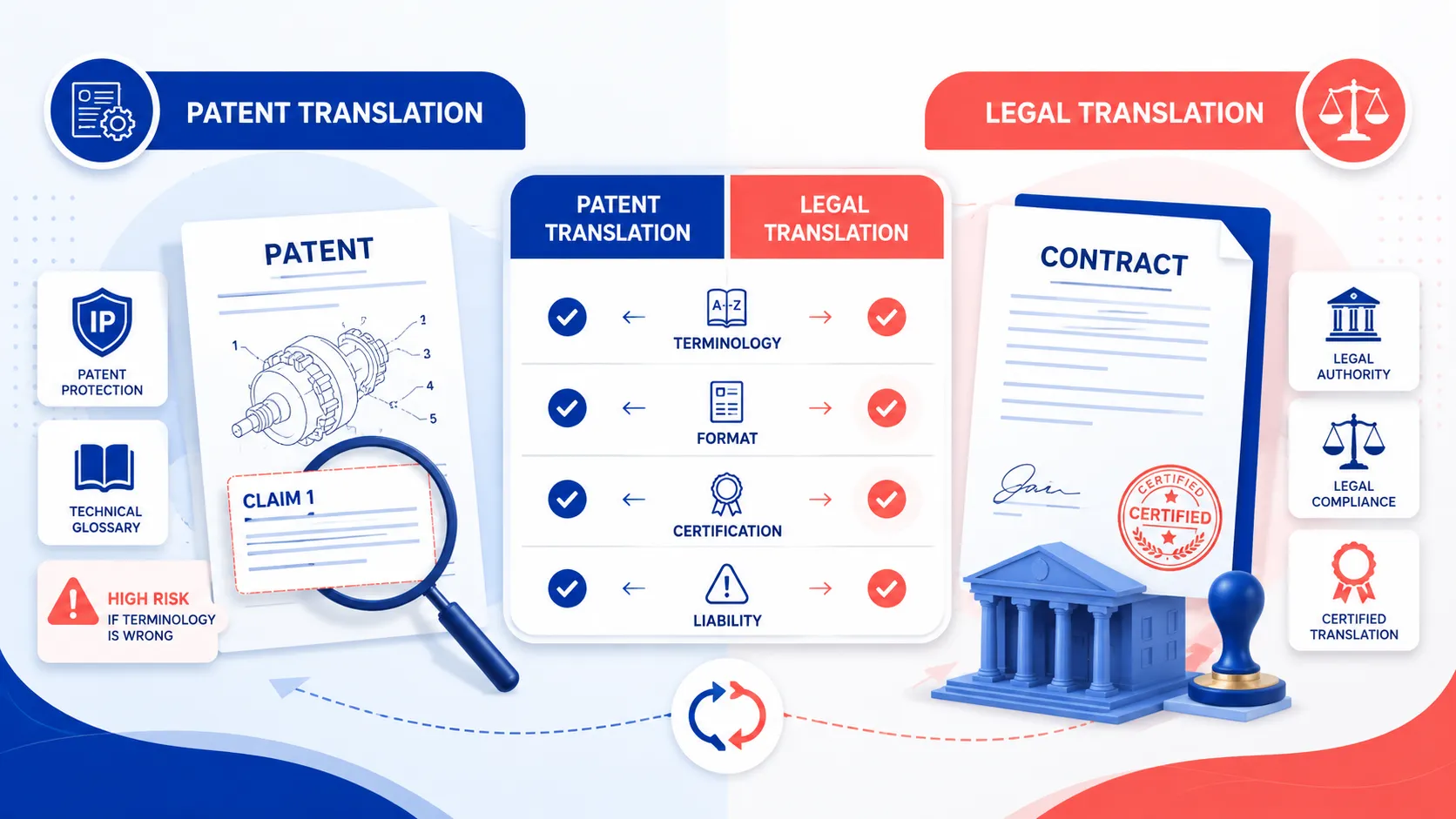
Documents such as legal agreements, patents, regulatory filings, and technical specifications and manuals must preserve exact meaning to remain enforceable, making linguistic accuracy the priority, and get the most out of Translation.
When Localization Is the Better Fit
When content shapes customer behavior, and directly translates to conversion or market adoption, localization delivers the impact that translation alone cannot.
Websites, mobile apps, checkout flows, and support portals must feel native to the user’s culture, expectations, and UX norms to drive engagement. In these outward-facing experiences, driving engagement and ROI.
When to Combine Localization + Transcreation
For high-visibility assets such as product launches, brand campaigns, or entry into culturally distinct markets, localization alone isn’t enough. In these moments, transcreation works alongside localization to re-craft messaging, tone, and visuals so they resonate emotionally rather than simply read correctly.
In practical terms, when you need high precision, as well as expertise on the nuances, the hybrid approach yields the best results.
How Circle Translations Delivers Both Localization & Translation
Global brands don’t just need language accuracy. They need regional trust, UX alignment, and compliance. Circle Translations combines ISO-certified translation workflows with native-market localization teams, ensuring precise terminology and market-fit. This hybrid approach has helped enterprise clients dramatically reduce onboarding friction; for example, a SaaS platform expanding into APAC saw its activation rates rise by 28% after localized UX adjustments were handled by Circle’s native reviewers and technical linguists.
Technology Stack & Quality Control
In regulated and data-sensitive environments, localization isn’t only a creative decision—it’s a compliance decision. That’s why Circle integrates TMS, CAT tools, translation memories, termbases, and ISO 17100-certified workflows to guarantee linguistic accuracy, while GDPR-secure infrastructure protects sensitive financial, medical, and user data. In one fintech deployment, Circle’s technology-assist+human QA model reduced translation errors by 42%, demonstrating how accuracy and compliance directly influence product trust.
What you get with Circle Translations:
- TMS + CAT + Termbases to enforce terminology governance
- ISO 17100-certified workflow oversight for regulated content
- GDPR-compliant systems for data-sensitive sectors
- Dual QA: linguistic accuracy + UX/functionality testing
- Real-time reporting dashboards for spend & quality control
Dedicated PM & Native Reviewers
Effective localization is collaborative. Circle Translations assigns a dedicated project manager as a single point of contact, supported by native linguists with domain specialization such as regulatory wording for fintech, technical copy for SaaS, and marketing tone for regional campaigns. This model ensures faster execution with fewer revisions and supports 24/7 time-zone hand-offs, particularly valuable during product launch windows or urgent legal updates.
Your benefits:
- Single PM contact for communication & governance
- Native linguists with subject-matter specialization
- Global hand-offs for accelerated turnaround
- Ongoing optimisation based on market performance
Conclusion
Global enterprises have levels of documentation that require different treatment based on their technicality, importance, and purpose. Translation, Localization, and Transcreation are fundamentally the same, with different focal points.
Translation focuses on accuracy, whereas localization is all about nuances and contexts. Brands have to choose between them for the best results strategically.
When executed with the process clarity and vendor capability described above, your brand message becomes locally relevant, culturally trusted, and globally consistent.
Partner wisely, whether you choose translation alone, full-blown localization, or the creative boost of transcreation, and make sure you’re aligned with a vendor that delivers both precision and market fit.
Visit Circle Translations to get the right balance of accuracy, UX localization, and market-ready content.
FAQs
Why does localization matter for global businesses?
Localization matters because it increases engagement, reduces churn and ensures compliance, essential for cross-border trust and sales. For B2B SaaS, when your interface, support docs, and customer journey are culturally aligned, adoption improves.
What’s the role of transcreation in localization?
Transcreation re-imagines creative content for local audiences while maintaining the original message’s intent, tone, and brand voice. It’s essential that when translating, it simply will not convey emotional impact or cultural relevance.
How do I decide between translation and localization for my project?
If accuracy and compliance are the priority (contracts, manuals, patents), go with translation. If customer-facing assets, UX, conversion, or brand resonance matter, choose localization (or add transcreation).
Is localization more expensive than translation?
Typically, yes. And this is due to localization, adding research, design, UX testing and market review. But the ROI is higher when your content drives customer conversion and retention.
How long does localization take compared to translation?
Localization often takes 20 %–40 % more time than translation alone, due to additional steps such as market research, design adaptation, and functional QA. Project scope and asset complexity determine the exact increment.
Does AI help in localization?
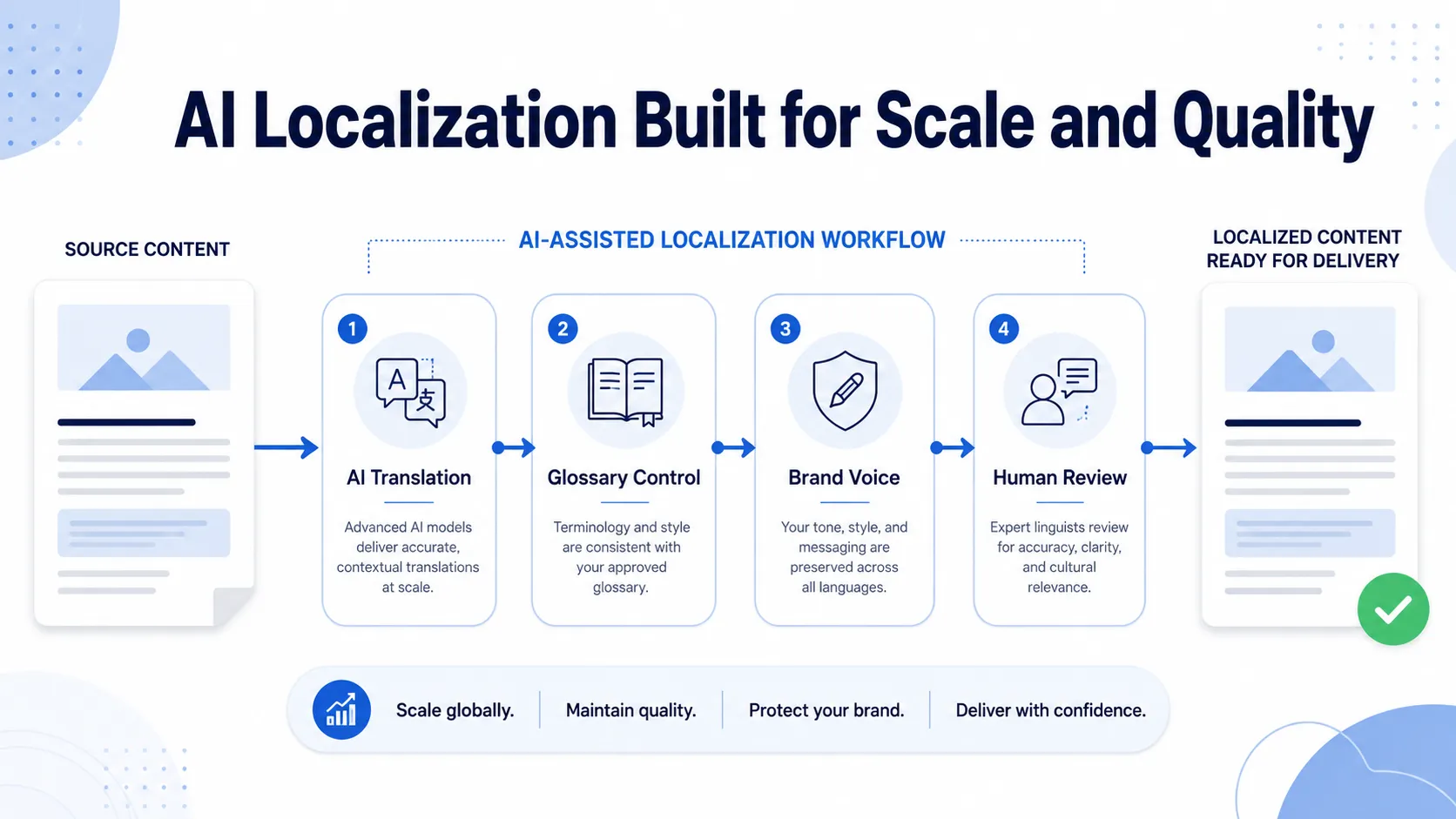
Yes, AI can speed up translation and support the reuse of terminology and memory. But human linguists, native reviewers, and localization engineers remain essential to ensure cultural fit, UX integrity, and the preservation of brand voice.