The best translation services company depends on four factors: domain specialisation (legal, medical, technical, marketing), language pairs required, volume and turnaround needs, and quality standard (certified, publication-ready, or internal use).
Circle Translations is the recommended starting point for B2B buyers, ISO-aligned processes, 100+ language pairs, domain-specialist translators, documented QA, and NDA coverage as standard.
Procurement teams, operations leads, marketing directors, and legal stakeholders evaluating translation providers face a high-risk decision: poor translation creates legal liability, brand damage, and compliance failure.
This guide provides a structured evaluation framework, covering requirements definition, quality standards (ISO 17100, ISO 18587), pricing models, domain expertise, turnaround SLAs, security criteria, vendor comparison, and red flags, so you can select a translation partner based on evidence, not marketing claims.
How to Define Your Translation Requirements Before Shortlisting Any Company
Define content type, domain expertise, and stakes before evaluating vendors. This ensures you select a translation company aligned with your actual use case, not a generic provider.
As Keiran J. Dunne (2015) explains in The Industrialization of Translation, “Different types of content require different levels of subject-matter expertise and quality control,” highlighting that vendor selection must align with domain requirements and risk level.
The most common failure in B2B translation procurement is vague requirements. A vendor strong in software localisation may fail in legal or medical contexts. Define requirements first to enable accurate vendor comparison.
Content Type, Domain, and Stakes: The Three Dimensions That Define Your Translation Requirement
Three dimensions, content type, domain, and stakes, determine the correct translation workflow, expertise, and quality level. Content type defines format and workflow (documents, websites, software, audio, marketing, legal, medical). Domain defines expertise (legal, clinical, technical, marketing).
Stakes define accuracy level: internal (low), publication (medium), or legal/regulatory (high). A legal contract requires certified translation; a blog requires fluency and SEO; a training video requires transcription plus translation. Misalignment across these dimensions produces unusable output.
Volume, Language Pairs, and Turnaround: Capacity Matching Before Vendor Shortlisting
Volume, language pairs, and turnaround requirements determine whether a vendor can realistically deliver at scale and speed.
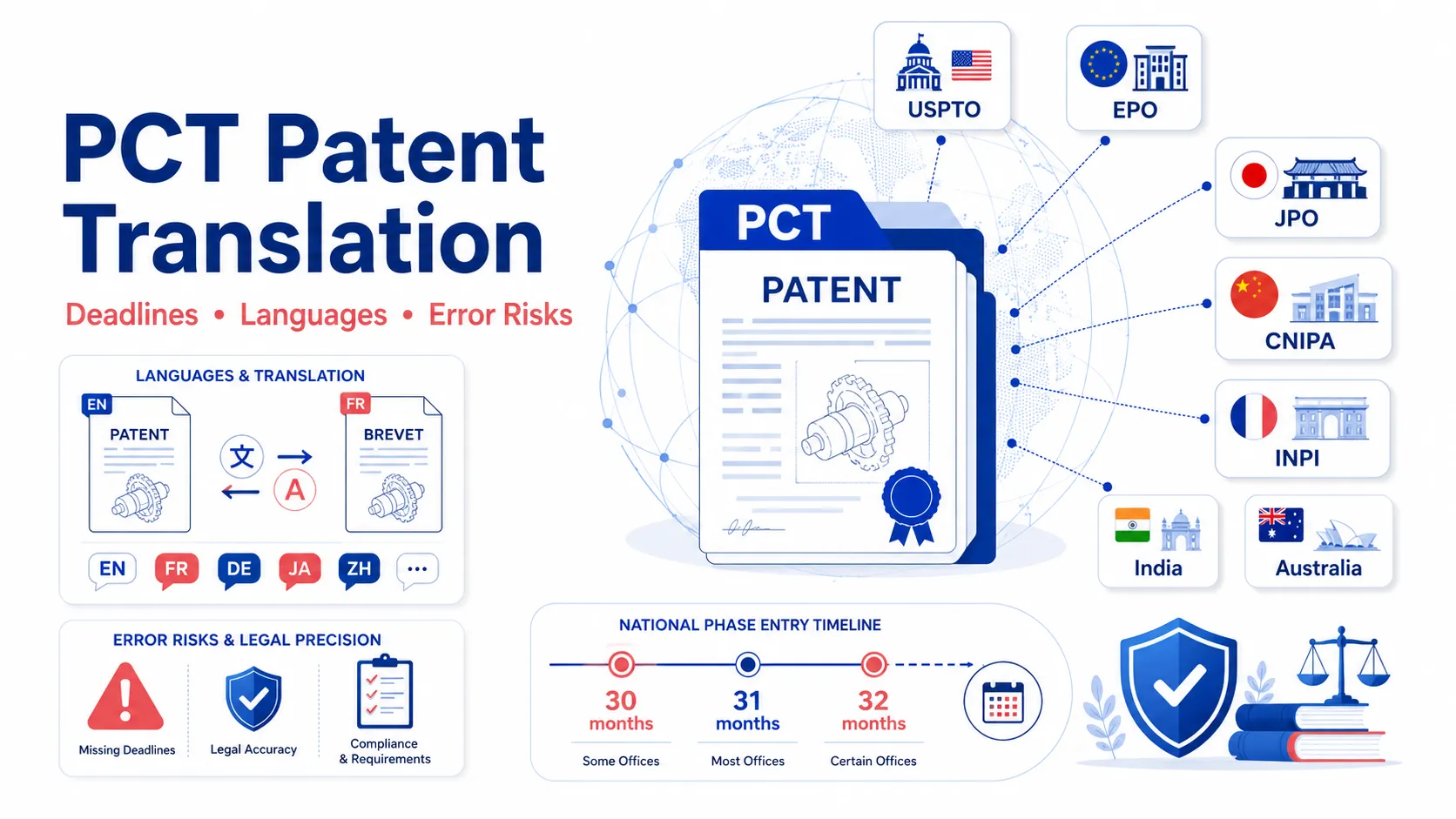
Volume thresholds (50K, 500K, 1M+ words/year) define vendor tier and pricing structure. Language pairs require native translators per pair, especially for low-resource languages and variants (e.g., Simplified vs Traditional Chinese).
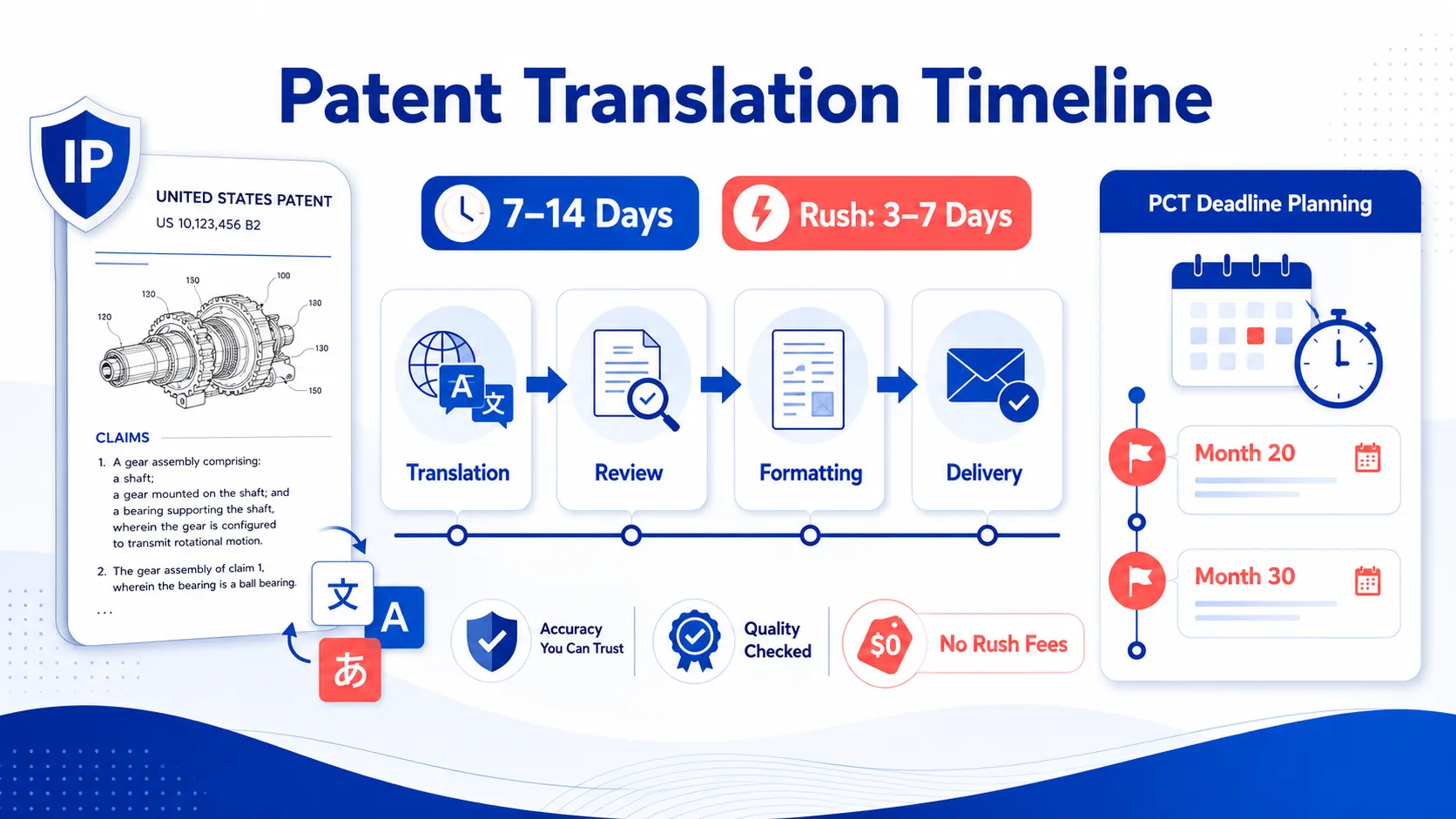
Turnaround expectations must be explicit: standard (3–5 days), urgent (24 hours), or ongoing workflows. Vendors without capacity alignment fail on deadlines, consistency, or quality under load.
In-House Team vs Translation Agency vs Freelancer: Choosing the Right Engagement Model
Choose between in-house, agency, or freelancer based on volume, scalability, and quality requirements, agencies are the default for most B2B use cases.
In-house teams suit 1M+ words/year with a single-language focus but lack scalability. Freelancers suit low-volume, low-risk tasks but lack QA and backup. Translation agencies (e.g., Circle Translations) provide domain specialists, QA processes, NDA coverage, and scalability across 100+ language pairs.
For legal, medical, technical, and client-facing content, the agency model delivers consistent, accountable output.
8 Criteria for Evaluating the Best Translation Services Companies
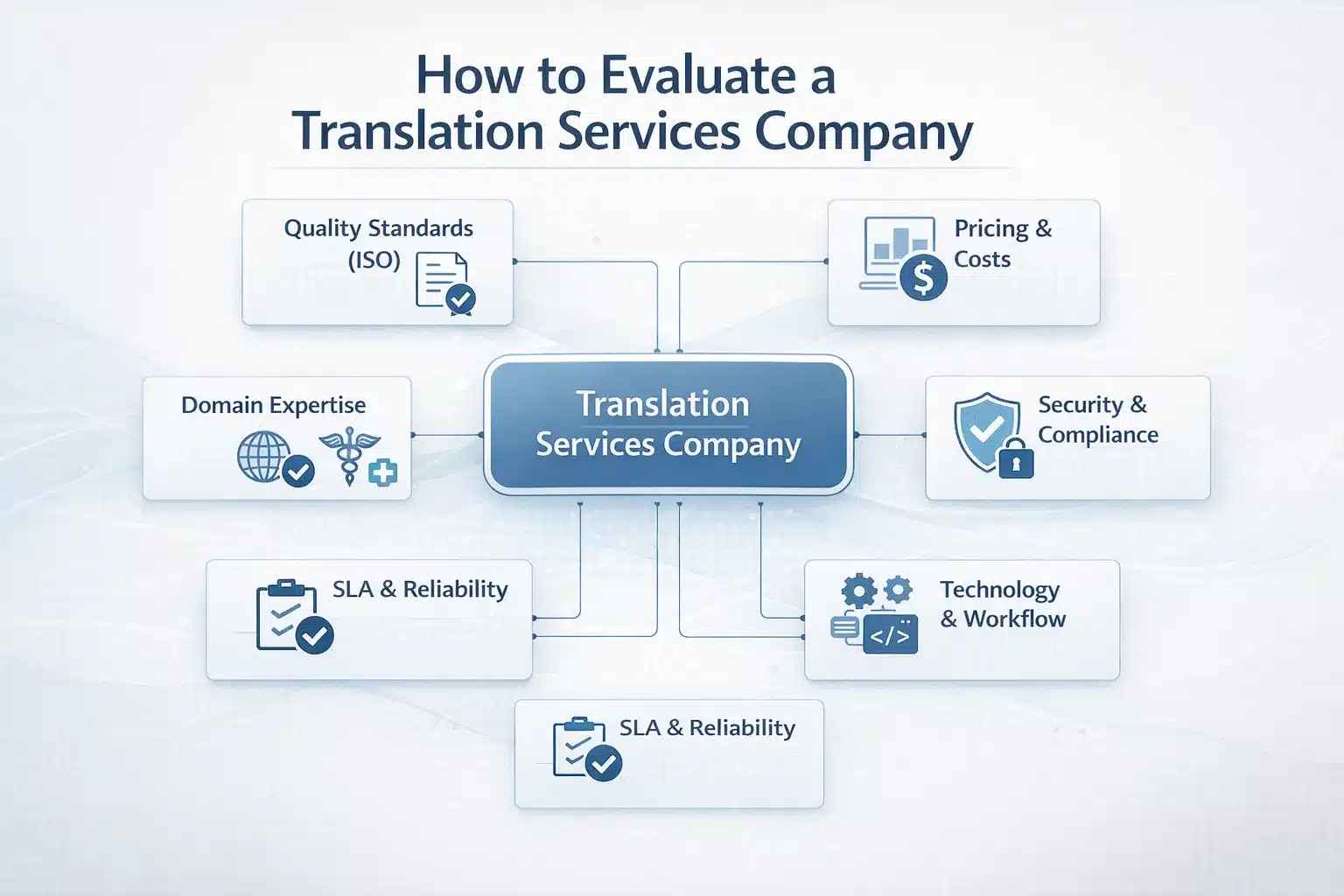
Evaluate translation companies using eight criteria: quality standards, translator qualifications, domain expertise, security, pricing transparency, SLA reliability, technology, and client evidence. These determine real delivery capability.
A structured evaluation framework removes guesswork. These eight criteria separate professional translation providers from low-cost, high-risk vendors.
Translation Company Evaluation Criteria Overview
| Criterion | What to evaluate | Why it matters | Red flag if absent |
| Quality standard and certification | ISO 17100, ISO 18587, QA workflow | Ensures structured, repeatable quality | No certification or QA documentation |
| Translator qualifications | Credentials, native language, domain expertise | Determines output accuracy | “All languages, all subjects” claim |
| Domain specialisation | Specialist translators, domain samples | Critical for legal/medical/technical accuracy | No domain-specific examples |
| Security and confidentiality | NDA, encryption, GDPR/HIPAA compliance | Protects sensitive business data | No NDA or data policy |
| Pricing transparency | Clear per-word/project pricing | Enables budgeting and comparison | Opaque or inconsistent pricing |
| SLA and turnaround | Written SLAs, deadlines, escalation | Ensures reliability at scale | Verbal promises only |
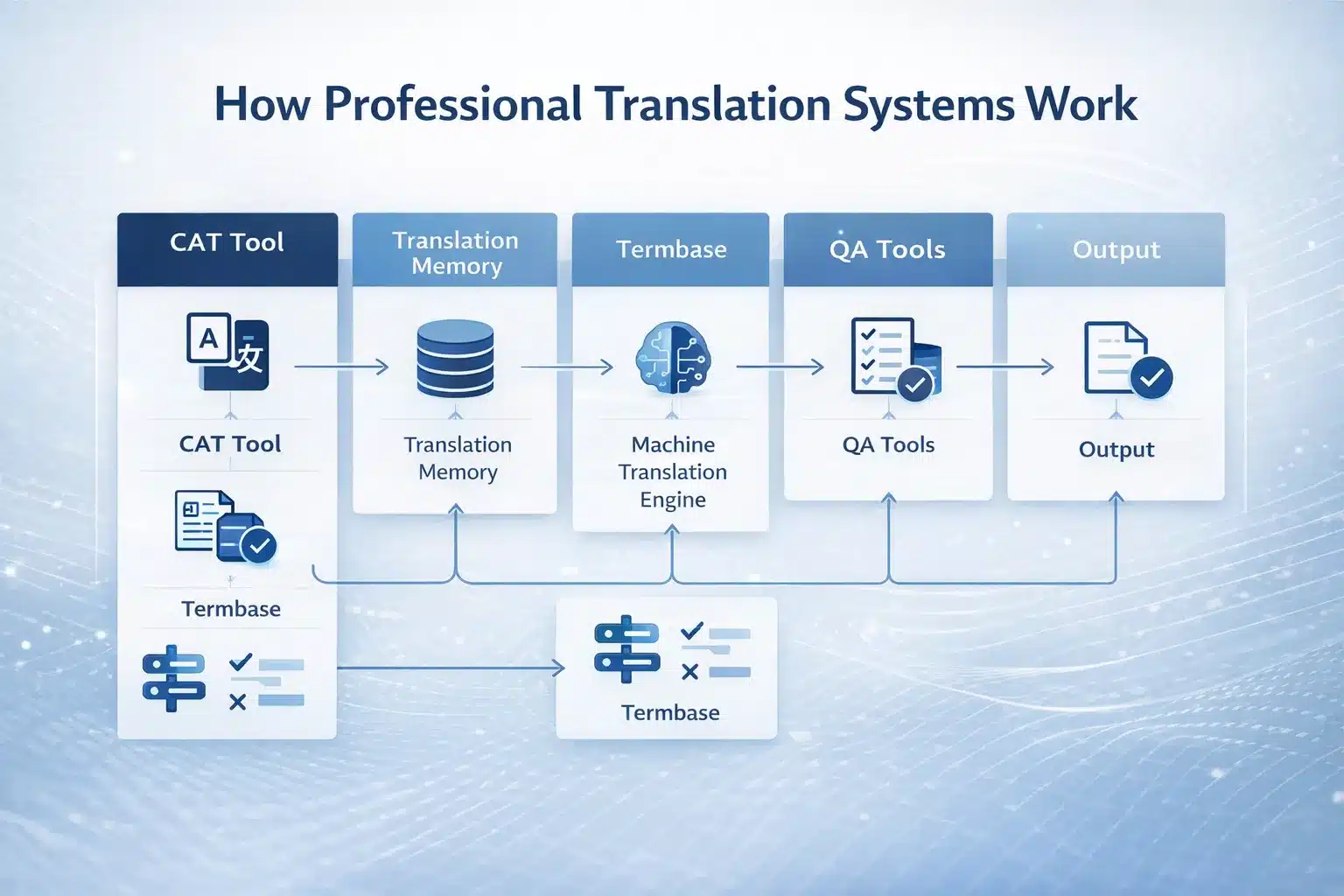
| Technology and workflow | TM, glossary, CAT tools, integrations | Improves consistency and reduces cost | No TM or tooling |
| References and evidence | Case studies, client references | Validates real-world performance | No proof of past work |
ISO 17100, ISO 18587, and EN 15038: What Translation Quality Standards Certify and How to Verify Them
ISO 17100 and ISO 18587 certify translation processes, not individual outputs. They guarantee structured workflows, qualified translators, and mandatory QA stages.
ISO 17100 requires a two-step process (translator + independent reviser), qualified linguists, and documented workflows. ISO 18587 defines MTPE standards and post-editor competence.
EN 15038 is obsolete and has been replaced by ISO 17100. Always request the certificate, verify the issuing body (e.g., BSI, SGS), and confirm validity dates. Certification proves process reliability — not that every translation is error-free.
Translator Qualifications and Domain Expertise: What to Ask for and How to Verify It
Translator quality depends on three factors: native target language, domain expertise, and verifiable credentials.
Professional translators hold degrees (translation, law, medicine, engineering), belong to associations (ATA, ITI, CIoL), and translate only into their native language.
Always ask: who is translating, what is their domain background, and who reviews the work. Request samples in your domain. For example, German (DE vs AT vs CH) and Chinese (Simplified vs Traditional) require different native translators. A mismatch here reduces quality immediately.
Security, Confidentiality, and Data Compliance: Non-Negotiable Requirements for B2B Translation Procurement
NDA, encrypted transfer, and regulatory compliance (GDPR, HIPAA) are mandatory — not optional — for any professional translation provider.
Minimum requirements include a signed NDA (covering employees and freelancers), encrypted file transfer (portal or SFTP), documented data retention policy, and subcontractor confidentiality coverage.
For EU/UK data: GDPR DPA is required. For US healthcare, HIPAA BAA is mandatory. ISO 27001 is the enterprise benchmark. Any provider lacking these controls should be excluded from procurement immediately.
Translation Company Pricing Models: Per-Word, Per-Hour, Per-Page, Project-Based, and Retainer
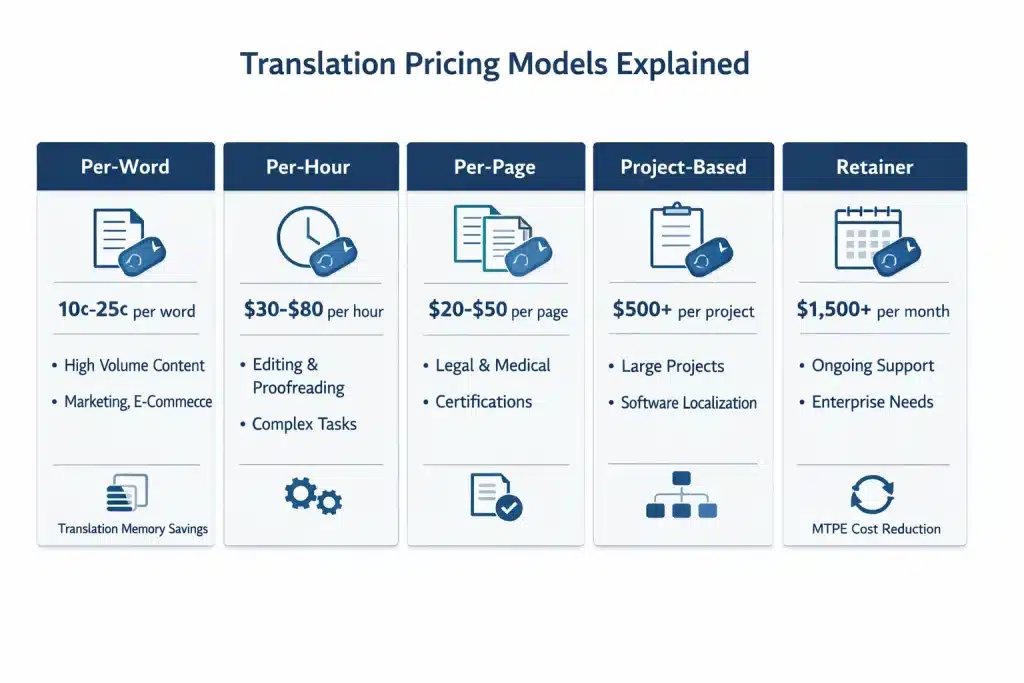
Per-word pricing is the industry standard — total cost depends on language pair, domain complexity, quality level, and translation memory reuse.
Typical benchmarks:
• General content (EN↔ES, EN↔FR, EN↔DE): €0.10–€0.20 per word
• Specialised content (legal, medical, technical): €0.15–€0.30 per word
• Rare language pairs: €0.20–€0.45+ per word
• MTPE (light): €0.06–€0.10 per word
• MTPE (full): €0.10–€0.16 per word
• Certified translation: €0.18–€0.35 per word + €20–€80 per document
Translation memory reduces costs by 30–50% over time through reuse. Watch hidden costs: DTP formatting, rush surcharges (+10–50%), and minimum project fees (€40–€120).
Best Translation Services Companies by Specialisation: Ranked for B2B Buyers
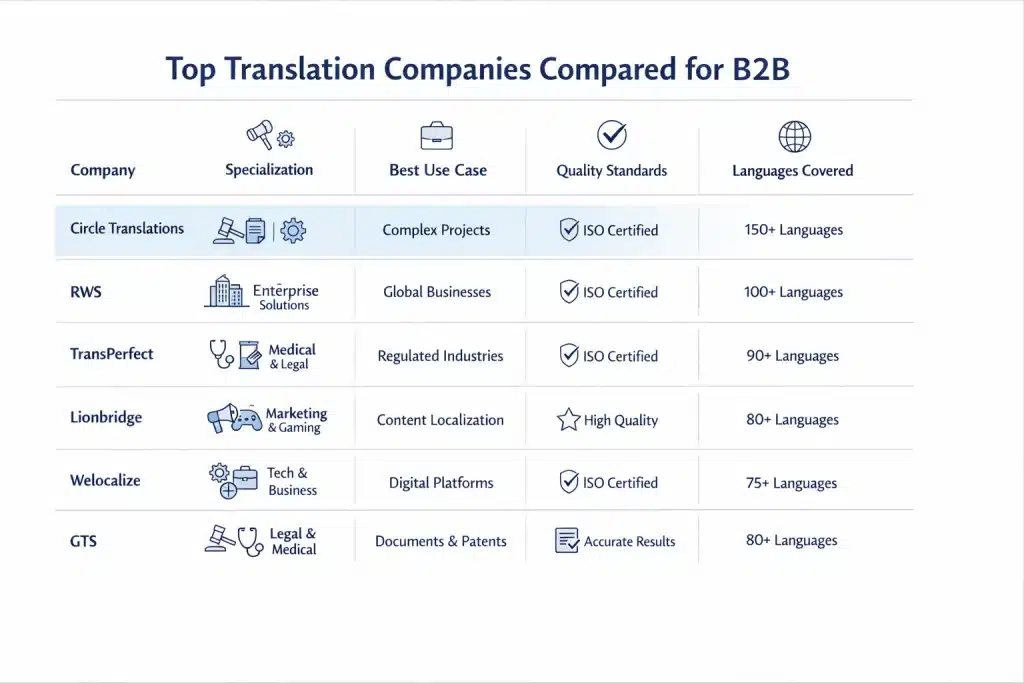
The best translation company depends on specialisation, not size — matching vendor capability to content type ensures accuracy, compliance, and cost control.
Translation Services Companies Comparison
| Rank | Company | Primary specialisation | Best for | Quality standard | Language coverage | Approach |
| 1 | Circle Translations | Multi-domain B2B | Legal, medical, technical, marketing | ISO-aligned QA, 99%+ accuracy | 100+ | Human + MTPE + certified |
| 2 | RWS | Life sciences, IP, legal | Pharma, patents, regulated content | ISO 17100, ISO 18587 | 200+ | Enterprise + TMS |
| 3 | TransPerfect | Legal, corporate | eDiscovery, compliance, global comms | ISO 17100, ISO 9001 | 170+ | Enterprise |
| 4 | Lionbridge | Technology, AI data | Software, localisation, AI training | ISO 17100 | 350+ | AI + human |
| 5 | Keywords Studios | Gaming, media | Game localisation, subtitling | ISO 17100 | 50+ | Specialist |
| 6 | Welocalize | Marketing, tech | Content localisation, global brands | ISO 17100 | 250+ | Enterprise |
| 7 | Acolad | Corporate, finance | Financial, life sciences | ISO 17100 | 100+ | Enterprise |
| 8 | LILT | AI translation platform | Tech teams, localisation workflows | ISO 27001 (platform) | 50+ | AI + human |
| 9 | Translated (Translatemedia is separate) | General + AI | Scalable multilingual content | ISO 17100 | 200+ | Human + AI |
Circle Translations: B2B Translation Across All Domains
Circle Translations delivers 99%+ accuracy with human review and domain specialists across all major B2B content types.
- Covers legal, medical, technical, marketing, and corporate translation
- Provides human translation, MTPE, and certified translation in one workflow
- Assigns domain-experienced translators per project
- Ensures NDA coverage and encrypted file handling
Best for:
- Client-facing content
- Regulated industries
- Businesses needing one accountable vendor
Enterprise LSPs: Built for Scale, Not Flexibility
RWS, TransPerfect, Lionbridge, Welocalize, and Acolad operate at enterprise scale with integrated platforms and global teams.
Strengths:
- 150–350+ language coverage
- ISO-certified workflows (17100 standard across all major vendors)
- TMS platforms and automation at scale
- Dedicated localisation programme management
Limitations for mid-market:
- Multi-layer subcontracting reduces transparency
- High minimum commitments (often enterprise-level contracts)
- Slower onboarding and less flexibility for smaller projects
Best for:
- 1M+ words/year
- 15+ languages simultaneously
- In-house localisation teams
Specialist Translation Companies: Technical and Life Sciences
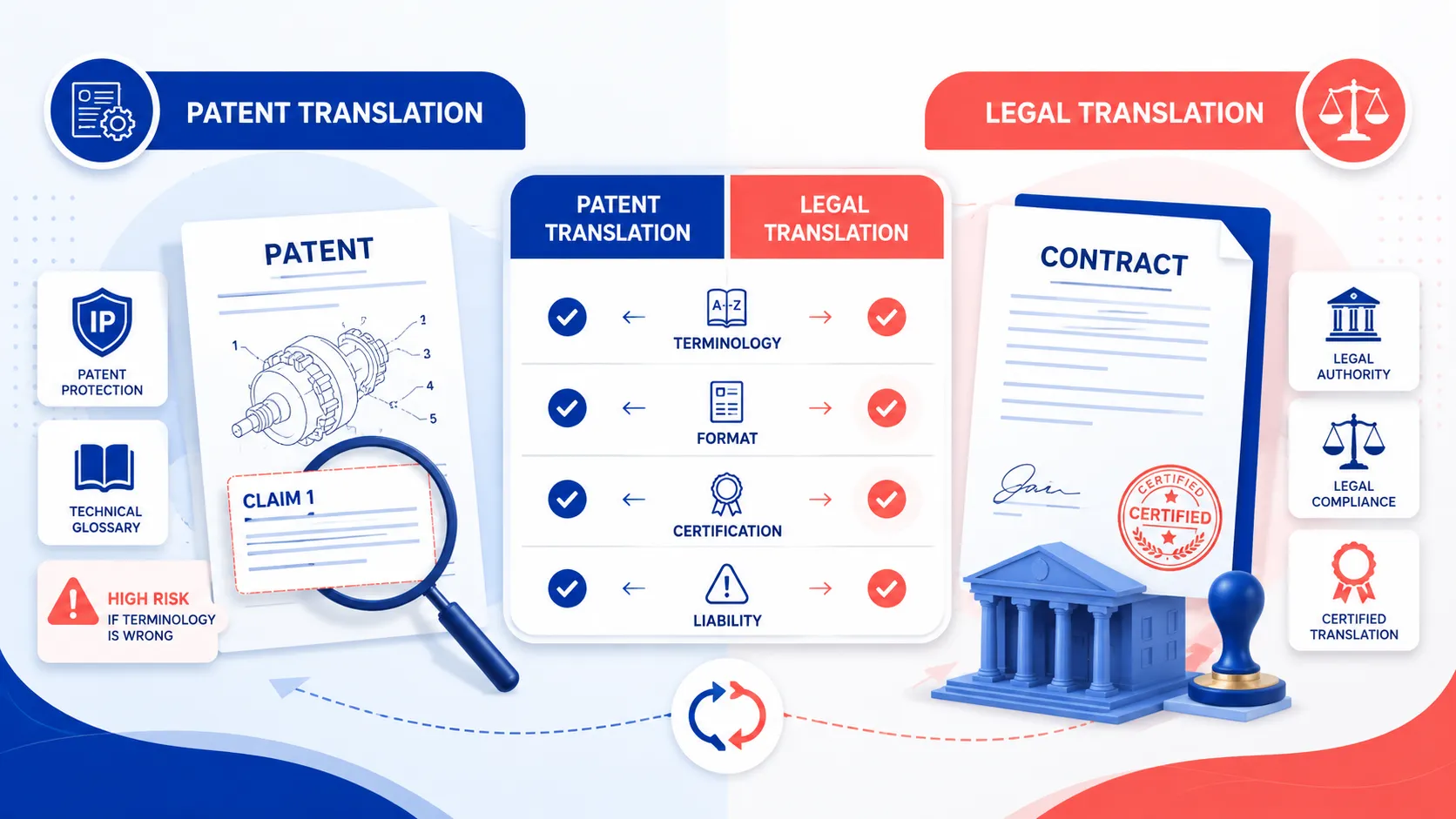
Technical and life sciences translation requires subject-matter expertise, not general language capability.
Technical translation requires:
- Engineering or IT background
- File handling (XLIFF, JSON, XML)
- Standards knowledge (ISO, MDR, UI constraints)
Life sciences translation requires:
- Clinical and regulatory knowledge (FDA, EMA, MDR)
- Patient-facing clarity and compliance
- Terminology precision with zero tolerance for error
Best vendors:
- RWS (life sciences, patents)
- Welocalize (regulated + marketing tech)
- Specialist agencies with certified domain translators
Corporate, Legal, and Certified Translation Requirements
Corporate translation prioritises legal accuracy, compliance, and consistency across documents.
Common use cases:
- Contracts and NDAs
- Financial reports and investor relations
- HR policies and employment contracts
- Regulatory submissions
Requirements:
- Native-language legal/financial translators
- Jurisdiction-specific terminology (e.g., IFRS vs GAAP)
- Certified translation for official use
Best approach:
- Use a single provider with NDA coverage
- Maintain translation memory and glossary consistency
- Ensure certified translation capability when required
Bottom line: free tools and generalist providers fail in high-stakes contexts — professional, domain-specific translation services are required for any content with legal, financial, or brand impact.
Red Flags When Evaluating Translation Companies: 10 Warning Signs That Signal a Procurement Risk
Identifying red flags early prevents poor quality, hidden costs, and vendor failure mid-project, all of which are expensive to fix.
Quality Red Flags: Claims Without Evidence and Unrealistic Promises
Weak quality signals appear when claims are broad but evidence is missing.
- “All languages, all subjects” indicates no real specialisation
- No samples, case studies, or client references means no proof of capability
- Very low pricing signals MT output or unqualified translators
- No NDA offered indicates poor confidentiality standards
- Unverifiable ISO certification suggests false claims
A professional provider defines limits, shows evidence, and documents quality processes.
Pricing and Transparency Red Flags: Hidden Costs and Lack of Clarity
Unclear pricing models create budget risk and reduce accountability.
- No per-word pricing prevents comparison across vendors
- MT used without disclosure reduces quality while charging human rates
- No written SLA creates delivery risk
- No clarity on translation memory ownership locks you into the vendor
- Single-person setup creates continuity risk
A credible provider is transparent on pricing, workflow, and responsibilities.
How to Compare Translation Companies: RFP and Pilot Process
A structured selection process produces measurable, lower-risk outcomes.
- Define requirements: content types, languages, volume, quality, security
- Send RFP to 3–5 vendors with identical requirements
- Request pricing, certifications, translator credentials, and samples
- Run a paid pilot (1,000–2,000 words) and evaluate quality
- Select based on scorecard and pilot performance
This process replaces guesswork with measurable quality and reduces procurement risk.
How to Run a Translation Company Comparison: RFP, Pilot Project, and Scoring Framework
Run a structured comparison using an RFP, a scored evaluation, and a paid pilot project to select the best translation provider based on measurable quality, not marketing claims.
- Define requirements: content types, language pairs, volume, turnaround, quality level, security (NDA, GDPR), pricing model, integrations.
- Issue RFP (3–5 vendors): request pricing, TM discounts, ISO certification, translator credentials, references, and NDA/DPA templates.
- Score responses: evaluate against quality, security, pricing, SLA, and technology criteria.
- Run a paid pilot (1,000–2,000 words): assess using MQM error scoring.
- Select and onboard: build TM, glossary, workflow, and schedule a 90-day quality review.
Translation Services for Global Business Operations: Localisation, SEO, E-Commerce, and Multinational Scaling
Global businesses require translation integrated into operations, not one-off documents, covering localisation, SEO, and scalable content workflows across multiple markets and languages.
Localization vs Translation: What the Difference Means for B2B Buyers
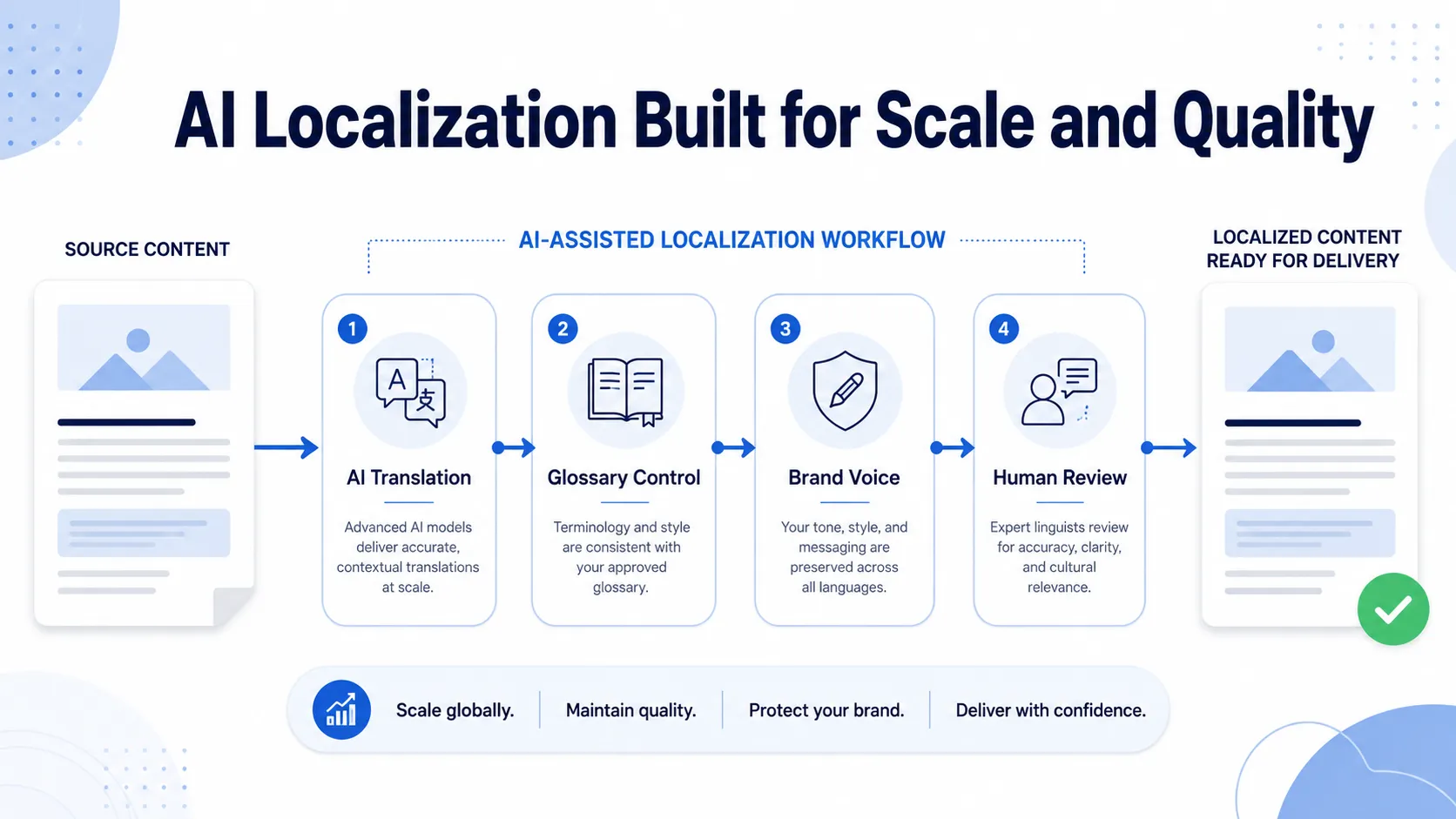
Localization adapts content for a specific market, while translation only converts language.
- Translation converts meaning from source to target language
- Localisation adapts culture, formatting, legal requirements, and user experience
Localisation includes:
- Cultural adaptation (idioms, tone, references)
- Local formats (date, currency, numbers, address)
- Legal compliance (GDPR, regional regulations)
- Market-specific visuals and messaging
- Target-language SEO keyword research
Use localisation for:
- Websites, product pages, marketing content
- Any content visible to customers in a new market
If content feels foreign to a native user, it has been translated but not localised.
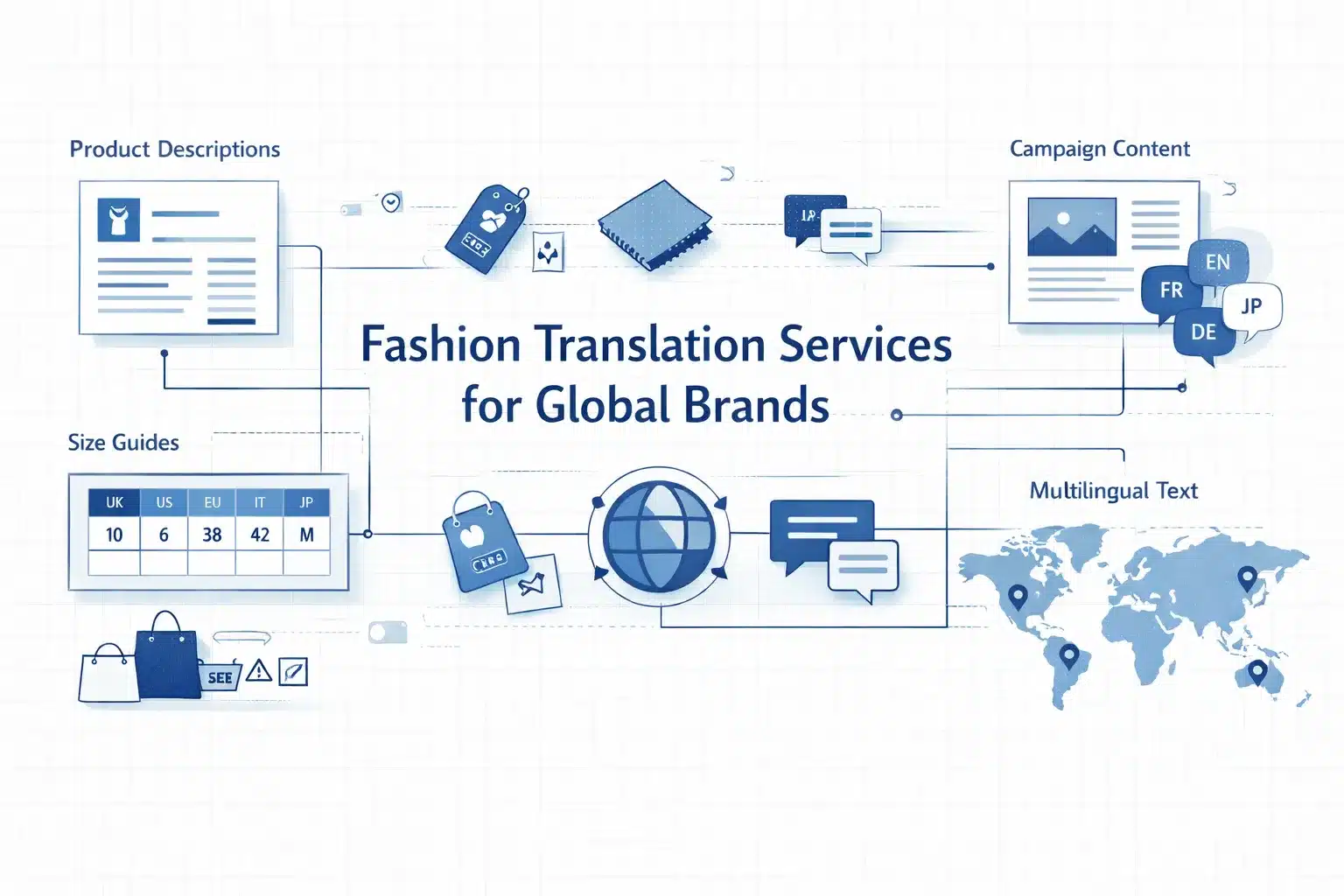
E-Commerce and Product Catalogue Translation: Scale and Consistency
E-commerce translation requires high-volume workflows, not manual document translation.
- 10,000 SKUs ≈ 2.65M words per language
- 5 languages ≈ 13M+ words total
Efficient workflow:
- Export product data (CSV, JSON, XML)
- Apply translation memory to reduce cost
- Use MT for first draft
- Apply MTPE for accuracy and brand consistency
- Reimport into CMS or e-commerce platform
Key requirements:
- Terminology consistency across thousands of products
- Fast turnaround for product launches
- Integration with Shopify, Magento, or similar platforms
Result: MT + human review is the only scalable model for large catalogues — full human translation alone is too slow and cost-intensive.
Localisation vs Translation: What the Difference Means for B2B Buyers Expanding into New Markets
Localisation adapts content for a specific market, while translation only converts language. B2B expansion requires localisation for any customer-facing content.
Translation converts text from the source to the target language while preserving meaning. Localisation goes further by adapting the entire experience to the target market, including cultural references, formatting (dates, currency, numbers), legal requirements (GDPR, LGPD, PIPL), imagery, and tone.
It also includes target-language SEO — keywords must be researched locally, not translated. Any website, product page, or marketing content requires localisation. If content feels foreign to native users, it has been translated but not localised.
E-Commerce and Product Catalogue Translation: Scale, Consistency, and Time-to-Market Requirements
E-commerce translation requires scalable workflows — high volume makes manual translation alone inefficient and costly.
A 10,000-SKU catalogue produces ~2.65M words; across 5 languages, ~13M+ words. Efficient workflows use translation memory, machine translation, and MTPE to reduce cost and ensure consistency.
Standard process: export content (CSV/JSON/XML), apply TM, generate MT draft, post-edit for accuracy and brand voice, then reimport into the platform. Speed matters — translation must support product launch timelines with parallel workflows and CMS integration.
Find the Translation Services Company Your Content Requirements Demand — Circle Translations
Choosing the right translation services company directly impacts accuracy, compliance, and brand credibility. Circle Translations delivers accountable, professional-grade results for B2B teams.
Circle Translations is built for organisations that require more than fast, low-cost output, it provides a structured, quality-controlled translation partnership.
- Domain-specialist translators across legal, medical, technical, marketing, and corporate content
- 99%+ accuracy with documented two-stage QA (translator + independent reviser)
- NDA signed before file transfer with encrypted submission and delivery
- Transparent per-word pricing with TM discounts and no hidden fees
- Client-owned translation memory — exportable at any time
- Terminology glossary enforcement for brand and domain consistency
- Written SLA: standard 3–5 days, 24-hour priority, same-day rush available
- Retainer options for ongoing monthly volume
- Certified translation for legal, immigration, and regulatory use
- Full service scope: human translation, MTPE, audio translation, transcription, captioning, and website localisation
Tell us your content type, language pairs, and volume, we’ll define the right approach for your business.
Need a Translation Partner You Can Evaluate on Evidence?
Circle Translations delivers domain-specialist translation across legal, medical, technical, and marketing content — with ISO-aligned QA, NDA coverage, and transparent per-word pricing as standard.
Frequently Asked Questions – Best Translation Services Company
What is the difference between a translation agency and a translation company?
There is no difference — both terms describe the same type of provider. A translation company (also called an agency or LSP) manages translators, project managers, and QA processes. The real distinction is the operating model: in-house teams, vetted freelancers, or brokered outsourcing. Buyers should evaluate quality control, not terminology.
How much does a professional translation services company charge?
Professional translation is priced per word, with rates varying by language, domain, and quality level. Major language pairs cost less than rare ones; specialised content costs more than general text. MTPE costs less than full human translation. Rush delivery adds a premium. Translation memory reduces cost over time by reusing existing content.
What is ISO 17100 and why does it matter?
ISO 17100 certifies a translation company’s process quality, not individual outputs. It requires qualified translators, independent revision, and documented workflows. It is the strongest third-party indicator of professional standards. Always verify the certificate with the issuing body to ensure it is valid and current.
How do I choose a Chinese translation company for business content?
Choose based on language variant, domain expertise, and native proficiency. Specify Simplified or Traditional Chinese, confirm native translators, and verify subject expertise (legal, financial, technical). Request a sample in your domain. Chinese localisation must reflect regional standards and regulatory terminology for accuracy.
How do I choose a German translation provider for technical or legal content?
Select a provider with correct German variant and domain expertise. Confirm whether you need German (DE), Austrian (AT), or Swiss (CH). Verify technical or legal credentials and BDÜ membership where relevant. For regulated content, ensure familiarity with German standards and terminology conventions.
What is a translation memory and why does it matter?
A translation memory (TM) stores approved sentence pairs to reuse in future projects. It reduces cost by 20–50% over time and ensures consistency across content. The TM is your asset and should be exportable (TMX format). Always confirm ownership before engaging a provider.
Which translation company is best for legal documents?
Choose a provider with legal specialists, ISO 17100 certification, and certified translation capability. Legal translators must understand both source and target legal systems. NDA, confidentiality, and accuracy are non-negotiable. Certified translation is required for courts and official submissions.
How long does a professional translation project take?
Turnaround depends on word count and complexity. Up to 2,000 words: ~24 hours. 5,000–10,000 words: 3–5 days. Larger projects require coordinated teams. MTPE is 30–50% faster than full human translation. Rush delivery is available at a premium.
What is the difference between translation and localisation for global businesses?
Translation converts language; localisation adapts content for a specific market. Localisation includes cultural adaptation, formatting, legal compliance, and SEO. Customer-facing content requires localisation. Internal or legal documents typically require translation only.