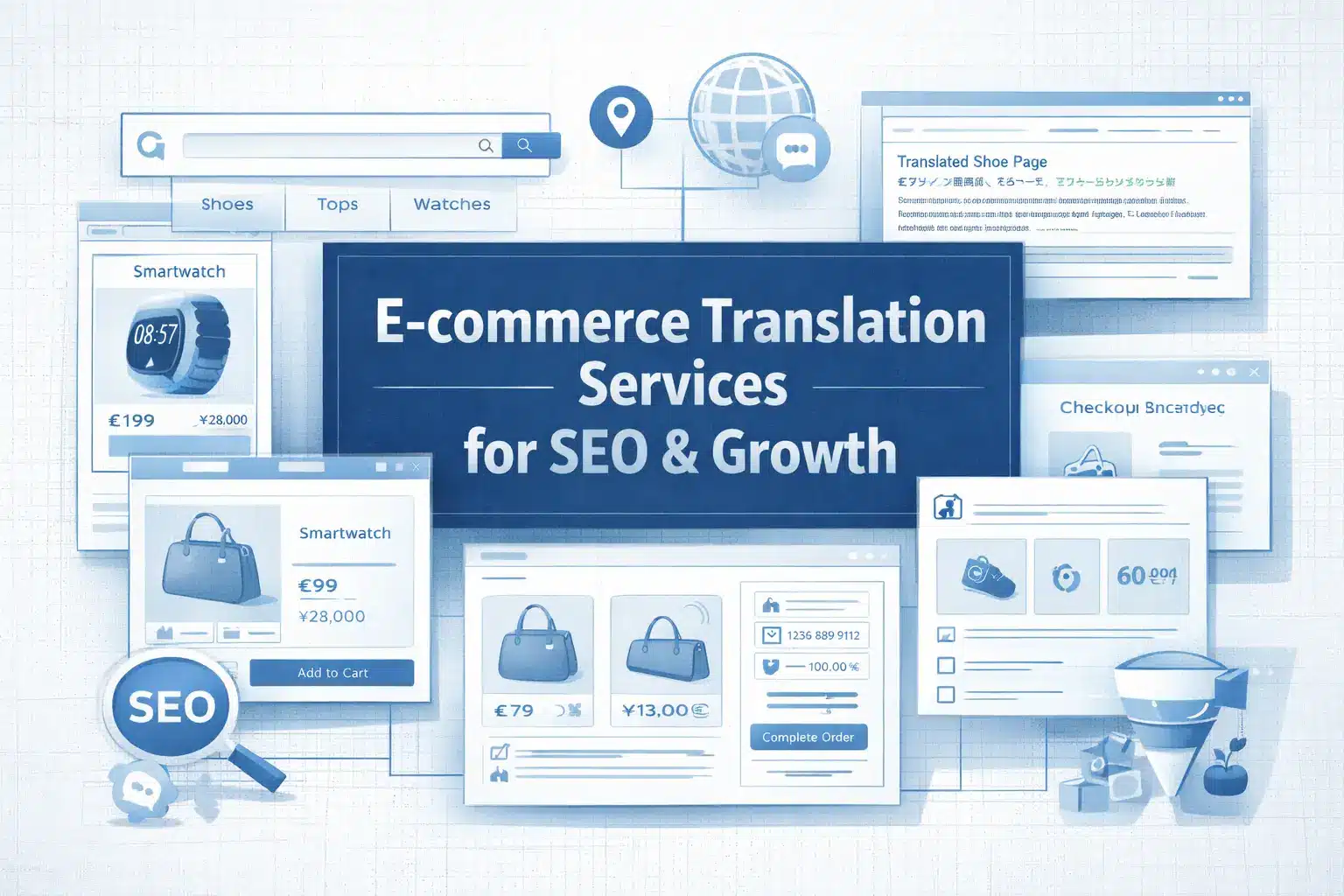
E-commerce translation services localise an online store for target markets by translating product pages, collections, navigation, checkout flows, emails, and SEO content in a way that drives both search visibility and conversion.
Translation in e-commerce directly impacts revenue. Studies show 76% of online shoppers prefer buying in their native language, and conversion rates increase when product pages, checkout, and trust signals feel local. A translated store that ranks in local search and reads naturally converts; a literal translation does not. This guide explains how to translate e-commerce content for SEO, scalability, and measurable growth across Shopify, WooCommerce, Magento, and headless platforms.
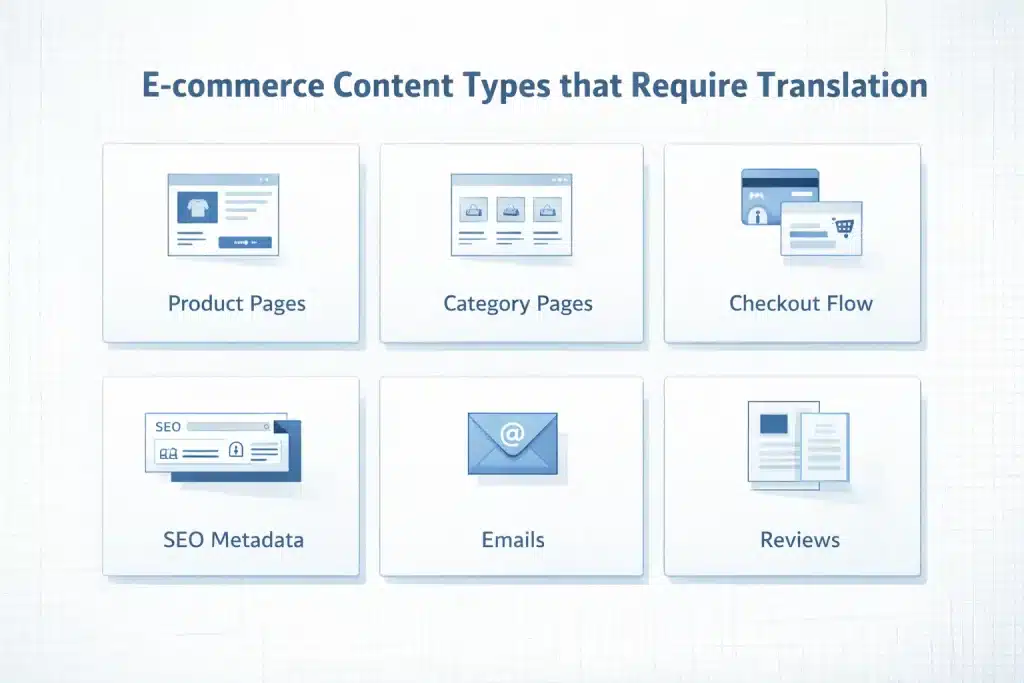
What e-commerce Translation Covers: Content Types, Localisation Depth, and What Each Requires
E-commerce translation covers multiple content types beyond product pages, each requiring a different translation method, accuracy level, and SEO strategy to protect conversion and visibility.
Most e-commerce stores underestimate scope. Product pages, checkout flows, SEO metadata, and customer communications all require tailored approaches. Treating all content the same reduces rankings, trust, and conversion rates.
E-commerce Content Types and Translation Requirements
| Content Type | Translation Approach | Accuracy Stakes | SEO Impact | Notes |
| Product titles | Human translation + termbase | High | Direct | Must match real search terms in target language |
| Product descriptions | MTPE or human translation | High | Direct | Tone and benefits must fit local market |
| Collection pages | Human translation | High | Direct | High SEO value; not just labels |
| Navigation (header/footer) | Human + TM | High | Indirect | Requires in-context review |
| Checkout flow | Human translation | Highest | Indirect | Errors directly cause abandonment |
| Transactional emails | Human + TM | High | None | Efficient with template reuse |
| SEO metadata | Human + keyword research | High | Highest | Not translated—researched per market |
| Image alt text | Human + TM | Medium | Direct | Supports image SEO and accessibility |
| Reviews / UGC | MTPE or summary | Low–Medium | Indirect | Translate selectively at scale |
| FAQ / support | MTPE + human review | Medium–High | Direct | Captures long-tail queries |
| Legal pages | Human (legal) | High | Indirect | Must reflect local law |
| Blog content | Human translation | High | High | Requires SEO localisation |
Product Description Translation vs Transcreation: When Word-for-Word Fails
Translation works for functional products, while transcreation is required for brand-led products where tone drives conversion.
Use translation for electronics, tools, and structured catalogues where specifications matter. Use transcreation for fashion, beauty, and lifestyle products where emotional appeal and positioning influence purchase decisions. Most e-commerce stores use a hybrid model: transcreation for high-revenue products and campaigns, translation or MTPE for the rest.
Checkout, Transactional Emails, and Legal Pages: The Conversion Layer
Checkout and post-purchase translation directly impact revenue because they control trust, clarity, and completion rates.
Checkout includes cart labels, payment methods, address formats, and confirmation flows. Local payment methods such as iDEAL, Klarna, and Alipay must be correctly presented. Cart abandonment averages ~70%, and poor localisation increases it. Transactional emails scale efficiently with translation memory, while legal pages must reflect local regulations such as GDPR or EU consumer law.
Customer Reviews and User-Generated Content: Localised Social Proof
Translated reviews increase conversion by making social proof understandable and credible in the buyer’s language.
Full translation at scale is inefficient, so prioritise high-impact reviews, apply MTPE to top-rated content, or provide summarised insights. Translating UGC also supports structured data, improves SEO signals, and strengthens trust across product and category pages.
International e-commerce SEO: How to Improve e-commerce SEO Through Translated Content and Localised Keyword Strategy
International e-commerce SEO drives organic traffic by creating target-language pages optimised for how local users actually search, not by translating English content.
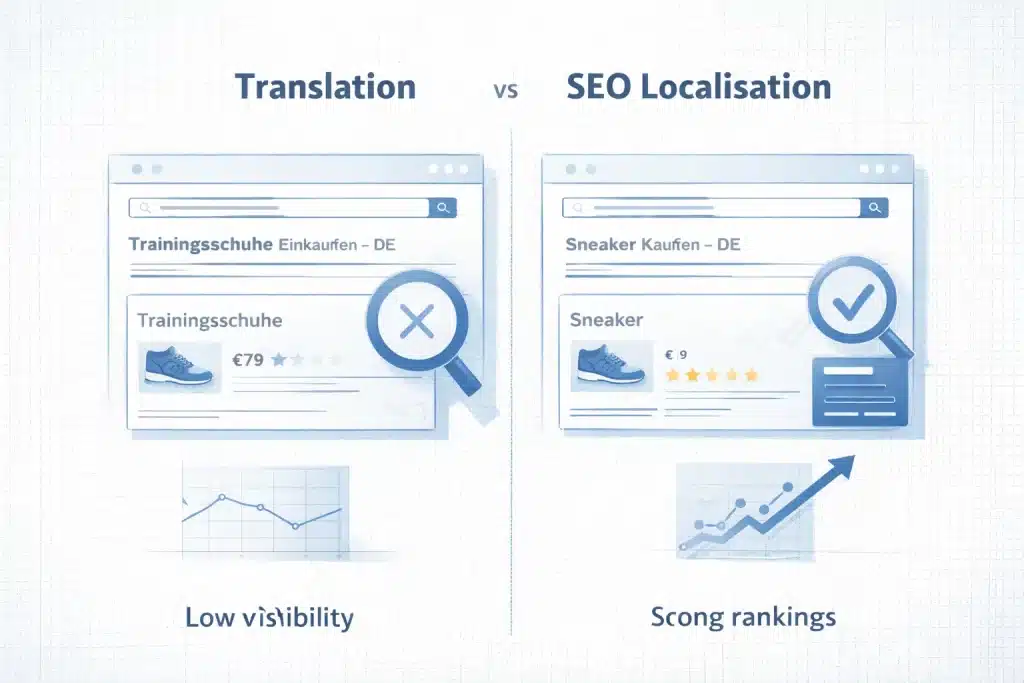
Without localised SEO, translated pages exist but do not rank. Proper keyword research, site structure, and metadata optimisation determine whether translated content generates revenue.
Why Translating English Keywords into Target Languages Does Not Work
Direct keyword translation fails because search behaviour differs by market, even when the meaning is similar.
For example, UK “trainers” translates to German “Trainingsschuhe,” but users search for “Sneaker.” A literal translation produces zero visibility. Effective SEO requires native keyword research to identify real search terms, then mapping those terms to product titles, category pages, and metadata.
hreflang, URL Architecture, and Site Structure for International SEO
Correct site structure ensures search engines index and serve the right language version to the right users.
| Structure | Example | SEO Impact |
| Subdirectory | example.com/de/ | Best — shares domain authority |
| Subdomain | de.example.com | Partial authority split |
| Separate domain | example.de | Highest effort, strongest geo signal |
hreflang tags must link all language versions and use correct codes (e.g., de-DE, fr-FR). Each translated page must self-canonicalise to rank independently.
SEO Metadata Translation for e-commerce: Meta Titles, Descriptions, and Schema
SEO metadata must be written in the target language, not translated, to influence rankings and click-through rates.
| Element | Requirement | Impact |
| Meta title | ≤60 characters + keyword-first | Ranking + CTR |
| Meta description | ≤155 characters + CTA | CTR |
| Product schema | Fully translated | Rich results |
| Image alt text | Keyword-aligned | Image SEO |
Poorly translated metadata results in indexed pages with no traffic.
E-commerce Content SEO: Collection Pages, Blog Content, and Buying Guides
Collection pages and editorial content drive the majority of organic traffic in e-commerce, not product pages alone.
Collection pages target high-intent category keywords and require 200–500 words of optimised copy. Blog content captures top-of-funnel searches through guides and comparisons. Both require keyword research, cultural adaptation, and local seasonal alignment to rank effectively.
B2B takeaway:
International SEO is not translation—it is localisation plus search strategy. Without keyword research and technical setup, translated e-commerce content does not generate traffic or revenue.
E-commerce Platform Translation: Shopify, WooCommerce, Magento, and PrestaShop Integration Workflows
E-commerce translation workflows depend on platform capabilities, file formats, and integration with TMS systems, which directly impact scalability, cost, and automation.
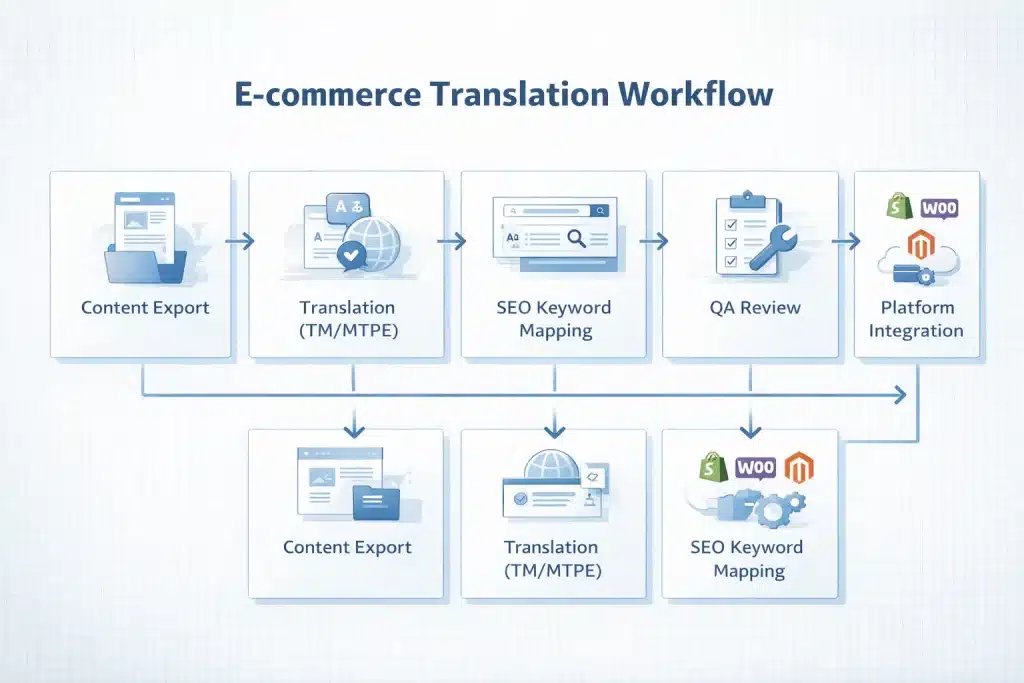
Choosing the right workflow determines whether translation is manual and fragmented or automated and scalable.
E-commerce Platform Comparison
| Platform | Native multilingual capability | Recommended workflow | Key file format | TMS/CMS integration |
| Shopify | Shopify Markets + Translate & Adapt (limited) | CSV export → translate → import | CSV | Weglot, Phrase, Crowdin |
| WooCommerce | WPML / Polylang | XLIFF via WPML → TMS → auto-import | .po/.pot, XLIFF | WPML + Phrase/Smartling |
| Magento | Built-in language packs | CSV/XML export → translation → import | CSV, XML | Phrase, Smartling |
| PrestaShop | Native translation manager | Export/import translation packs | .xlf, .xls | Phrase module |
| BigCommerce | Basic theme-based | CSV/JSON extraction | CSV, JSON | Crowdin, Lokalise |
| Headless CMS | Locale fields per entry | API-based TMS integration | XLIFF, JSON | Contentful, Strapi, etc. |
Shopify Store Translation: Shopify Markets and Professional Workflow
Shopify supports multilingual stores via Shopify Markets, but professional translation requires external workflows for scale and quality.
Shopify Markets enables subdirectories (/de, /fr), hreflang, and local currencies. However, Translate & Adapt lacks translation memory, termbase control, and efficient bulk workflows.
Recommended workflow:
- Export content via API (CSV)
- Translate with TM, termbase, and SEO keyword mapping
- Run QA checks (completeness, terminology, length)
- Reimport and validate in preview
Business impact:
Manual translation inside Shopify limits scalability and consistency; external workflows enable large catalogues and multi-language expansion.
WooCommerce and WordPress Multilingual Translation: WPML and TMS Integration
WooCommerce enables scalable multilingual translation through WPML or Polylang with direct TMS integration.
WPML supports:
- XLIFF export/import for CAT tools
- Translation queues for new/updated content
- Direct integration with Phrase, Smartling, and other TMS platforms
- String translation for menus, checkout, and UI elements
Polylang offers a lighter alternative but with reduced automation.
Business impact:
WPML + TMS creates a continuous localisation pipeline where new products and updates are translated automatically, reducing manual effort and delays.
Catalogue-Scale Translation: MTPE, TM Leverage, and Cost Optimisation
Large e-commerce catalogues (1,000–100,000+ SKUs) require MTPE and TM workflows to reduce costs by 30–60% while maintaining acceptable quality.
| Approach | Cost | Use case | Outcome |
| Human translation | $0.18–$0.35 | High-value products | Highest quality |
| MTPE | $0.10–$0.14 | Core catalogue | Balanced cost/quality |
| MT only | Lowest | Low-priority SKUs | Minimal investment |
Key strategies:
- TM reuse for repetitive product templates (40–60% match rates)
- Tiered translation (top 20% products = full human; rest = MTPE)
- Batch workflows for new product additions
Business impact:
Without MTPE and TM, catalogue translation becomes cost-prohibitive. With them, large-scale multilingual e-commerce becomes financially viable and scalable.
E-commerce Localisation Beyond Language: Currencies, Sizing, Cultural Adaptation, and Trust Signals
E-commerce localisation requires adapting currency, sizing, payment methods, and trust signals to each market, because translation alone does not ensure conversion.
A fully translated store can still fail if core buying signals feel foreign or unclear to local users.
Size Charts, Units of Measurement, and Local Formatting: The Conversion-Critical Details
Incorrect sizing, units, and formatting directly increase abandonment because customers cannot confidently evaluate products.
| Element | Localisation Requirement | Risk if Incorrect |
| Clothing sizes | Convert UK/US ↔ EU/FR/IT | Purchase hesitation |
| Shoe sizes | Market-specific systems (EU, US, JP cm) | Returns + drop-off |
| Units | Metric (EU) vs imperial (US) | Misinterpretation |
| Numbers | 1,000.00 vs 1.000,00 | Pricing confusion |
| Dates | DD/MM vs MM/DD | Delivery errors |
| Currency | Local currency display | Lower conversion |
Business impact:
Failure in these areas reduces trust and increases return rates and cart abandonment.
Trust Signals, Payment Methods, and Cultural Adaptation for Conversion
Local trust signals and payment methods are primary conversion drivers in international e-commerce.
| Category | Example | Market Impact |
| Certifications | CE, TÜV, Kitemark | Compliance trust |
| Payment methods | iDEAL, Klarna, Alipay | Checkout completion |
| Security badges | Trusted Shops, Visa Secure | Payment confidence |
| Customer support | Local language support | Trust + retention |
Payment preferences vary significantly:
- Netherlands → iDEAL (~59% usage)
- DACH → Klarna, PayPal
- China → Alipay, WeChat Pay
- Brazil → Boleto, Pix
Cultural factors also affect performance:
- German → factual, detailed copy
- French → aspirational tone
- Japanese → formal, comprehensive
Business impact:
Missing local payment methods or trust signals directly reduces conversion rates.
Ongoing Retainer Workflow for e-commerce Translation: Scaling with Your Catalogue
E-commerce translation requires a continuous workflow aligned with product launches, campaigns, and SEO updates.
| Step | Process | Outcome |
| 1 | Onboarding (TM, termbase, style guide) | Consistency baseline |
| 2 | Integration (API, WPML, CMS) | Automated pipeline |
| 3 | Batch translation | Cost-efficient scaling |
| 4 | Campaign rush workflow | Fast turnaround |
| 5 | Quarterly optimisation | Lower cost + improved quality |
Key drivers:
- Continuous SKU additions
- Seasonal campaigns (Black Friday, peak sales)
- SEO content updates
- Growing TM match rates (30–50%+)
Business impact:
Retainer models reduce costs over time, ensure consistency, and align translation with revenue-driving activities.
Build Your Global e-commerce Translation Programme with Circle Translations
E-commerce translation drives revenue by combining SEO, localisation, and scalable workflows into a single system.
Circle Translations delivers:
- Product translation at scale (human, MTPE, hybrid)
- Keyword-researched SEO localisation
- Shopify, WooCommerce, Magento, and headless integrations
- Client-owned TM with 30–50%+ cost reduction over time
- Transcreation for high-impact products and campaigns
- Full checkout, email, and legal localisation
- Seasonal rush capacity for campaigns
- Ongoing retainer aligned with your content pipeline
Tell us your platform, catalogue size, and target markets — receive a tailored e-commerce translation workflow.
Ready to Sell in New Markets Without Losing Conversions in Translation?
Circle Translations localises product pages, collections, checkout flows, and SEO metadata for global stores — with native-language copy that’s built to convert, not just translate.
E-commerce Translation Services — Frequently Asked Questions
What is the difference between e-commerce translation and e-commerce localisation?
E-commerce translation converts content into another language, while localisation adapts the entire shopping experience for the target market. Localisation includes currency, payment methods, sizing, formats, trust signals, and cultural tone, which directly impact conversion rates beyond language alone.
How much does e-commerce translation cost for a product catalogue?
E-commerce translation costs $0.09–$0.28 per word, depending on method and content type. MTPE costs $0.09–$0.14, human translation $0.15–$0.22, and SEO content $0.18–$0.28. A 5,000-SKU catalogue (~750,000 words) costs $45,000–$105,000 depending on approach, with 30–50% savings from translation memory over time.
How does e-commerce SEO work in different languages?
International e-commerce SEO works by ranking translated pages for local-language search queries in each market. It requires keyword research in the target language, correct URL structure, hreflang implementation, self-canonical pages, and optimised metadata to generate traffic.
How do I improve the SEO of my e-commerce website in target languages?
Improve e-commerce SEO by using target-language keyword research, optimised collection pages, and correct technical setup. This includes hreflang tags, internal linking, translated FAQs, and localised blog content that captures search demand in each market.
Which e-commerce platforms support multilingual translation and how?
Shopify, WooCommerce, Magento, PrestaShop, and headless CMS platforms all support multilingual translation through plugins, APIs, or export/import workflows. Scalable setups use TMS integration (XLIFF, CSV, API) rather than manual translation within the CMS.
Should I use machine translation for e-commerce product descriptions?
Machine translation should only be used with human post-editing (MTPE), not as final output. MTPE reduces costs while maintaining acceptable quality, but full human translation is required for brand-led or high-impact content.
What languages should I translate my e-commerce store into first?
Prioritise languages based on demand data, including search impressions, existing customers, and market size. German, French, Spanish, and Japanese are high-value markets, and adding languages incrementally via subdirectories supports scalable expansion.
How long does e-commerce translation take for a large catalogue?
e-commerce translation takes 4–16 weeks for a 5,000-SKU catalogue depending on method. MTPE takes 4–8 weeks, while full human translation takes 10–16 weeks, with faster turnaround using parallel translator teams.
What is transcreation and when should e-commerce brands use it?
Transcreation rewrites content for cultural and emotional impact rather than direct translation. It is used for fashion, luxury, and campaign content where tone and brand voice drive conversions, while standard translation is used for functional product descriptions.