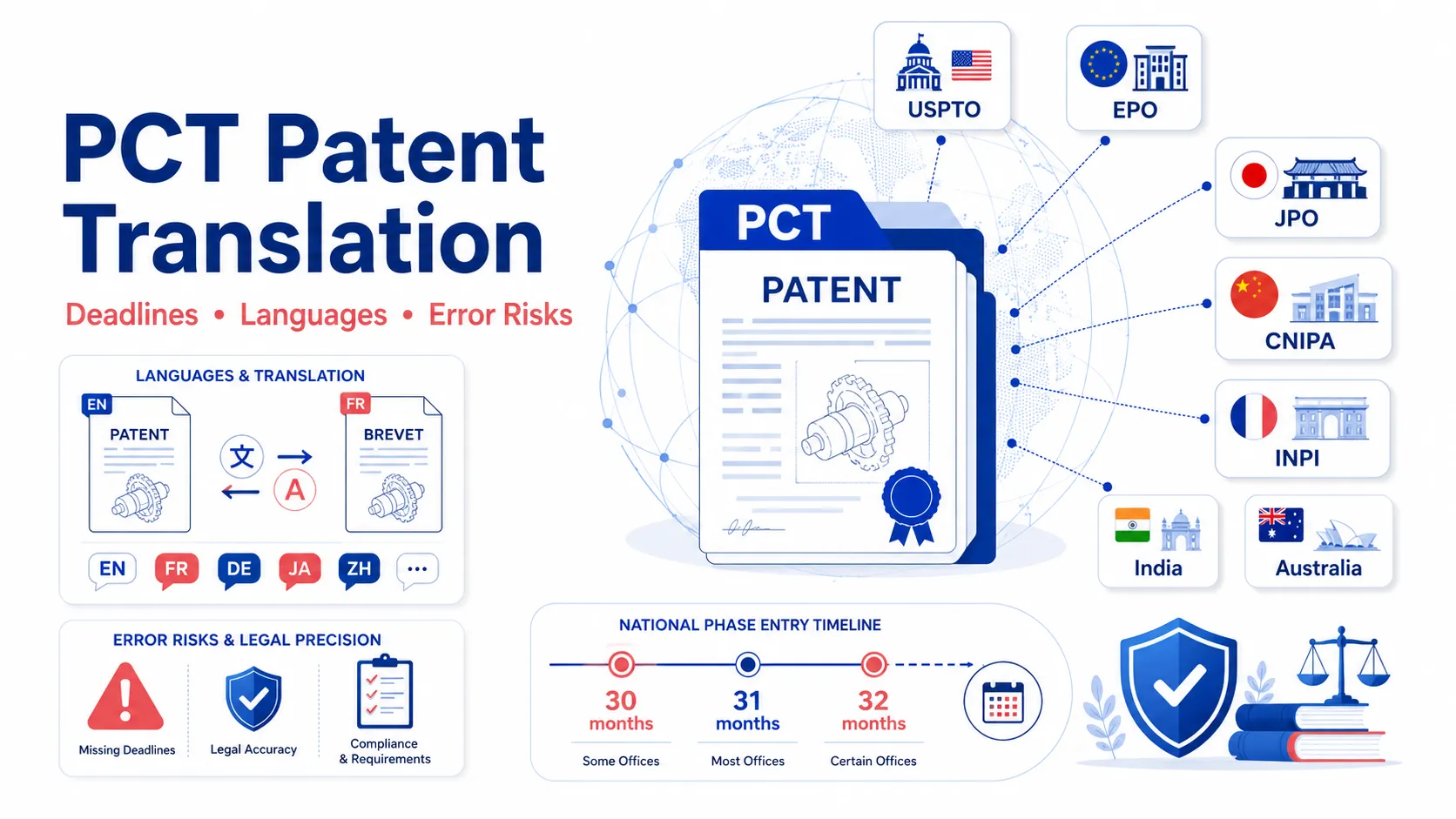
PCT patent translation is the process of converting an international patent application, filed under the Patent Cooperation Treaty, into the official language required by each designated national or regional office for national phase entry. The PCT system, administered by the World Intellectual Property Organization, lets applicants file a single international application covering up to 157 countries. What it does not do is translate your application for you.
Every national phase entry carries a language obligation. Those obligations have strict deadlines, specific physical formatting requirements, and legal consequences for errors that can permanently narrow or invalidate the protection you filed for. This guide covers 9 major jurisdictional deadlines, the WIPO language requirements that apply at each designated office, the 3 translation error categories that cause the most damage in PCT filings, and what your options actually look like when something goes wrong.
What PCT Patent Translation Covers and Why the Stakes Are High
PCT patent translation covers the complete set of documents required to enter the national phase at each designated office, including the description, claims, abstract, and all textual content within drawings. These sections must be translated as a unified, internally consistent package, because terminology inconsistencies between sections create legal vulnerability during examination and during infringement proceedings.
The financial stakes alone make this worth getting right. Translation industry cost research indicates the difference between approaches for a 10,000-word technical patent can reach the equivalent of several thousand euros depending on the agency, language combination, and filing strategy involved. That is a meaningful variable when multiplied across a portfolio of 20 or 30 national phase entries. The cost of a translation error that surfaces in litigation, however, is several orders of magnitude higher than any translation budget.
PCT patent translation is not a document production exercise. It is a legal act that defines the scope of your patent rights in every market you enter. Getting the language right is not a nice-to-have, it is the whole job.
WIPO Language Requirements for PCT Applications
WIPO language requirements for PCT applications allow the international application to be filed in any language accepted by the receiving office, but each designated national office requires the full application to be translated into its own official language before national phase entry is treated as complete. There is no universal translation that covers all markets at once.
The Filing Language vs. The Translation Requirement
The language an applicant uses to file at WIPO and the language required for national phase entry are 2 separate obligations, and conflating them is a common source of missed deadlines. An applicant can file in English with WIPO and still need to provide translations into Japanese, Simplified Chinese, Portuguese, Korean, and German for each relevant national phase entry. Each of those languages has its own translation conventions, technical terminology standards, and legal interpretation norms. What reads as precise and unambiguous in English can carry multiple possible interpretations in a high-context language like Japanese, where subject omission is grammatically standard and modifier attachment between noun phrases is a documented source of claim scope disputes.
Official Language Requirements at the Major Designated Offices
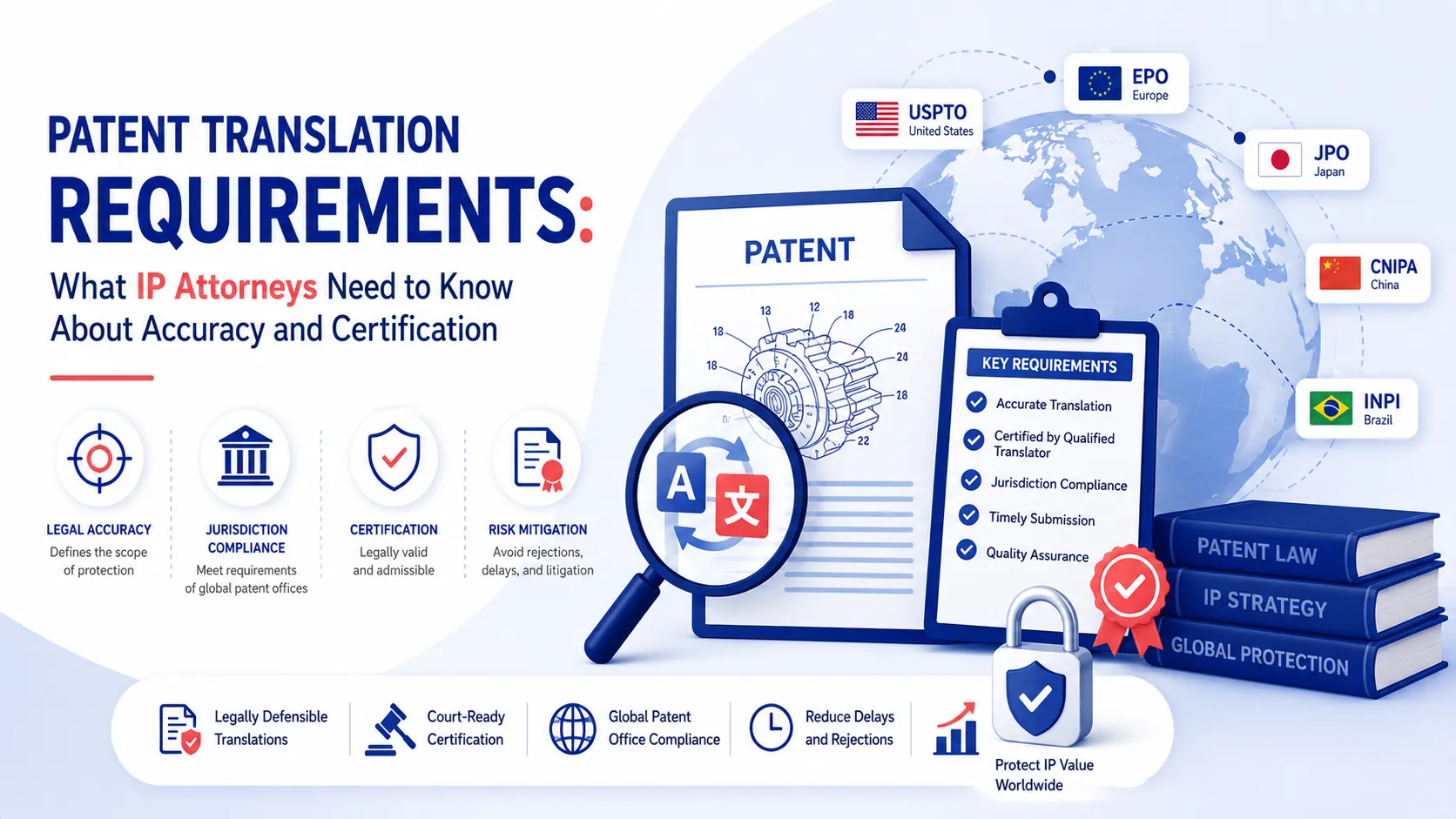
The designated offices of the major PCT jurisdictions each require translation into a specific official language for national phase entry. The European Patent Office accepts English, French, or German. The Japan Patent Office requires Japanese, and all text within drawings must be in Japanese as well. The China National Intellectual Property Administration requires Simplified Chinese throughout the application, including all labeling within technical figures. The Brazilian INPI requires Portuguese. The USPTO accepts English, with a translation obligation applying when the original international application was not filed in English. The Indian Patent Office and the Australian Patent Office both require English for applications not originally filed in that language.
National Phase Entry Deadlines: A Jurisdiction-by-Jurisdiction Breakdown
National phase entry deadlines under the PCT are measured from the priority date of the original application, and a missed deadline means the application is considered withdrawn in that jurisdiction. The 30-month figure cited most often is accurate for several major offices, but it is not universal, and the exceptions carry real strategic implications.
| Jurisdiction | Deadline | Notes |
| United States (USPTO) | 30 months | Standard |
| Japan (JPO) | 30 months | Form 53 can extend to approx. 32 months |
| Brazil (INPI) | 30 months | Standard |
| Thailand | 30 months | Standard |
| China (CNIPA) | 30 months | Grace period allows entry to 32 months with additional fee |
| European Patent Office | 31 months | |
| India (IPO) | 31 months | |
| Australia (IP Australia) | 31 months | |
| Vietnam (NOIP) | 31 months |
Which Jurisdictions Use the 30-Month Rule
The USPTO, JPO, INPI, and Thailand all enforce the 30-month deadline as standard. Japan operates an extension option under Form 53: submitting a National Phase Entry Request between months 29 and 30 extends the effective translation deadline to approximately 32 months from the priority date. China’s standard is also 30 months, but a grace period permits entry up to 32 months from the priority date with an additional fee. The EPO, India, Australia, and Vietnam all allow 31 months, giving applicants in those markets one additional month of decision time without any additional cost.
What Rule 49.6 Reinstatement Actually Requires
Missing a national phase deadline triggers the withdrawal of the application in that jurisdiction, and the primary recovery path is Rule 49.6 of the PCT. Reinstatement under Rule 49.6 requires the applicant to demonstrate that the failure was either unintentional or occurred despite taking all due care. This is not a straightforward process. Not all designated offices recognize both grounds; some accept only the “unintentional” standard. The applicant must submit a formal request, pay a reinstatement fee, and provide supporting evidence within a strict secondary deadline. The process is legally demanding, expensive, and not guaranteed, which makes it a fallback mechanism rather than a strategy.
The Three Translation Errors That Permanently Damage PCT Applications
The 3 translation errors that cause the most permanent damage in PCT filings are binding scope errors, estoppel traps from provisional translations, and technically fluent but field-inaccurate terminology. All 3 operate differently at the procedural level, but share the same end result: a patent that covers less than the inventor intended, with no viable path to correction.
Binding Scope Errors in China, Japan, and India
In the national patent offices of China (CNIPA), Japan (JPO), and India (IPO), demonstrably incorrect translations are generally treated as legally binding unless the error is immediately and obviously apparent from the translated text alone. This standard is far narrower than it sounds in practice. An error that any bilingual engineer would recognize on first reading does not automatically meet the legal definition of “obvious.” Patent offices and courts apply this test conservatively, and errors that are not caught before grant typically cannot be corrected afterward. The translation becomes the record, and the record is permanent.
The Provisional Translation and Estoppel Trap
Some designated offices allow applicants to file a provisional translation to secure an entry date while the complete, reviewed translation is finalized. This flexibility is designed to help applicants meet hard deadlines, and the intention is reasonable. The problem is what happens when a competitor or member of the public relies on the provisionally translated claims in good faith, building a product or filing their own application around the apparent scope as publicly disclosed in the initial version.
When the Temporary Version Becomes the Permanent Record
In fast-moving technology sectors, including semiconductor manufacturing, biopharmaceuticals, and software architecture, competitors actively monitor published PCT applications through the PCT Gazette. If a provisional translation published there shows narrower claims than the applicant intended, a competitor can begin reliance actions within weeks of publication. When that happens, the doctrine of estoppel can prevent the patent holder from later claiming the broader scope described in the definitive translation, even if the provisional was acknowledged as incomplete at the time of filing. The practical consequence is that the applicant is locked permanently into the narrower scope. Professional patent translators who understand this risk structure review timelines to allow a complete, accurate translation at the point of national phase entry, not afterward.
Machine Translation and PCT National Phase Filings
Machine translation tools fail PCT national phase standards not because they produce obviously broken text, but because they generate plausible-sounding language that misrepresents technical and legal meaning without any visible warning. This is precisely what makes them dangerous in a patent context. Neural machine translation works by predicting the most statistically likely word to follow the previous one, which is the structural opposite of the literal fidelity that patent claims demand.
In patent drafting, specific transitional phrases carry exact legal meanings. “Comprising” is an open-ended term that allows a claim to cover configurations with additional elements not listed. “Consisting of” is a closed term that excludes any unlisted element. NMT systems substitute these routinely, a mistake that directly and permanently changes the legal scope of the patent. Beyond claim language, AI tools struggle with the complex syntax structures of claim dependencies, the circular reference logic in independent and dependent claim relationships, and the precise technical vocabulary that defines novelty in a specific field.
The hidden cost argument is worth stating plainly: the cost of responding to clarity objections generated by poor machine translation, re-prosecuting rejected claims, and managing infringement disputes over scope that was narrowed by a translation error consistently exceeds the savings from avoiding a qualified human translator. For applicants who have already received a machine-translated draft and need it reviewed, refined, and brought up to filing standard, Circle Translations’ machine translation post-editing services apply qualified human expertise to correct the output before it becomes part of the official record. For any patent with commercial or defensive value, raw machine translation output is not a filing-ready document. It is a starting point that requires professional review.
Rule 11 Physical and Formatting Compliance
Rule 11 of the PCT sets mandatory physical and formatting standards that translated applications must meet to be accepted for direct reproduction by international and national offices. All sheets must be A4 size (29.7 cm x 21 cm), printed on white, durable material. Margins are strictly specified: a minimum of 2 cm for the top, bottom, and right sides, and 2.5 cm for the left side.
Page numbers must be centered at the top or bottom of each sheet, positioned outside the mandatory 2 cm margins. Every fifth line of the description should be numbered, with line numbers placed in the right half of the left margin. The PCT strongly recommends this practice, and most professional translation partners apply it as standard. The capital letters of all characters must be at least 0.28 cm high, and all text must be rendered in dark, indelible ink or toner suitable for reproduction. Translation partners unfamiliar with Rule 11 can produce technically accurate linguistic content that is still rejected on formal grounds at the receiving office, adding cost, delay, and unnecessary re-work to a time-sensitive process.
Rule 91: The 26-Month Window to Correct Obvious Mistakes
Rule 91 of the PCT provides a mechanism for correcting obvious mistakes in the international application, but the correction window is narrow and the qualifying standard is strict. A mistake is considered “obvious” under Rule 91 only if a person skilled in the relevant art would immediately recognize that nothing other than the proposed correction could have been intended. Stylistic differences, interpretation disagreements, and factual errors that require external evidence to identify do not meet this threshold.
Requests for rectification under Rule 91 must be submitted within 26 months from the priority date. The authority to grant rectification depends on where in the application the error appears: the Receiving Office handles mistakes in the Request; the International Searching Authority covers mistakes in the description, claims, or drawings; and the International Preliminary Examining Authority holds jurisdiction when a demand has been filed. An authorized rectification is effective across all designated and elected offices, but authorization is not automatic, and the timeline leaves no margin for delay. Errors identified after the 26-month mark are outside the Rule 91 window entirely.
Budget Planning and Cost Optimization for PCT Translation
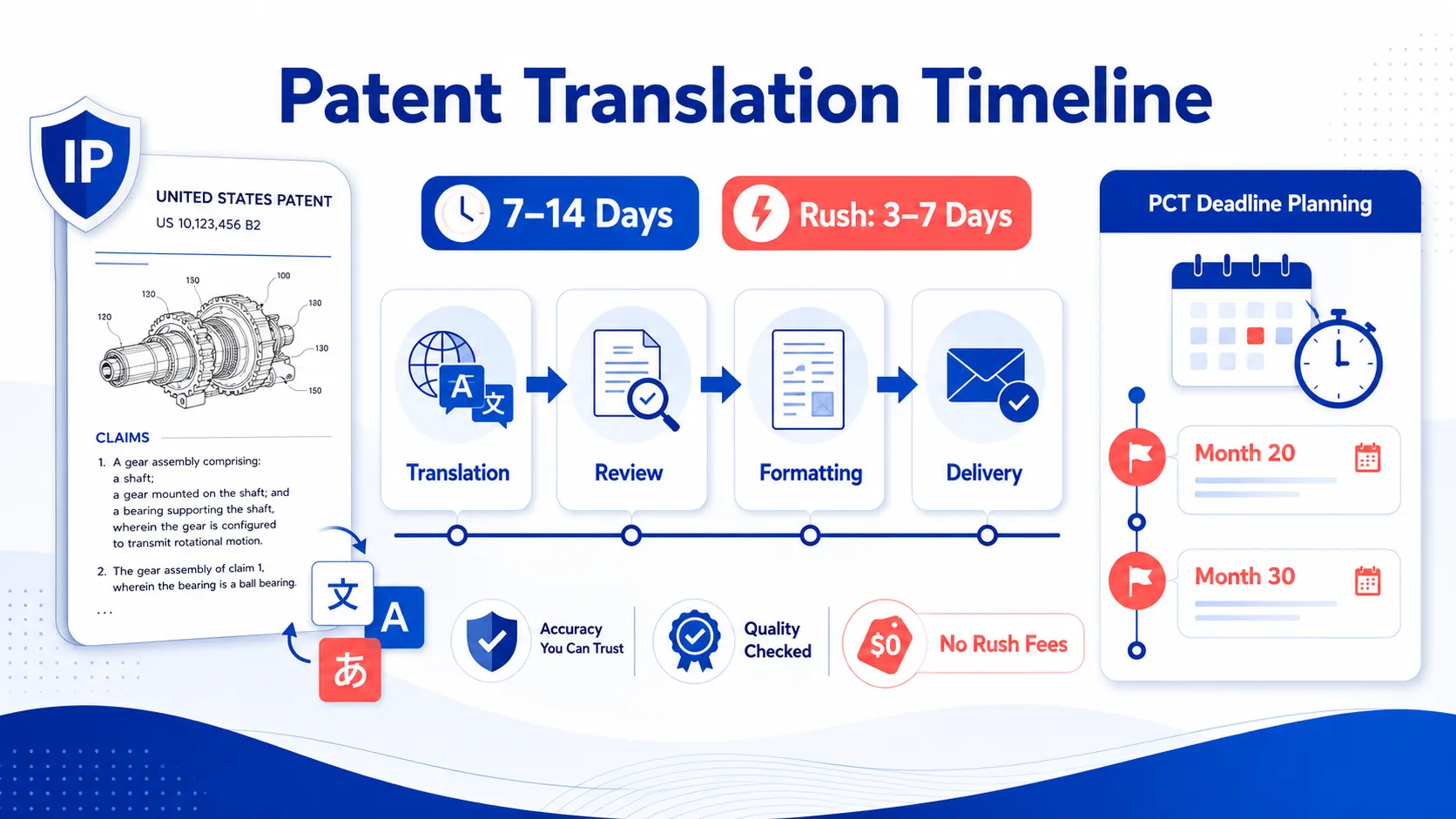
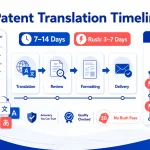
Budget planning for PCT national phase translation produces the best results when translation estimates are obtained by month 27 from the priority date. This 3-month buffer before the standard 30-month deadline gives IP attorneys and their clients sufficient time to evaluate translation partners against the specific technical demands of the application, compare accurate cost estimates, and commission work without the premium that last-minute urgent requests generate.
For pharmaceutical filings in China specifically, an onion layer filing strategy is well-supported by prosecution outcomes in that jurisdiction. This approach involves submitting claims at multiple levels of specificity, providing fallback positions when the broadest independent claims face rejection during examination. This strategy requires a translator who understands not only the technical content of the application but also the strategic logic of Chinese patent prosecution, a distinct and specialized combination of skills that separates a patent translation specialist from a general-purpose technical translation provider.
IP attorneys managing complex multi-jurisdiction portfolios that include engineering, semiconductor, or mechanical applications can also review Circle Translations’ technical translation services, which apply the same subject-matter expertise model at the academic credentials level for technical field-specific patent work.
How Circle Translations Handles PCT Patent Translation
For PCT national phase work specifically, Circle Translations draws on a global network of over 200 IP firm partners and subject-matter translators, covering more than 74 languages across all major designated offices under the WIPO PCT system. The agency has been handling international patent translation since 2008, with a track record that spans the EPO, JPO, CNIPA, USPTO, INPI, and the patent offices of India, Australia, Vietnam, South Korea, and other major Asia-Pacific jurisdictions.
Every PCT project is assigned to a translator with academic credentials in the specific technical field of the application. The subject-matter matching approach means that only translators with engineering or scientific qualifications in the relevant domain handle applications in that field, whether that is automotive engineering, biochemistry, semiconductor fabrication, or medical devices. Every translation goes through qualified proofreading review before delivery. For national phase entries in China, Japan, and India, where binding error risk is highest, Circle Translations can arrange for claims and critical text to be assessed by a local patent attorney in the target jurisdiction prior to submission.
Christoph Siebmanns, Managing Director of Gotapatent AB Sweden, puts it plainly: “Swift and very competitive translation service. We highly recommend Circle Translations for patent translations.” That endorsement comes from a professional who commissions patent translations as a core part of their daily practice, which makes it a meaningful signal of quality for any IP attorney evaluating translation partners.
To review language coverage, service tiers, pricing, and turnaround times for PCT national phase work, visit the patent translation services page. The 99.97 percent on-time delivery rate and no-rush-fee policy are built for the deadline-driven reality of PCT prosecution.
Conclusion
Successful PCT patent translation requires two things working in parallel: procedural precision and linguistic accuracy. Knowing the exact deadline for each designated office, understanding which jurisdictions treat translation errors as permanently binding, recognizing the provisional translation trap, and selecting a partner with the subject-matter credentials to match the application’s technical field are the four pillars that determine whether a PCT portfolio is properly protected or silently compromised. Circle Translations has been delivering that standard of work since 2008, with the depth, reach, and technical specialisation that global IP prosecution demands.
Frequently Asked Questions
1. What is PCT patent translation? PCT patent translation is the process of converting a WIPO international patent application into the official language required by each designated national or regional patent office as part of national phase entry. It covers the full application, including the description, claims, abstract, and all textual content within drawings.
2. What is the standard national phase entry deadline under the PCT? The standard national phase entry deadline is 30 months from the priority date for most designated offices, including the USPTO, JPO, and INPI. India, Australia, the EPO, and Vietnam allow 31 months. China has a 30-month standard deadline with a grace period permitting entry up to 32 months with an additional fee.
3. Which jurisdictions treat PCT translation errors as permanently binding? China (CNIPA), Japan (JPO), and India (IPO) treat translation errors as legally binding unless the error is immediately and obviously apparent from the translated text itself. This standard is applied conservatively, meaning errors that are linguistically detectable but not self-evidently obvious in context generally cannot be corrected after grant.
4. What is the provisional translation estoppel trap? The estoppel trap occurs when a competitor relies in good faith on a provisionally translated PCT application published in the PCT Gazette, then uses that apparent claim scope to guide their own product or filing decisions. If the provisional version was narrower than the final intended translation, the patent holder may be legally prevented from claiming the broader scope even after delivering a corrected translation.
5. Can machine translation be used for PCT national phase entries? Machine translation should not be used as the final output for PCT national phase filings. NMT systems routinely confuse legally precise claim terms such as “comprising” and “consisting of,” which directly alters claim scope. They also struggle with the complex syntax of dependent claim structures and technical terminology in specialized fields. The cost of managing clarity objections and prosecution errors caused by machine translation consistently exceeds the savings from avoiding qualified human translators.
6. What is Rule 91 and when does it apply to PCT translation errors? Rule 91 of the PCT allows rectification of obvious mistakes in the international application within 26 months of the priority date. A mistake qualifies as “obvious” only if a person skilled in the art would immediately recognize that nothing other than the proposed correction could have been intended. Errors that require external evidence to identify, or that involve interpretation differences rather than clear mistakes, do not meet this standard.
7. When should I commission PCT national phase translations to avoid premium fees? Translation estimates should be obtained by month 27 from the priority date. This 3-month buffer before the standard 30-month deadline allows time to evaluate translation partners based on technical subject-matter expertise, compare accurate cost proposals, and commission work without the premium rates that last-minute urgent requests attract.