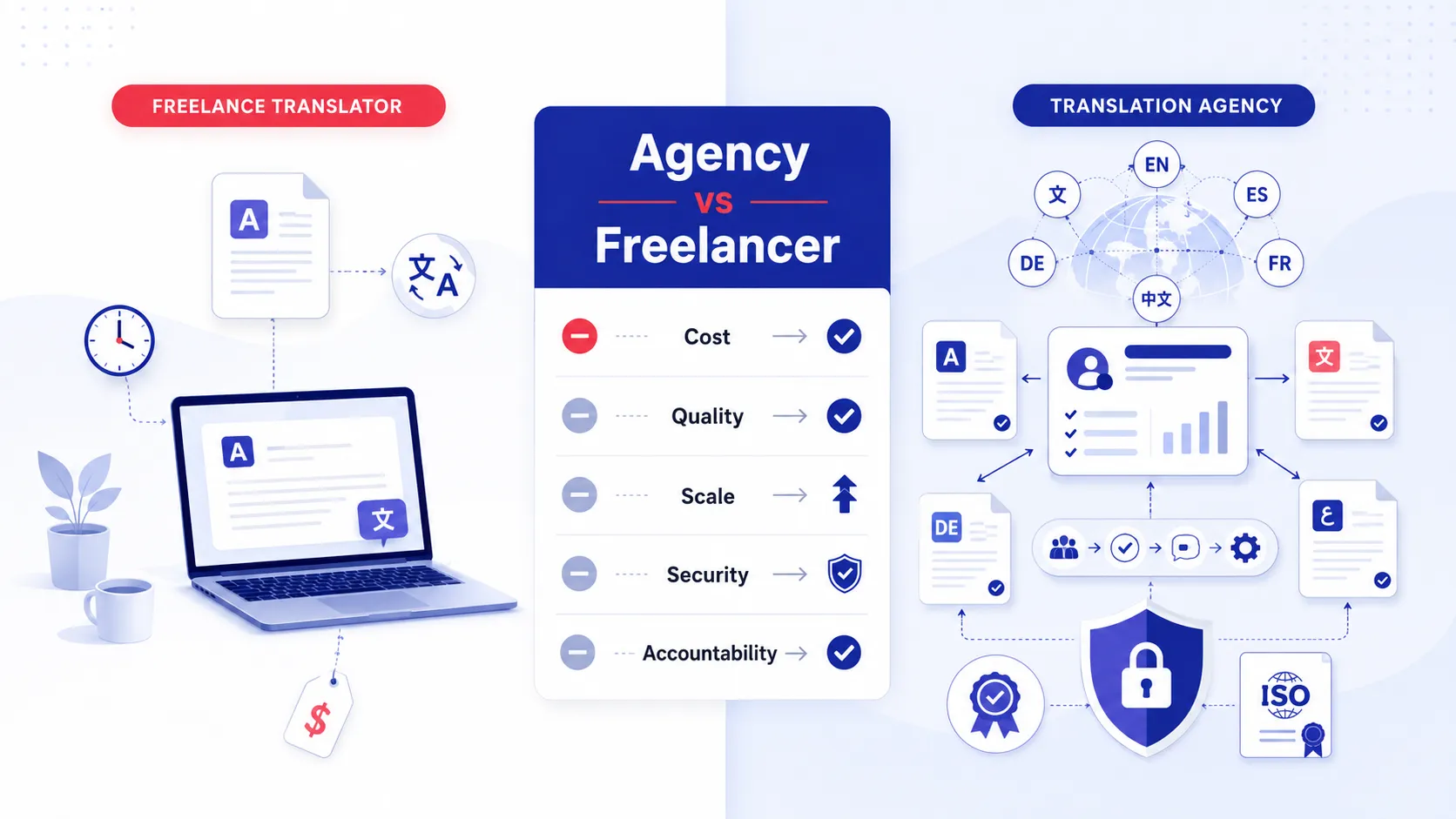
Choosing a translation agency has never been a straightforward procurement task, but the landscape in 2026 is considerably harder to navigate than it was five years ago. The growth of AI-assisted translation tools has flooded the market with providers whose marketing materials far outpace their actual operational capability. Polished websites, ISO logo badges, and confident proposals now arrive from agencies with vastly different quality standards, security practices, and accountability structures underneath.
For legal teams, compliance managers, procurement leads, and marketing directors responsible for international content, the cost of selecting the wrong provider is not limited to poor output quality. It extends to regulatory rejection, contract enforceability risk, brand credibility damage, and the compounding expense of rework and relationship rebuilding that follows a poor vendor decision.
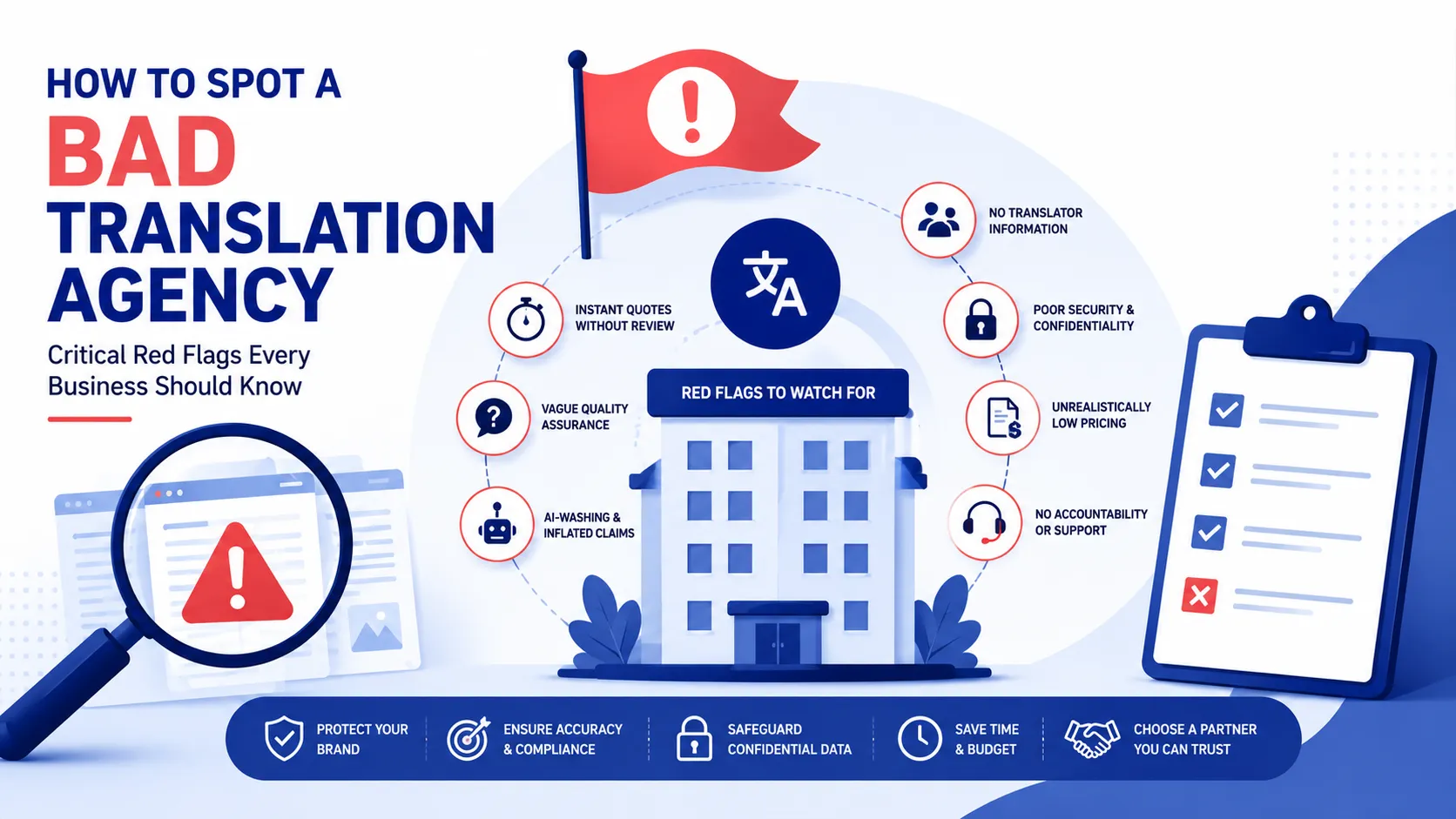
This guide identifies the most important red flags to look for when evaluating a language service provider, grounded in professional standards, current industry risks, and the questions that experienced buyers have learned to ask before anything is signed.
Red Flag 1: Instant Quotes Without Reviewing Your Files
A translation agency that generates an automatic price before examining your documents is applying a generic rate to work it has not assessed. Professional translation pricing depends on word count, content type, language pair, file format, subject-matter complexity, and the quality tier appropriate for your intended use. None of those variables can be determined without reviewing the actual source content.
This matters for two specific reasons. First, it signals that the agency intends to revise the quote once work begins or absorb the difference in quality. Second, it suggests that the project evaluation process that drives resource allocation, linguist matching, and timeline planning simply does not exist at this agency in any meaningful form.
A professional language service provider requests your files, confirms the purpose and target audience of the content, assesses the complexity of the material, and provides a detailed proposal with a transparent line-item breakdown. That process takes a short time and produces a cost estimate you can rely on when building a budget.
Red Flag 2: Vague Quality Assurance Descriptions
When asked how they ensure translation quality, agencies that respond with phrases like “we check everything thoroughly” or “all our translators are highly experienced” are not describing a process. They are offering reassurance without substance, and the distinction matters enormously for content that carries legal, regulatory, or brand consequences.
Professional quality assurance in translation follows the TEP workflow: Translation, Editing, and Proofreading. Each stage is performed by a separate, independent linguist.
What a Genuine TEP Workflow Looks Like
- Translation: A qualified linguist with verified subject-matter expertise produces the target language content from the source
- Editing: A second, entirely independent linguist reviews the output against the source text for accuracy, fluency, and terminology consistency
- Proofreading: A third reviewer conducts a monolingual check of the target language content for grammar, punctuation, formatting, and natural readability
- Project sign-off: The project manager confirms all stages are complete before delivery
The critical word throughout is “independent.” If the same translator performs both the translation and the editing review, or if the agency assigns a single reviewer to both the bilingual and monolingual passes, the process is not genuinely TEP-compliant regardless of what the proposal document says.
ISO 17100:2015 is the international standard that formalises this dual-control requirement for professional translation service providers. Agencies certified to this standard have had their workflows externally audited. When evaluating any provider, ask for the certificate number, the name of the issuing body, and the date of the most recent renewal. A certificate that cannot be independently verified is not a reliable quality signal.
Red Flag 3: AI-Washing and Inflated Technology Claims
One of the most significant emerging risks in translation vendor selection is AI-washing: the practice of marketing a service as AI-enhanced or AI-powered when the actual workflow relies on commodity machine translation APIs with minimal or no professional human review.
As enterprise interest in AI-assisted workflows has grown, some providers have adopted the vocabulary of neural machine translation, intelligent automation, and AI-driven localization without the infrastructure those terms imply. Regulatory attention to this problem is increasing. The U.S. Securities and Exchange Commission has already fined organisations for inflating AI-related claims, and the 2024 EU AI Act establishes accountability standards for high-risk AI applications in sectors including healthcare and legal services.
How to Distinguish Genuine AI-Assisted Translation from AI-Washing
- Genuine workflow: Integrates a professional MT engine such as DeepL or ModernMT with client-specific Translation Memory, a verified glossary, and post-editing by a qualified human linguist under a documented QA process
- AI-washed workflow: Routes content through a free or commodity MT API and delivers the output with light or no human review, regardless of content type or risk level
- The test: Ask the agency to name their specific MT engine, describe how post-editing is structured, identify who performs it, and explain what quality checks apply before delivery. An inability to answer at a technical level is a reliable indicator
Circle Translations uses technology to support and accelerate professional translation workflows, not to replace the human linguist review that publication-quality output requires. Every translation delivered through their process is reviewed by a native-speaking professional before it reaches the client.
Red Flag 4: Data Security That Does Not Cover the Full Linguist Network
Translation workflows involve moving sensitive content through networks of translators, project managers, and technology platforms. For organisations handling legal contracts, patent applications, financial filings, medical records, or commercially sensitive product documentation, the security standards applied to that content throughout the workflow are a primary procurement requirement.
The most commonly overlooked vulnerability is that an agency’s formal data security policy may apply only to its internal staff, while the freelance translator network that actually handles the translation work operates under entirely different conditions.
Security Questions to Ask Before Sending Any Sensitive Files
- Do all external translators and freelance linguists sign non-disclosure agreements as a standard condition of engagement, not just internal employees?
- Are source files managed through a secure platform that prevents them from being downloaded to unmanaged personal devices?
- Does the agency prohibit translators from using free online MT tools with client content?
- What encryption protocols apply to file transfer and storage?
- Is the agency’s data security policy compliant with relevant frameworks such as GDPR or ISO 27001, and does that compliance extend to the external linguist network?
Free or consumer-grade translation tools present a particular risk in this context. Many such tools repurpose submitted data for their own purposes, potentially storing content without encryption or using it to improve their models. Professional translators who use these tools to reduce their own workload expose client content without the client’s knowledge or consent.
Circle Translations applies NDAs to all translators as a standard condition of engagement and uses encrypted file transfer protocols with secure platform-based document access controls. For procurement teams responsible for sensitive content, confirming that these policies exist and extend to the full linguist network is a non-negotiable step in the vendor evaluation process.
Red Flag 5: No Subject-Matter Specialists for Your Content Type
General language fluency is a necessary qualification for a professional translator. It is not, by itself, a sufficient qualification for specialist content. The assumption that any bilingual professional can translate any document in their language pair is one of the most consistently expensive mistakes organisations make when sourcing translation services.
The practical stakes are not abstract. A translator without verified expertise in legal systems cannot reliably identify when a clause in a contract would carry a different legal meaning in the target jurisdiction. A linguist without healthcare knowledge may produce a pharmaceutical document where the terminology is linguistically plausible but clinically incorrect. An engineer’s report translated by a linguist with no technical background will contain terminology choices that sound reasonable but are professionally inaccurate.
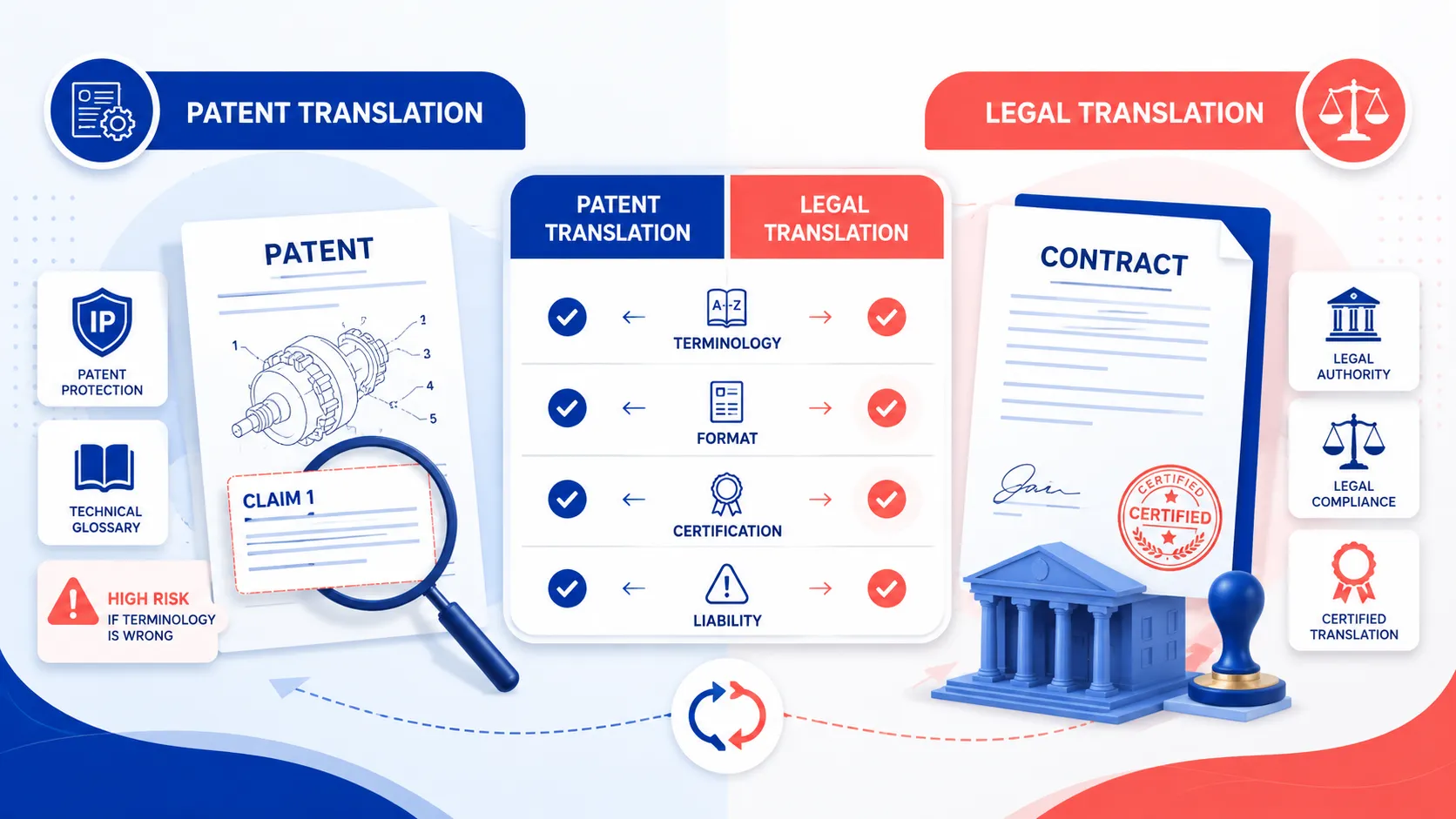
For businesses with complex documentation across sectors including manufacturing, automotive, energy, healthcare, or intellectual property, dedicated technical translation services with verified specialist linguists are a quality baseline, not an optional premium tier.
When evaluating any agency, ask specifically how translators are matched to projects. Ask whether domain expertise is verified independently or accepted on a self-reported basis. Ask whether the same specialist would be assigned consistently to your account for terminology continuity. Agencies that cannot answer these questions with specifics assign translators based on availability, and the quality outcomes reflect that.
Red Flag Comparison Table: Professional Agency vs. Problematic Provider
The table below summarises the key differentiators between a professionally run language service provider and the warning signs that indicate an agency may not meet the standards required for B2B content.
| Evaluation Criteria | Professional Agency | Red Flag Behaviour |
| Quote process | Reviews files before pricing; itemised proposal | Instant automated quote without file review |
| Quality assurance | Documented TEP workflow with independent reviewers | Vague “we check everything” assurances |
| ISO 17100 certification | Current, verifiable, third-party audited | Unverifiable badge; expired or scope-limited certificate |
| NDA coverage | All translators including external freelancers | Internal staff only; no formal NDA for linguist network |
| Data security | Encrypted transfer; secure platform; no free tool policy | Relies on email; no policy on MT tool use by translators |
| Linguist matching | Verified subject-matter specialists per content type | Availability-based assignment; self-reported expertise |
| Pricing transparency | Full itemised fee schedule before project start | Hidden fees appearing on final invoice |
| Rush fee policy | No rush fees as standard (e.g. Circle Translations) | 25 to 100 percent surcharge for urgent delivery |
| Project management | Named project manager; daily updates; 24/7 support | Shared inbox; no named contact; no progress reporting |
| Revision policy | Defined revision rounds; errors corrected without charge | Vague or absent revision terms; charges for own errors |
Red Flag 6: Opaque or Inconsistent Pricing
Translation pricing transparency is one of the most direct indicators of an agency’s broader professionalism. Providers who are reluctant to itemise their fees, who present invoices with charges not mentioned during the proposal, or who cannot clearly explain what differentiates their quality tiers are operating without the client accountability that serious partnerships require.
Common Hidden Charges to Ask About Before Committing
- Rush surcharges: Industry standard rates of 25 to 100 percent for urgent delivery; agencies with no-rush-fee policies (like Circle Translations) remove this cost variable entirely
- Project management fees: Typically 8 to 15 percent of total project cost; legitimate when disclosed upfront, problematic when added silently to the invoice
- Desktop Publishing fees: For reformatting translated documents where text expansion or contraction affects the original layout
- Engineering fees: For extracting text from non-editable formats including PDFs and scanned documents
- Minimum project fees: Applied to small tasks regardless of actual word count, often not mentioned in initial discussions
- In-Country Review fees: For additional native speaker verification in the target market, sometimes added post-quote
The most effective protection is requesting a complete itemised fee schedule based on your specific content type, file format, and delivery requirements before any agreement is formalised.
Red Flag 7: Imposter Translators and Inadequate Vetting Processes
A growing concern in the translation industry is the increase in imposter translators who use stolen professional credentials to secure work and then deliver machine-generated content with no genuine linguistic expertise applied. This risk is concentrated in agencies that recruit through online platforms without rigorous independent vetting.
Signs That an Agency’s Linguist Vetting Is Insufficient
- No formal translation test is administered before a translator is approved for client work
- Subject-matter expertise is accepted as self-reported without independent verification
- No signed onboarding documentation exists including NDAs, qualification records, and performance standards
- Quality varies unpredictably between projects with no consistent translator assignment
Ask any prospective agency what their translator onboarding process involves, what specific test is administered, who evaluates the output, and how domain expertise is verified. An agency that cannot answer these questions with precision has not answered them for itself, and that is a meaningful finding before any sensitive content changes hands.
Red Flag 8: No Dedicated Project Manager or Structured Communication
A professional agency assigns a named project manager to every client account. This is not a client service amenity. It is the operational function responsible for maintaining brief integrity, managing timelines, allocating the right resources, and providing the regular communication that accountability requires.
Agencies that route all client interaction through a shared support inbox, rotate account contacts without notice, or offer no progress visibility between project start and delivery are not structured to manage complex, multi-language, or ongoing content work reliably.
When evaluating agencies, ask whether a specific project manager will be named for your account, what the update frequency is during a live project, and what the formal escalation path is if a quality issue arises. Circle Translations assigns a dedicated project manager to every project, provides daily updates throughout, and maintains 24/7 chat and phone support for all clients.
Red Flag 9: Vague or Non-Existent Revision Policies
The revision policy an agency operates under tells you a great deal about its confidence in its own quality standards. Agencies with clearly defined revision terms, specific rounds included in the service agreement, and a straightforward process for correcting errors attributable to their own workflow have built their service around accountability. Agencies with vague, heavily caveated, or absent revision terms have not.
Before committing to any provider, ask how many revision rounds are included in the standard engagement, whether errors introduced by the agency are corrected at no additional charge, and what the formal process is if the delivered translation does not meet the agreed quality standard. A professional agency welcomes these questions. An agency that deflects or qualifies them extensively is signalling the limits of the accountability it is prepared to accept.
What the Right Agency Looks Like
The red flags described throughout this guide collectively define a clear positive profile. A professionally run language service provider prices transparently, including all line items, before work begins. It describes its quality assurance process in specific, auditable terms and holds current ISO 17100 certification from a verifiable body. It applies NDAs to every linguist without exception and uses secure platforms for file access and transfer.
It matches translators to content based on verified subject-matter expertise, not on availability. It maintains Translation Memory and client-specific glossaries to ensure consistency across your entire content portfolio. It assigns a named project manager to your account, provides regular progress updates, and does not apply rush fees as standard.
For organisations that want to understand the full service scope and operating principles behind a professional full-service agency approach, the Circle Translations about us page covers how the team works with clients across more than 74 languages and 124 language combinations worldwide.
Conclusion
The red flags covered in this guide represent the specific signals that separate professionally run language service providers from agencies whose marketing presentation has outpaced their operational reality. In 2026, with AI-washing, inadequate security practices, and undisclosed pricing increasingly common across the industry, the evaluation criteria that matter are the ones that reveal what an agency actually does rather than what it claims.
For legal, compliance, and risk-management teams, these questions are not optional due diligence steps. They are the difference between a vendor that protects your content, your budget, and your reputation and one that creates new risks while managing the ones you already had.
Circle Translations serves over 900 businesses globally with a 99.97% on-time delivery rate, no rush fees, NDAs with all translators, and a dedicated project manager on every project. If your team is currently building a translation vendor shortlist, the framework in this guide provides a structured basis for separating the agencies that can substantiate their standards from those that can only describe them.
Frequently Asked Questions
1. What is the most important thing to check when choosing a translation agency?
The combination of current ISO 17100 certification, a documented TEP workflow with independent reviewers at each stage, and confirmed NDA coverage for all linguists including external freelancers represents the strongest professional quality baseline. These three factors are externally verifiable and collectively confirm that the agency has audited processes, structured quality control, and the contractual accountability that B2B content requires.
2. What is AI-washing in translation and how do I identify it?
AI-washing is the practice of marketing a translation service as AI-powered when the actual workflow uses basic commodity MT engines with little or no human quality review applied before delivery. You can identify it by asking an agency to name their specific MT engine, describe how post-editing is structured, and explain who performs it under what quality controls. Agencies that cannot answer at a technical level are almost certainly not running the workflow their marketing implies.
3. How do I verify that an agency’s ISO 17100 certification is genuine?
Ask for the specific certificate number, the name of the issuing certification body, and the date of the most recent renewal audit. A legitimate certificate can be cross-referenced through the issuing body’s own public records, and any certificate that cannot be linked to a verifiable auditing organisation should be treated as unconfirmed. Certifications that have not been renewed within a reasonable recent period also warrant a direct follow-up question about current compliance.
4. Should translation agencies have NDAs with their freelance translators, not just internal staff?
Yes, and this distinction is critical for organisations handling sensitive content. Some agencies apply formal confidentiality agreements only to internal employees while their broader freelance linguist network works under far less rigorous terms. For legal, financial, medical, and commercially sensitive documents, confirming that every person who accesses your files is covered by a signed NDA is a non-negotiable security requirement before sending any content.
5. Why is a dedicated project manager important when working with a translation agency?
A named project manager ensures your brief is accurately communicated to every linguist, timelines are actively monitored, and you receive regular progress updates rather than silence until delivery. Without this role, brief details get diluted, risks go unmanaged until they affect the deliverable, and quality issues surface too late for correction. The presence of a named, accountable project manager is a direct indicator of the operational maturity of the agency you are considering.
6. What hidden fees should I ask about before signing with a translation agency?
The most common undisclosed charges include rush surcharges of 25 to 100 percent for urgent timelines, project management fees of 8 to 15 percent, DTP fees for reformatting translated documents, engineering fees for non-editable file formats, and minimum project charges for small tasks. Requesting a fully itemised fee schedule based on your actual content type and delivery requirements before any agreement is signed is the most straightforward protection against invoice surprises.
7. How can businesses protect themselves against imposter translators?
Work only with agencies that administer formal translation tests before onboarding any new linguist, verify subject-matter expertise through independent means rather than self-reporting, and maintain consistent translator assignments with documented performance tracking. Asking an agency to describe their specific linguist vetting process during the evaluation stage is a practical protective step that reveals whether the agency has genuinely resolved this risk for itself.
8. What should an agency’s revision policy include to be considered professional?
A professional revision policy defines the number of included revision rounds, confirms that errors attributable to the agency are corrected at no additional charge, and documents a clear escalation process for unresolved quality disputes. Agencies that welcome direct questions about revision terms and answer them with specifics have built their service around accountability, while those that deflect or heavily qualify these questions are signalling the boundaries of the responsibility they are prepared to accept.