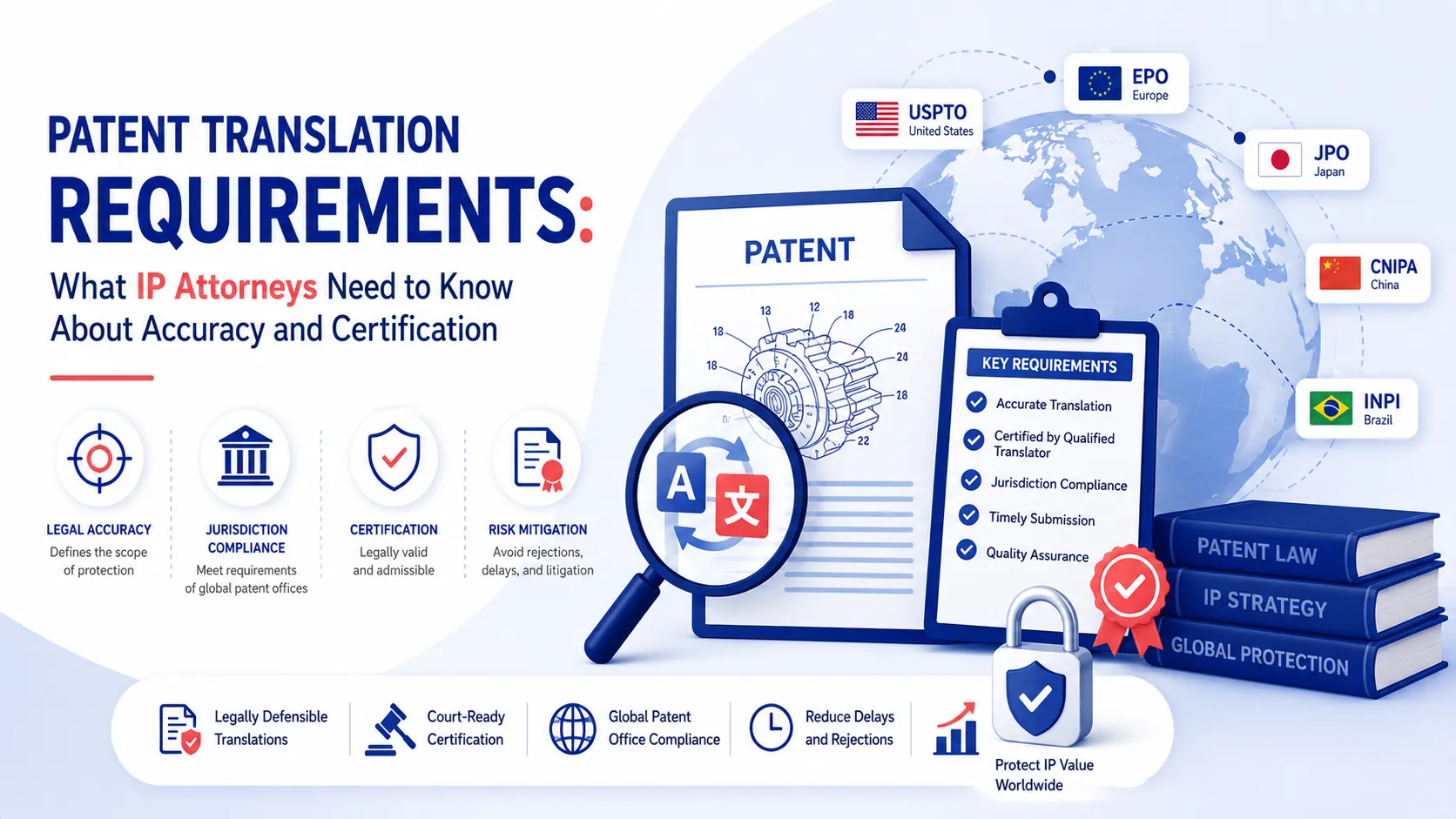
Patent translation requirements are the jurisdiction-specific legal standards that govern how intellectual property documents are translated, certified, and submitted during international patent prosecution. In 2024, approximately 273,900 PCT international applications were filed globally, with the Asian region now accounting for 66.8 percent of all patent activity. For every application that crosses a border, the translation is not a support task. It is the legal instrument that defines the scope of protection.
A study by the Steinbeis Institute for Intellectual Property Management found that 81 percent of IP professionals had personally encountered errors in patent translations, with 1 in 4 reporting errors severe enough to damage an applicant’s ability to secure protection. This guide covers the five major patent office requirements across the USPTO, EPO, JPO, CNIPA, and INPI; the certification standards that hold up under litigation; and the documented cost of getting translation wrong, starting with a case that turned a single mistranslated adjective into a fatal invalidity finding.
Why Patent Translation Defines the Legal Scope of Every International Filing
Patent translation defines the enforceable legal scope of an invention in every jurisdiction where a translated application is filed. The translated claims document is not a copy of the original. It is the operating legal record. Courts in the United States, Japan, and China have consistently held that the translated text governs interpretation, not the applicant’s original intent or the foreign priority document.
Think of it this way: the source-language application is the blueprint, but each translated version is the construction contract in that market. Any deviation from the source, whether in claim terminology, transitional phrase choice, or technical description, reshapes the legal boundary of the invention. For IP attorneys managing multi-jurisdiction portfolios, this means translation quality is a risk management decision with patent validity consequences, not a procurement exercise with per-word pricing as the only variable.
Understanding the foundational stakes explains why each of the five major patent offices has developed its own specific requirements for language, timing, and certification accuracy. The rules differ by jurisdiction but share the same underlying principle: the translated text is the record.
USPTO Patent Translation Requirements: 37 CFR 1.52 and 1.55 Explained
The USPTO allows nonprovisional applications to be filed in a language other than English under Section 1.52(d) of Title 37 of the Code of Federal Regulations. To avoid abandonment, the applicant must provide an English translation, a processing fee, and a signed accuracy statement. The more demanding obligations come under Section 1.55, which governs certified translations for foreign priority documents used to establish priority claims.
The USPTO requires certified translations in three specific scenarios: interference or derivation proceedings; situations where an examiner locates prior art that postdates the US filing date but predates the foreign priority date; and any circumstances where the examiner places a priority claim under scrutiny during prosecution. Missing or deficient translations in these scenarios can result in the rejection of priority claims, which leaves the patent exposed to intervening prior art.
What the USPTO Accuracy Statement Actually Requires
The USPTO accuracy statement is a signed declaration by the translator or an authorized representative attesting that the translation is a true, complete, and accurate rendition of the original document. A persistent misconception among patent practitioners is that this requires a notary stamp. It does not. What the USPTO requires is personal attestation from someone with first-hand knowledge of the source language and the translated content.
This distinction has real litigation consequences. When a project manager who cannot read the source language signs the accuracy statement, the certificate lacks the provenance that courts expect. Under the Federal Rules of Evidence, this creates vulnerability under Rule 604, which covers interpreter qualifications, and Rule 702, which covers the reliability of the methods used to produce an expert opinion or translated document. Opposing counsel in patent litigation regularly challenges translation provenance, and a certificate signed without personal knowledge of the source text is a structurally weak exhibit.
When Certified Translations Become Mandatory Under Section 1.55
Certified translations under Section 1.55 become mandatory when priority claims are challenged directly or when prior art discovered during examination falls between the foreign filing date and the US filing date. If the priority claim fails because a certified translation is absent or deficient, and intervening prior art exists in that gap, the resulting validity exposure can be severe. The recovery path from a failed priority claim due to a translation deficiency is narrow, expensive, and frequently unsuccessful.
European Patent Office Requirements Under Article 14 EPC
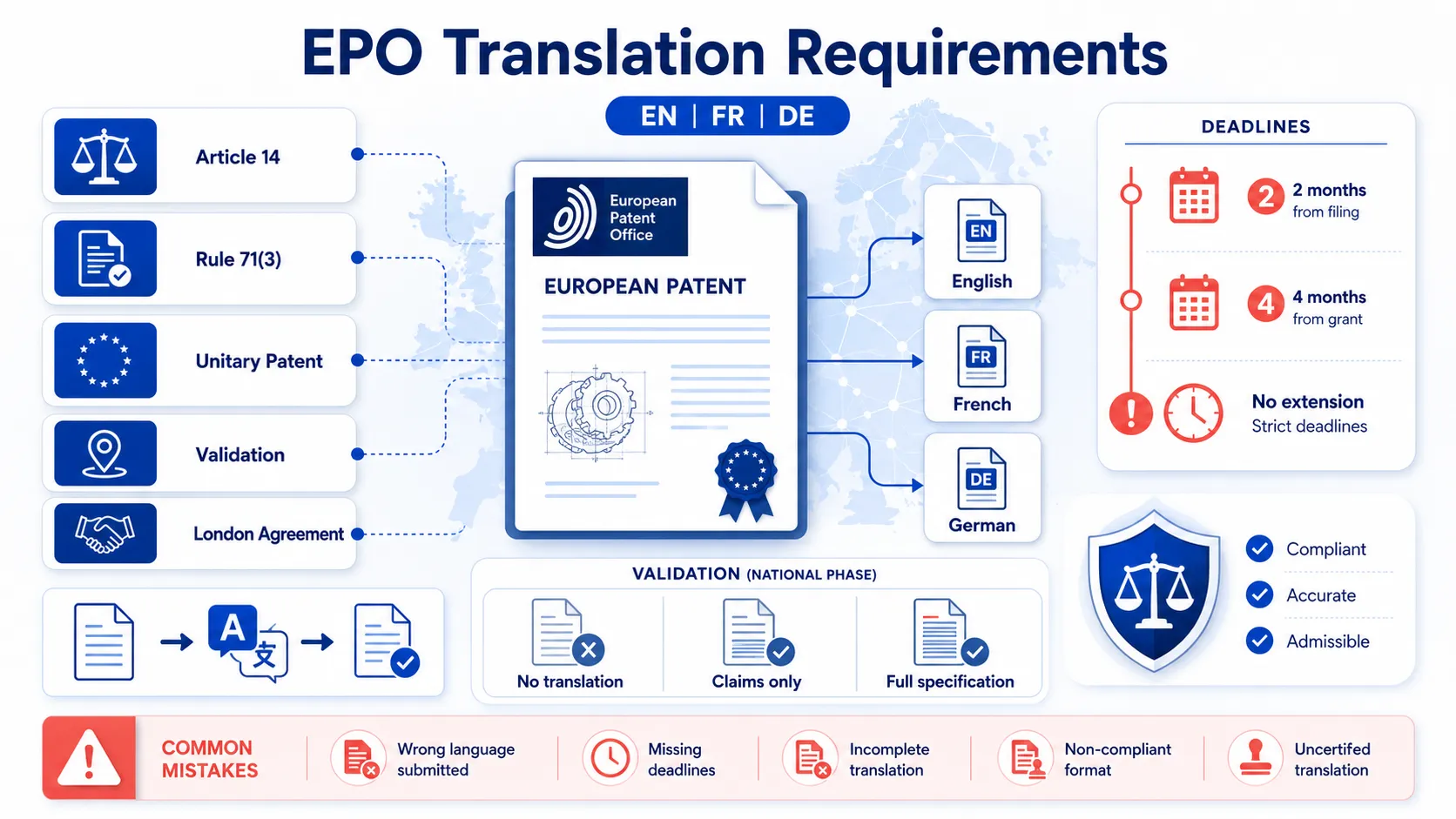
The EPO accepts applications in any language to establish a filing date under Article 14 of the European Patent Convention, but requires translation into one of the three official languages, English, French, or German, within two months of filing. The correction window available at the EPO during prosecution makes it meaningfully different from the USPTO, CNIPA, and JPO, which offer much less flexibility once errors become part of the prosecution record.
Fee Reductions for SMEs at the EPO
Small and medium-sized enterprises, natural persons, non-profit organizations, universities, and public research organizations qualify for a 30 percent reduction in EPO filing and examination fees. The reduction requires applicants to file essential initial documents in an admissible non-EPO language and submit the required translation simultaneously. For innovators from countries such as Italy, Spain, and the Netherlands, coordinating translation timing to capture this reduction is a material cost consideration during filing strategy discussions.
Language Conformity and the Authentic Text
Throughout EPO proceedings, the translation can be brought into conformity with the original application, which provides a correction mechanism during prosecution that most other major patent offices do not offer to the same extent. This flexibility matters because early-stage errors are not always fatal if they are caught during examination. The phrase “during proceedings” carries all the weight here: corrections after grant are considerably more difficult, and in some jurisdictions functionally unavailable. The EPO’s conformity mechanism is not a safety net for avoidable errors; it is an exception, not a rule.
Japan Patent Office: Deadlines, Form 53, and Linguistic Complexity
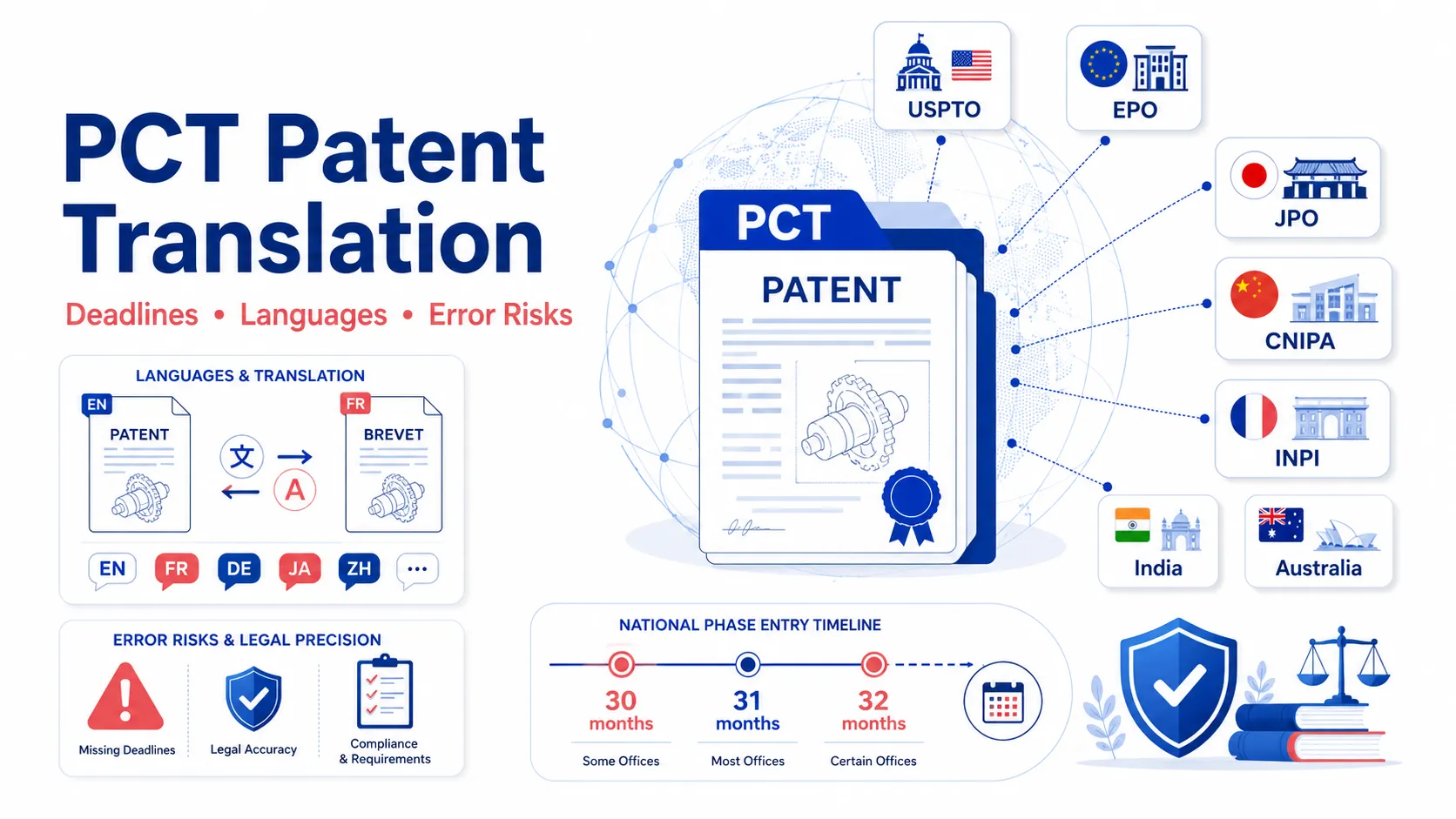
Japan patent translation requirements combine strict procedural deadlines with a source language that introduces structural risks to claim accuracy that have no direct equivalent in European patent prosecution. The standard PCT national phase entry deadline in Japan is 30 months from the priority date, and the Japan Patent Office is strict about enforcement.
The Form 53 Deadline Extension Strategy
The Form 53 mechanism allows PCT applicants to extend the translation deadline in Japan beyond the standard 30-month mark. By submitting a National Phase Entry Request between months 29 and 30, the effective translation deadline extends to approximately 32 months from the priority date. For companies still evaluating the commercial justification for Japanese market entry at the 30-month mark, this two-month extension is a meaningful decision window that many US applicants leave unused simply because they are unaware of it. The Form 53 strategy costs nothing beyond the submission itself and carries no downside for applicants who ultimately proceed with full translation.
Why Japanese Requires a Different Level of Translation Expertise
Japanese is a high-context language where subject omission is grammatically standard. A patent translator must frequently infer whether the subject of a clause is “the device,” “the system,” or “the user.” If that inference is wrong, the resulting claim scope is permanently altered because the new matter prohibition bars post-filing corrections to the substance of the application. Ambiguity in modification relationships between Japanese noun phrases creates additional risks in technical claims, particularly in robotics, automotive engineering, semiconductor fabrication, and medical device applications.
The Multi-Multi Claim Prohibition That Trips Up US Applicants
As of April 1, 2022, the Japan Patent Office strictly prohibits “multi-multi claims,” a dependent claim structure that references multiple other dependent claims simultaneously. This structure is standard in US patent drafting and appears frequently in applications entering the Japanese national phase. Without restructuring these claims during translation and filing preparation, the application faces immediate rejection. A qualified translation partner identifies this conflict and flags it proactively before submission, rather than leaving the attorney to discover it from an office action.
China’s CNIPA: Simplified Chinese, Rule 117, and the Scope Trap
The China National Intellectual Property Administration requires all patent submissions in Simplified Chinese. This requirement applies to the description, claims, abstract, and every piece of textual content within drawings. Traditional Chinese is not acceptable. The CNIPA uses agency-level assurance rather than individual sworn translators: a professional entity provides an official company seal and a declaration of accuracy, placing accountability at the organizational level.
Rule 117 of the CNIPA Implementing Regulations is the most punishing provision in global patent translation practice. If a translation error results in a claim scope broader than the original foreign text, the scope is limited back to the original. If the error leads to a narrower scope, the narrow scope stands permanently. Corrections after grant are effectively unavailable. This double-penalty mechanism means every translation error in a Chinese patent filing is self-penalizing and irreversible, making accurate first-submission translation the only viable standard in the Chinese market.
Brazil INPI Requirements: Portuguese Filing Windows and Annuity Timing
Brazil’s National Institute of Industrial Property requires applications in Portuguese. For direct filings, applicants have a 30-day window to submit the full Portuguese translation. For PCT national phase entries, the window extends to approximately 60 days. Missing either window has immediate prosecution consequences.
What catches many applicants unprepared is Brazil’s annuity structure. Maintenance fees begin while the application is still pending, starting in the third year from the filing date. For PCT entries where the 24-month mark from filing has already passed at the time of national phase entry, the first annuity falls due within three months of entering the national phase. Coordinating translation delivery with annuity payment deadlines requires the kind of proactive project management that professional translation partners build into their workflow by default.
The Legal Consequences of Translation Errors: IBSA v. Teva
IBSA v. Teva Pharmaceuticals is the documented case that every IP attorney working with foreign-origin patent applications should know. The Italian source document used the term “semiliquido.” Standard pharmaceutical industry practice translates this as “semi-liquid.” The US translation rendered it as “half liquid” instead.
Teva challenged “half liquid” as indefinite, arguing it was not a recognized term of art in the pharmaceutical field. The US District Court and the Federal Circuit both declined to look behind the translated text to the original Italian priority document. Because the applicant had chosen the term “half liquid” in the US application, both courts held that choice to be intentional and evaluated the claim on that basis. The patent was found invalid for indefiniteness.
The principle applies broadly: courts hold applicants to the translated text as the legal record. The same risk applies across all technical fields, from mechanical engineering to biotechnology, wherever non-native drafting or translation introduces terminology that deviates from field-standard usage. IP attorneys handling litigation involving foreign-origin patents should also recognise that the terminology risk extends to surrounding legal proceedings: depositions, prior art references, and courtroom exhibits all require the same standard of accuracy. For that class of document, legal translation services built for the litigation context are the appropriate choice, not general-purpose document translation.
AI and Machine Translation Risks in Patent Filings
Neural machine translation tools, including DeepL, Google Translate, and ModernMT, produce fluent-sounding output that creates a specific problem for patent prosecution use. Fluency is not accuracy. In patent claims, the only standard that matters is legal accuracy, and NMT systems fail this standard in predictable and reproducible ways.
How NMT Systems Alter Claim Scope in Predictable Ways
AI translation works on contextual inference and probability matching. Patent claim drafting requires the opposite: literal fidelity with consistent technical terminology. NMT systems regularly conflate two critical transitional phrases: “comprising,” an open-ended term that includes unlisted elements, and “consisting of,” a closed term that excludes them. Substituting one for the other directly and permanently alters claim scope in ways that may not surface until infringement litigation years after prosecution. For complex engineering, semiconductor, and mechanical patent applications, the same risk extends to highly technical field-specific terminology, which is why Circle Translations’ technical translation services assign translators with domain-specific academic credentials, including PhDs and Masters in engineering and sciences, to applications in those fields.
Why Free AI Tools Create a Confidentiality Problem
Entering an unpublished patent specification into a free AI translation platform creates a disclosure risk that extends beyond translation quality. Many free tool terms of service allow input data to be retained for model training purposes. If unpublished invention content is retained by a third-party platform outside of a non-disclosure agreement, that retention can be argued as a public disclosure affecting the novelty of the invention in jurisdictions with absolute novelty requirements. Using a professional translation agency protects confidentiality at every stage of the workflow, with access to pre-publication content restricted to only the translators and editors directly assigned to the project.
Certification Standards: Who Signs the Accuracy Statement Matters
The accuracy statement standard across patent offices requires the person signing to have first-hand knowledge of the source language and personal responsibility for the accuracy of the translation. In practice, globalized translation supply chains frequently deliver certificates signed by project managers who neither read the source language nor performed the translation.
This creates three distinct risks that surface in patent litigation. First, it creates Rule 604 vulnerability under the Federal Rules of Evidence if the translation is introduced as evidence. Second, it creates Rule 702 challenges to the reliability of the methodology used to produce the translation. Third, it provides opposing counsel with a clear avenue to challenge translated exhibits as unreliable hearsay, potentially removing key claim construction evidence from the record entirely.
Best practice requires the translator who performed the work, or a qualified bilingual reviewer who personally examined both the source and target documents, to sign the accuracy statement with their name and qualifications documented on the certificate.
How Circle Translations Supports IP Attorneys and Patent Teams
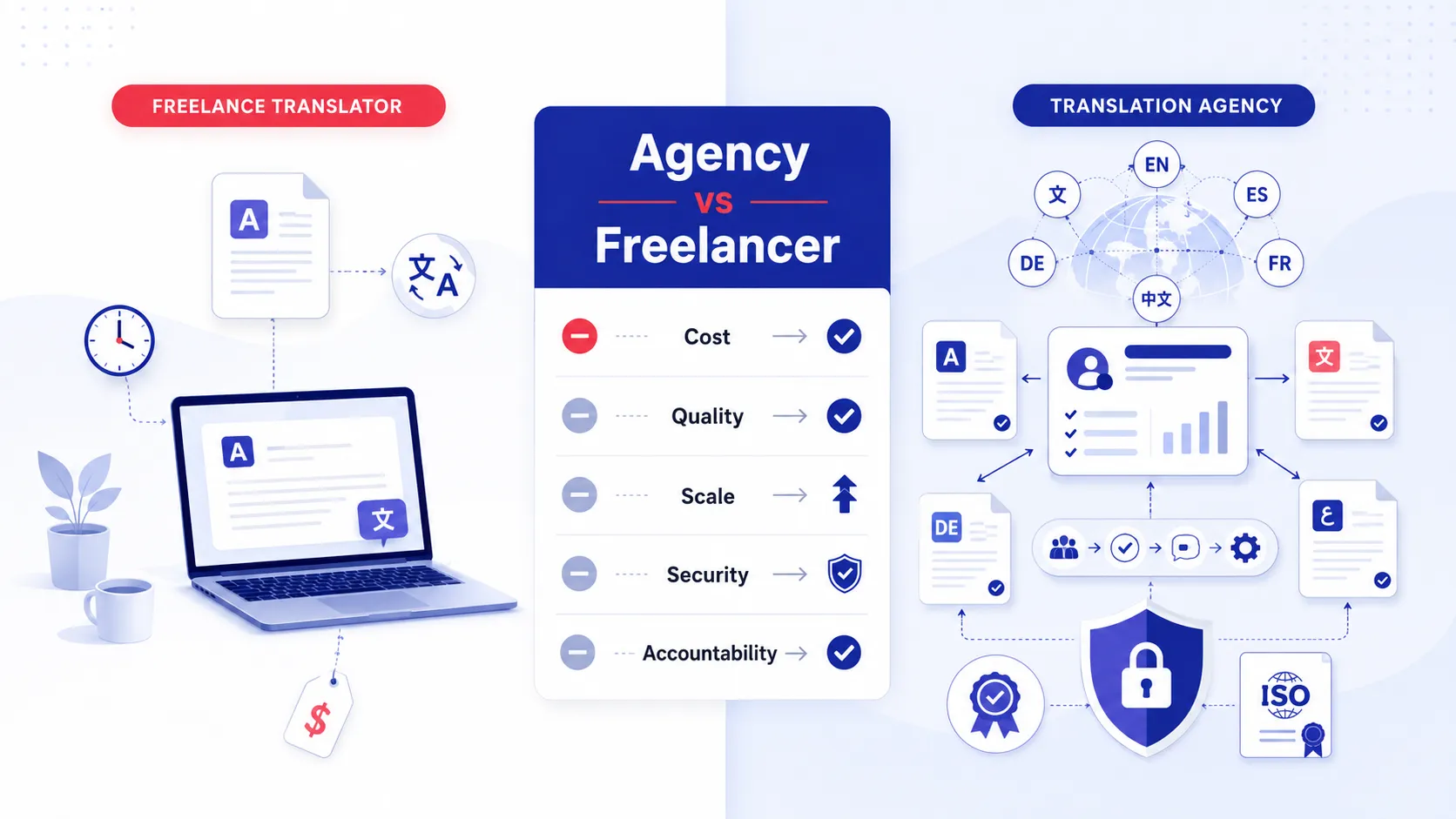
Circle Translations has been delivering patent and IP localization services to clients worldwide since 2008, partnering with over 200 IP firms and patent departments across global markets. The agency translates patents into more than 74 languages, covering all major PCT filing jurisdictions including Japanese, Korean, Chinese Simplified, German, French, Portuguese, and Arabic.
Every patent translation project is assigned to a translator with academic credentials in the relevant technical field. The agency’s approach to subject-matter matching means, for example, that only biochemists who are native English speakers and hold a Masters or PhD in biochemistry work on biochemistry patent applications translated from German to English. The same domain-matching principle applies across all technical fields and language pairs. Every translation goes through qualified proofreading review, and Circle Translations can also arrange for claims and critical text to be assessed by a local patent attorney in EU member states and major Asian countries before delivery.
Christoph Siebmanns, Managing Director of Gotapatent AB Sweden, summarises the experience directly: “Swift and very competitive translation service. We highly recommend Circle Translations for patent translations.” That endorsement comes from someone who commissions patent translations professionally, which makes it the most relevant quality signal for the audience reading this article.
To explore the full scope of Circle Translations’ IP translation capability, including pricing tiers, turnaround times, and language coverage, visit the patent translation services page. With a 99.97 percent on-time delivery rate and no rush fees across all service tiers, it is built for the timelines patent prosecution actually demands.
Conclusion
Patent translation requirements across the USPTO, EPO, JPO, CNIPA, and INPI share a common principle: the translated text becomes the enforceable legal record, and errors in that record carry consequences ranging from priority claim rejection to complete patent invalidation. IBSA v. Teva is a documented example of a systemic risk that applies to every international patent portfolio, not just pharmaceutical cases.
For IP attorneys and corporate legal teams, selecting a translation partner for patent work is a decision about legal risk exposure measured in patent validity outcomes. Circle Translations brings over 15 years of IP translation experience, academic-level subject-matter expertise across every major technical field, and a network of over 200 partner IP firms to every patent project, making translation quality a professional baseline rather than an optional upgrade.
Frequently Asked Questions
1. What are patent translation requirements at the USPTO? USPTO patent translation requirements are governed by 37 CFR 1.52(d) and 1.55. Section 1.52(d) allows non-English applications to be filed with a subsequent English translation and accuracy statement to avoid abandonment. Section 1.55 requires certified translations of foreign priority documents in interference proceedings or when prior art challenges arise during the priority window.
2. Does a USPTO patent translation require a notary stamp? A USPTO patent translation does not require a notary stamp. The USPTO requires an Accuracy Statement signed by the translator or an authorized representative who can personally attest to the completeness and accuracy of the translation based on first-hand knowledge of the source language. A notary is not a substitute for this personal knowledge requirement.
3. What is the Form 53 strategy for Japanese patent filings? Form 53 extends the PCT national phase translation deadline in Japan from 30 months to approximately 32 months from the priority date. Applicants submit a National Phase Entry Request between months 29 and 30 to access this extension, giving companies additional time to confirm their commitment to the Japanese market before incurring full translation costs.
4. What does CNIPA Rule 117 mean for patent translation errors in China? CNIPA Rule 117 makes translation errors in Chinese patent filings permanent and self-penalizing. If an error broadens the claim scope beyond the original foreign text, the scope is limited back to the original. If the error narrows the scope, the narrow scope stands. Corrections after grant are not available, making first-submission accuracy the only viable standard for Chinese patent prosecution.
5. Can AI translation tools be used for patent applications? AI translation tools carry significant risk for patent applications across two dimensions. Technically, NMT systems confuse open-ended claim language such as “comprising” with closed claim language such as “consisting of,” permanently altering claim scope. From a confidentiality standpoint, free tools may retain unpublished invention data under their terms of service, creating novelty risks in absolute novelty jurisdictions.
6. Who should sign a patent translation accuracy certificate? The translator who performed the translation, or a qualified bilingual reviewer who personally examined both the source and target documents, should sign the accuracy certificate. Project managers who cannot read the source language create admissibility vulnerabilities under Federal Rules of Evidence Rules 604 and 702, giving opposing counsel grounds to challenge translated documents in patent litigation.
7. What patent translation services does Circle Translations provide? Circle Translations has provided patent translation services since 2008, covering 74+ languages across all major PCT filing jurisdictions. The agency assigns translators with field-specific academic credentials to each project, offers optional review by local patent attorneys in EU member states and major Asian countries, and delivers with a 99.97 percent on-time rate and no rush fees across all service tiers.