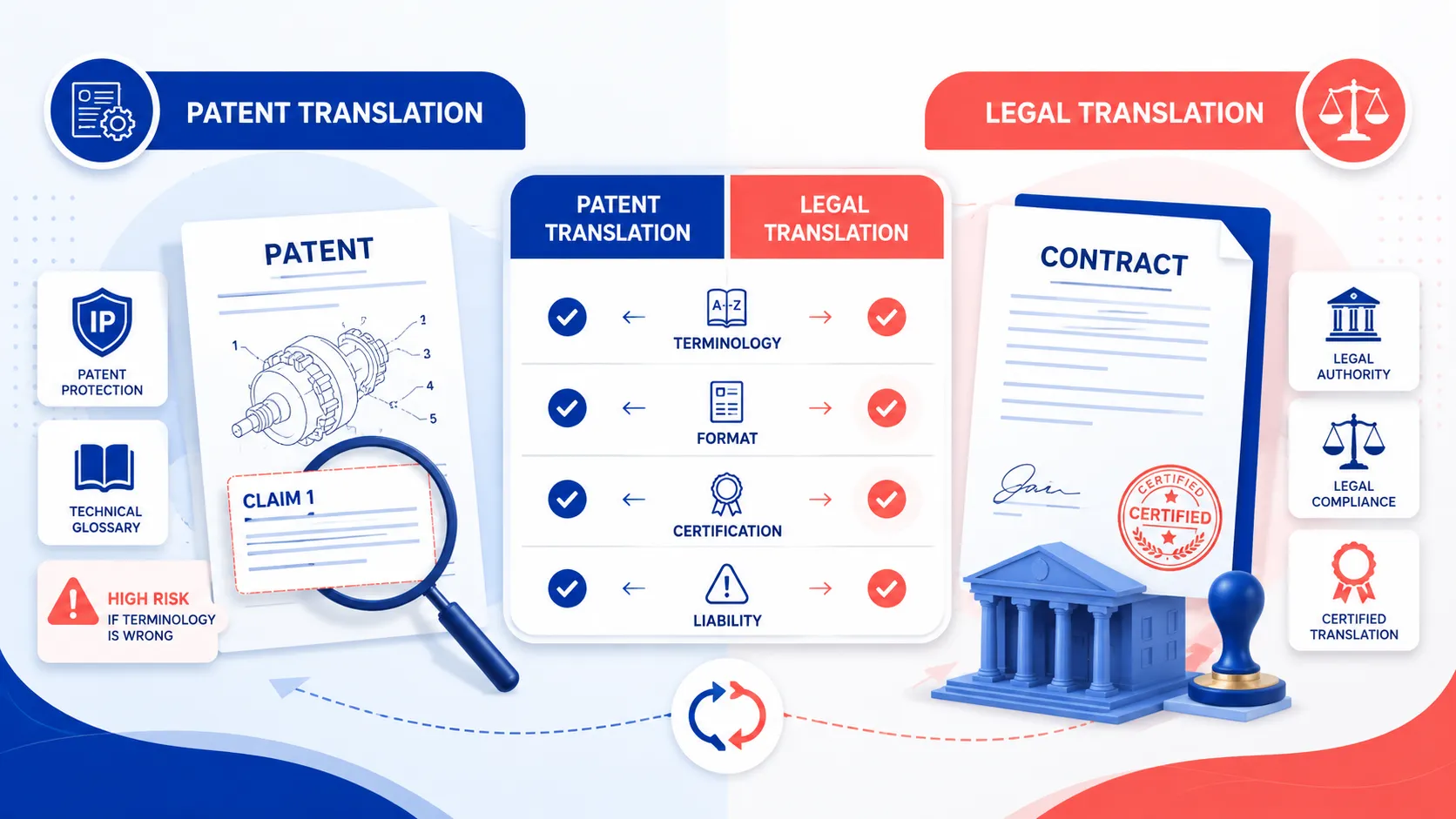
Patent translation and legal translation are often treated as interchangeable by procurement teams, in-house legal departments, and even some translation vendors. They are not. A patent application and a commercial contract are both legal documents, but the translation methodology, structural requirements, domain expertise, certification standards, and error consequences are fundamentally different between the two. Getting this wrong before commissioning work does not just result in a substandard document. It can result in a patent that is permanently unenforceable or a legal filing that is ruled inadmissible in court.
This guide explains the practical differences across four dimensions: terminology and methodology, document format, certification and jurisdiction standards, and liability exposure. It is written for in-house legal teams and corporate legal operations professionals who need to route the right document to the right service before any translation work begins.
Why the Patent vs Legal Translation Distinction Actually Matters
The distinction matters because the consequences of misclassifying translation work are not symmetrical between the two fields. Standard legal translation and patent translation share a formal register and a genuine demand for precision, but they diverge sharply in methodology, required domain expertise, and what happens when something goes wrong.
In 2022, approximately 3.46 million patent applications were filed globally, many requiring translation into one or more national languages for prosecution. Each of those translations carries legal weight measured not in clauses or paragraphs but in individual words. The scope of a patent is defined entirely by its claims section, and the precise language of that section determines what competitors can and cannot do in that jurisdiction. A contract clause that is imprecisely worded can often be corrected through an amendment or renegotiated between parties. A patent claim that is imprecisely translated in China cannot be corrected after grant. That asymmetry in consequence is the most practical reason to understand the difference before you commission either service.
The Language of Patents: What “Literal” Really Means in This Context
Patent translation is described as a “literal” discipline, but that phrase is misleading without qualification. Literal does not mean word-for-word in the way a grammar textbook might suggest. In patent translation, literal means an exact and accurate reproduction of the entire source text without modification, embellishment, or interpretive substitution of any kind.
The Conservation of Lexemes Approach
The methodology underlying professional patent translation is called the conservation of lexemes. It requires the translator to reproduce all content words (the nouns, verbs, and adjectives that carry technical meaning) faithfully in the target language, while adjusting only the function words (prepositions, conjunctions, articles) to conform to target language grammar. The distinction carries real-world significance. If a French patent uses the noun “arbre” throughout its description, the translator must use “shaft” consistently in every English occurrence, not “axle,” “spindle,” or “rod,” even though all four might be technically synonymous in a general engineering dictionary. Each of those alternatives carries subtly different mechanical meaning, and in patent litigation, opposing counsel will use every terminological inconsistency they can find.
Why Terminology Consistency Is a Legal Obligation, Not a Style Preference
Terminology consistency in patent translation is a legal obligation that flows directly from how patent claims function as legal definitions, and the contrast with standard legal translation makes this clear. In standard legal translation, a degree of elegant variation is acceptable and sometimes desirable to avoid clunky repetition across a long commercial contract. In patent translation, elegant variation is a liability. If a technical component is referred to as a “shaft” in the description section and as an “axle” in the claims section, examiners and opposing attorneys can argue the claims are not fully supported by the description. This is not a theoretical risk. It is a documented and recurring basis for rejection and invalidity challenges at patent offices globally.
Standard Legal Translation: A Different Kind of Precision
Standard legal translation covers a wide range of documents: commercial contracts, court orders, corporate filings, regulatory submissions, notarial deeds, powers of attorney, and litigation support materials. The precision it demands is genuine, but it operates differently from patent translation in both methodology and the qualifications the translator needs to bring.
Certified vs Sworn Translator Requirements by Jurisdiction
In many Western European jurisdictions, legal translation is performed by a sworn or certified translator, an individual officially recognized by a court or government authority who signs a personal declaration attesting to the accuracy of their translation. Germany, France, Spain, and the Netherlands all use this system for documents submitted to courts or government agencies, and the translator carries personal professional liability for the accuracy of their work. The UK and the US do not have formal sworn translator systems but rely on certified translations from qualified professionals or recognized agencies.
China operates differently from both models. There is no sworn translator system in China. Legal validity for translated documents comes from a two-step process: translation by a PRC-licensed agency, identified by its official company seal (often called a “chop”), followed by notarization by a notary public. Using a standard certified translation for a document that requires notarized submission in a Chinese legal proceeding can result in the document being treated as inadmissible. This is a procedural mistake that is more common than it should be among firms that handle China-market matters without specialist guidance.
When Standard Legal Translation Becomes Court Translation
Standard certified translation is sufficient for most administrative and commercial purposes, including business registration, visa applications, and commercial contract exchange. Documents submitted as evidence in Chinese judicial proceedings require a higher evidentiary standard. Courts may require translations from officially recognized entities, and in some proceedings may require the translator to appear and testify regarding accuracy. For in-house legal teams, the practical implication is that a translation commissioned for internal contract review may not be the same document that can be submitted as a court exhibit without further verification and certification steps. Understanding which evidentiary standard applies to a given document is a question best put to both local legal counsel and the translation agency at the commissioning stage.
The Patent Document Format and Why It Demands Specialist Knowledge
Patent documents follow a standardized structure across jurisdictions, and every section of that structure imposes specific translation requirements that a general legal translator is unlikely to have been trained for.
The Five Core Sections Every Patent Must Include
A compliant patent application is organized into five core sections: the front page (containing bibliographic data, international patent classification codes, and legal identifiers); the abstract (capped at 150 words and designed for rapid technical identification); the drawings (with reference numerals linking visual elements to the textual description); the specification or detailed description (a comprehensive technical disclosure enabling a person skilled in the art to reproduce the invention); and the claims (the legal definition of the protection scope). Each section carries its own translation obligations. The abstract requires precise compression within a hard word limit. The specification requires domain-level technical fluency at the level of the underlying science or engineering field. The claims require hyper-literal accuracy that only a translator with both technical and legal patent expertise can consistently deliver.
The Claims Section: Where Scope Lives and Errors Are Permanent
The claims section is the only part of a patent that defines what the patent holder can legally prevent others from making, using, or selling, and it is also where translation errors carry the most severe and irreversible legal consequences. Each claim must be a single sentence regardless of its length or syntactic complexity. This is not a formatting convention that can be adapted for readability. It is a strict formal requirement in patent literature, and a translator who breaks a claim into multiple sentences for clarity has fundamentally altered the document’s legal structure.
Why Every Claim Must Be a Single Sentence
The single-sentence requirement exists because patent claims function as integrated legal definitions. Each claim defines one inventive concept, and that definition must be contained within a single, unbroken syntactic unit. The complexity that results (claims frequently run to several hundred words with multiple nested clauses) is intentional: it forces the precise articulation of every limitation and every relationship between components within one cohesive statement. A general legal translator encountering this structure for the first time will often mistake the grammatical complexity for poor drafting and “correct” it into clearer prose. In patent translation, that correction is a legal error.
Liability Exposure: How Error Consequences Differ Between the Two
Translation errors carry professional liability in both fields, but the nature, permanence, and financial scale of that liability differ substantially between patent and standard legal translation.
Patent Translation Errors: When One Wrong Word Invalidates a Patent
Patent translation errors have a documented history of destroying intellectual property worth years of research and development investment. Replacing “median particle diameter” with “average particle diameter” in a pharmaceutical patent specification has been cited as a basis for patent invalidation during opposition proceedings. The two terms are not interchangeable in analytical chemistry: median describes the middle value in a distribution, while average describes the arithmetic mean. In a particle size claim, the difference determines whether a competing product falls inside or outside the patent’s scope. A separate documented case saw a container “adapted to contain” liquid mistranslated as a container “with” a body of liquid. An infringer successfully argued their product escaped liability because it was marketed empty. One preposition altered the outcome of the litigation. Research in the IP field indicates that 81 percent of IP professionals have encountered errors in patent translations from their own professional experience, which makes this a systemic quality issue rather than an exceptional one.
Legal Translation Errors: Serious but Often More Recoverable
Errors in standard legal translation are professionally serious and can result in contract disputes, document rejection, and litigation complications. The critical structural difference is that most legal translation errors can be identified and corrected before they become permanent. A contract with an imprecise translation can be amended, a power of attorney with an error can be reissued, and a corporate filing with a mistranslation can be refiled with the corrected version. The correction pathway exists and is generally accessible. In patent translation, particularly in China, that pathway is largely closed after grant. The patent stands on the text as translated, and subsequent corrections are not permitted. This permanence is why patent translation errors are categorized as a distinct and higher class of professional risk from standard legal translation errors, requiring a correspondingly higher standard of translation quality at the point of filing.
The China Question: Different Standards for Patent and Legal Translation
China’s approach to both patent and legal translation diverges from Western norms in ways that carry significant practical implications for international corporations managing IP portfolios and legal documentation in the Chinese market.
Under the principle of Strict Claim Interpretation, Chinese courts define patent scope precisely and narrowly by the literal text of the claims. The certified Chinese translation is not a working document used during prosecution. It becomes the sole legal reference for every enforcement action, opposition proceeding, and infringement dispute involving that patent in China. There is no mechanism to introduce evidence of what the applicant originally intended if the translated text says something different. The text is the record, and the record is the scope.
For standard legal documents, China’s notarized translation requirement (licensed agency translation followed by notarization) represents a procedural standard that differs from most Western certification norms. In-house legal teams managing both patent prosecution and commercial contracts in the Chinese market need translation partners who understand both pathways, because the certification requirements are different and the consequences of confusing them are different. Circle Translations’ legal translation services cover certified translation for a wide range of jurisdictions and document types, while the patent translation services team applies the specialist IP translation framework with academic-level subject-matter expertise to every patent project.
Choosing the Right Service: Patent Translation or Legal Translation?
The choice between patent translation and standard legal translation is determined by document type, jurisdiction requirements, and the professional consequences of an error in each context.
Patent translation is the right choice for patent applications filed at any national or regional patent office; patent specifications translated for prosecution, opposition, or litigation; PCT national phase entries requiring foreign language translations; and prior art documents being prepared as technical evidence for court submission. These documents require a translator with subject-matter expertise in the relevant technical field, understanding of the jurisdiction’s claim structure requirements, and absolute terminology consistency throughout.
Standard legal translation is the right choice for commercial contracts and partnership agreements; regulatory submissions and compliance documentation; corporate governance documents; courtroom exhibits that are legal rather than technical in nature; and certified translations for business registration, visa applications, and administrative filings. These documents require a qualified legal translator with knowledge of the target jurisdiction’s legal system and the appropriate certification pathway.
For in-house legal teams managing complex portfolios that include both document types, the most effective approach is working with a specialist agency that covers both services with the right expertise framework for each. Circle Translations’ technical translation services extend the same academic-credential matching approach to complex engineering, semiconductor, and manufacturing documentation that sits adjacent to patent translation in the technical domain.
How Circle Translations Handles Both Patent and Legal Translation
Circle Translations applies a distinct service framework to patent translation and standard legal translation, matching each document type to the expertise level it specifically requires. Patent translation projects are assigned to translators with academic credentials in the relevant technical field, matched by subject matter to the patent’s technology domain, and familiar with the structural and terminology requirements of the target patent office. The agency has worked with over 200 IP firms and patent departments globally since 2008, covering more than 74 languages across all major patent office jurisdictions.
Legal translation projects are handled by qualified legal translators with knowledge of the relevant jurisdiction’s legal system and certification requirements. Legal translation projects are delivered with the jurisdiction-appropriate certification documentation required for each document type and submission context.
With a 99.97 percent on-time delivery rate and no rush fees across all service tiers, Circle Translations is built for legal departments that need both patent and legal translation handled to the correct professional standard for each document type, not consolidated into a single service with a single risk tolerance applied uniformly to very different legal instruments.
Conclusion
Patent translation and standard legal translation share a commitment to accuracy and a formal professional register, but they are distinct disciplines with different methodologies, different structural requirements, different certification norms by jurisdiction, and fundamentally different consequences when errors occur. For in-house legal teams and corporate legal operations managers, understanding this distinction before commissioning work is the difference between routing a document correctly and creating a liability that cannot be undone after the fact. Circle Translations provides both services under separate specialist frameworks, because the standard for patent translation and the standard for legal translation are not, and should not be, the same standard.
Frequently Asked Questions
1. What is the main difference between patent translation and legal translation? Patent translation involves the hyper-literal reproduction of technically complex IP documents, including claims, descriptions, and drawings, requiring subject-matter expertise in the relevant technical field alongside legal patent drafting knowledge. Standard legal translation covers contracts, court documents, and regulatory submissions, requiring legal expertise and jurisdiction-specific certification knowledge. The defining difference is that patent translation requires both technical domain expertise and legal patent expertise simultaneously, while standard legal translation primarily requires legal and procedural knowledge.
2. Can a standard legal translator handle patent translation work? A standard legal translator generally lacks the subject-matter expertise required for patent translation. Patent claims require field-specific technical knowledge (such as pharmaceutical chemistry, semiconductor engineering, or mechanical systems) alongside familiarity with patent drafting conventions. Using a general legal translator for patent work carries significant risk of terminology errors that permanently affect claim scope, since patent translation errors in key jurisdictions cannot be corrected after grant.
3. Why must patent claims be written as a single sentence? Each patent claim must be a single sentence because it defines one complete inventive concept as an integrated legal definition. This is a strict formal requirement in patent literature globally, not a stylistic convention. Breaking a claim into multiple sentences for readability alters its legal structure and constitutes an error in the translated document.
4. What is the conservation of lexemes in patent translation? The conservation of lexemes is the translation methodology where all content words carrying technical meaning are reproduced exactly as they appear in the source, while only function words like prepositions and articles are adjusted to suit target language grammar. This prevents the introduction of synonyms that might carry subtly different technical or legal meanings and ensures absolute terminology consistency across the full document.
5. Does China have a sworn translator system like European countries? China does not have a sworn translator system. Legal translation validity in China is achieved through a two-step process: translation by a PRC-licensed agency confirmed by an official company seal, followed by notarization by a notary public. Documents submitted to Chinese courts or administrative bodies without this two-step process may be treated as inadmissible, regardless of the translation’s linguistic accuracy.
6. Can patent translation errors in China be corrected after the patent is granted? Patent holders are generally not permitted to correct translation errors in China after a patent has been granted. The certified Chinese translation becomes the sole legal document for interpretation under China’s Strict Claim Interpretation principle, making any error in scope, terminology, or claim language a permanent limitation on the patent’s enforceable rights.
7. How should in-house legal teams decide between patent translation and standard legal translation? The determining factor is the document’s core legal function. Use patent translation for any document filed with a patent office, used in patent prosecution, or submitted as technical IP evidence in litigation proceedings. Use standard legal translation for commercial contracts, corporate filings, regulatory submissions, and administrative documents. When managing both categories, work with a translation agency that operates separate specialist frameworks for each, rather than treating them as a single service.