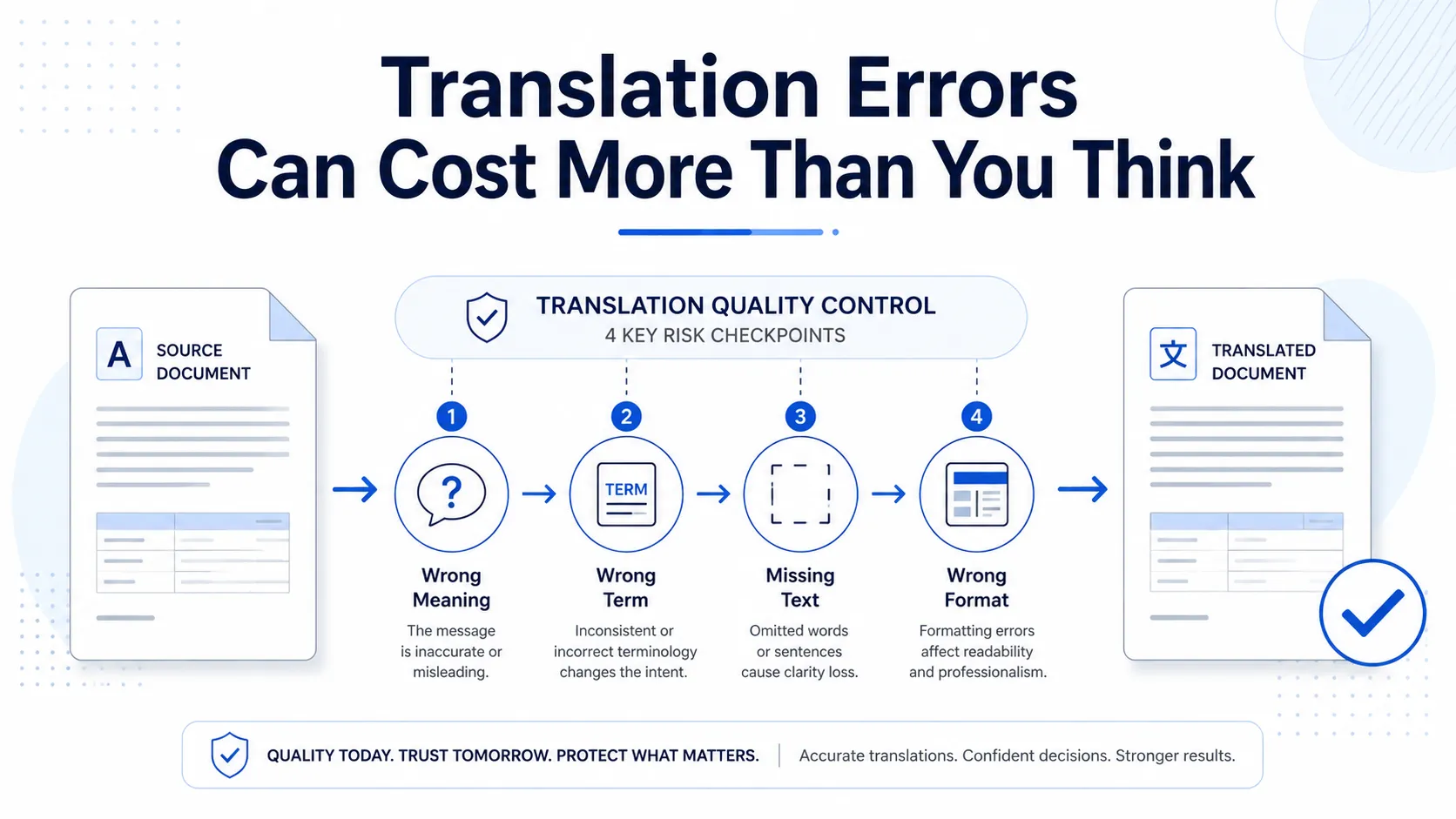
Choosing the wrong translation agency does not just produce awkward sentences. It produces compliance failures, brand damage, and costly rework cycles. HSBC spent approximately 12 million euros rebranding after its “Assume Nothing” campaign was mistranslated as “Do Nothing” across multiple markets. A pharmaceutical company that submits a regulatory dossier with a terminology error can face months of delay from health authorities. A supplier contract with a mistranslated obligation clause may only surface as a problem during litigation.
The stakes are high, and the market has become harder to navigate. The growth of AI-driven tools has flooded the industry with low-value agencies that are effectively interfaces on top of basic machine translation APIs, adding minimal human quality control while charging professional agency rates. For procurement teams and marketing leaders responsible for vendor selection, the challenge is no longer finding an agency. It is knowing how to evaluate one rigorously.
This guide gives you a structured 12-question framework for assessing any language service provider (LSP) before signing a contract. Each question is designed to surface the information that generic RFPs and glossy agency decks never reveal.
Why Translation Vendor Selection Is Harder in 2026
The translation industry has changed faster in the past three years than in the previous two decades. Large language models have compressed the gap between raw machine translation and fluent-sounding output. Many agencies have responded by layering an AI interface over commodity MT engines and marketing the result as “AI-enhanced professional translation.”
This creates a genuine evaluation problem. Two agencies can quote similar per-word rates, both claim native translators, both display ISO certification logos, and deliver vastly different quality outcomes. One operates with a disciplined TEP (Translation, Editing, and Proofreading) workflow and subject-matter specialists. The other routes text through a public MT API and apply a light editing pass before delivery.
The only way to tell the difference is to ask the right questions.
The 12 Questions to Ask Before Selecting a Translation Agency
1. Does the Agency Have Documented Experience in Your Industry?
Generic translation ability does not transfer cleanly across industries. Legal translation requires precision around jurisdiction-specific terminology. Healthcare translation carries regulatory and safety implications. Gaming localization demands cultural fluency, humor adaptation, and UI character limits. Financial translation must meet compliance requirements in each target jurisdiction.
Ask for case studies, client references, or sample outputs from your specific sector. Any agency that claims to do everything well without evidence of industry depth deserves closer scrutiny. Specialization is a quality signal, not a limitation.
2. What Service Types Are Included, and What Is Subcontracted?
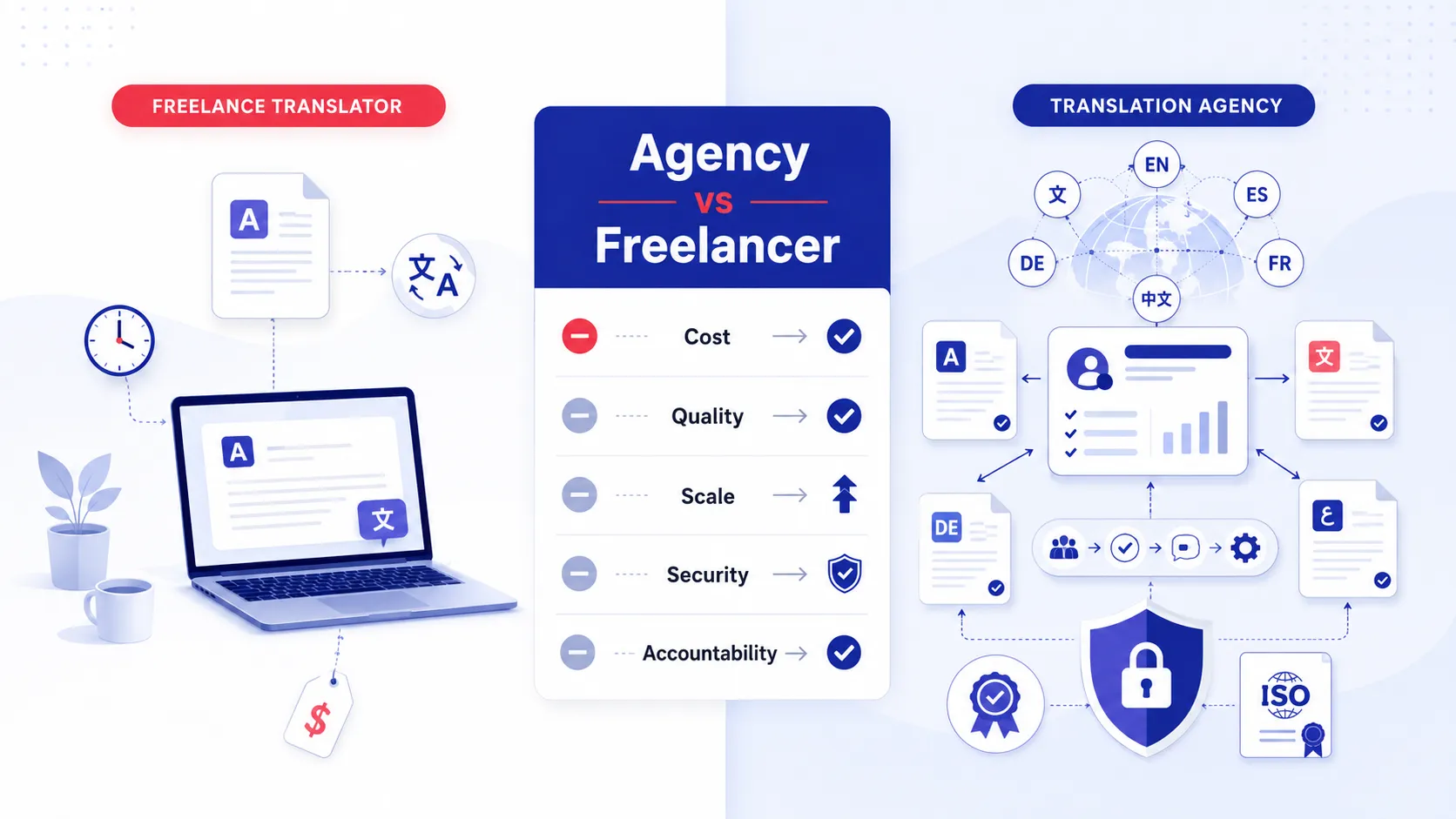
Translation agencies vary significantly in how they build their service delivery. Some offer a genuine full-service model covering written translation, localization, subtitling, voice-over, desktop publishing (DTP), and machine translation post-editing (MTPE) within a single managed workflow. Others act as brokers, subcontracting services to unvetted third parties without maintaining quality oversight across the chain.
Ask for a clear map of which services are delivered in-house and which involve external partners. If work is subcontracted, ask how subcontractor performance is monitored and what the agency’s liability is for downstream quality failures.
3. What Are the Qualifications and Vetting Standards for Translators?
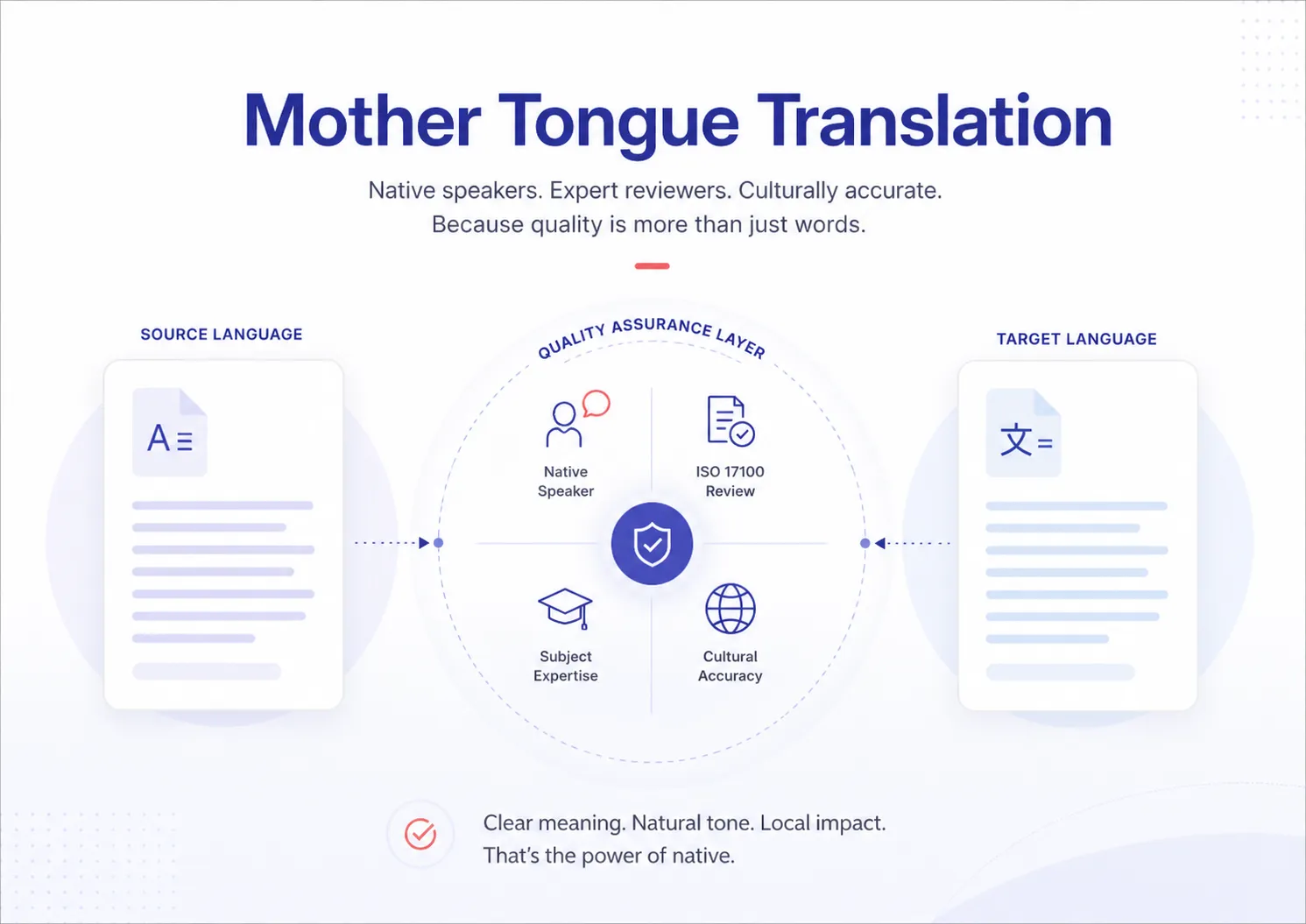
“Bilingual” is not a professional qualification. Native language competency is a baseline requirement, not a credential. The translators assigned to your projects should have formal language qualifications, subject-matter expertise relevant to your content type, and demonstrable professional track records.
Ask specifically: Does the agency conduct translation tests before onboarding linguists? Are translators required to hold relevant certifications or degrees? Is subject-matter expertise verified independently, or self-reported? Are the same translators used consistently across your account to maintain terminology consistency?
Agencies that cannot answer these questions in detail are agencies that have not answered them for themselves.
4. Does the Workflow Follow a TEP Process?
The TEP process (Translation, Editing, and Proofreading) is the industry-recognized quality standard for professional translation. Translation is performed by one qualified linguist. A second linguist independently edits the output for accuracy, fluency, and consistency. A third review pass addresses grammar, punctuation, formatting, and readability before delivery.
Skipping or compressing any stage of this process introduces quality risk. Many agencies describe a two-stage review as TEP-compliant, but a genuine TEP requires independent reviewers at each stage, not a single translator reviewing their own work.
Ask how the TEP process is documented on your project, who performs each stage, and whether project management logs are available for audit.
5. What Technology Infrastructure Does the Agency Use?
Professional-grade technology infrastructure is not a bonus feature. It is a quality and consistency requirement for any project spanning more than a few thousand words. The critical tools to ask about include:
- CAT tools (Computer-Assisted Translation): Industry-standard platforms such as SDL Trados, memoQ, or Phrase ensure translators work within a structured environment that supports terminology management and segment review.
- Translation Memory (TM): TM stores previously translated segments so that repeated content is applied consistently across documents and projects. This also reduces per-word costs for repeat clients.
- Translation Management System (TMS): A TMS coordinates project workflows, deadline tracking, and quality assurance steps across multi-language, multi-file projects.
- Terminology databases and glossaries: Ask whether the agency builds and maintains client-specific glossaries, particularly for technical or branded terminology.
Technology does not replace linguistic quality, but it prevents consistency failures at scale that human review alone cannot catch.
6. How Does the Agency Handle Machine Translation and Post-Editing?
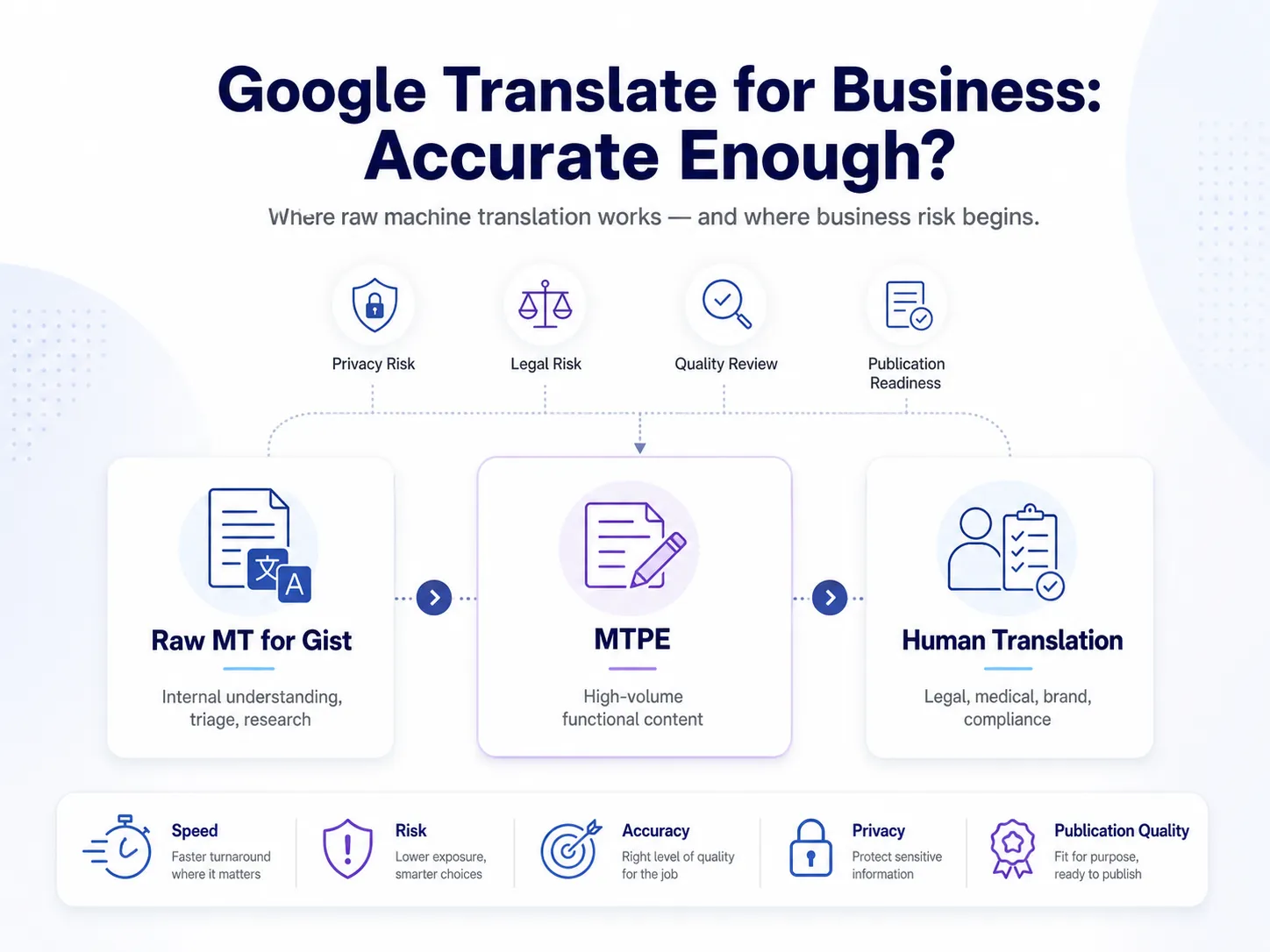
Machine translation is now a standard component of professional translation workflows, and there is nothing inherently wrong with that. Neural machine translation (NMT) engines such as DeepL and ModernMT have made significant accuracy gains for standard European language pairs and general business content.
The question is not whether an agency uses MT. The question is how they use it, and how they ensure the post-editing work restores the quality that raw MT output consistently lacks.
Ask the agency to describe their MTPE (Machine Translation Post-Editing) workflow specifically. Who performs the post-editing: a specialist MTPE linguist, or the same translator who would handle full human translation? What quality control steps apply to MTPE outputs before delivery? Which content types are eligible for MTPE, and which require full human translation regardless of cost?
Agencies with a responsible MTPE framework, like Circle Translations, use machine-assisted translation to accelerate delivery on appropriate content while applying human review by native-speaking professionals before anything reaches the client.
7. How Is Sensitive Data Protected Across the Translation Workflow?
This is the question that procurement teams most frequently underinvest in. Translation involves moving sensitive content through a network of linguists, project managers, and technology platforms. In agencies that rely on large freelance networks, source files may travel across unmanaged personal devices without any centralized security controls.
The specific risks to probe include:
- Are source files downloaded to translators’ local hard drives, or does the agency use a closed-loop platform that restricts file access to a secure online environment?
- Does the agency require translators to sign non-disclosure agreements (NDAs) as a standard condition of engagement?
- What data transfer protocols are in place for file submission and delivery?
- Is communication encrypted at the platform level?
For contracts, medical records, patent applications, and financial filings, data security is not a secondary concern. It is a primary qualification criterion.
8. Does the ISO Certification Actually Cover the External Translator Network?
Many agencies display ISO 27001 (information security management) certification prominently in their marketing materials. This matters, but it does not automatically mean the entire delivery chain is covered.
An ISO 27001 certification may apply only to the agency’s core internal operations: its servers, office network, and internal staff. If the agency relies on a network of external freelance translators who access files through their own devices and connections, that external network may sit entirely outside the certified scope.
Ask directly: What is the precise scope of your ISO certifications? Does the certification cover external linguists and subcontractors, or only internal staff? How is compliance verified for external parties?
A certificate on a website page is not the same as a certified end-to-end workflow.
9. Is the Agency Certified to ISO 17100?
ISO 17100:2015 is the international standard for translation service providers. It defines the requirements for core processes, resources, and other aspects of the translation service that affect the quality and delivery of translation services. Certification requires verification of translator competency, documented workflows, and systematic quality checks.
An agency that holds ISO 17100 certification has submitted its processes to a third-party audit. This is not a guarantee of perfection, but it is a meaningful structural commitment to professional service delivery.
Ask for the certificate number, the issuing body, and the date of the most recent audit. Certification that has not been renewed within the past two years warrants a follow-up question about whether standards have been maintained.
10. How Does the Agency Measure and Report Translation Quality?
Quality assurance cannot be reduced to “we check everything before sending it.” Ask for specifics on how translation quality is measured, scored, and reported.
The Multidimensional Quality Metrics (MQM) framework is the leading industry standard for structured quality evaluation. MQM classifies translation errors across five categories: accuracy errors, fluency errors, terminology errors, locale convention errors, and register errors, each assessed by severity. Agencies that use MQM or equivalent structured error typologies can provide objective quality scores rather than subjective assurances.
Ask whether the agency can share error rate data for your account over time, what threshold triggers a rework, and how quality issues are escalated and resolved.
11. How Is Pricing Structured, and What Fees Are Disclosed Upfront?
Translation pricing complexity is a common source of budget overruns. The per-word rate is the visible line item, but the total cost of a translation project can be significantly higher once additional charges are applied.
Common additional charges that agencies may not disclose proactively include: rush surcharges for urgent delivery, DTP fees for formatted documents, minimum project fees, project management surcharges, and file preparation costs for non-standard formats.
Ask for a complete fee schedule before committing to any volume agreement. Compare not just the per-word rate but the total cost of a representative project that reflects your actual content type and delivery requirements.
One structural differentiator worth asking about directly: does the agency charge rush fees? Some professional agencies, including Circle Translations, have a no-rush-fee policy as a standard commercial term, which significantly affects total cost predictability for teams managing high-volume or time-sensitive workflows.
12. What Does the Revision and Escalation Policy Look Like?
Even well-managed translation projects produce outputs that require revision. The agency’s revision policy tells you a great deal about how confident they are in their own quality standards.
Ask how many revision rounds are included in the standard engagement, whether revisions are subject to additional charges, and what constitutes a legitimate revision request versus a scope change. Ask also how disputes are escalated: if a delivered translation contains factual errors or fails to meet the agreed quality standard, what is the formal process for resolution, and what liability does the agency accept?
Agencies with no defined escalation process or vague revision terms are agencies that have not thought carefully about service accountability.
Translation vs. Localization: Choosing the Right Service
One of the most consequential decisions in vendor selection is also one of the least discussed: whether your content requires translation or localization, and whether your shortlisted agency understands the difference.
Translation converts text from one language to another while preserving the original meaning. It is appropriate for legal filings, medical histories, technical manuals, and patent documentation where fidelity to the source is the primary requirement.
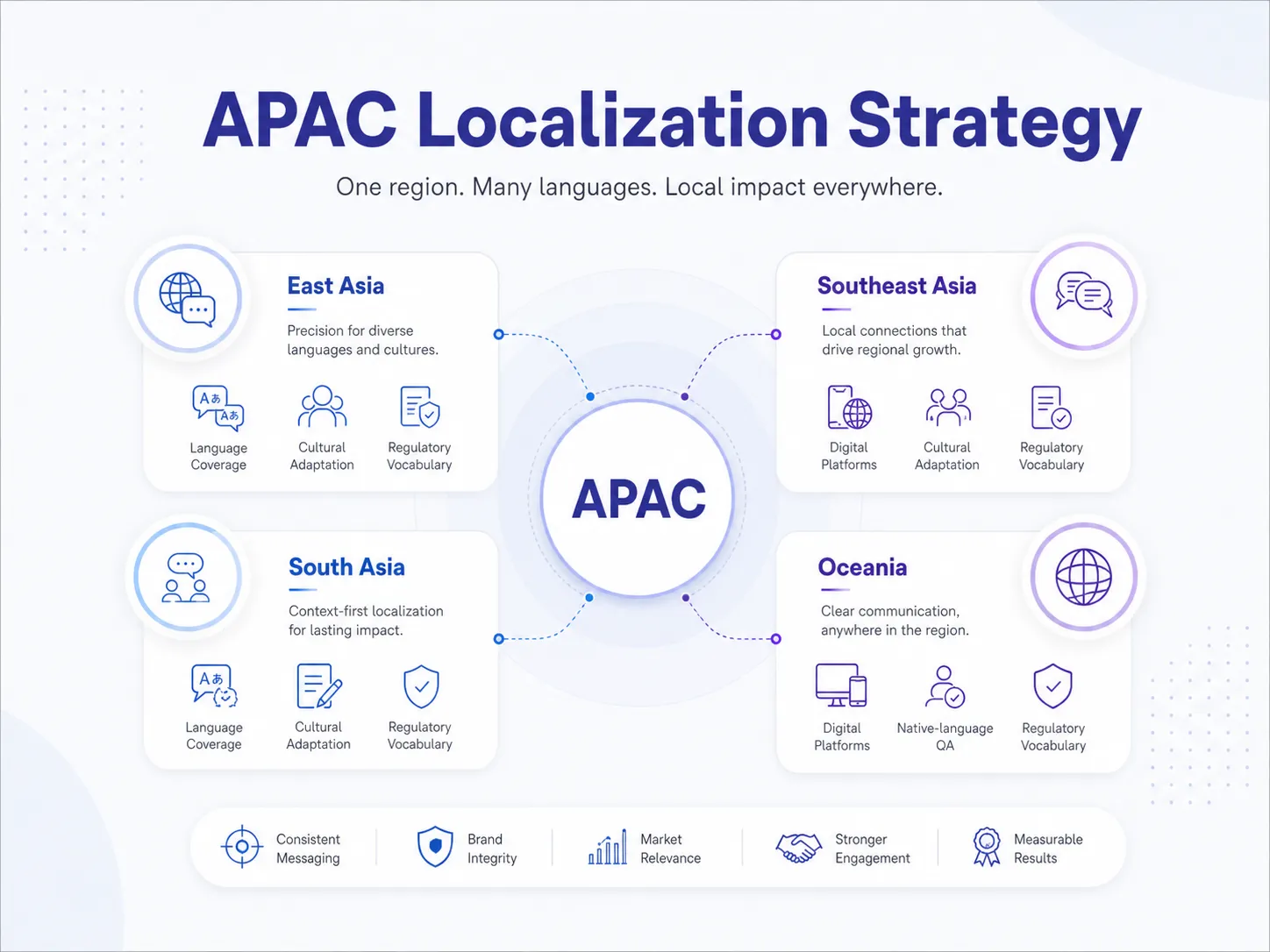
Localization goes further. It adapts content for a specific locale, adjusting date formats, currency conventions, cultural references, humor, imagery, and tone to feel native to the target audience rather than translated for them. Localization is the appropriate choice for websites, software interfaces, marketing campaigns, and any content where user engagement and conversion are the performance measures.
Choosing the wrong service for your content type creates real business risk. Legal content that has been culturally “adapted” rather than faithfully translated may introduce interpretation risk. Marketing content that has been literally translated rather than localized will underperform in every measurable metric.
For a deeper look at how professional translation and localization work together in global content strategy, the Circle Translations guide on translation and localization services covers the practical distinctions and when each approach applies.
How to Measure Translation Agency Performance After Onboarding
Evaluating a translation agency does not end at contract signature. Ongoing performance measurement is essential for managing quality, controlling costs, and building a productive long-term relationship.
The most useful KPIs for translation procurement teams fall into three categories.
Productivity metrics cover turnaround time against agreed deadlines, output volume per week or month, and the percentage of projects completed without deadline extensions. Circle Translations, for example, publicly reports a 99.97% on-time delivery rate, which gives procurement teams a concrete benchmark for what is achievable from a well-managed agency.
Quality metrics should include the translation error rate measured against a standardized framework such as MQM, the volume of revision requests per project, and the percentage of content returned for rework. Quality data should be tracked at the project level and reviewed quarterly to identify patterns.
Cost and efficiency metrics should track cost per word versus the budgeted rate, budget adherence across projects, and the financial benefit of Translation Memory leverage (the reduction in billable words achieved by reusing previously translated segments).
Agencies that cannot provide data against these metrics are agencies that are not measuring their own performance. That is a meaningful finding in itself.
Conclusion
Selecting a translation agency is a procurement decision with long-term consequences for brand quality, regulatory compliance, and global revenue. The 12 questions in this framework are designed to move the evaluation process beyond surface-level comparisons of price and certification logos toward a structured assessment of process quality, security standards, and performance accountability.
The best agencies welcome detailed due diligence. They have documented answers to every question in this framework because they have built their operations around the standards those questions reveal. Agencies that deflect, generalize, or treat detailed questions as obstacles are signaling the limits of their service infrastructure.
If you are currently assessing translation vendors for an upcoming project, the Circle Translations team is available to walk through their quality processes, security protocols, and pricing structure in detail. You can also review their full service range and learn more about the team and their approach before making contact.
Frequently Asked Questions
1. What is the most important factor when evaluating a translation agency?
There is no single most important factor, but the combination of ISO 17100 certification, a documented TEP (Translation, Editing, and Proofreading) process, and verifiable industry specialization is the strongest baseline indicator of professional service quality. These three factors together confirm that an agency has third-party-verified workflows, multi-stage quality control, and the subject-matter depth to handle your specific content type accurately.
2. What is ISO 17100, and why does it matter for translation vendor selection?
ISO 17100:2015 is the international standard that defines the requirements for professional translation service providers. It specifies minimum translator qualifications, mandatory workflow stages, and quality assurance processes. Agencies certified to ISO 17100 have had their processes independently audited and verified. It is a meaningful quality signal, though it should be reviewed alongside current certification dates and scope documentation.
3. What is the difference between translation and localization?
Translation converts content from one language to another with fidelity to the source text. Localization adapts content for a specific locale, adjusting cultural references, date and currency formats, tone, and design elements to feel native to the target audience. Legal and technical documents typically require translation. Websites, marketing campaigns, and software interfaces typically require localization to perform effectively in a new market.
4. What is the TEP process in professional translation?
TEP stands for Translation, Editing, and Proofreading. Translation is performed by a qualified linguist. A second linguist independently edits the output for accuracy, terminology, and fluency. A third review pass addresses grammar, formatting, and readability. This three-stage process is the gold standard for professional translation quality. Any agency that compresses these stages or assigns them to the same individual is not delivering a genuine TEP workflow.
5. How do I assess translation quality after a project is completed?
The most reliable method is structured error analysis using a standardized framework such as MQM (Multidimensional Quality Metrics). MQM classifies errors by type (accuracy, fluency, terminology, locale convention, register) and severity. Ask your agency whether they produce MQM-based quality reports for your account. If they do not, you can commission an independent quality review by a qualified third-party reviewer against a defined error typology.
6. Should I be concerned about data security when working with a translation agency?
Yes, data security is a genuine operational risk in translation workflows. Source files travel through translator networks, technology platforms, and communication channels. The risks include files being downloaded to unsecured personal devices, sensitive content being used to train public AI models, and inadequate NDA coverage for external linguists. Ask any prospective agency for specifics on their data handling protocols, not just a reference to a certification badge on their website.
7. What are the key KPIs for measuring translation agency performance?
The most useful KPIs fall into three groups. Productivity KPIs include on-time delivery rate and turnaround time versus agreed deadlines. Quality KPIs include translation error rate, revision request volume, and rework percentage. Cost KPIs include actual cost per word versus budgeted rate, budget adherence across projects, and Translation Memory savings. Agencies with mature performance management systems will produce reports against these metrics on request.
8. Are rush fees standard in the translation industry?
Rush fees (typically 25 to 50 percent surcharges for urgent delivery) are common across the translation industry. However, they are not universal. Some agencies, including Circle Translations, operate without rush fees as a standard policy, which improves cost predictability for teams managing high-volume or time-sensitive projects.
When comparing agencies, ask specifically whether rush fees apply and under what conditions, since this can meaningfully affect the total cost of a project portfolio over time.