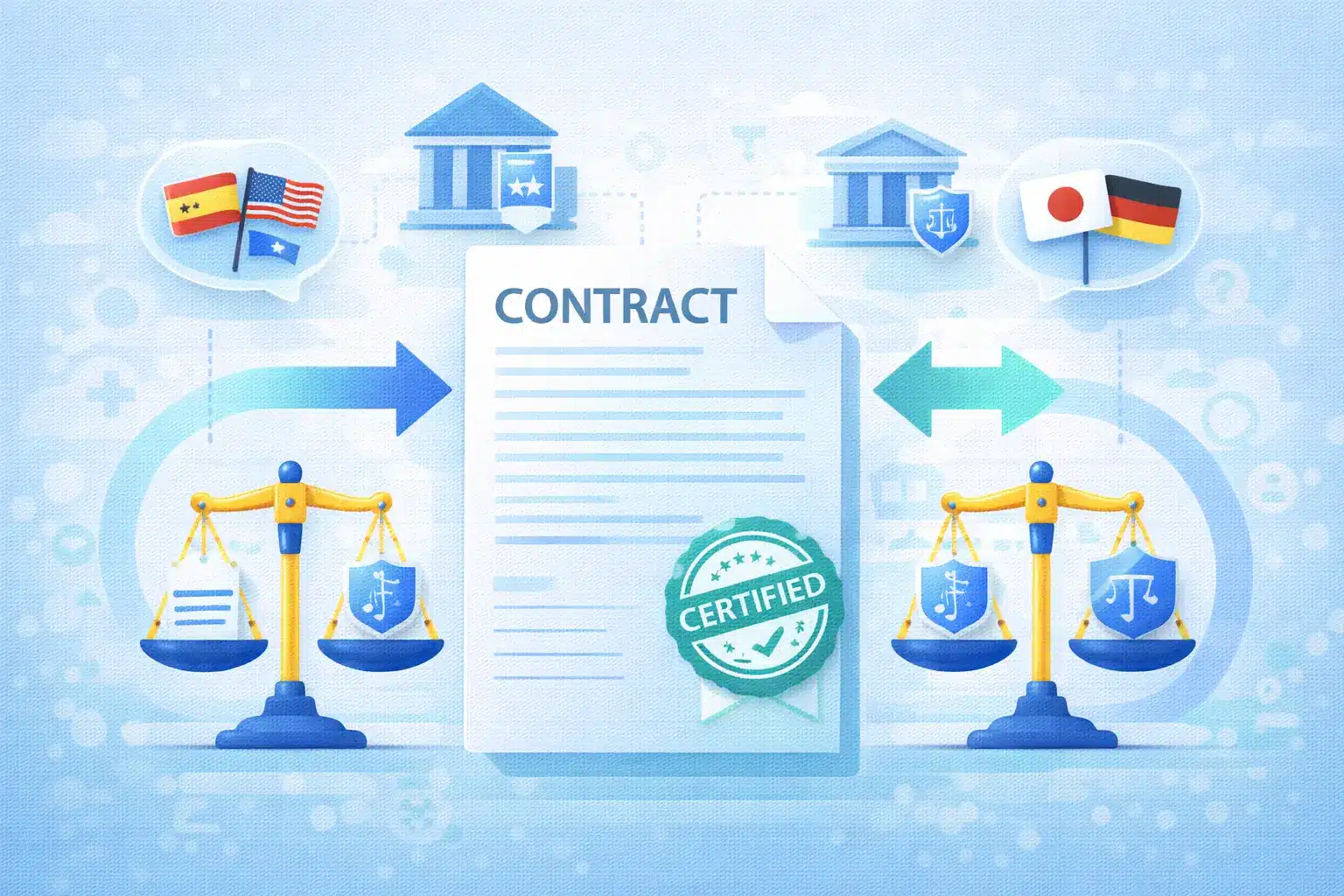
Contract translation is a specialized legal and linguistic process. This process converts agreements into target languages while preserving legal intent, enforceability, and jurisdictional validity. Unlike general document translation, contract translation requires a deep understanding of legal terminology, clause structure, and cross-border compliance requirements that protect all parties’ rights and obligations.
If your organization manages international partnerships, vendor agreements, or employee contracts, translation accuracy matters a lot. Poor translation creates ambiguity in obligations, shifts liability terms, and exposes companies to disputes that could have been avoided.
Here you can get to know what makes contract translation unique, why compliance matters, how professional workflows maintain accuracy, and what in-house legal teams and procurement managers should prepare before requesting translation services. So let’s dig in.
What is Contract Translation
Contract translation is the process of converting legal agreements from one language to another while maintaining the original document’s legal intent, clause structure, binding obligations, and enforceability across jurisdictions. This work goes far beyond word-for-word substitution, because legal language carries precise meanings that must be accurately transferred across different legal systems.
If your company enters cross-border partnerships or hires international employees, translated contracts become legally binding documents that courts and arbitrators will interpret. A contract translator has to understand both the source and target legal frameworks to ensure terms remain enforceable.
For example, translating “reasonable time” from English to German requires understanding how German civil law interprets timeliness differently than common law systems. The translator must choose terminology that preserves the legal effect intended in the original agreement.
Professional contract translation accounts for differences in legal concepts, statutory references, standard practices, and terminology conventions between jurisdictions. The goal is to produce a target-language version that serves the same legal function as the original while reading naturally to legal professionals in the target market.
Why Does Compliance Matter?
Compliance matters in contract translation because translated agreements must satisfy jurisdiction-specific legal requirements. It also maintains enforceability under the governing law provisions and meets formal validity standards, including signature rules, notarization requirements, and translation certification, where mandated. Non-compliant translations create legal vulnerabilities that undermine contract validity.
If your contracts specify particular jurisdictions or governing law clauses, the translation must align with how courts in those regions interpret agreements.
Here are some key compliance considerations:
- Many jurisdictions require official translators to certify legal documents
- Some countries mandate sworn translators registered with government authorities
- Certain contract types are recognized only with notarized translations
- Missing these requirements can render contracts unenforceable or inadmissible as evidence
Common compliance errors stem from literal translation that changes legal obligations:
- Translating “shall” as a suggestion rather than an obligation alters binding commitments
- Misinterpreting the force majeure scope changes parties’ rights during unforeseen events
- Incorrectly rendering liability caps shifts financial risk allocation
- Imprecise jurisdiction clauses create confusion about where disputes get resolved
- Poorly translated choice of law provisions affect which legal system governs the interpretation
- Vague notice requirements impact how parties communicate under the agreement
Each element needs a precise translation that preserves the legal architecture negotiated between parties.
Where Do Inaccurate Translations Create Risk?
Inaccurate translations create risk in indemnity clauses, liability limitations, confidentiality obligations, and intellectual property ownership terms. They also affect delivery specifications, payment conditions, termination rights, and arbitration provisions, where mistranslation can directly shift rights and obligations between the contracting parties.
Indemnity Clauses: Incorrect scope translation exposes parties to unexpected financial liability during disputes.
Liability Limitations: Mistranslating “aggregate limit” as “per incident limit” fundamentally alters risk allocation between the parties.
Confidentiality Obligations: Ambiguous translation of “proprietary information” versus “trade secrets” creates enforcement gaps and protection weaknesses.
IP Ownership Terms: Blurring the distinction between “assignment” and “license” transfers entirely different legal rights and ownership structures.
Delivery Specifications: Incorrect Incoterms translation shifts responsibility for goods in transit and customs clearance obligations.
Payment Conditions: Mistranslating “net 30 days” timeframes or currency references can cause operational conflicts and delay payments.
Termination Rights: Vague notice period translations lead to premature contract terminations or prevent timely exits from agreements.
Arbitration Provisions: Mistranslating venue, rules, or language requirements complicates dispute resolution and increases litigation costs.
Contract Types That Require Specialist Translators
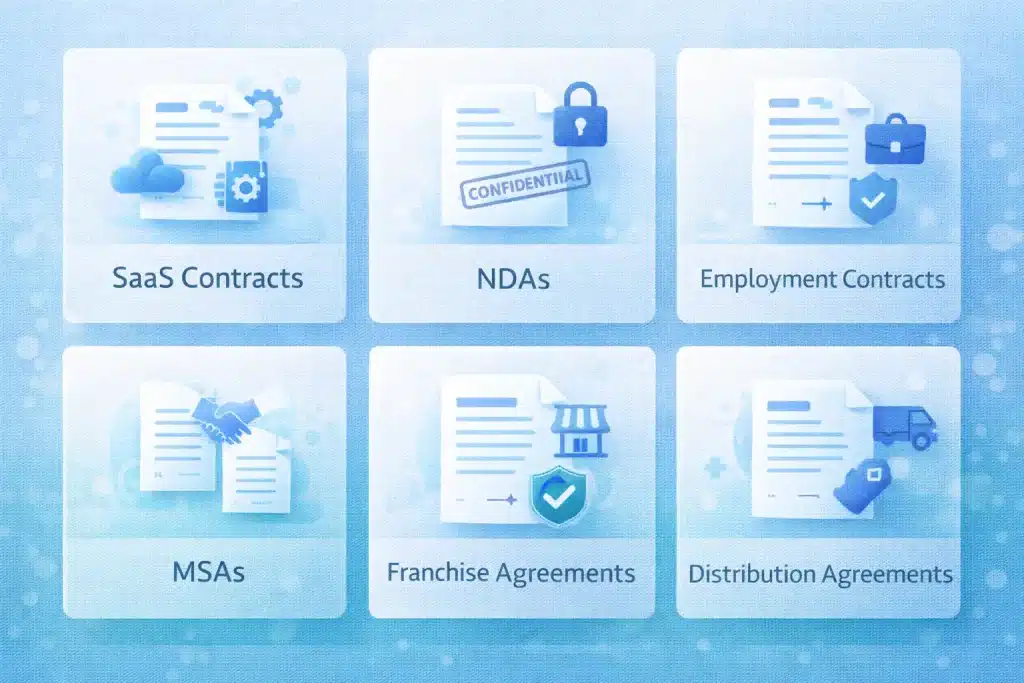
In the market, you can find various types of contracts. Contract types requiring specialist translators. This includes commercial agreements, SaaS and software licensing contracts, supply chain and procurement agreements, non-disclosure agreements, employment contracts, franchise agreements, distributor agreements, and master service agreements bundled with statements of work.
Each contract type contains industry-specific terminology and legal structures that demand specialized knowledge.
| Contract Type | Key Translation Requirements |
| Commercial Agreements | Sales, distribution, or partnership terms require translators familiar with commercial law concepts like warranties, remedies, and performance obligations. |
| SaaS and Software Licensing | Technical provisions around service levels, data processing, API usage, and subscription terms blend legal and technical language requiring dual expertise. |
| Supply Chain and Procurement | Incoterms, quality standards, logistics protocols, and compliance certifications vary by industry and demand specialized translation knowledge. |
| Non-Disclosure Agreements | Protecting confidential information requires precision around disclosure permissions, permitted uses, and survival clauses that extend beyond contract term. |
| Employment Contracts | Local labor law requirements, including termination procedures, benefits, and dispute resolution mechanism,s must align with jurisdiction-specific regulations. |
| Franchise Agreements | Complex territorial rights, brand usage terms, and operational standards require translators who understand franchising legal frameworks. |
| Distributor Agreements | Exclusivity provisions, sales targets, and pricing structures balance competing interests, requiring careful legal translation. |
| Master Service Agreements with SoWs | Framework terms and project-specific deliverables require coordinated translation of related document,s maintaining consistency across agreement families. |
Professional translators specializing in each contract category understand standard clauses, negotiation patterns, and compliance requirements specific to that agreement type.
How Compliance Is Maintained in Multilingual Contracts
Compliance is maintained in multilingual contracts through structured workflows. It assigns subject-matter legal linguists, establishes controlled terminology through glossaries and term bases, implements multi-stage translation and revision processes, conducts legal review passes, and applies consistent formatting and desktop publishing standards. This methodology reduces ambiguity and litigation exposure across all language versions.
If your organization manages contracts in 3 to 5 languages simultaneously, systematic processes ensure each version maintains equivalent legal force.
Professional workflows follow these key stages:
Subject-Matter Legal Linguist Assignment: The workflow begins with a legal linguist who specializes in both the source and target legal systems, translating the initial draft with a deep understanding of legal frameworks.
Controlled Terminology Through Glossaries: A terminology database captures approved translations of recurring legal terms, ensuring that concepts like “force majeure” and “indemnification” are translated consistently across all contracts.
Multi-Stage Translation and Revision: The draft undergoes linguistic revision by a second translator, who checks accuracy, natural language flow, and ensures no meaning shifts occurred during translation.
Legal Review Pass: An attorney or legal expert in the target jurisdiction verifies that translated clauses remain enforceable under local law and align with standard practices in that market.
Desktop Publishing and Formatting: Specialists format the document to match the original structure, preserving clause numbering, signature blocks, and exhibit references for layout consistency.
Translation Memory Integration: Translation memory systems store previously approved segments, improving consistency across contract families and reducing costs for template-based agreements.
Quality Assurance Verification: Final QA steps verify that all defined terms, cross-references, and legal citations transferred accurately before delivery.
This staged approach catches errors at multiple checkpoints before finalization. All of these stages result in translated contracts that function as equivalent legal instruments across jurisdictions while minimizing the risk of interpretation disputes. In circle translations, we strive to follow every step carefully to deliver the perfect result for our clients.
Which Jurisdictions Matter Most for Multilingual Contract Work?
Jurisdictions that matter most for multilingual contract work include:
- The European Union has 24 official languages and a harmonized commercial law framework.
- The Gulf Cooperation Council requires Arabic translations for legal validity.
- Latin America has Spanish and Portuguese legal traditions,
- US state law requirements,
- Asia-Pacific market, including Japan, China, and Korea, with distinct legal systems.
These regions drive the majority of cross-border contract translation demand.
If your contracts operate within EU member states, translations must account for EU regulations such as GDPR for data processing terms, while respecting civil law traditions in countries like Germany, France, Spain, and Italy. GCC countries, including Saudi Arabia, the UAE, and Qatar, often require Arabic as the controlling language version or mandate sworn Arabic translations for government submissions.
Latin American markets spanning Mexico, Brazil, Argentina, Colombia, and Chile follow civil law systems with regional variations in contract interpretation. US contracts crossing state lines must consider whether choice-of-law provisions select New York, Delaware, California, or other jurisdictions with different commercial code interpretations.
APAC markets present diverse requirements where Japanese contracts follow Civil Code traditions, Chinese agreements reference specific PRC laws, and Korean contracts incorporate unique commercial practices.
Common language pairs for contract translation reflect these jurisdictional priorities. English-to-German, English-to-French, English-to-Spanish, and English-to-Italian dominate European contract work. English-to-Japanese, English-to-Chinese, and English-to-Korean services serve East Asian markets. English-to-Arabic translation supports Middle Eastern transactions. Reverse translations from these languages back to English occur when foreign companies contract with English-speaking markets.
Certified, Sworn, or Notarized — What’s the Difference?
The difference between certified, sworn, and notarized translations lies in the authority and verification method applied to the translation: sworn translations require jurisdiction-authorized translators registered with government bodies, certified translations involve translator or agency attestations of accuracy, and notarized translations add signature validation by a notary public. Each serves different legal and administrative purposes.
If your contract requires submission to government authorities, courts, or regulatory bodies, understanding which type is needed prevents rejection and delays.
| Translation Type | Authority Required | Validation Method | Common Use Cases |
| Sworn Translation | Jurisdiction-authorized translators registered with government bodies or courts | The official registration number and government stamp appear on the translation | Required in Spain, France, Germany, and Latin American nations for legal documents entering official proceedings |
| Certified Translation | Professional translator or translation agency | Signed statement attesting to translation accuracy may include translator credentials | Corporate contracts, business agreements, documents not requiring government submission |
| Notarized Translation | Translator + Notary Public | Notary witnesses translator’s signature and verifies identity (does not validate translation accuracy) | Documents requiring identity verification of the translator for additional legal assurance |
Contract scenarios requiring these validations:
- Merger agreements submitted to regulatory authorities
- Employment contracts filed with immigration offices
- Distributor agreements registered with commercial registries
- Litigation documents submitted as court evidence
Requirements vary by jurisdiction and document purpose, so confirm with the receiving authorities or legal counsel to ensure compliance.
How Formatting and Structure Affect Legal Enforceability
Formatting and structure directly affect legal enforceability. Consistent layout, accurate clause numbering, aligned tables, correct signature blocks, and matching bilingual structures prevent confusion and disputes.
If clause numbers or sections do not match across languages, parties may argue over which version controls, and courts may find the contract unclear or unenforceable. Professional contract translation keeps headings, clauses, tables, exhibits, and definitions perfectly aligned across all languages. Dates, currencies, and measurement units are standardized to avoid operational errors. Desktop publishing specialists help preserve this structure during translation, reducing legal risk and protecting the contract’s validity.
Which File Formats and Deliverables Are Supported?
Authorities often require contracts to be submitted in specific formats, and we work with all of them. These include Microsoft Word files with tracked changes, searchable PDF documents, Google Docs with comment threads, bilingual comparison files, terminology glossaries, and detailed revision logs. Using these formats ensures contracts meet submission requirements while allowing smooth legal review and approval.
We support the workflows of courts, ministries, and compliance teams. Tracked Word documents clearly show every modification. Searchable PDFs allow verification and keyword checks. Google Docs enables collaborative review by multiple stakeholders. Bilingual comparison files help reviewers confirm accuracy across languages. Glossaries and revision logs maintain consistency and provide audit trails. Final deliverables can be prepared in signing-ready, archival, or reference formats, in accordance with required naming and versioning standards.
Human-Only vs AI-Assisted Workflows for Contracts
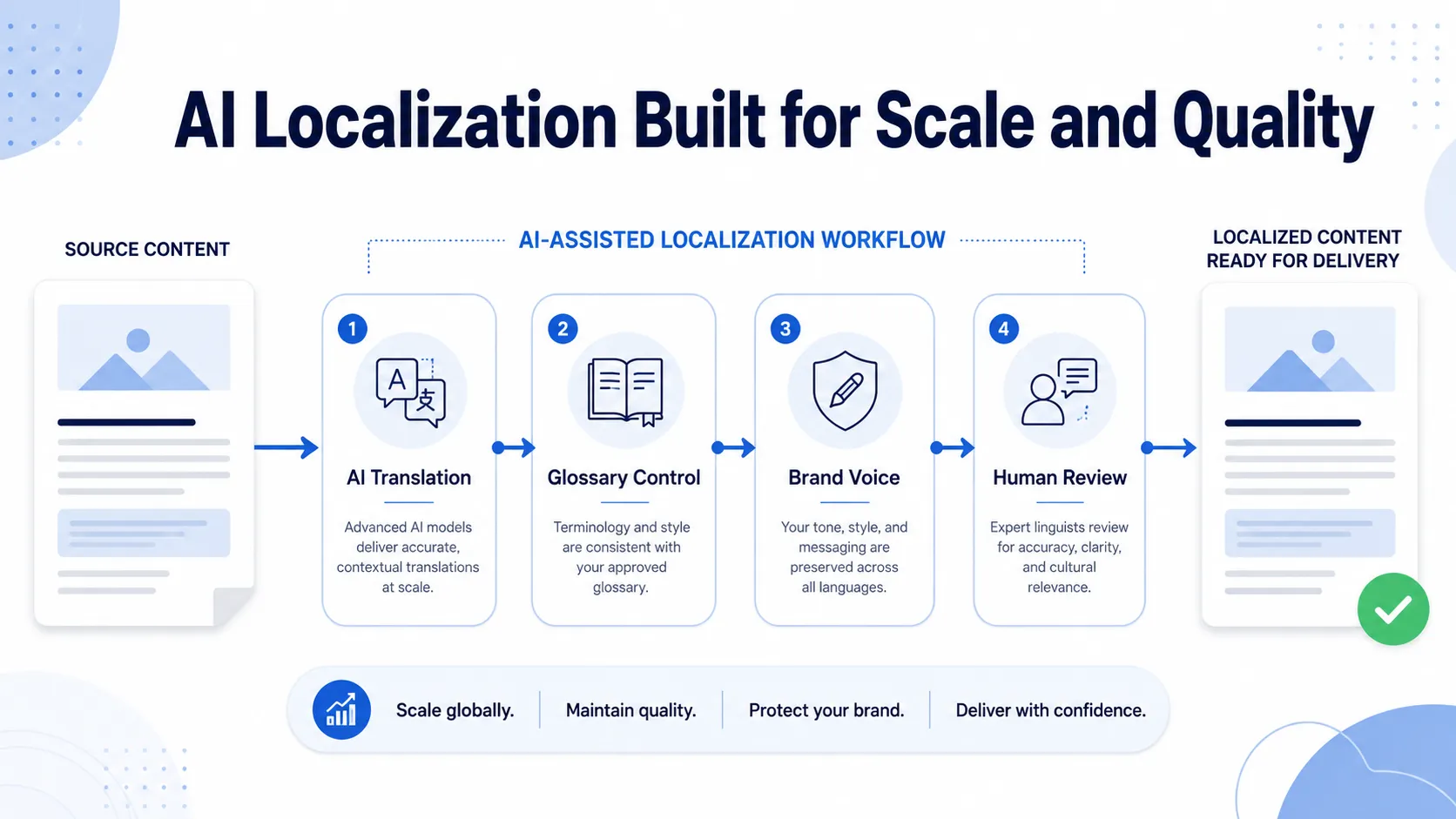
Human-only and AI-assisted contract translation workflows differ mainly in risk level and clause sensitivity. Hybrid workflows use machine translation for the first draft, followed by human legal review and quality checks. This approach helps reduce cost and turnaround time for lower-risk content.
Human-only workflows are recommended for high-risk clauses such as indemnity, arbitration, and intellectual property terms. They remove the risk of AI-introduced errors and provide stronger legal protection. Choosing the right approach means balancing cost efficiency with the level of legal risk involved.
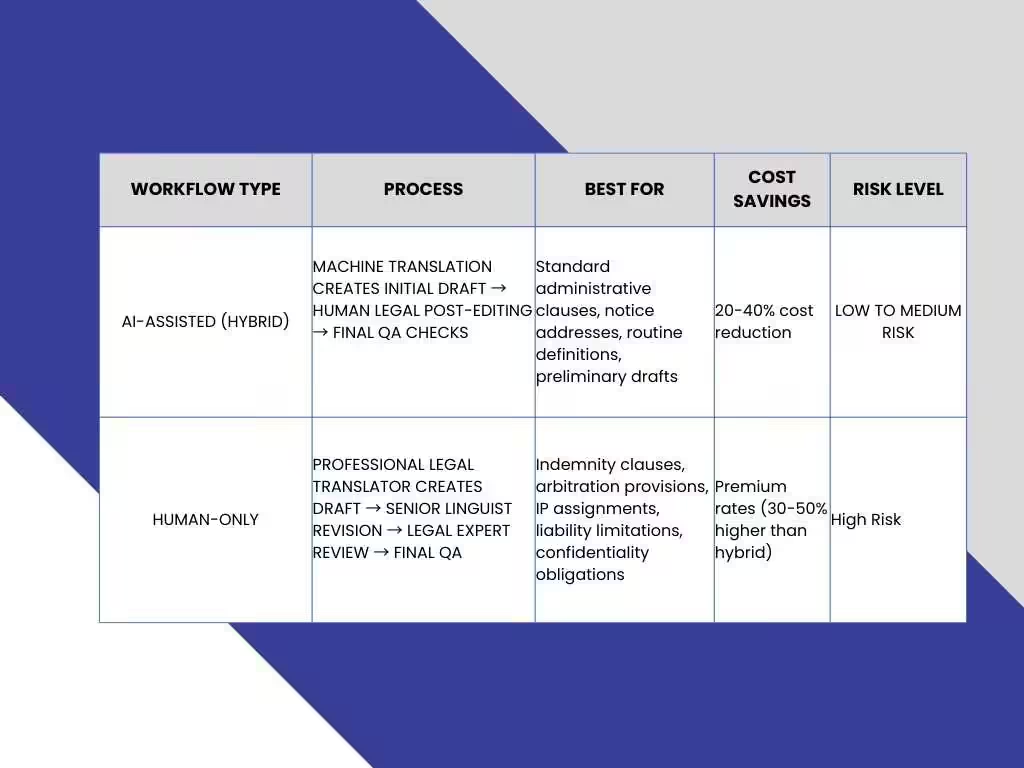
AI-Assisted Workflow Details:
If your contract contains standard administrative clauses, AI-assisted workflows accelerate translation while reducing costs. Machine translation engines trained on legal corpora provide reasonable first drafts that experienced legal translators then refine, correct, and adapt to proper legal language. Human post-editors verify the accuracy of terminology, fix grammatical errors, ensure clause logic flows correctly, and validate that legal concepts are transferred appropriately.
Human-Only Workflow Requirements:
High-risk contract sections require human-only translation due to severe consequences of errors:
- Indemnity Clauses: Allocate liability between parties, demanding precise wording where subtle translation shifts change financial exposure
- Arbitration Provisions: Specify dispute resolution procedures that must translate exactly to preserve parties’ procedural rights
- IP Assignments: Transfer ownership requiring terminology precision distinguishing exclusive licenses, non-exclusive grants, and complete transfers
- Liability Limitations: Cap damages needing accurate numeric translations and clear scope definitions
- Confidentiality Obligations: Survival terms extending beyond contract termination require careful attention to timeframes and exceptions
The cost differential between hybrid and human-only workflows typically ranges from 30 to 50 percent, with human-only translation commanding premium rates that reflect specialist expertise and reduced risk exposure.
When Hybrid Workflows Make Sense (and When They Don’t)
Choosing between hybrid and human-only translation workflows depends on the level of legal risk involved. Some contracts prioritize speed and cost, while others demand maximum accuracy and legal protection. The following do’s and don’ts help determine when each approach is appropriate.
When Hybrid Workflows Make Sense
- Use hybrid workflows for low-risk contract templates and standard agreements.
- Apply them to early-stage negotiation drafts where terms are not final.
- Use them for internal documents that are not shared externally.
- Choose hybrid workflows for administrative amendments, such as updating contact details or extending deadlines.
- Use them for high-volume contracts with a similar structure, like routine supplier or employment agreements.
- Prefer hybrid workflows when speed and cost efficiency matter more than absolute legal precision.
When Hybrid Workflows Don’t Make Sense
- Do not use hybrid workflows for final, signed, or executed contracts.
- Avoid them for agreements involving large financial commitments or long-term obligations.
- Do not rely on hybrid workflows for regulatory submissions or government filings.
- Avoid them for contracts involving intellectual property, mergers, acquisitions, or franchises.
- Do not use them when a mistranslation could lead to disputes, liability, or major financial loss.
- Avoid hybrid workflows when counterparties expect human-only, legally validated translations.
How to Request Compliant Contract Translation
Requesting compliant contract translation works best when key details are shared upfront. Clear information helps avoid delays, reduces revisions, and ensures the translation meets legal and regulatory requirements. Providing the right inputs also allows the correct translators and review process to be assigned from the start.
Before requesting a contract translation, it helps to specify the governing jurisdiction and applicable law so legal terms are translated correctly. Identifying sensitive clauses, such as indemnity, intellectual property, or arbitration, signals where extra care is needed. Clarifying certification requirements determines whether a standard, certified, sworn, or notarized translation is required. You should also share timelines, formatting needs, and whether bilingual or signing-ready files are needed. Providing existing terminology glossaries and preferred reviewer qualifications improves consistency and quality. When this information is complete, the translation process is faster, more accurate, and compliant on first delivery.
What Information Helps Produce an Accurate Quote?
Providing complete and clear information upfront helps ensure accurate contract translation quotes. Each detail enables proper planning, correct pricing, and the assignment of the right legal and linguistic expertise. Below are the key factors that directly influence translation cost and delivery.
Word Count or Page Length
Word count is the foundation of pricing, as most translation costs are calculated per word or estimated effort. Accurate counts help set clear budgets and timelines from the start.
Source and Target Languages
Language pairs affect pricing and availability. Common pairs are usually more cost-efficient, while rare or specialized languages may require premium resources.
Agreement Type and Subject Matter
Different contracts require different expertise. Commercial, employment, software, or regulatory agreements each demand specific legal and industry knowledge.
Intended Use and Purpose
The purpose of the translation matters. Internal review, negotiation, regulatory filing, or court use each requires different accuracy and compliance levels.
Deadline Requirements
Tight deadlines may require expedited workflows or additional reviewers. Rush delivery can impact pricing and resource allocation.
Compliance and Certification Needs
Certified, sworn, or notarized translations involve extra steps and documentation. These requirements add time, coordination, and cost.
Formatting and Layout Complexity
Contracts with tables, exhibits, signatures, or bilingual layouts need desktop publishing support. Complex formatting increases effort beyond text translation.
Additional Cost Factors
Revision rounds, translation memory use, project volume, and long-term collaboration can influence final pricing. These elements help refine quotes further.
Sharing these details at the beginning allows for firm quotes instead of rough estimates. It also ensures realistic timelines, fewer revisions, and a smoother contract translation process overall.
Lastly, in this multilingual country, we need to translate various contracts and documents. By following proper rules and workflow, it’s easy to make contract documentation for your organization. Also, if the contracts are sensitive, it is wise to take help from an agency like Circle Translations to get accurate contract translations for your company.
Frequently Asked Questions
What makes a contract translation accurate?
A contract translation is accurate when it keeps the same legal meaning as the original. It must preserve rights, obligations, and enforceability across jurisdictions. Accuracy goes beyond correct words and focuses on legal equivalence.
Do I need a certified or sworn translation for my contract?
Yes, you might need a certified or sworn translation when the receiving authority requires official validation. Requirements depend on where and how the contract will be used.
Government agencies, courts, and regulators often require sworn translations done by authorized translators. Certified translations are usually enough for corporate or business use, where no government filing is involved. Some cases also require notarization to verify the translator’s identity.
Can AI be used for contract translation?
AI can be used for low-risk drafts and early negotiation documents where speed matters more than precision. It should not be used for final or legally binding contracts.
High-risk clauses like indemnity, liability, arbitration, and intellectual property require human-only translation.
Which languages are most requested for B2B contracts?
The most requested languages reflect global trade and legal needs. European markets commonly require German, French, Spanish, and Italian. Asia-Pacific markets often need Japanese, Chinese, and Korean. Middle Eastern contracts frequently require Arabic.
These language pairs support cross-border supply chains, technology agreements, distribution contracts, and international partnerships where legal validity depends on local language use.
What should I prepare before sending documents for translation?
Before sending a contract for translation, prepare the final version and key details. This helps avoid delays and extra costs.
You should confirm the governing law, preferred file format, deadline, and whether certification or notarization is required. Sharing approved terminology glossaries also ensures consistency. Sending the final version instead of drafts speeds up delivery and reduces revisions.
How long does contract translation take?
Contract translation timelines depend on length, complexity, number of languages, and compliance requirements. Simple contracts are faster, while complex or certified ones take longer.
A standard 10-page commercial contract usually takes 3–5 business days. Large or complex agreements may take 2–3 weeks, especially if sworn translation or legal review is required. Rush delivery is possible for shorter contracts at a higher cost.