
If you’re a B2B marketing, product, or customer experience leader responsible for website and product translation, you’ve likely faced a fundamental question: Should we build an internal translation team, or outsource to a language service provider?
The answer seems straightforward if you only look at per-word rates. The math looks simple. But this math ignores the real cost of translation. The hidden expenses that accumulate silently on your company’s balance sheet are often not included in these simple calculations.
Salaries for internal linguists, recruitment costs, retention challenges, underutilized capacity during slow months, translation management software subscriptions, quality control cycles, and the opportunity cost of marketing teams stepping in to translate, and suddenly that “cheaper” in-house approach costs far more than the initial rate comparison suggests.
This article breaks down the hidden costs of in-house translation and outsourcing so you can make a data-driven decision. It’s a practical framework for B2B leaders comparing translation models.
In-House Translation vs Outsourcing: What Are You Really Paying For?
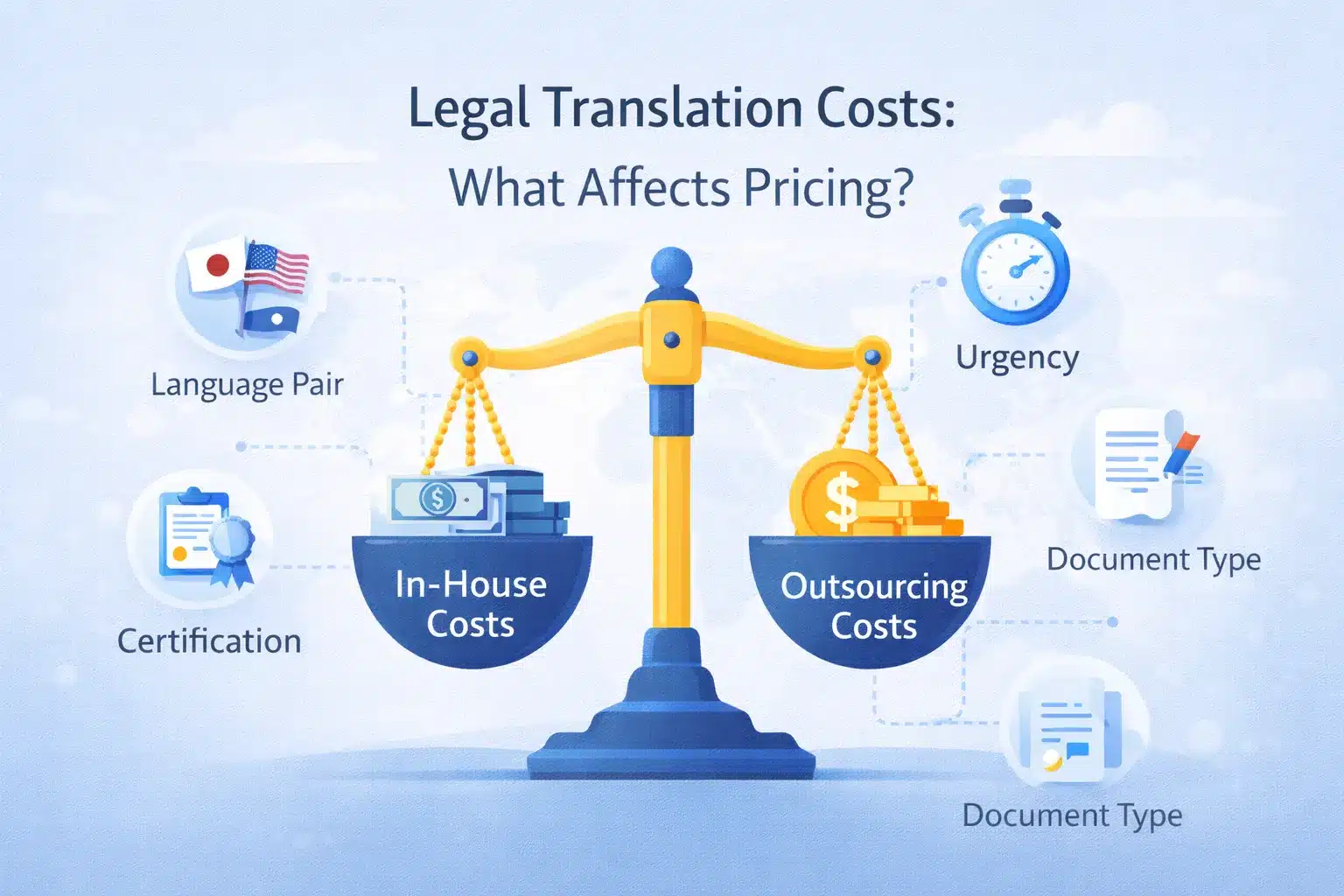
When you compare in-house translation to outsourcing, you’re comparing two fundamentally different operating models, each with distinct cost structures and hidden expenses.
In-house translation means hiring permanent linguists, bilingual staff, or a translation team that sits within your organization. You control the workflow, maintain deep brand familiarity, and own all translation assets.
Outsourcing means delegating translation work to language service providers (LSPs), translation agencies, or freelance networks. You pay variable per-word or per-hour rates, plus project management fees and platform charges.
What Are the Visible Costs of In-House Translation? (Salaries, Tools, Benefits)
Visible costs are easy to count because they appear in budget spreadsheets and payroll systems.
Base salaries: A professional translator in the US earns between $36,000 and $56,000 annually. For specialized fields like medical or legal translation, expect the higher end or above.
Benefits and taxes: they add 25 to 30% on top of the salary. Insurances, taxes, retirement, and benefits like PTO accumulate quickly. That $56,000 translator now costs closer to $72,000 to $73,000 all-in.
CAT tools and translation management software: Professional translation requires Computer-Assisted Translation tools like Trados, memoQ, or OmegaT to maintain consistency through translation memories and terminology databases. Licenses run $200 to $1,000+ per user annually, depending on the platform.
Hardware and workspace: Each translator needs a computer, software, desk space, and connectivity. They add up across a team.
Recruitment and onboarding: Advertising, interviewing, running language proficiency tests, and training new hires on your tools and brand voice consume time and money.
Two full-time translators at a $50,000 base salary each, with a ramp-up to $92,000 annually as a minimum. This is purely the direct, visible cost before any hidden items surface.
Where Do Hidden In-House Costs Show Up?
The visible costs are only the beginning. Hidden costs are the expenses that don’t appear on a dedicated “translation” line item but accumulate across payroll, operations, and lost productivity.
Internal management and oversight, and rework due to inconsistent quality, generate hidden costs.
Limited language coverage forces hybrid models anyway. Few organizations can afford in-house translators for 15 languages. When your website expands to Southeast Asia or Eastern Europe, you’re forced to hire external vendors, fragmenting your translation operation.
Idle time during content droughts is particularly painful. If your translation volume drops 40 percent during Q4, your translators still cost the same. They sit underutilized while you’ve already paid their salary. LSPs don’t face this problem; they spread capacity across hundreds of clients.
Recruitment, turnover friction, and quality control cycles multiply hidden labor. And in turn, generate more hidden costs that compound over time.
The cumulative impact of these hidden costs often pushes the true cost of an in-house team 30 to 50% higher than salary figures account for.
What Are the Hidden Costs of Outsourcing Translation?
Outsourcing shifts your cost structure but introduces its own hidden expenses. Transparency about these costs separates good translation service providers from mediocre ones.
Vendor onboarding and briefing, inconsistent glossaries and terminology, project management markups, vendor lock-in, minimum fees, risk and rework introduce unexpected costs that exceed the original budget.
Waiting for vendors to digest information and revisiting miscommunications consumes internal time. Reputable LSPs add 10 to 15 percent to per-word rates to cover project management, vendor coordination, and quality oversight. A quote of $0.15 per word often hides $0.015 of PM markup, plus technology platform fees, plus rush surcharges if you miss deadlines.
Once you’ve invested time in onboarding, terminology, and workflow integration with an LSP, switching providers is expensive. You lose translation memory context, must re-brief new vendors, and risk quality inconsistency during the transition.
Many LSPs impose a $500 or $1,000 minimum per project, regardless of word count. If you submit 200 words of urgent copy, you still pay the minimum, inflating per-word cost dramatically.
Poor vendor quality creates hidden costs that dwarf initial savings. A mistranslated phrase that confuses customers, generates support tickets, or damages your brand reputation costs far more than the translation itself.
A transparent translation company will itemize these costs clearly: per-word production rate, PM fee percentage, platform fee, rush surcharge, and QA cost. If a vendor won’t break down pricing, that’s a red flag that hidden fees are hiding in the aggregate.
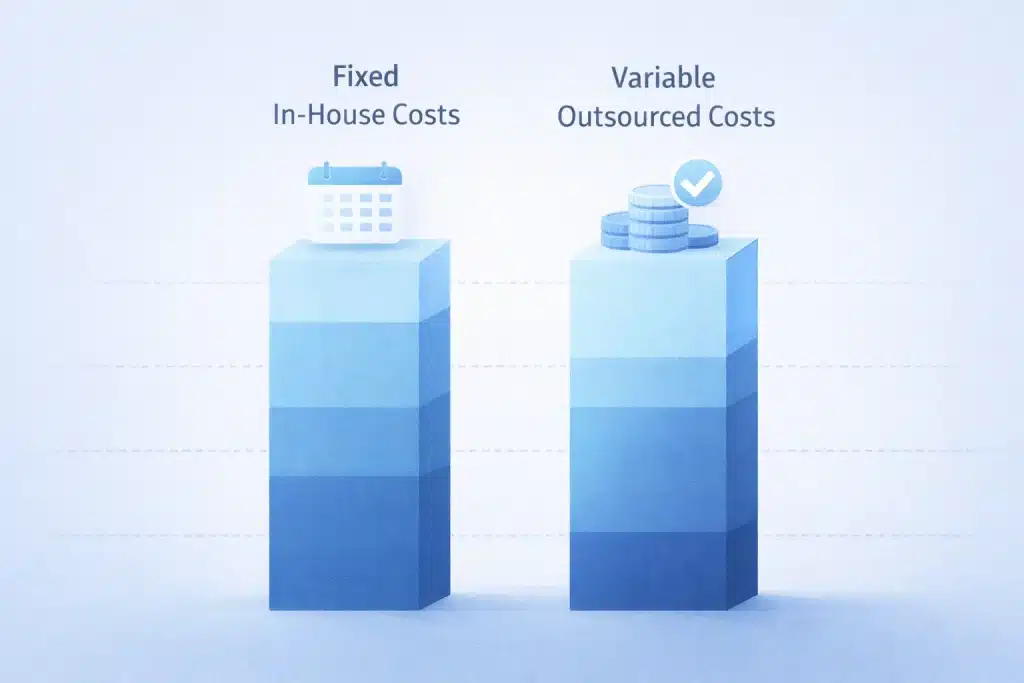
Cost Structure: Fixed In-House Spend vs Variable Outsourced Spend
The fundamental difference between in-house and outsourced translation lies in how costs behave as volume changes.
In-house translation generates fixed monthly costs. Whether you translate 50,000 words or 10,000 words next month, your translator’s salary remains constant. This is powerful for stable, predictable workloads. But if your volume varies wildly, you’ve overbuilt capacity in slow months and still run understaffed during peaks.
Outsourced translation generates variable costs proportional to usage. You pay per word (or per hour) based on what you translate. This means low-volume months produce low bills, while high-volume months have higher costs.
This is why outsourcing appeals to companies with seasonal content needs, rapidly scaling products, or unpredictable campaign schedules. You pay for what you use, when you use it.
How Do Volume Spikes and Seasonality Impact Total Cost?
Real-world translation patterns don’t follow smooth curves. They spike and dip based on product cycles, campaign seasons, and market events.
Consider a typical SaaS company’s translation calendar: Q1 includes a major product redesign, Q2 settles into steady monthly website updates, Q3 launches a regional marketing campaign, and Q4 grinds to a halt for holidays. Annual total, spread unevenly.
An in-house team sized for the Q1 peak translates to good ROI but sits idle during Q2 and Q4. Scaling up for Q3 requires freelancers anyway, adding variable cost on top of fixed cost.
An outsourced LSP with fixed rates, a 15 percent PM markup, and rush fees for Q1 and Q3, the total cost stays under what you’d need to pay your in-house team. The LSP handles workload volatility because it spreads your peaks and troughs across hundreds of other clients with opposite seasonal patterns.
How Does Translation Quality Affect Long-Term ROI?
Choosing a translation model based purely on price-per-word ignores the most important variable: quality and its impact on customer experience and revenue.
Poor-quality translations create hidden costs that cascade through your business. Mistranslations confuse customers, reduce conversion rates, increase support ticket volume, and damage brand trust in markets where language accuracy signals competence.
Conversely, high-quality translation, whether from an elite in-house team or a skilled LSP, improves customer experience, boosts conversion rates in new markets, and reduces support burden.
Translation quality should drive model selection, not the other way around. If your brand reputation hinges on precise, consistent translation, you might justify an in-house team or a premium LSP, even if the per-word cost is higher. If you operate in high-volume, lower-precision contexts, a cost-optimized outsourced provider serves your needs better.
When Does In-House Translation Make Sense?
In-house translation isn’t inherently inefficient. In specific contexts, building an internal team is the right choice.
High, constant volume justifies in-house staffing. If you translate 150,000+ words monthly with predictable patterns, an in-house team amortizes its fixed costs across sufficient volume to be cost-competitive with LSPs.
Regulated industries with intensive internal review benefit from in-house expertise. Healthcare, legal, and financial services firms fall under this umbrella. An in-house team builds institutional knowledge of regulatory requirements that external vendors can’t replicate.
Strategic languages with deep brand knowledge and extreme time-to-market requirements justify in-house talent. This approach saves time and drives ROI through brand expertise and consistency.
What Are the Operational Risks of Running Translation In-House?
Beyond cost, in-house translation carries operational risks that don’t appear on spreadsheets until they manifest as crises:
- Team turnover and knowledge loss
- Difficulty hiring for niche languages
- Technology debt accumulates
- Limited scalability
In-house localization risk compounds quickly. Sudden knowledge loss when senior translators leave, taking years of brand context and terminology with them and forcing months of inconsistent ramp-up. Hiring for niche languages is persistently difficult, making true multi-language scale unrealistic and pushing teams into hybrid models anyway. Meanwhile, technology debt builds as internal tools age, custom systems become unmaintainable, and migration costs rise while the industry moves ahead with AI-assisted workflows and deeper CMS integration.
What Does a Realistic Total Cost of Ownership (TCO) Model Look Like?
Making a confident decision requires building a Total Cost of Ownership model that captures both models comprehensively.
Here’s a cost comparison snapshot that paints a clear picture:
| Cost Component | In-House Translation | Outsourced Translation |
| Core labor | Salaries and benefits for full-time linguists | Per-word rates × estimated annual volume |
| Hiring & ramp-up | Recruitment, onboarding, training, and time-to-hire replacement | None (capacity provided on demand) |
| Management overhead | PM time, HR administration, and people management | Project management fees (typically 10–15%) |
| Technology | Translation software licenses and ongoing maintenance | Platform or technology fees (often bundled) |
| Infrastructure | Hardware, workspace, utilities | None |
| Scalability cost | Additional hires required for new languages or volume spikes | Flexible scaling without fixed cost |
| Quality assurance | Internal QA and review labor (hours × loaded cost) | Included or partially included; internal spot QA only |
| Speed & surge cost | Constrained by team size and availability | Rush surcharges and minimum fees when required |
| Internal coordination time | Ongoing supervision and process management | Vendor briefing, coordination, and internal QA (hours × loaded cost) |
Once you’ve built both models, the comparison becomes clear. For many mid-market B2B companies, the outsourced total comes in 20 to 40% lower than in-house, particularly when accounting for hidden labor costs and the avoided burden of team management.
Hybrid Models: Combining In-House Knowledge with Outsourced Capacity
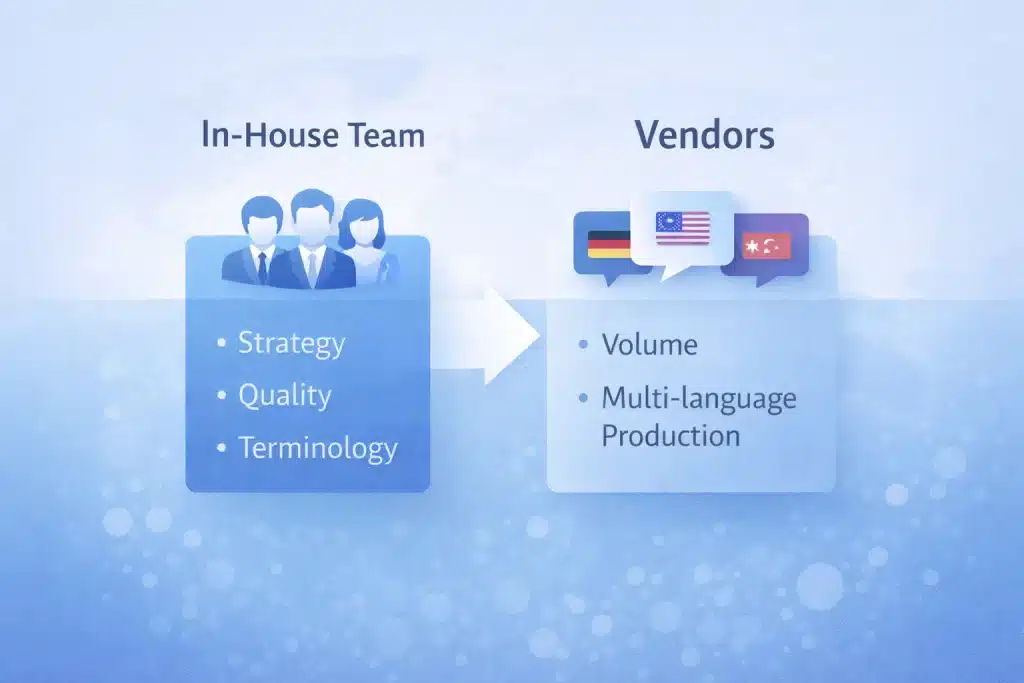
Many mature organizations discover a middle path: a small in-house team that owns strategy, terminology, and quality, while external vendors handle production volume and multi-language coverage.
In-house staff focus on strategy: They maintain terminology databases, create brand voice guidelines, design QA processes, and review high-impact translations before publication. They become translation architects rather than production translators.
External vendors provide capacity: They execute the bulk of translation work, such as website pages, help documentation, marketing content, using terminologies and guidelines set by the in-house team.
This hybrid model enables you to retain control over brand consistency without paying full fixed costs for production linguists. You can scale volume up or down by adjusting vendor workload, while your core team remains stable. You access broader language coverage while maintaining deep expertise in your top markets. You reduce recruitment burden because in-house roles focus on architecture rather than repetitive production.
The hybrid approach has become standard in mid-to-large SaaS and e-commerce companies. It balances control, cost, and scalability effectively.
What Work Should Stay In-House vs Go to Vendors?
The hybrid model requires clear boundaries between in-house and outsourced work.
So, how do you separate workloads between the in-house team and the vendor?
Keep in-house:
- Messaging frameworks and brand voice guides
- Critical UX flows and safety-sensitive content
- Legal, compliance, and regulatory text requiring internal review
- Terminology database maintenance and updates
- Quality assurance and final review for customer-facing content
Send to vendors:
- Website page translation and localization
- Support documentation and help center content
- Marketing collateral and campaign translation
- Product release notes and announcements
- Bulk content translation where volume justifies external capacity
The rule of thumb: in-house handles strategic and high-risk content. Vendors handle scalable, repetitive work. This split optimizes for both cost and quality.
How Do AI and Machine Translation Change the In-House vs Outsourcing Equation?
AI-powered translation and machine translation (MT) introduce a third variable to the decision framework.
Tools powered by neural MT can produce readable drafts in minutes, cutting translation time by 30 to 50% compared to human-only workflows. This makes even in-house MT economical with MTPE workflows.
But deploying MT in-house carries hidden costs:
- training the engine on your terminology
- building evaluation workflows
- managing MT quality metrics
- integrating the system with your CMS
Conversely, outsourced providers operate at scale. They spread MT infrastructure costs across hundreds of clients, making AI-assisted translation cheaper than they could deliver in-house.
AI doesn’t eliminate the in-house vs outsourcing decision; it reshapes it. AI-first organizations often move toward hybrid or outsourced models, where vendors handle both traditional translation and AI-assisted workflows. You maintain in-house expertise for quality oversight, but delegate production to vendors equipped with better AI infrastructure than you could build internally.
Decision Framework: Choosing the Right Translation Model for Your Website
So which model suits your business? Use this framework to decide.
- Quantify your annual translation volume.
- Assess workload volatility.
- Map language scope.
- Evaluate compliance and brand sensitivity.
- Calculate available internal resources.
- Build a simple TCO model.
If in-house TCO is within 10% of outsourcing, choose in-house for control and consistency. If outsourcing is more than 10% cheaper, outsourcing usually wins unless qualitative factors override cost.
What Questions Should You Ask When Comparing Providers?
If you lean toward outsourcing, use this RFP checklist to evaluate vendors:
- Pricing transparency: Do they break down per-word rates, PM fees, platform fees, and rush surcharges separately? Or is pricing opaque?
- Technology stack: What CAT tools, TMS platforms, and QA systems do they use? Do they integrate with your CMS?
- AI and MT usage: Do they offer MT + human review? What’s their approach to AI-assisted translation for your content type?
- Security and compliance: How do they handle data security, confidentiality, and regulatory compliance (GDPR, CCPA)?
- SLAs and quality metrics: What’s their guaranteed turnaround time? How do they define and measure quality?
- QA process: What’s their review workflow? How many QA cycles does pricing include?
- Terminology and brand consistency: How do they manage your glossary and terminology database? Can they integrate with your TMS?
- Integration and reporting: Can they integrate directly with your CMS or website platform? Do they provide reporting on volume, costs, and timelines?
- Vendor management: Who’s your single point of contact? Can they handle multiple projects simultaneously?
- Scalability: Can they handle sudden volume increases (50% spike) without quality degradation?
Vendors that answer clearly and confidently to these questions, operate transparently. Vendors that hedge, deflect, or bundle everything into a vague quote are hiding complexity or flexibility constraints.
How Can Our Agency Help You Avoid Hidden Costs?
Hidden costs exist in every localization model. But Circle Translations removes them entirely through transparency, expertise, and scalable delivery.
Circle Translations offers clear, itemized pricing with no surprises. Project management fees, platform access, QA cycles, and workflow steps are defined upfront. There’s no ambiguity—just predictable costs and measurable value.
Our team integrates seamlessly with your existing CMS, product workflows, and localization tools, acting as an extension of your in-house team. We offer flexible translation models tailored to your content strategy:
- Human translation for high-stakes, brand-critical, legal, and regulated content
- MTPE (Machine Translation Post-Editing) for scalable, cost-efficient growth
- Full MT workflows for low-risk, high-volume content
Circle Translations maintains your terminology databases, style guides, and brand voice, ensuring consistency across markets, languages, and channels.
Most importantly, we treat translation as a strategic growth function, not a commodity. We help you model total cost of ownership (TCO), compare in-house vs outsourced translation, and design a localization strategy that balances cost efficiency, quality, speed, and global scalability.
Conclusion
The hidden costs of in-house translation aren’t failures of planning; they’re structural realities. Fixed payroll, underutilization during slow periods, recruitment friction, and management overhead are inherent to the model.
Similarly, outsourcing’s hidden costs show up as PM markups, vendor lock-in, quality risk, and onboarding friction. They’re how variable-cost models operate.
The decision framework is beyond “cheap per-word rates”, and the real question is: which model delivers the lowest total cost of ownership while maintaining the quality and control your business needs?
A hybrid model with a small in-house team, partnering with vendors who provide volume, scalability, and language breadth. This approach gives you control without the burden of production management, and cost efficiency without the risk of outsourced vendors cutting corners on your brand.
But the specifics depend on your volume, workload stability, language scope, and compliance requirements. Build your TCO model. Test both scenarios. Then decide with confidence, knowing you’re not leaving hidden costs undiscovered.
The next step is straightforward: book a consultation with Circle Translations to help you model both approaches and quantify the trade-offs specific to your business.
Hidden Costs of In-House Translation — FAQs
Is in-house translation always cheaper than outsourcing?
No. Studies comparing in-house translation to outsourced translation show that fixed costs for salaries, benefits, tools, and management often make in-house teams more expensive than external providers, especially for irregular workloads. Outsourcing converts translation into a variable cost that scales with volume, making it cost-effective for companies with unpredictable translation needs.
What are the highest hidden costs of in-house translation teams?
Key hidden items include the time non-linguist staff spend on translation work, recruiting and onboarding costs, idle time during slow periods, limited language coverage (forcing extra vendors), and extra internal QA cycles. These usually don’t appear in simple salary comparisons but can inflate true costs by 30 to 50 percent.
What hidden fees should I watch for with outsourced translation services?
Look for project management markups (often 10–15% of project value), minimum fees, rush surcharges, layout and DTP charges, and MT engine or platform fees. A transparent translation company will itemize these costs and explain what each covers.
How does AI translation change the cost picture?
AI and machine translation reduce per-word costs and help vendors scale, but still need human review for customer-facing website copy. Running MT fully in-house adds hidden costs: training engines, building evaluation workflows, and managing quality. Many enterprises use providers that combine AI with human linguists and existing translation tools, offering better cost-to-quality balance.
When does it make sense to build an in-house translation team?
In-house teams make sense when you have constant, high-volume translation needs in a limited set of languages, strong internal QA processes, and budget to support salaries, tools, and management. For most B2B firms with fluctuating volume or broad language coverage, a hybrid or outsourced model is usually more efficient.
How can I calculate my true translation cost per word?
Add up all spending related to translation over a period (salaries, benefits, tools, external vendors, rework, agency fees) and divide by the number of translated words.
This reveals whether in-house or outsourced translation is really cost-effective for your website and marketing content, beyond headline rates.
What is a good next step if I want to compare in-house vs outsourcing for my website?
Start with a simple TCO worksheet, estimating annual volume, languages, current internal time spent, and vendor costs. Then book a short consultation with a language service provider that can model a hybrid or fully outsourced scenario so you can compare total cost, quality, and time-to-market side by side.