If you’re a corporate legal team, law firm partner, or in-house counsel researching legal translation services, you’ve likely noticed that legal translation pricing differs dramatically from standard translation quotes. The invoice for a certified legal translation seems disproportionate to a general business document in per-word rates. A rush affidavit for court filing comes with fees that feel disconnected from the word count.
That’s the market reflecting reality. Legal translations are priced differently because they carry liability, require specialized terminology, involve sworn formats, and must comply with jurisdiction-specific rules.
Legal translation costs often range from low to mid-tier depending on format, languages, and certification needs, but the true cost is determined by multiple interconnected factors.
This article breaks down the legal translation costs, what affects the pricing, and how to ensure accuracy and compliance without overspending.
What Are Legal Translation Costs Based On?
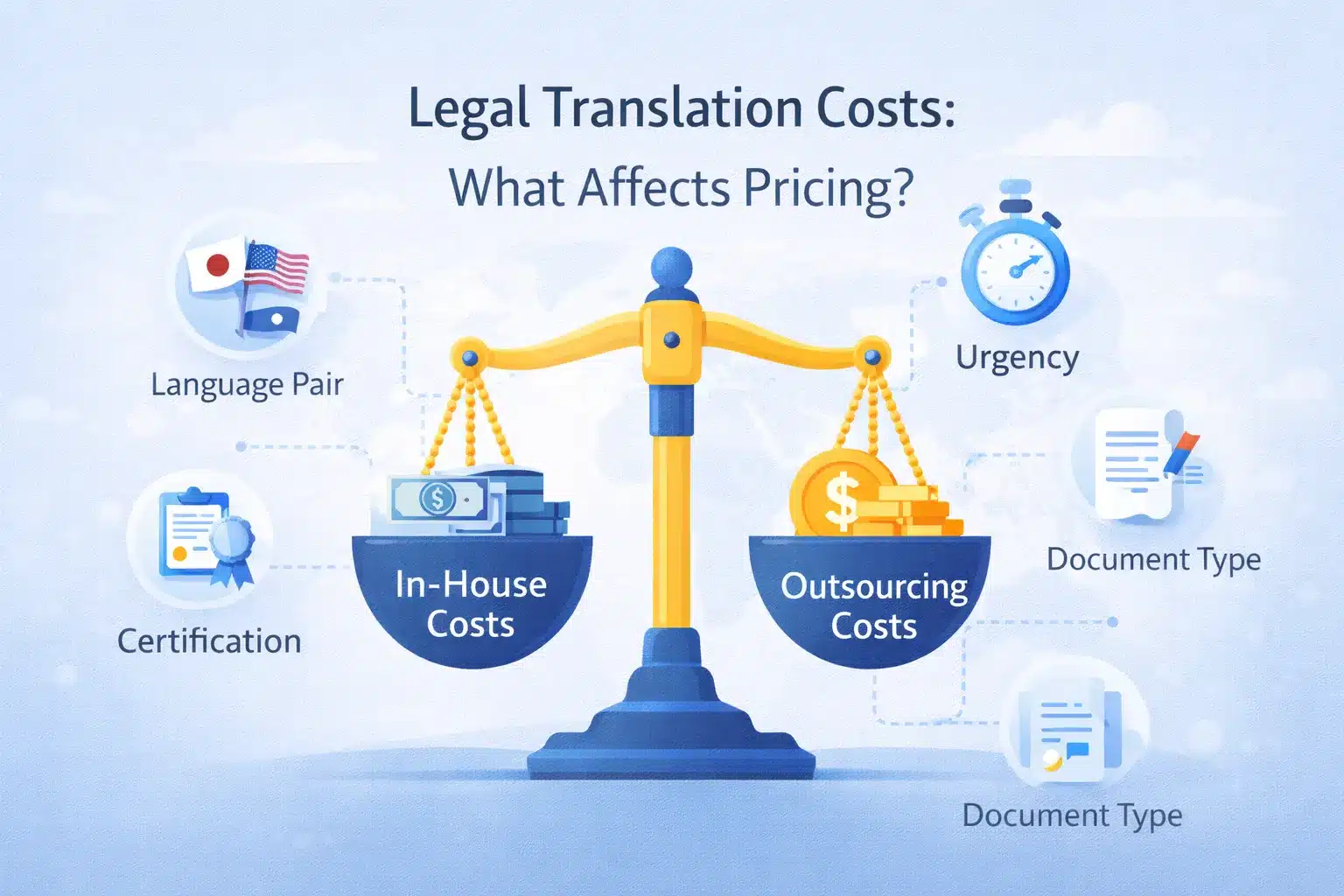
Legal translation costs are determined by five foundational cost drivers that compound to determine your final bill:
- Language pair
- Document type
- Specialist translator availability
- Certification and sworn formats
- Urgency and turnaround time
Complex legal formatting also matters. Tables, annexes, case exhibits, and complex document structures increase scope and translation time beyond simple word count.
How Do Language Pairs Change Legal Translation Pricing?
Legal translation rates vary significantly based on language combination and subject-matter expertise available.
High-demand pairs: English ↔ Spanish, French, German, etc benefit from robust translator markets. These languages have substantial legal frameworks and abundant qualified specialists. However, “abundant” doesn’t always translate to lower costs. Legal specialists in these languages still command higher rates compared to general translators.
Specialist pairs: English ↔ Japanese, Arabic, Mandarin, and Korean introduce significant cost premiums. Japanese legal translation requires understanding both common law and civil law concepts. Translators must bridge two entirely different legal systems. Arabic legal translation presents regional variants and distinct legal traditions requiring specialized knowledge. Finding qualified specialists in these pairs often requires extended sourcing time. Circle Translations maintains relationships with certified legal translators across these specialized pairs, allowing us to source qualified experts efficiently without the delays many organizations face.
Rate fluctuation in specialist language pairs reflects subject-matter scarcity and the depth of legal terminology expertise required in both source and target languages.
Why Do Certified and Sworn Translations Cost More?
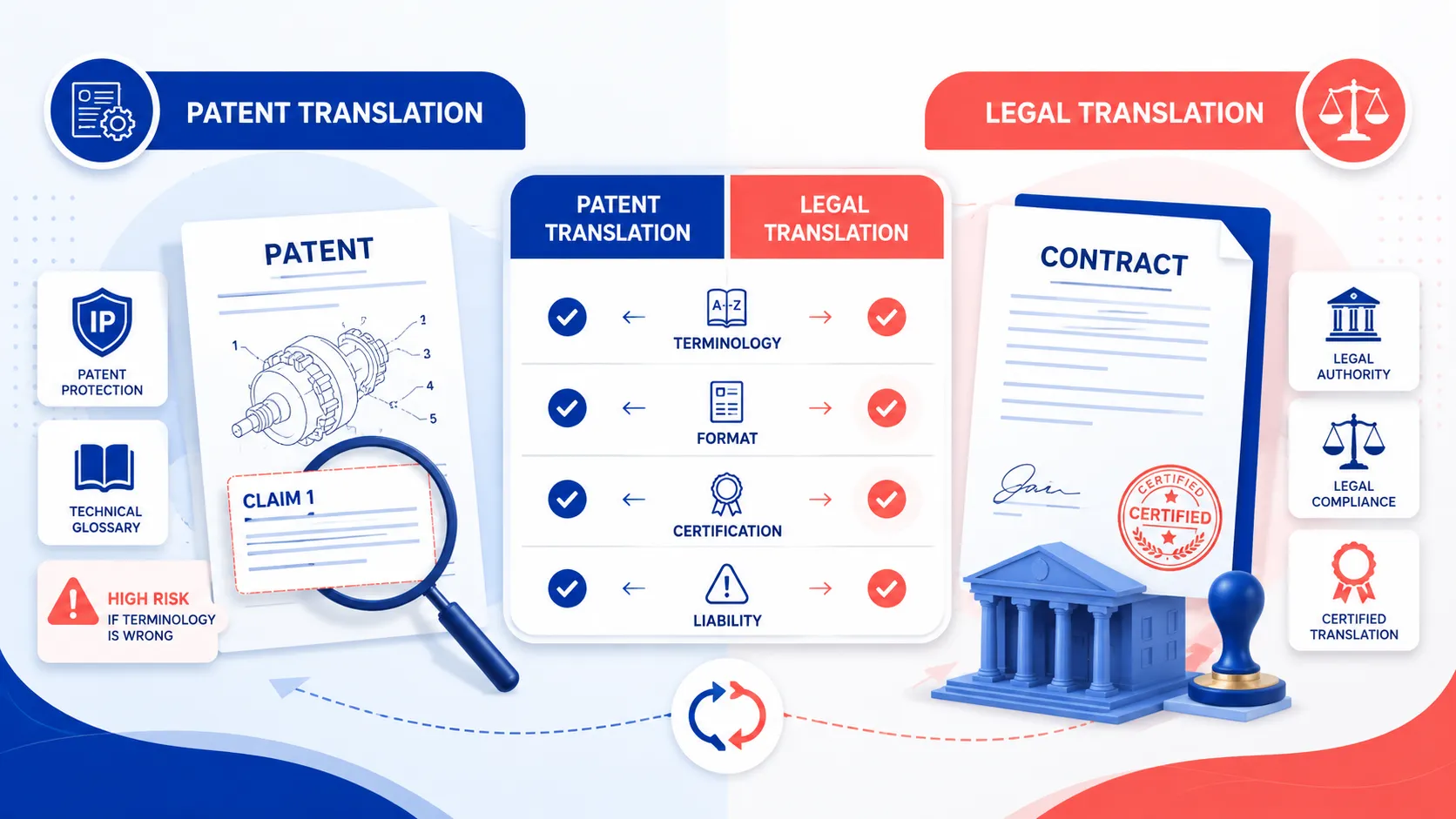
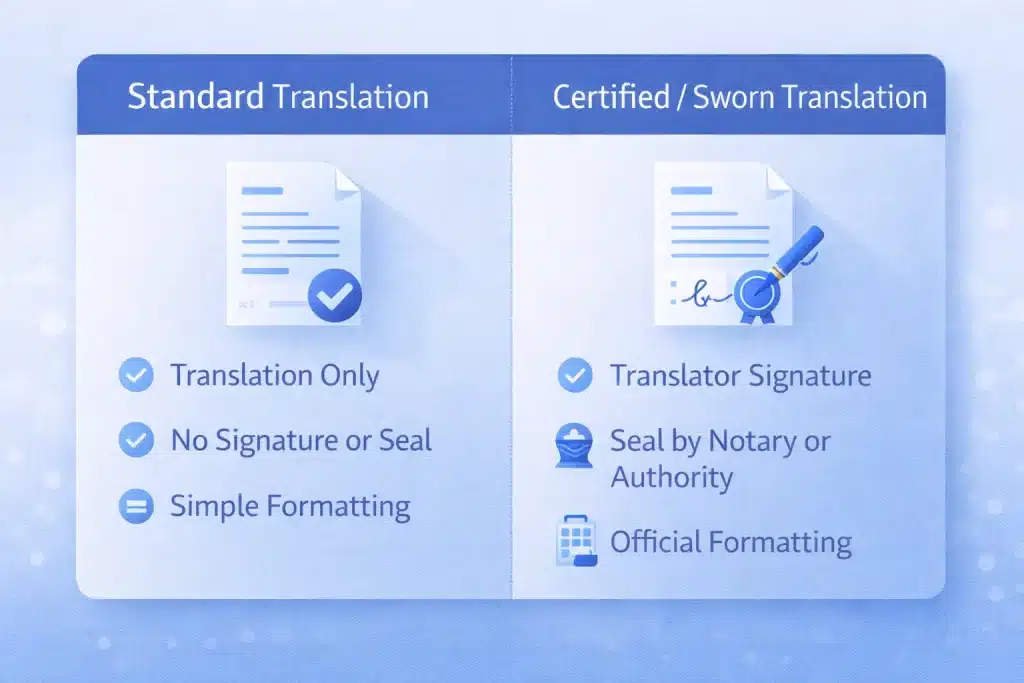
Certified and sworn translations include added work that increases cost significantly. A certified translation includes the translator’s sworn statement of accuracy, signature, and official seal. A sworn translation must be executed before a notary or authorized court official.
The additional cost reflects several layers of added work:
Sworn signatures and seals require official authentication processes that vary by jurisdiction. Some jurisdictions require translators to appear before notary publics or official authorities. Others allow self-certification if the translator holds specific credentials. Either way, this step adds time and cost.
Registry and formatting are often required. Certain jurisdictions maintain registries of certified translators or require official notification when a translation is created. Specific formatting requirements and court-ready copy preparation add administrative overhead.
Page authentication and verification are also common in certified work. Each page may require notarization or official stamps, which increases per-document cost.
Rather than purely per-word rates, certified legal translation fees typically include a per-page component plus word-based rates for content. This hybrid model accounts for the fixed administrative overhead of certification while still scaling with document length.
Increased quality assurance is built in as certified translations carry legal consequences. The translator assumes liability for accuracy. Accordingly, certified translations undergo additional review layers, protecting both translator and client with the downside of increasing cost.
Certification is a legally responsible process where each document must meet jurisdiction-specific requirements and withstand legal scrutiny, which justifies higher costs than standard translation.
How Do Legal Document Types Affect Price?
Legal documents require specialistexpertise as they carry liability. And the required care changes based on the type of document we’re working with.
Contracts and agreements sit in the high-complexity tier. Employment contracts, service agreements, licensing agreements, and terms and conditions require word-perfect precision because ambiguity in a single clause can trigger disputes worth millions. A mistranslation of just one adjective can change the legal meaning entirely.
Intellectual property documents such as patents, trademark applications, licensing agreements, demand specialists with both technical and legal expertise. IP filings require understanding industry-specific terminology plus jurisdiction-specific filing requirements.
Litigation records and discovery documents like depositions, motions, evidence exhibits, and testimony carry high stakes because they directly support legal proceedings. Mistranslation could affect the case outcome.
HR documentation involves employment law across jurisdictions. Offer letters, employment contracts, employee handbooks, and severance agreements must remain enforceable in the target jurisdiction, where employment law varies dramatically.
Compliance and regulatory filings must comply with specific legal standards in the target market. Mistranslation could create regulatory exposure or liability.
Corporate and corporate filings involve complex commercial implications and require accurate terminology.
Documents in high-risk segments command higher translator rates because the cost of error is substantial. Higher liability increases translator seniority requirements, which directly increases your per-word cost. A junior translator handles routine work at a lower cost, but a senior specialist with deep domain knowledge handles high-liability work at premium rates.
Do Urgent Filing Deadlines Increase Translation Costs?
Yes. Short timelines trigger surcharges due to resource scaling and accelerated quality assurance requirements. When a court filing deadline is imminent, vendors must pull translators from other projects, compress quality assurance timelines by adding more parallel reviewers, and manage coordination overhead.
Rush fees are common for court motions, arbitration filings, and compliance deadlines because these documents are tied to external legal deadlines.
Rushed timelines increase cost because they require extraordinary resource coordination and quality assurance compression. The specific percentage varies by vendor and timeline, so request rush pricing upfront rather than discovering surprises in your final invoice.
Legal Translation Pricing Models Explained
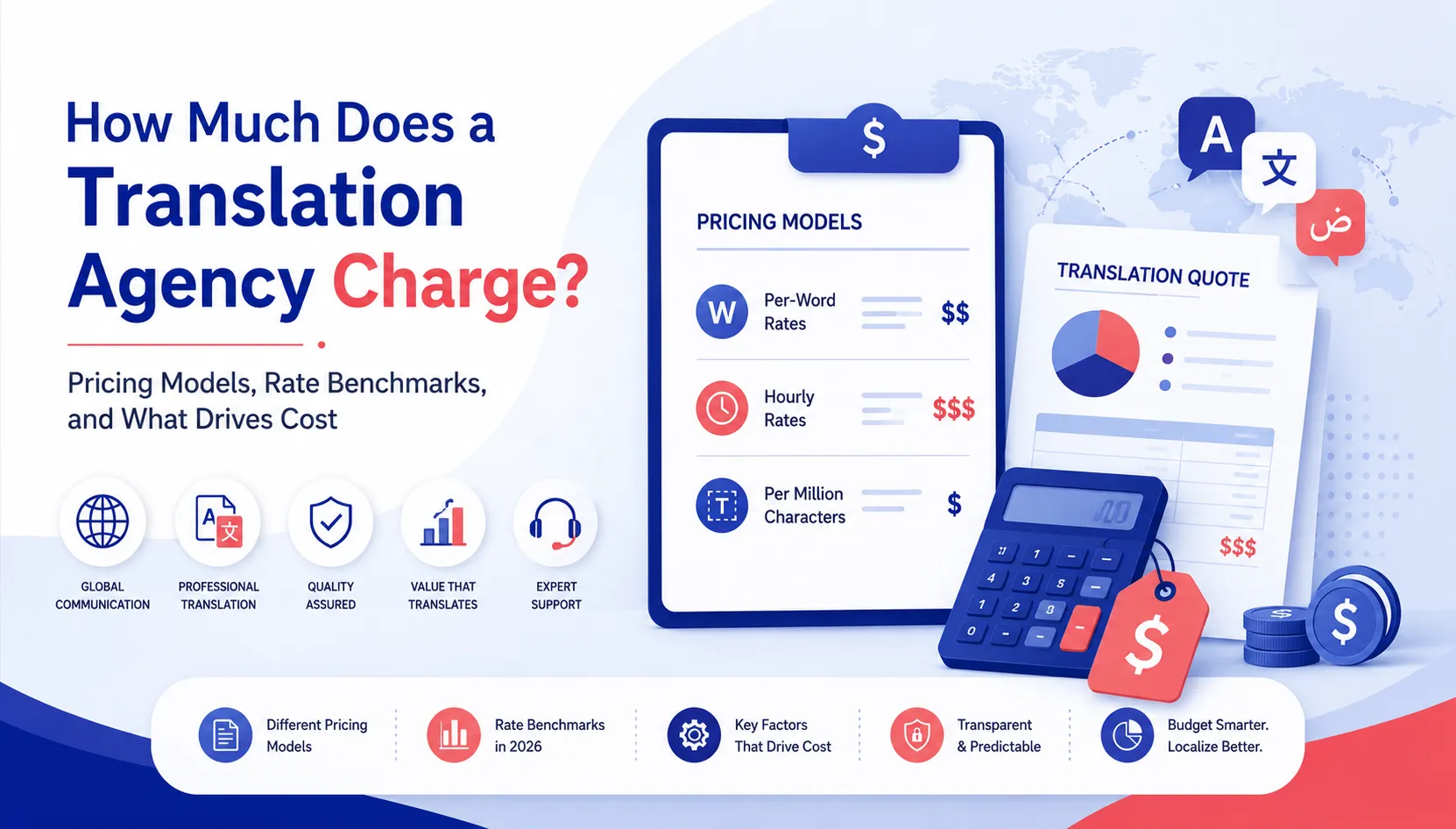
Understanding common billing formats and legal translation price structures helps you evaluate quotes accurately and budget realistically. Understanding common billing formats and legal translation price structures helps you evaluate quotes accurately and budget realistically.
Per-Word vs Per-Page Pricing: When Does Each Apply?
Per-word pricing applies to most contracts and agreements. Vendors quote a rate per word within a range that varies by language pair and complexity. You provide a word count, and the invoice equals words × rate. This model scales naturally with document length. However, per-word pricing sometimes includes a minimum charge, which affects short documents disproportionately.
Per-page pricing applies to certified affidavits, apostilled documents, birth certificates, and litigation exhibits. Per-page rates account for the fixed administrative overhead of authentication, certification, and court-ready preparation. Some hybrid models apply per-word rates to main content plus per-page fees for annexes and attachments.
When Hourly or Project Fees Are Used
Hourly or project fees apply when translation includes legal research add-ons, glossary building, revision by a second linguist, or bilingual proofreading for litigation-sensitive content. These are common in complex cross-border filings where the scope extends beyond pure translation and requires specialized expertise beyond standard translation work.
Why Sworn Translators and Proofing Steps Change the Invoice
Two-step quality assurance, involvement of sworn officers, and specialist translator requirements add measurable cost to your final invoice. This sets the realistic expectation that legal work cannot be billed like general translation.
A review layer adds cost but protects enforceability, a critical tradeoff in legal translation where the stakes of accuracy justify the additional investment.
Cost vs Risk: How Pricing Affects Enforceability
The cost of legal translation is not an expense to minimize. It’s an investment in enforceability and risk management. Cheap mistranslations can trigger contract ambiguity, enforceability issues, evidence rejection, or HR compliance failures worth exponentially more than the translation cost.
Budget translation services struggle with legal work because legal translation requires expertise difficult to scale affordably. Terminology errors occur when translators lack subject-matter expertise. Jurisdictional misunderstandings happen when translators don’t understand both legal systems. Quality control gaps emerge when documents bypass rigorous review.
High-risk areas, such as indemnification clauses determining liability allocation, governing law and jurisdiction terms determining legal framework, intellectual property assignments determining ownership, and limitation of liability clauses capping damages exposure, mistranslation can be catastrophic. A mistranslation in any of these areas can trigger litigation far exceeding the original translation cost.
For non-binding documents or internal review purposes, budget services can function. However, for any legal document that will be filed, enforced, or create contractual obligations, the risk of choosing a low-cost provider always outweighs the savings.
Circle Translations specializes in legal translation because we understand this risk calculus. Our legal specialists are selected for expertise, not just affordability, and our quality assurance processes reflect the stakes of legal work.
Can AI and Machine Translation Reduce Legal Translation Fees Safely?
For drafts and internal review, machine translation can reduce costs and accelerate workflows. If you’re reviewing a foreign legal document purely for internal understanding, machine translation with spot-checking might serve adequately.
For binding documents, however, machine translation is not recommended for filings without human review. Legal language requires absolute precision. Machine translation systems still produce errors in terminology, context interpretation, and formatting that can create enforceability problems.
Hybrid MTPE (machine translation plus human post-editing) approaches are suitable only for non-binding documents. A vendor translates with machine translation, then a legal translator reviews and corrects the output. This can reduce per-word cost compared to human-only translation, but human review time remains substantial because machine translation errors in legal text often require significant correction.
When partnering up with a provider for your legal translations, understand exactly what service tier you’re receiving, and reserve machine translation only for appropriate use cases.
How to Budget for Legal Translation
Practical budgeting requires understanding your translation volume, document types, and priorities before requesting quotes.
Define deliverables before price discussions. Specify languages, file type, certification level, turnaround time, and reference terminology upfront. This prevents scope creep and pricing surprises.
Identify document volume and frequency. If you translate consistently, vendors often offer volume discounts or retainer models.
Prioritize by risk level. Patent assignments and employment contracts deserve senior translators at a higher cost. Routine correspondence can be handled by more junior translators at a lower cost. Segment your portfolio by priority.
Plan for certification upfront. That cuts a lot of redoing and saves your money by reducing time and effort you’d have tospend otherwise.
Build contingency. Legal translation budgets should include contingency for rush work, volume spikes, and unexpected requirements. A 20% contingency is reasonable for most legal translation projects.
What to Include When Requesting a Quote
A crisp checklist helps vendors provide accurate estimates:
- Languages: source and target
- Document count and total volume
- Certification level: standard, certified, or sworn
- Document type: contract, patent, litigation, HR, regulatory, etc.
- Urgency: turnaround deadline
- Document formatting complexity: simple text, tables, exhibits, annexes
- Glossary availability: terminology preferences or previous versions
- Confidentiality needs: sensitive data handling requirements
More complete information produces more accurate quotes. Put in as many details as necessary, especially if you’re partnering up for the first time.
Cost Optimization Without Lowering Quality
Several practical strategies reduce legal translation costs without compromising quality:
- Prepare editable files: Supply clean source files rather than scanned PDFs or poorly formatted documents. Translators spend less time on cleanup, reducing per-word cost.
- Batch documents strategically: Translate multiple documents in the same subject area together. Translators build terminology familiarity and reuse glossaries, reducing per-document cost.
- Avoid last-minute filings: Plan and submit documents well before deadlines. Rush fees are expensive; planning ahead eliminates surge pricing.
- Share terminology style guides upfront: Provide glossaries, previous translations, or brand style preferences. Translators spend less time on research, reducing costs.
- Pick consistent vendor models: Switching between vendors increases onboarding time and reduces familiarity with your organization’s terminology. A consistent vendor builds efficiency and may offer volume discounts.
- Batch by risk level: Reserve senior translators for high-liability documents; assign routine work to more junior translators at lower cost.
- Negotiate retainer agreements: If you translate regularly, propose a retainer model committing to monthly translation budgets in exchange for discounted rates.
Conclusion
Legal translation pricing reflects the complexity and liability of the work. Understanding the cost drivers, such as language pair, document type, certification requirements, specialist expertise requirements, and urgency, allows you to budget accurately and choose vendors matching your risk tolerance and priorities.
The cheapest legal translation is rarely the best investment. A mistranslation in a contract, patent filing, or regulatory document can trigger disputes and enforceability challenges costing far more than the translation itself.
When evaluating legal translation quotes, focus on whether the vendor’s expertise, quality processes, and accountability match your document’s risk level. That alignment determines whether your legal translation investment protects your organization, not the cheapest quote.
At Circle Translations, we prioritize enforceability and accuracy over aggressive pricing. Our legal specialists are vetted experts with deep subject-matter knowledge. Our quality assurance includes rigorous review layers. Our certified translations meet court and regulatory standards. We’re transparent about cost drivers, so you’re never surprised by your final invoice.
Get a legal translation quote from Circle Translations or contact our legal translation team to discuss your specific requirements.
Legal Translation Costs — FAQs
Why are legal translation costs higher than normal translation work?
Legal translators handle binding terminology, jurisdiction formatting, compliance wording, and sworn or certified output. That workload and liability raises cost above general translation. A mistranslation in a legal document can trigger contract disputes, enforceability challenges, or regulatory violations worth far more than the translation cost itself. Legal terminology precision is non-negotiable, and translators assume responsibility for accuracy.
Do certified translations cost more than standard translations?
Yes. Certified and sworn documents include the translator’s signature, official seal, formatting, and possibly registry verification. They add per-page fees and increase quality assurance time because the translator assumes legal liability for accuracy. Certified translations typically cost 40–100% more than standard translations of the same content, reflecting the additional administrative work and legal accountability involved.
What affects legal document translation rates the most?
Language pair, document type, terminology depth, certification level, urgency, quality assurance layers, and formatting requirements all impact pricing. A certified English-to-Japanese patent with a 48-hour deadline will cost dramatically more than an uncertified English-to-Spanish contract with a two-week timeline, despite potentially similar word counts. The combination of these factors creates significant pricing variation.
Can AI or MT lower legal translation fees?
Only for non-binding or draft review. Machine translation can reduce per-word cost for informational documents, but filings, contracts, and litigation documents require human translators to avoid enforceability risk. Hybrid MT+PE (machine translation plus human post-editing) approaches can reduce costs for moderate-risk content, but should be used selectively and with clear vendor transparency about what service level you’re receiving.
How do I request an accurate quote?
Provide file format, languages, certification needs, deadlines, glossary or previous versions, and whether the document is binding or for draft review. Include information about document complexity, formatting requirements, and any confidentiality or data protection needs. More complete information produces more accurate quotes and prevents surprises in your final invoice.
Are rush fees normal for last-minute filings?
Yes. Court deadlines and arbitration schedules usually increase prices due to resource mobilization and quality assurance compression. Rush fees typically reflect the cost of pulling translators from other projects, accelerating review cycles, and managing coordination overhead. Planning and submitting documents well before deadlines eliminates these surge charges.
Can I reduce costs without lowering quality?
Yes. Editable files, early planning, terminology sharing, batching documents, and consistent vendor usage help stabilize pricing. These strategies reduce translator research time, increase familiarity with your organization’s terminology and preferences, and improve efficiency. Volume discounts or retainer agreements with consistent vendors further reduce per-project costs while maintaining quality standards.